Choosing between Yours, Your’s, and Yours’ can confuse English learners. Yours or Your’s or Yours’ Correct Spelling and Usage Explained helps you understand the correct spelling and avoid common grammar mistakes.
The correct spelling is yours, without an apostrophe. In English grammar, your is a possessive adjective that comes before a noun, as in “This is your book.” However, yours is a possessive pronoun that shows ownership without repeating the noun. For example, “This book is yours.” Both forms express possession, but their grammatical usage differs. Understanding these word forms improves sentence structure, pronoun usage, and word choice.
Neither your’s nor yours’ follows standard English spelling rules. Although apostrophes often show possession with nouns, possessive pronouns follow different grammatical conventions. Learning this distinction helps you avoid spelling errors, punctuation mistakes, and incorrect forms. With regular practice, you can improve your writing accuracy and use possessive expressions confidently in everyday written English.
Quick Answer:
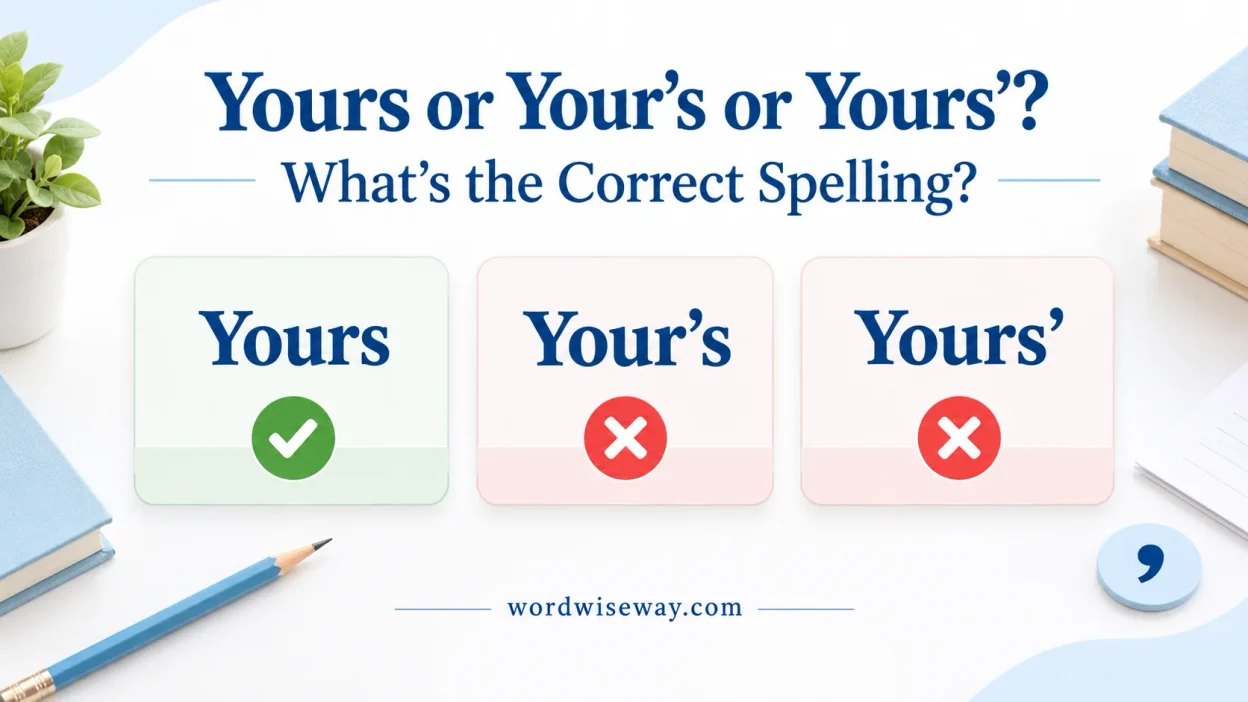
Yours is the correct spelling. Both your’s and yours’ are incorrect in standard English because the possessive pronoun yours never requires an apostrophe.
Here’s a quick comparison:
| Word | Correct or Incorrect? | Explanation | Example |
| Yours | ✅ Correct | A possessive pronoun that indicates ownership or association | This notebook is yours. |
| Your’s | ❌ Incorrect | Adds an unnecessary apostrophe | This notebook is your’s. |
| Yours’ | ❌ Incorrect | Places an unnecessary apostrophe after the final s | This notebook is yours’. |
Remember this simple rule: Possessive pronouns don’t use apostrophes. Words such as mine, yours, his, hers, ours, and theirs already express possession without one.
For example, you can write, “Your jacket is on the chair, but the blue one is yours.” The word your introduces a noun, while yours replaces a noun phrase. Neither word needs an apostrophe.
What Does Yours Mean?
The word yours is a possessive pronoun that shows ownership, connection, or association. It tells readers that something belongs to the person or people being addressed. Instead of repeating a noun and its possessive determiner, you can use yours to make your sentence shorter and smoother.
Consider this example:
- Repetitive: This is your notebook, and that is your notebook, too.
- Better: This is your notebook, and that one is yours.
The second sentence avoids unnecessary repetition while keeping the meaning clear. That’s one of the main purposes of possessive pronouns.
Although yours often indicates physical ownership, it can describe much more than personal belongings. You can use it to discuss responsibility, decisions, relationships, ideas, and personal experiences.
For example:
- Ownership: That blue backpack is yours.
- Responsibility: The final decision is yours.
- Personal choice: The choice is yours to make.
- Ideas: Your opinion differs from mine, but the final answer is yours.
- Relationships: Your family is yours to cherish and support.
In each example, yours connects something with the person being addressed. The exact relationship depends on the surrounding sentence.
Examples of Yours in Sentences
Seeing yours in different contexts makes its meaning easier to understand. The following examples show how naturally this possessive pronoun fits into everyday writing.
- This seat is yours, so you don’t need to move.
- My phone is charging upstairs, but yours is on the table.
- I finished my assignment yesterday, and I hope yours is ready, too.
- The responsibility for this project is yours.
- Your answer was different from mine, but yours also makes sense.
- I borrowed my sister’s umbrella because yours was missing.
- This opportunity is yours if you decide to accept it.
- My handwriting has improved, but yours has always been easy to read.
- The final choice is yours, regardless of what others recommend.
- Your package arrived this morning, and the smaller one is yours.
Notice that yours doesn’t need a noun immediately after it. You wouldn’t normally write “yours notebook” because the possessive pronoun already represents the thing being discussed.
Instead, write “your notebook” or “the notebook is yours.” Both constructions are correct, but they serve different grammatical purposes.
Why Is Yours the Correct Spelling?
The reason yours is correct comes down to how English forms possessive pronouns. Unlike possessive nouns, these pronouns don’t use apostrophes to indicate ownership.
Apostrophes appear in several English constructions, including contractions and possessive nouns. For example, it’s means it is or it has in certain contexts, while Sarah’s indicates something associated with Sarah. However, possessive pronouns follow a different convention.
Compare these examples:
- Sarah’s book: The apostrophe indicates possession by Sarah.
- Your book: The possessive determiner your identifies the book as belonging to you.
- The book is yours: The possessive pronoun yours indicates ownership without an apostrophe.
The important distinction is grammatical, not simply visual. A word can express possession without containing an apostrophe.
Possessive Pronouns That Don’t Use Apostrophes
English includes several common possessive pronouns. None of the following requires an apostrophe.
| Possessive Pronoun | Example Sentence |
| Mine | This pencil is mine. |
| Yours | The red bicycle is yours. |
| His | That jacket is his. |
| Hers | The decision was hers. |
| Ours | The victory was ours. |
| Theirs | The house near the river is theirs. |
These words follow the same basic principle. They indicate possession without needing apostrophes.
One common trap is confusing hers with her’s. The standard possessive pronoun is hers, just as yours is correct instead of your’s.
Why Possessive Pronouns Don’t Need Apostrophes
Possessive pronouns already have established forms that express ownership. Adding an apostrophe doesn’t improve their meaning or make them more grammatically complete.
For instance, mine doesn’t become mine’s when it indicates ownership. Similarly, ours doesn’t become our’s, and theirs doesn’t become their’s.
However, some related forms do contain apostrophes because they perform different grammatical functions. Who’s is a contraction of who is or who has, while whose expresses possession.
Understanding these distinctions is more useful than memorizing isolated spellings. Once you recognize a word’s grammatical role, the correct form becomes much easier to choose.
Why Is Your’s Incorrect?
The spelling your’s is incorrect because it adds an apostrophe to a possessive pronoun that doesn’t require one. Writers often make this mistake because they associate apostrophes with ownership.
That association isn’t entirely wrong. Apostrophes often mark possession in nouns, as in the teacher’s desk or James’s backpack. However, English doesn’t apply that rule to every possessive word.
Consider the difference between these sentences:
- Incorrect: The red folder is your’s.
- Correct: The red folder is yours.
The corrected sentence follows the standard spelling convention for possessive pronouns.
Why Writers Confuse Your’s With Possessive Nouns
The confusion often begins with examples such as the student’s book. Since the apostrophe indicates that the book belongs to the student, writers may assume the same punctuation belongs in yours.
The problem is that these words perform different grammatical functions.
A possessive noun begins with a noun and uses an apostrophe to show possession. A possessive pronoun has its own established form and doesn’t need an additional punctuation mark.
Compare the following:
| Possessive Noun | Possessive Pronoun |
| This is Emma’s notebook. | This notebook is yours. |
| That is Daniel’s bicycle. | That bicycle is his. |
| The teacher’s desk is clean. | The desk is hers. |
| The children’s toys are here. | The toys are theirs. |
The possessive nouns use apostrophes, while the possessive pronouns don’t.
Correcting Your’s in Everyday Writing
You might encounter your’s in casual messages, online comments, handwritten notes, or older drafts. However, seeing a spelling frequently doesn’t make it standard.
When proofreading, replace your’s with yours whenever you intend to express possession using the pronoun.
For example:
- Incorrect: I hope this gift is your’s.
- Correct: I hope this gift is yours.
- Incorrect: The responsibility is your’s now.
- Correct: The responsibility is yours now.
- Incorrect: Is this pen your’s or mine?
- Correct: Is this pen yours or mine?
These corrections require only one small change, but they make your writing more accurate.
Why Is Yours’ Incorrect?
The spelling yours’ is also incorrect when you intend to use the standard possessive pronoun. The apostrophe appears in the wrong place and serves no grammatical purpose.
Some writers may assume that words ending in s need an apostrophe after the final letter. That rule sometimes applies to plural possessive nouns, but it doesn’t apply to yours.
For example, consider these two sentences:
- Incorrect: The choice is yours’.
- Correct: The choice is yours.
The second sentence is the standard form because yours already expresses possession.
Yours’ vs. Genuine Plural Possessives
To understand why yours’ doesn’t work, compare it with a genuine plural possessive noun.
A plural possessive noun shows that something belongs to multiple people or things. When a regular plural noun already ends in s, writers generally place the apostrophe after that final letter.
Examples include:
- The students’ classroom is upstairs.
- The players’ uniforms are ready.
- The teachers’ meeting starts at noon.
In these sentences, the apostrophe belongs to a plural noun. It indicates that the classroom, uniforms, or meeting relates to the people identified.
However, yours isn’t a plural noun. It’s a possessive pronoun that can refer to something belonging to one person or multiple people.
For example:
- Your coat is here. The other coat is yours.
- Your team’s seats are ready. Those seats are yours.
The number of people involved doesn’t change the spelling of yours. It never becomes yours’.
Yours vs. Your: What’s the Difference?
Although your and yours look similar, they have different grammatical functions. Learning when to use each word will help you avoid spelling mistakes and build clearer sentences.
Your is a possessive determiner. It appears before a noun to show that something belongs to or relates to the person being addressed.
Yours is a possessive pronoun. It can stand alone and replace a noun phrase when the context makes the meaning clear.
Here’s how the two forms compare:
| Feature | Your | Yours |
| Grammatical role | Possessive determiner | Possessive pronoun |
| Usually followed by a noun | Yes | No |
| Shows possession | Yes | Yes |
| Requires an apostrophe | No | No |
| Example | Your phone is ringing. | The ringing phone is yours. |
When to Use Your
Use your when you want to identify a noun associated with the person you’re addressing.
Examples include:
- Your assignment needs one final revision.
- Please bring your identification card.
- Your explanation helped me understand the problem.
- I enjoyed reading your article.
In each sentence, your appears before a noun. Those nouns are assignment, identification card, explanation, and article.
Remember that your doesn’t mean the same thing as you are. The contraction you’re means you are, while your indicates possession or association.
For example, “Your presentation is excellent” is correct because your describes the presentation. “You’re presentation is excellent” is incorrect because you’re would mean you are presentation.
When to Use Yours
Use yours when the noun or noun phrase doesn’t need to be repeated.
Examples include:
- This seat is yours.
- My answer differs from yours.
- The last slice of cake is yours.
- Your handwriting is neat, but hers is smaller.
- My responsibilities end here, and yours begin tomorrow.
Notice that yours stands independently in each sentence. It replaces a phrase such as your seat, your answer, or your slice of cake.
Here’s a simple test: if the word appears directly before a noun, you probably need your. If it stands alone to express possession, yours may be the right choice.
Key Differences
The difference between these three spellings becomes straightforward once you understand the rule.
Yours is the standard possessive pronoun. Your’s adds an unnecessary apostrophe, while yours’ incorrectly adds one after the final s.
| Form | Grammar | Standard English Usage | Correct Example |
| Yours | Possessive pronoun | Correct | The final decision is yours. |
| Your’s | Incorrect spelling | Incorrect | The final decision is yours. |
| Yours’ | Incorrect spelling | Incorrect | The final decision is yours. |
Neither incorrect form becomes acceptable simply because the writer intends to show possession. Standard spelling depends on the word’s established grammatical form.
Common Mistakes to Avoid When Using Yours
Even experienced writers can make small punctuation mistakes when they write quickly. These examples show what to watch for.
- Adding an apostrophe to yours: Write “The choice is yours,” not “The choice is your’s.”
- Confusing your with yours: Write “Your bag is here” or “The bag is yours.”
- Confusing your with you’re: Write “Your idea is interesting,” not “You’re idea is interesting.”
- Adding an apostrophe after the final s: Write “The responsibility is yours,” not “The responsibility is yours’.”
- Using an apostrophe in a possessive pronoun: Write “The house is theirs,” not “The house is their’s.”
The most reliable proofreading habit is to identify the word’s grammatical job. Ask whether you’re describing a noun, replacing a noun phrase, or forming a contraction.
That quick check can catch several common errors at once.
How to Remember the Correct Spelling of Yours
You don’t need to memorize a complicated punctuation chart to spell yours correctly. A short rule and a few comparisons will usually do the job.
Memory trick: Possessive pronouns don’t need apostrophes.
Keep this group together:
- Mine
- Yours
- His
- Hers
- Ours
- Theirs
All six forms express possession without apostrophes. When you remember the group, you can check yours against familiar words such as mine and hers.
A Quick Proofreading Trick
Whenever you hesitate between yours and your’s, try replacing the word with mine.
For example:
- The blue notebook is yours.
- The blue notebook is mine.
Both sentences work without apostrophes. However, “The blue notebook is your’s” doesn’t follow the standard spelling pattern.
This substitution test is especially helpful when proofreading emails, assignments, captions, and professional messages.
Another useful trick is to separate your from yours. Write your notebook when a noun follows. Write the notebook is yours when the pronoun stands alone.
With a little practice, the correct form becomes automatic.
Practice: Yours, Your’s, or Yours’?
Test your understanding with these eight sentences. Choose the correct word or phrase for each blank.
- This water bottle belongs to you. It’s ______.
- Please bring ______ notebook to class.
- My favorite color is blue. What’s ______?
- The final decision is ______ to make.
- Is this ______ jacket or your brother’s?
- Your handwriting is neat, but ______ is easier to read.
- I hope this seat is ______.
- ______ going to need your identification card.
Answers and Explanations
- Yours: The pronoun expresses ownership without an apostrophe.
- Your: The possessive determiner appears before the noun notebook.
- Yours: The pronoun replaces the phrase your favorite color.
- Yours: The pronoun identifies who has the final choice.
- Your: The word appears before the noun jacket.
- Yours: The pronoun replaces your handwriting.
- Yours: The sentence expresses ownership or assignment of the seat.
- You’re: This contraction means you are. The sentence reads, “You are going to need your identification card.”
The last question tests a related distinction. Your and yours express possession, while you’re is a contraction. Keeping these forms separate will make your writing more accurate.
Read More: Series or Series’s or Series’: Which Is Correct?
FAQs
1. Is it Yours, Your’s, or Yours’?
Yours is the correct spelling. Both your’s and yours’ are incorrect in standard English. You don’t need an apostrophe to show possession with this pronoun.
2. Why is Yours spelled without an apostrophe?
Yours is a possessive pronoun with its own established spelling. Unlike possessive nouns, it doesn’t need an apostrophe to express ownership.
3. What is the difference between Your and Yours?
Your comes before a noun, while yours replaces a noun phrase. For example, “Your phone is here” and “The phone is yours” are both correct.
4. Can I write Your’s when talking about ownership?
No, your’s is not correct in standard English. Even though apostrophes often indicate possession, yours never requires one.
5. Is Yours’ ever grammatically correct?
No, yours’ isn’t the standard possessive form of you. Write yours instead, whether you’re talking about a book, a choice, or a personal belonging.
6. How do I use Yours correctly in a sentence?
Use yours when the noun is already clear from the context. For example, “My answer is different, but yours is correct.” The word shows which answer belongs to the other person.
7. Is Yours a possessive pronoun or a possessive adjective?
Yours is a possessive pronoun because it can stand alone. Your is a possessive adjective because it describes a noun, as in “your idea.”
8. Do possessive pronouns need apostrophes?
No, possessive pronouns such as yours, mine, hers, ours, and theirs don’t use apostrophes. Remembering this rule helps you avoid common spelling and punctuation mistakes.
9. What is a common mistake when writing Yours?
A common mistake is adding an apostrophe and writing your’s. This happens because people confuse possessive pronouns with possessive nouns, such as “the student’s book.”
10. How can I remember the correct spelling of Yours?
Remember this simple rule: yours never needs an apostrophe. When expressing ownership, write “This seat is yours,” not “This seat is your’s” or “This seat is yours’.”
Conclusion
Understanding the difference between yours, your’s, and yours’ makes English writing easier and clearer. The correct spelling is yours, without an apostrophe. Although all three forms might look similar, only one follows standard English grammar rules. Learning this small spelling difference can help you avoid common punctuation mistakes and communicate more confidently.
Remember that your comes before a noun, while yours replaces a noun phrase to show ownership. For example, “Your choice matters” and “The choice is yours” are both correct. These words serve different grammatical functions, so using them properly improves sentence structure, word choice, and overall writing accuracy.
The easiest way to remember the rule is simple: possessive pronouns don’t need apostrophes. Whenever you’re unsure, check whether the word stands alone or describes a noun. With regular practice, you’ll recognize the correct form naturally and make fewer spelling mistakes in emails, essays, articles, and everyday conversations.

Evelyn Shaw has spent 14 years at Yale University’s English Department, leading students through close readings, genre studies, and interpretive methodologies. Her scholarly interests include Renaissance drama, gothic fiction, feminist literary criticism, and archival research and examining how texts generate meaning across historical periods. Evelyn has presented at major academic conferences and published essays in peer-reviewed journals, reflecting her passion for rigorous analysis and student-centered learning.