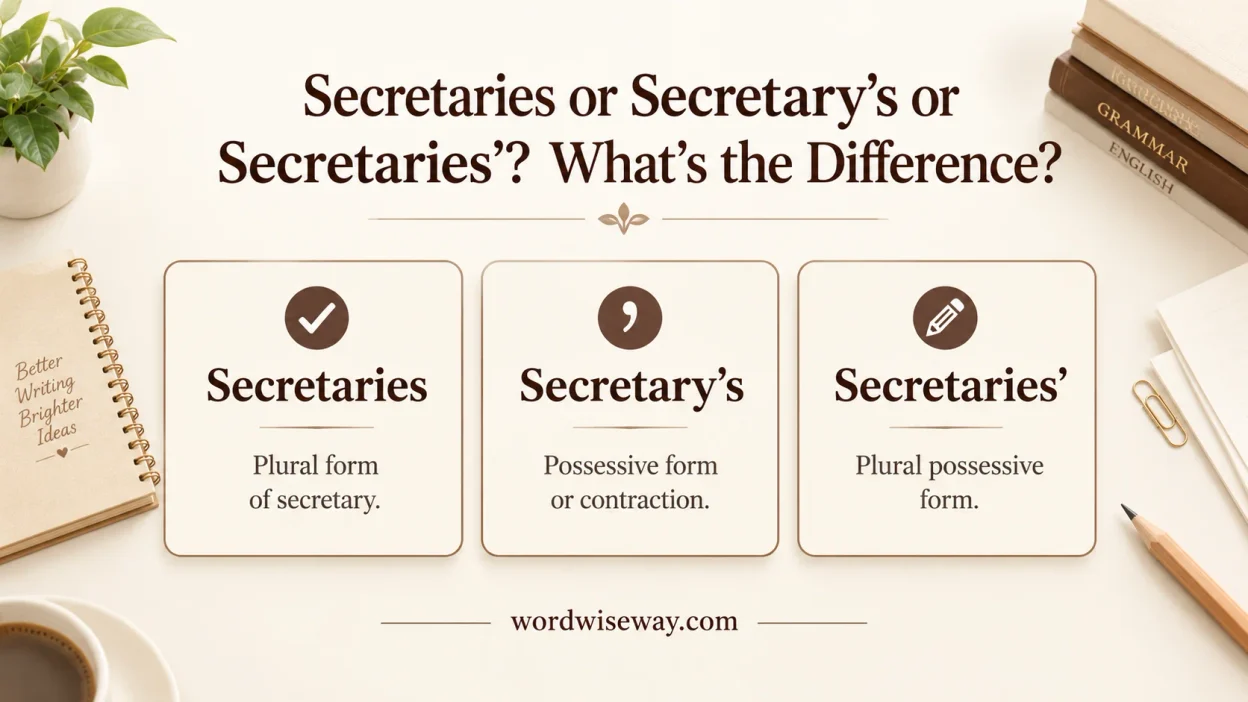
Secretaries or Secretary’s or Secretaries’? What’s the Difference? Understanding these forms becomes easier when you learn how apostrophes work and show ownership correctly.
Each form has a different purpose, so choosing the right one helps you communicate clearly. Whether you’re writing an email, preparing a report, or describing office responsibilities, understanding these small differences can make your writing more accurate and professional.
The word secretary’s shows possession by one secretary. For example, “The secretary’s desk is near the window” means the desk belongs to one person. The apostrophe and letter s indicate ownership. This form is useful when you want to connect one secretary with an object, responsibility, document, or workplace item.
In contrast, secretaries refers to more than one secretary, while secretaries’ shows possession by multiple secretaries. For example, “The secretaries’ office is spacious” indicates an office shared by several people. Remembering this simple rule makes it easier to select the correct form whenever you write about one secretary or a group.
Quick Answer:
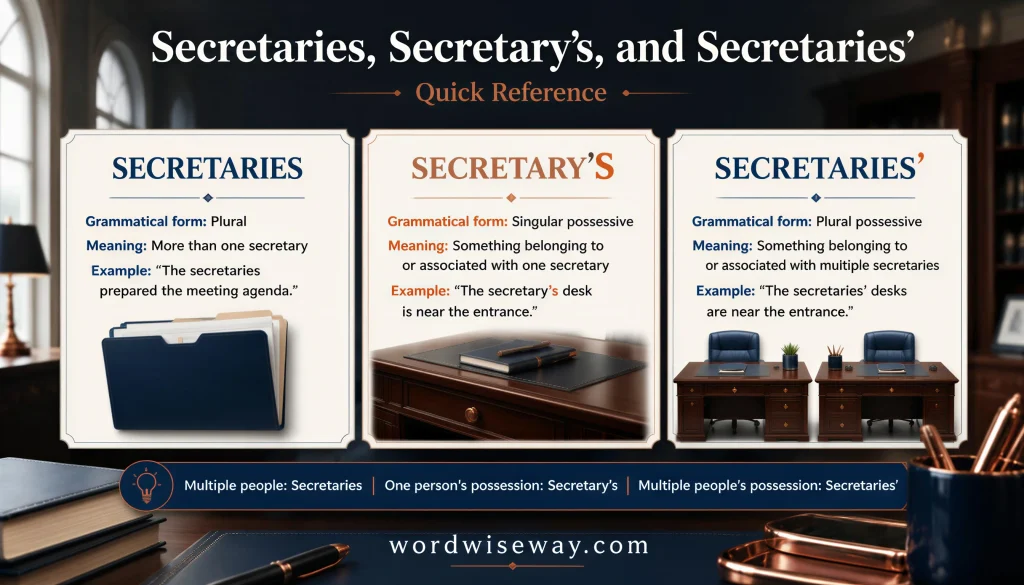
- Secretaries is the plural form of secretary. Use it when referring to two or more secretaries. Example: The secretaries prepared the meeting agenda.
- Secretary’s is the singular possessive form. Use it when something belongs to one secretary or relates to that person. Example: The secretary’s desk is near the entrance.
- Secretaries’ is the plural possessive form. Use it when something belongs to or relates to multiple secretaries. Example: The secretaries’ desks are near the entrance.
The easiest way to remember the difference is to look for ownership. If you mean more than one secretary without showing ownership, use secretaries. If one secretary owns something, use secretary’s. If several secretaries share ownership, use secretaries’.
Secretaries: Meaning, Definition, and Usage
The word secretaries is the regular plural form of the noun secretary. It refers to two or more people who perform secretarial, administrative, organizational, or official duties.
A secretary might schedule appointments, answer correspondence, maintain records, organize meetings, or assist an executive. Depending on the workplace, the title can describe an administrative employee, an organizational officer, or a government official.
The word itself doesn’t indicate ownership. It simply tells readers that you’re talking about multiple secretaries.
What Does Secretaries Mean?
Secretaries is a plural noun. You form it by changing the ending of secretary from -y to -ies.
This spelling follows a common English rule. When a noun ends in a consonant followed by y, you generally change the y to ies to form its plural.
For example:
- Secretary → Secretaries
- Library → Libraries
- Company → Companies
- Dictionary → Dictionaries
- Responsibility → Responsibilities
The rule applies because the letter before the y is a consonant. Words ending in a vowel followed by y generally form their plurals by adding s, as in key → keys and boy → boys.
Example: The three secretaries coordinate appointments for different departments.
Here, secretaries identifies several employees. The sentence doesn’t indicate that anything belongs to them.
When to Use Secretaries
Use secretaries whenever you need to refer to more than one secretary without expressing possession.
You’ll commonly see this form in workplace discussions, job descriptions, organizational charts, staff reports, and administrative instructions.
Consider these examples:
- The secretaries attend a weekly coordination meeting.
- Our company employs four secretaries across two departments.
- The secretaries handle incoming calls during business hours.
- Several secretaries applied for the newly advertised position.
- The executive thanked the secretaries for organizing the conference.
Each sentence refers to multiple people. None uses an apostrophe because the noun doesn’t show ownership.
Remember that secretaries can refer to people with different responsibilities. For example, a school might employ administrative secretaries while a professional association has elected secretaries responsible for meeting minutes.
The context determines their roles, but the plural spelling remains the same.
Secretaries in Singular and Plural Sentences
Choosing between secretary and secretaries depends on the number of people you’re describing.
| Singular | Plural |
| The secretary answers the phone. | The secretaries answer the phone. |
| A secretary prepares the report. | Two secretaries prepare the report. |
| The secretary attends the meeting. | The secretaries attend the meeting. |
| One secretary manages the calendar. | Several secretaries manage the calendar. |
Notice how the verb may change with the noun. In the present tense, secretary usually takes a singular verb, such as is, has, or works. The plural secretaries takes plural forms, such as are, have, or work.
For example, write The secretary is available but The secretaries are available.
Getting the noun and verb to agree makes your writing grammatically correct and easier to follow.
Examples of Secretaries in Sentences
Here are additional examples showing how secretaries works in different contexts.
- Office administration: The secretaries organize documents before the annual audit.
- Education: The school secretaries help parents arrange appointments with teachers.
- Business: The company hired two secretaries to support its growing management team.
- Government: The department’s secretaries attended a briefing about new administrative procedures.
- Meetings: The secretaries recorded the decisions and distributed the minutes afterward.
In each example, secretaries functions as a plural noun. It identifies multiple people without using an apostrophe to indicate ownership.
Secretary’s: Meaning, Definition, and Usage
The word secretary’s is the singular possessive form of secretary. Use it when something belongs to one secretary or when a noun phrase identifies something associated with that individual.
You create this form by adding an apostrophe and s to the singular noun.
Secretary → Secretary’s
For example, The secretary’s notebook contains the meeting schedule.
The notebook belongs to one secretary, so the singular possessive form is appropriate.
What Does Secretary’s Mean?
Secretary’s can express ownership, responsibility, association, or a relationship with one secretary.
Ownership doesn’t always mean legal possession. In English, possessive forms also identify responsibilities, relationships, and things connected with a person.
Consider these examples:
- The secretary’s computer needs an update.
- The secretary’s responsibilities include scheduling appointments.
- The secretary’s signature appears at the bottom of the document.
- The secretary’s office closes at five o’clock.
- The secretary’s explanation clarified the scheduling mistake.
In these sentences, the apostrophe connects the singular noun secretary with something related to that person.
The possessive form doesn’t necessarily mean the secretary personally owns the item. For instance, the secretary’s office might be a room assigned to that employee rather than property they purchased.
Secretary’s as a Singular Possessive
To form the singular possessive, add ’s to the singular noun secretary.
This rule applies even though secretary already ends in the letter y. You don’t remove the y before adding the apostrophe and s.
Correct: The secretary’s report is ready.
Incorrect: The secretaries report is ready. This version doesn’t show ownership and instead appears to describe a report prepared by multiple secretaries.
However, the second sentence could be grammatically correct in a different context. For example, The secretaries report their findings every Friday uses report as a verb.
Context matters. Apostrophes help clarify meaning, but the surrounding words also determine how readers interpret a sentence.
When to Use Secretary’s
Use secretary’s when the sentence refers to one secretary and expresses a possessive relationship.
Common situations include:
- Personal belongings: The secretary’s bag is under the desk.
- Work responsibilities: The secretary’s duties include preparing meeting agendas.
- Professional communication: The secretary’s email contains the updated schedule.
- Workplace locations: The secretary’s office is on the second floor.
- Opinions or decisions: The secretary’s recommendation helped resolve the scheduling issue.
- Records and documents: The secretary’s notes summarize the main discussion points.
A useful way to check your sentence is to replace secretary’s with belonging to the secretary or associated with the secretary. If the revised sentence preserves your intended meaning, the possessive form may be correct.
For example, the secretary’s calendar means the calendar belonging to or used by the secretary.
This substitution won’t work perfectly in every expression, but it helps you recognize possession and association.
Examples of Secretary’s in Sentences
Let’s examine several examples more closely.
Example 1: The secretary’s desk is covered with paperwork.
The apostrophe and s indicate that the desk is assigned to or associated with one secretary.
Example 2: I reviewed the secretary’s draft before the meeting.
The draft belongs to or was prepared by one secretary.
Example 3: The secretary’s appointment was moved to Thursday.
The appointment is associated with one secretary. The sentence doesn’t necessarily mean the secretary owns anything.
Example 4: The secretary’s decision surprised the department.
The decision was made by one secretary.
Example 5: The secretary’s and manager’s offices are next door to each other.
Each singular possessive identifies an office associated with one person. Both secretary’s and manager’s follow the singular possessive rule.
The key point is simple: use secretary’s when you mean one secretary’s belongings, responsibilities, decisions, or other associations.
Secretaries’: Meaning, Definition, and Usage
The word secretaries’ is the plural possessive form of secretary. Use it when something belongs to, is shared by, or relates to multiple secretaries.
To create this form, first change secretary into its plural form, secretaries. Then add an apostrophe after the final s.
Secretary → Secretaries → Secretaries’
For example, The secretaries’ meeting begins at nine.
This sentence refers to a meeting associated with multiple secretaries. Depending on the context, they might organize it, attend it, or hold responsibility for it.
The apostrophe’s position distinguishes this form from the singular possessive secretary’s.
What Does Secretaries’ Mean?
Secretaries’ indicates a possessive or associative relationship involving more than one secretary.
Consider these examples:
- The secretaries’ desks are arranged along the wall.
- The secretaries’ schedules overlap on Tuesday.
- The secretaries’ meeting lasted two hours.
- The secretaries’ shared workspace needs additional chairs.
- The secretaries’ reports were submitted before the deadline.
Each example refers to multiple secretaries. The apostrophe appears after the plural noun’s final s because secretaries already expresses plurality.
This is a standard English punctuation rule for most regular plural nouns ending in s.
For instance, the teachers’ lounge refers to a lounge associated with multiple teachers. Similarly, the secretaries’ lounge refers to a lounge associated with multiple secretaries.
Secretaries’ as a Plural Possessive
The plural possessive form follows two steps:
- Change secretary to secretaries.
- Add an apostrophe after the final s.
The result is secretaries’.
Compare the following sentences:
- Plural: The secretaries prepared the documents.
- Singular possessive: The secretary’s documents are ready.
- Plural possessive: The secretaries’ documents are ready.
The first sentence describes multiple people performing an action. The second refers to documents associated with one secretary. The third refers to documents associated with multiple secretaries.
Notice that the apostrophe doesn’t change the noun’s basic plural spelling. It marks the possessive relationship.
One more detail matters: plural possession doesn’t always mean joint ownership. In the secretaries’ individual offices, each secretary may have a separate office. The plural possessive still works because the offices are associated with the group.
When to Use Secretaries’
Use secretaries’ when a possessive relationship involves two or more secretaries.
You might use it in office policies, administrative reports, meeting announcements, or discussions about shared resources.
Examples include:
- Shared resources: The secretaries’ printer is available to the entire department.
- Schedules: The secretaries’ calendars show their upcoming appointments.
- Meetings: The secretaries’ meeting will cover the revised filing procedure.
- Work responsibilities: The secretaries’ combined efforts helped complete the project.
- Documents: The secretaries’ reports contain the latest departmental updates.
- Workspaces: The secretaries’ workstations are located near reception.
In these examples, the possessive form connects something with several secretaries. Depending on the sentence, that relationship may involve shared ownership, individual assignments, or collective responsibility.
Examples of Secretaries’ in Sentences
Example 1: The secretaries’ office supplies arrived this morning.
The supplies are associated with multiple secretaries, perhaps because they share them.
Example 2: The secretaries’ schedules need to be updated.
The schedules belong to or are maintained for several secretaries.
Example 3: We reviewed the secretaries’ recommendations.
Multiple secretaries provided recommendations, and the sentence refers to those recommendations.
Example 4: The secretaries’ training session starts next week.
The training session is intended for or associated with multiple secretaries.
Example 5: The secretaries’ individual assignments were published yesterday.
Each secretary has an assignment, but the sentence discusses the assignments collectively.
These examples demonstrate that secretaries’ can describe shared items or separate things associated with several people.
Key Differences
The main difference between secretaries, secretary’s, and secretaries’ lies in number and possession. Although these forms share the same root word, they perform different grammatical functions.
Meaning and Grammatical Function
Each form answers a different question:
- Secretaries: Are you talking about multiple secretaries?
- Secretary’s: Does something belong to or relate to one secretary?
- Secretaries’: Does something belong to or relate to multiple secretaries?
These questions provide a quick way to identify the correct spelling before you finish a sentence.
For example, imagine you’re writing about an office with three administrative employees.
You might write, The secretaries attended the meeting. This sentence describes the employees themselves.
If you write, The secretary’s presentation was excellent, you’re referring to a presentation associated with one secretary.
Finally, The secretaries’ presentations were excellent refers to presentations associated with several secretaries.
The surrounding context determines whether the possessive relationship involves one person or multiple people.
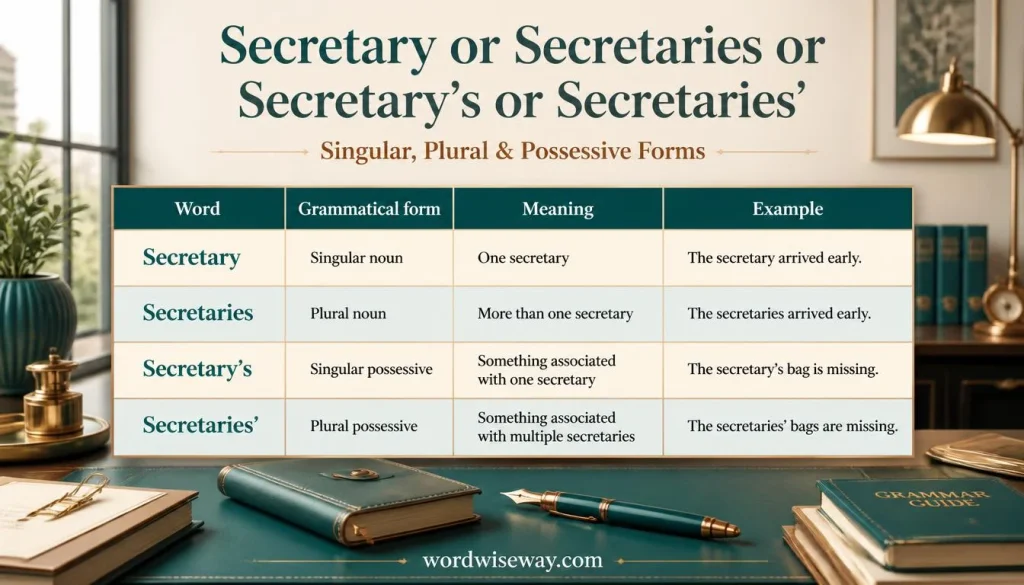
Singular vs. Plural vs. Possessive Forms
Use this comparison table whenever you’re unsure which form belongs in your sentence.
| Word | Grammatical form | Meaning | Example |
| Secretary | Singular noun | One secretary | The secretary arrived early. |
| Secretaries | Plural noun | More than one secretary | The secretaries arrived early. |
| Secretary’s | Singular possessive | Something associated with one secretary | The secretary’s bag is missing. |
| Secretaries’ | Plural possessive | Something associated with multiple secretaries | The secretaries’ bags are missing. |
The table also highlights an important distinction: secretaries doesn’t automatically mean ownership, while both possessive forms indicate a relationship with something else.
Apostrophes therefore serve a grammatical purpose rather than simply making words look formal.
Comparison Table With Examples
Sometimes, seeing the same idea expressed in three different ways makes the distinction easier to remember.
| Secretaries | Secretary’s | Secretaries’ |
| The secretaries arrived. | The secretary’s car arrived. | The secretaries’ cars arrived. |
| The secretaries prepared reports. | The secretary’s report is complete. | The secretaries’ reports are complete. |
| The secretaries attended training. | The secretary’s training starts Monday. | The secretaries’ training starts Monday. |
| The secretaries shared ideas. | The secretary’s idea was useful. | The secretaries’ ideas were useful. |
| The secretaries organized the event. | The secretary’s plan worked. | The secretaries’ plan worked. |
Notice that the last row requires context. The secretary’s plan refers to one secretary, whereas the secretaries’ plan refers to multiple secretaries.
The word plan remains singular in both examples. The possessive form identifies whose plan you’re discussing, not how many plans exist.
How to Use Secretaries, Secretary’s, and Secretaries’ Correctly
Once you understand the difference between plural and possession, choosing the right form becomes much easier. The following rules can help you apply the correct spelling consistently.
How to Form the Plural of Secretary
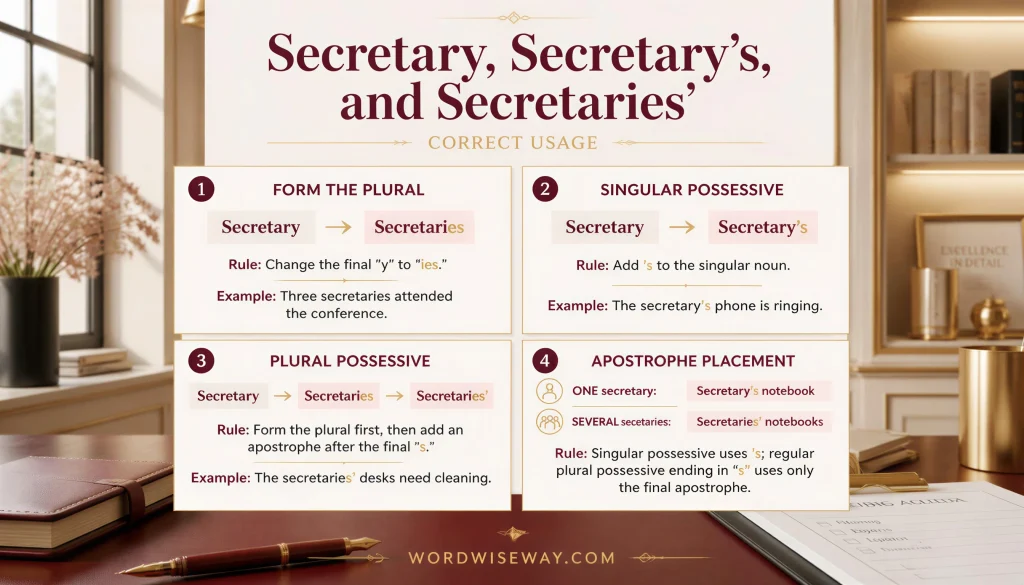
To form the regular plural of secretary, replace the final y with ies.
Secretary → Secretaries
Use the plural form when referring to two or more people.
Correct examples:
- The secretaries work in separate departments.
- Three secretaries attended the conference.
- Several secretaries applied for the position.
Incorrect for the intended plural meaning:
- The secretary’s work in separate departments.
- Three secretary’s attended the conference.
The second incorrect example uses an apostrophe unnecessarily. Regular plurals generally don’t need apostrophes.
Remember this distinction: secretaries identifies multiple people, while secretary’s identifies possession by one person.
How to Form the Singular Possessive of Secretary
To form the singular possessive, add ’s to secretary.
Secretary → Secretary’s
Use this form when one secretary owns something or has a particular responsibility or association.
Examples:
- The secretary’s phone is ringing.
- The secretary’s report needs revision.
- The secretary’s responsibilities have increased.
Don’t remove the final y. The correct spelling is secretary’s, not secretar’s or secretaries’s.
This rule also applies to most other singular nouns ending in y. For example, the company’s policy and the city’s population both use an apostrophe followed by s.
How to Form the Plural Possessive of Secretary
The plural possessive requires one additional step.
First, make the noun plural. Then place an apostrophe after its final s.
Secretary → Secretaries → Secretaries’
Use the final form when referring to something associated with multiple secretaries.
Examples:
- The secretaries’ desks need cleaning.
- The secretaries’ reports arrived yesterday.
- The secretaries’ responsibilities differ by department.
Avoid writing secretaries’s. The regular plural already ends in s, so you add only the apostrophe to show possession.
This pattern also appears in expressions such as students’ assignments, employees’ benefits, and managers’ meetings.
Where to Place the Apostrophe
Apostrophe placement is the most visible difference between the two possessive forms.
For a singular possessive, place the apostrophe before the added s. For a regular plural possessive ending in s, place the apostrophe after the existing s.
Compare:
- One secretary: The secretary’s notebook.
- Several secretaries: The secretaries’ notebooks.
The apostrophe’s position tells readers whether the possessive noun is singular or plural.
However, apostrophe placement alone doesn’t always determine the meaning of an entire sentence. Readers also rely on context, verb agreement, and the surrounding words.
Common Mistakes
Even experienced writers sometimes confuse these forms, particularly when typing quickly. Most errors happen because writers focus on the spelling instead of the intended meaning.
Using Secretary’s Instead of Secretaries
This mistake occurs when someone uses a singular possessive form to describe multiple people.
Incorrect: The secretary’s attended the training session.
Correct: The secretaries attended the training session.
The second sentence works because secretaries is the plural noun required by the intended meaning. No ownership appears in the sentence.
However, The secretary’s presentation impressed everyone is correct because the apostrophe marks possession by one secretary.
Before adding an apostrophe, ask yourself whether the sentence expresses ownership or simply refers to several people.
Using Secretaries’ Instead of Secretary’s
This mistake reverses the number of people involved in the possessive relationship.
Incorrect for one secretary: The secretaries’ computer needs repair.
Correct for one secretary: The secretary’s computer needs repair.
If several secretaries share the computer, however, The secretaries’ computer needs repair can be correct.
The difference depends on whether the computer is associated with one secretary or multiple secretaries.
Practical tip: Identify the owner before choosing the apostrophe’s position. If one secretary is involved, use secretary’s. If multiple secretaries are involved, use secretaries’.
Adding an Apostrophe to a Regular Plural
Another common error involves inserting apostrophes into ordinary plural nouns.
Incorrect: The secretary’s attended the conference.
Correct: The secretaries attended the conference.
Apostrophes don’t normally make nouns plural. They show possession or appear in contractions, such as don’t and isn’t.
The same principle applies to many everyday words:
- Incorrect: book’s when you simply mean multiple books.
- Correct: secretaries.
- : books.
- Incorrect: employee’s when you simply mean multiple employees.
- Correct: secretaries.
- : employees.
- Incorrect: secretary’s when you simply mean multiple secretaries.
- Correct: secretaries.
Each possessive form may be correct in another context. The mistake occurs when writers use an apostrophe to express plurality alone.
Confusing Plural and Possessive Forms
Sometimes a sentence contains a plural noun but doesn’t require a possessive form.
Compare these examples:
Plural: The secretaries organized the files.
Singular possessive: The secretary’s files were organized.
Plural possessive: The secretaries’ files were organized.
The first sentence describes an action performed by several secretaries. The second describes files associated with one secretary. The third describes files associated with multiple secretaries.
A simple editing technique can help. Read the sentence without the apostrophe first, then ask whether the meaning requires ownership or association.
If the sentence simply identifies people, use the plural. If it connects something with a person or group, consider the appropriate possessive.
Practical Examples
Realistic examples make grammatical rules easier to apply. These situations show how each form works in everyday administrative and professional writing.
Workplace and Office Examples
Imagine a company with several secretaries who support different executives.
- Plural: The secretaries arrive at eight every morning.
- Singular possessive: The secretary’s desk is beside the reception area.
- Plural possessive: The secretaries’ desks are beside the reception area.
The first sentence describes multiple employees. The second identifies a desk associated with one employee. The third connects several desks with multiple employees.
The same distinction applies when discussing office equipment, schedules, correspondence, and shared facilities.
For example, The secretary’s computer contains the presentation refers to one secretary’s computer. Meanwhile, The secretaries’ computers contain the presentations refers to computers associated with several secretaries.
Business and Administrative Examples
Professional documents often use these forms when describing responsibilities, records, and organizational procedures.
Consider the following examples:
- Plural: The secretaries prepare monthly administrative reports.
- Singular possessive: The secretary’s report includes the latest figures.
- Plural possessive: The secretaries’ reports include the latest figures.
These sentences are grammatically different even though they share similar vocabulary.
The plural version focuses on employees performing work. The singular possessive identifies one person’s report. The plural possessive identifies reports associated with several people.
In business writing, this distinction helps prevent confusion about responsibility and ownership.
For instance, if a manager requests the secretary’s report, the manager may expect a report from one particular employee. If the manager requests the secretaries’ reports, the request may cover submissions from several employees.
Examples Showing Ownership and Responsibility
Possessive forms can identify responsibility even when they don’t describe literal ownership.
| Sentence | Meaning |
| The secretary’s signature is required. | One secretary must provide the signature. |
| The secretaries’ signatures are required. | Multiple secretaries must provide their signatures. |
| The secretary’s duties include scheduling. | The duties are assigned to one secretary. |
| The secretaries’ duties include scheduling. | The duties are associated with multiple secretaries. |
| The secretary’s decision was final. | One secretary made the decision. |
| The secretaries’ decision was final. | The decision was made by or attributed to multiple secretaries. |
Notice the difference between the last two sentences. A singular possessive can identify one decision-maker, while a plural possessive can identify a group responsible for a decision.
These examples show why apostrophes matter beyond spelling. They help readers understand who performs an action, who has responsibility, and whose work a sentence describes.
Tips to Remember the Difference
You don’t need to memorize complicated grammar terminology to use these forms correctly. A few practical checks can help you choose the right spelling quickly.
A Simple Apostrophe Rule
Remember these three patterns:
- Secretaries: Multiple people, no possession.
- Secretary’s: One person, possession or association.
- Secretaries’: Multiple people, possession or association.
The most important distinction is whether you’re expressing possession.
For example, The secretaries arrived contains no possessive relationship. The secretary’s arrival refers to the arrival of one secretary. The secretaries’ arrival refers to the arrival of multiple secretaries.
This rule works in most everyday writing situations involving these three forms.
How to Identify Whether a Sentence Shows Ownership
Look at the noun following the word. Does it describe something owned, used, assigned to, or associated with the secretary or secretaries?
Consider these examples:
- The secretary’s appointment.
- The secretary’s responsibility.
- The secretaries’ appointments.
- The secretaries’ responsibilities.
The possessive form links the secretary or secretaries to the appointment or responsibility.
Remember that the relationship doesn’t have to involve legal ownership. A job responsibility, a scheduled meeting, or an assigned office can also use the possessive form.
A Quick Substitution Test
When you’re uncertain, replace the possessive phrase with a longer expression.
For secretary’s, try belonging to one secretary.
For secretaries’, try belonging to or associated with multiple secretaries.
For example:
- The secretary’s folder → The folder belonging to one secretary.
- The secretaries’ folder → The folder belonging to or used by multiple secretaries.
If the replacement matches your intended meaning, you’ve probably chosen the correct possessive form.
The test isn’t perfect for every sentence, especially when the possessive expresses responsibility rather than ownership. Still, it provides a useful starting point when proofreading.
Read more: Churches or Church’s or Churches’ What’s the Difference?
FAQs
1. What Is the Difference Between Secretaries, Secretary’s, and Secretaries’?
Secretaries refers to more than one secretary, secretary’s shows ownership by one secretary, and secretaries’ indicates ownership by multiple secretaries. Each form serves a different purpose in writing.
2. When Should You Use Secretary’s in a Sentence?
Use secretary’s when something belongs to one secretary. For example, “The secretary’s notebook is on the desk.” The apostrophe comes before the s to show singular possession.
3. Is Secretaries the Correct Plural Form of Secretary?
Yes, secretaries is the correct plural form. When a word ends in a consonant followed by y, you usually change the y to ies to form the plural.
4. How Do You Show Possession for Multiple Secretaries?
Use secretaries’ when something belongs to two or more secretaries. For example, “The secretaries’ meeting starts at noon.” The apostrophe follows the final s because the noun is already plural.
5. Is Secretaries’ Singular or Plural?
Secretaries’ is plural possessive. It refers to something owned, used, or shared by multiple secretaries. The apostrophe after the s distinguishes it from the singular possessive form, secretary’s.
6. Can You Use Secretary’s When Talking About Several Secretaries?
Not usually. Secretary’s indicates possession by one secretary, while secretaries’ indicates possession by several. Choosing the correct form helps readers understand who owns or shares something.
7. What Is an Example of Secretaries in a Sentence?
Here’s a simple example: “The secretaries prepare reports every Monday.” The word secretaries identifies several people without showing ownership. No apostrophe is necessary because the sentence describes what they do.
8. Does Secretaries’ Always Mean Shared Ownership?
No. Secretaries’ indicates that something belongs to or is associated with multiple secretaries, but it doesn’t always mean they share it. For example, “The secretaries’ individual schedules were updated” refers to schedules associated with several people.
9. Why Does Secretary Change to Secretaries in the Plural?
The word secretary ends in a consonant followed by y. In standard English, you replace the y with ies to form secretaries. This spelling pattern also appears in words such as library and libraries.
10. How Can You Remember the Correct Form of Secretary?
Think about the number of people and whether you’re showing ownership. Use secretaries for a group, secretary’s for one person’s belongings, and secretaries’ for belongings associated with multiple people. This quick check can help you avoid apostrophe mistakes.
Conclusion: Secretaries vs. Secretary’s vs. Secretaries’
Understanding Secretaries or Secretary’s or Secretaries’? What’s the Difference? becomes much easier when you focus on the number of people and the meaning of the sentence. Although these three forms look similar, each serves a different purpose. Secretaries refers to more than one person, secretary’s shows ownership by one secretary, and secretaries’ indicates possession associated with several secretaries.
The easiest way to remember these forms is to check whether you’re describing a group or showing ownership. For example, “The secretaries attended the meeting” needs no apostrophe because it simply refers to multiple people. However, “The secretary’s computer” belongs to one person, while “The secretaries’ computers” refers to computers belonging to several secretaries. These small spelling differences can change the meaning of your sentence.
Before finishing any piece of writing, take a moment to check your apostrophes. Ask yourself whether you mean one secretary or several, then choose the appropriate form. With regular practice, you’ll recognize the difference naturally and write with greater confidence. Paying attention to these details also makes your emails, reports, and other professional documents clearer and easier to understand.

Amelia Sanders has spent 14 years in Harvard University’s English Department, helping students navigate literary analysis, interpretive theory, and narrative techniques. Her academic pursuits center on 18th-century British prose, romantic poetry, diasporic writing, and digital editing exploring how textual choices influence cultural perspectives. Amelia has spoken at major international meetings and contributed essays to respected academic volumes, demonstrating her dedication to thoughtful scholarship and effective teaching.