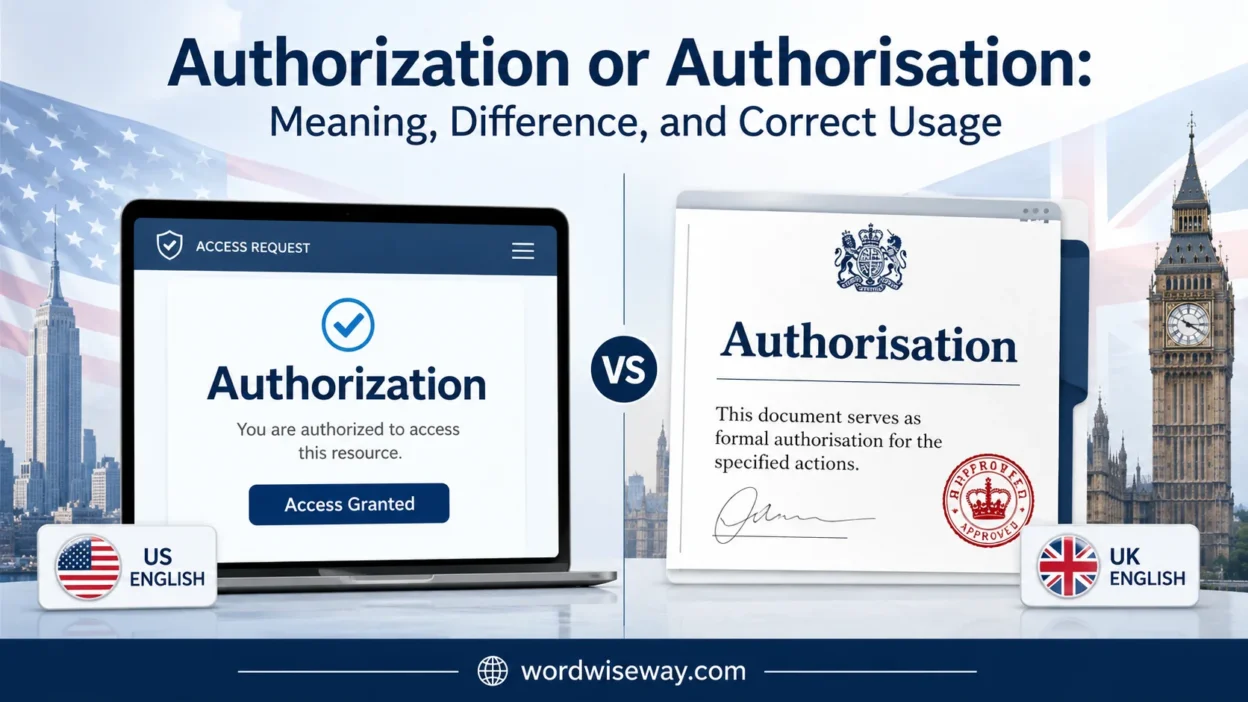
Authorization and authorisation mean exactly the same thing; the only difference is spelling. Authorization is standard in American English, authorisation is preferred in British English and Commonwealth countries.
Using the correct spelling improves clarity, consistency, and professionalism in business documents, legal writing, academic papers, and digital content. If your audience is in the United States, use authorization. If you’re writing for the United Kingdom or countries that follow British English conventions, use authorisation.
Quick Answer
| Feature | Authorization | Authorisation |
| English type | American English | British English |
| Meaning | Permission or approval | Permission or approval |
| Usage region | United States | United Kingdom, Commonwealth |
| Tech usage | Common in software | Less common but valid |
| Legal usage | US legal documents | UK legal documents |
| Correctness | Fully correct | Fully correct |
What Does Authorization Mean in English Grammar?
In the context of the English language, authorization refers to official permission or approval to do something.
It comes from the verb authorize, which means to give permission or power.
In simple terms:
- Authorization = permission granted by an authority
You see it everywhere in real life:
- Logging into a bank app
- Accessing restricted documents
- Entering secure buildings
- Giving someone legal approval to act on your behalf
Everyday meaning of authorization
Think of authorization like a digital or legal “green light.” Without it, access is blocked.
For example:
- Your bank app asks for authorization before showing your account balance.
- A teacher gives authorization for students to access exam results.
- A company requires authorization before employees download sensitive files.
Authorization in modern systems
In technology, authorization plays a major role in security systems.
Common uses include:
- User login permissions
- API access control
- Role-based access systems (admin, editor, viewer)
- Token verification systems
For example, when you log into Netflix, authentication confirms you are you, while authorization decides what you can watch.
That difference matters more than most people realize.
The Real Difference
Here’s the core truth that clears the confusion:
Authorization and authorisation mean exactly the same thing. The only difference is spelling.
The variation depends on regional English standards inside the English language.
American English: Authorization
In the United States, the standard spelling is:
- Authorization
This follows American English spelling rules, which simplify certain word endings.
Example:
- “You need authorization to access this file.”
This form is widely used in:
- US government documents
- American legal writing
- Software interfaces built in the US
British English: Authorisation
In the United Kingdom, the standard spelling is:
- Authorisation
This follows British English conventions that preserve traditional Latin-based spelling patterns.
Example:
- “You must obtain authorisation before proceeding.”
This form is used in:
- UK legal documents
- Academic writing in British institutions
- Commonwealth countries such as Australia and New Zealand
Same meaning, different spelling
Both versions share:
- Same definition
- Same usage contexts
- Same grammatical role (noun form of authorize/authorise)
The only difference is regional spelling preference.
When Should You Use Authorization?
Choosing the correct form of authorization or authorisation depends mainly on your audience.
Use authorization when you are writing for:
United States audiences
- Business communication in the US
- American legal writing
- US-based tech companies
Technology and software systems
Most global software systems default to American English, including:
- APIs
- SaaS platforms
- Cloud documentation (AWS, Google Cloud often uses US spelling)
International business contexts influenced by US English
Many global companies adopt American spelling for consistency.
When Should You Use Authorisation?
Use authorisation when your writing follows British English standards.
United Kingdom audiences
- UK government documents
- British academic writing
- Legal documents in England and Wales
Commonwealth countries
Many regions follow British English conventions:
- Australia
- New Zealand
- South Africa
- India (varies by institution)
Academic writing standards
Many universities aligned with Oxford style or British formatting expect:
- Authorisation instead of authorization
- Consistency throughout the document
Real-Life Examples
Let’s look at both forms in real sentences so you can see how naturally they work.
American English examples (Authorization)
- You need authorization to edit this file.
- The system denied authorization for the request.
- The manager gave authorization to proceed with the project.
British English examples (Authorisation)
- You must request authorisation before accessing the lab.
- The committee granted authorisation for the event.
- Without authorisation, entry is not allowed.
Side-by-side Difference
| Context | American English | British English |
| Security access | Authorization required | Authorisation required |
| Legal approval | Written authorization | Written authorisation |
| Digital systems | API authorization | API authorisation |
Notice something important: nothing changes except spelling.
Common Mistakes Writers Make
Even experienced writers slip up when dealing with authorization or authorisation.
Mixing both spellings in one document
This is the most common issue. It makes writing look inconsistent and unprofessional.
Wrong:
- “You need authorization before access is granted, and authorisation must be approved by admin.”
Correct:
- Stick to one version throughout.
Ignoring audience expectations
Using British spelling in an American legal document can look out of place and vice versa.
Always match your:
- Audience location
- Style guide
- Organization standards
Authorization in Technology and Security Systems
In modern English language usage, authorization is heavily tied to digital security.
Let’s break it down simply.
Authentication vs Authorization
These two terms are often confused.
| Term | Meaning |
| Authentication | Confirms identity |
| Authorization | Grants access |
Example:
- You enter your password → Authentication
- You open your dashboard → Authorization
API authorization in real systems
In software development, API authorization controls access using:
- API keys
- OAuth tokens
- JWT (JSON Web Tokens)
For example:
- A weather app uses authorization to allow limited data access.
- A payment system uses authorization to approve transactions securely.
Role-based access control (RBAC)
Many systems assign roles:
- Admin → full access
- Editor → modify content
- Viewer → read-only access
Each role depends on authorization rules set by the system.
How to Choose the Right Spelling
Choosing between authorization or authorisation becomes easy once you follow a few simple rules.
Identify your audience first
Ask yourself:
- Are you writing for US readers?
- Or UK and Commonwealth readers?
Follow your style guide
Different style guides enforce different standards:
- APA → American English
- Chicago Manual → American English
- Oxford Style → British English
Stay consistent
Once you pick a spelling:
- Do not switch halfway through
- Keep consistency across headings, body text, and tables
Consistency matters more than preference.
Read More: Contractor vs Contracter: Spelling, Meaning and Differences
Case Study: Authorization in a Real Software System
Let’s look at a real-world style example used in cloud platforms.
Scenario: Online banking app
A banking app typically uses:
- User login (authentication)
- Account access rules (authorization)
- Transaction permissions (authorization)
How authorization works here
- User logs in successfully
- System checks role (customer, admin, support)
- System grants access to allowed features
For example:
- A customer can view balance
- A customer cannot access admin dashboards
- A manager can approve transactions
Without proper authorization rules, the system becomes insecure.
This is why companies spend millions on secure authorization systems.
FAQs
1. What is the main difference between “authorization” and “authorisation”?
Ans: The difference is entirely regional. Authorization is the standard spelling in American English, whereas authorisation is preferred in British, Australian, and New Zealand English.
2. Is it wrong to use the ‘s’ spelling in the United States?
Ans: Yes, in formal American writing, using authorisation is considered a spelling error. The ‘z’ variant is strictly required.
3. Can I use the ‘z’ spelling in the United Kingdom?
Ans: While some traditional British style guides (like Oxford) accept the ‘z’ variant, the ‘s’ version is the usual and preferred choice for everyday business, media, and academic writing in the UK.
4. How do I choose which spelling to use for a global audience?
Ans: When writing for a mixed audience, the most critical approach is strict consistency. Pick one regional style (US or UK) and apply it uniformly across your entire document.
5. How do these spellings affect digital workflows?
Ans: When organizing calendar systems, online booking apps, or user databases, matching your platform’s language settings to your target market prevents spelling mismatches in automated text.
6. What is the best way to prevent spelling mistakes across a team?
Ans: Set clear company policies in a central style guide, declare a standard brand voice, and make sure every team member’s digital document editor is set to the correct default regional language.
Conclusion
Choosing between authorization and authorisation boils down to identifying your target audience and respecting regional language rules. While the two terms mean the exact same thing, selecting one standard form whether the US standard or the preferred UK text and maintaining strict consistency across your documents protects your professional credibility and brand voice from start to end.

Evelyn Shaw has spent 14 years at Yale University’s English Department, leading students through close readings, genre studies, and interpretive methodologies. Her scholarly interests include Renaissance drama, gothic fiction, feminist literary criticism, and archival research and examining how texts generate meaning across historical periods. Evelyn has presented at major academic conferences and published essays in peer-reviewed journals, reflecting her passion for rigorous analysis and student-centered learning.