To understand Free Rein or Free Reign: Meaning, Difference, and correct usage, one must study how people handle homophones in writing. In many professional settings, a careless approach to spelling creates a massive layer of confusion when utilizing popular phrases.
These expressions sound exactly the same, leading many to commit classic idiom mistakes by misusing the words. Historically, granting freedom meant giving a horse a loose rein, but because a monarch’s royal reign also represents power, writers often blend their meanings accidentally.
This comprehensive guide helps you learn exactly what each sentence contextually requires to ensure correct usage. A significant definition to remember is that a rein guides an animal, while a reign governs a kingdom; meanwhile, a third lookalike, “rain,” simply refers to weather precipitation.
When you use the accurate expression “free rein” properly within your context, you show that you understand the true origins of these English sayings. Reading an article like this helps eliminate phrases that confuse readers, ensuring you mean exactly what you intend to say.
What People Are Actually Searching For
Before diving into grammar rules, let’s clear up something important.
Most people searching “free rein or free reign” are trying to answer one of these questions:
- Which version is correct?
- Do they mean the same thing?
- Why do both versions appear in books, articles, and social media?
- Will I sound wrong if I use “free reign”?
The short answer:
“Free rein” is the original and correct phrase.
“Free reign” is a common mistaken variation that spread through modern usage.
Now let’s unpack that properly.
Free Rein Meaning: What the Phrase Actually Says
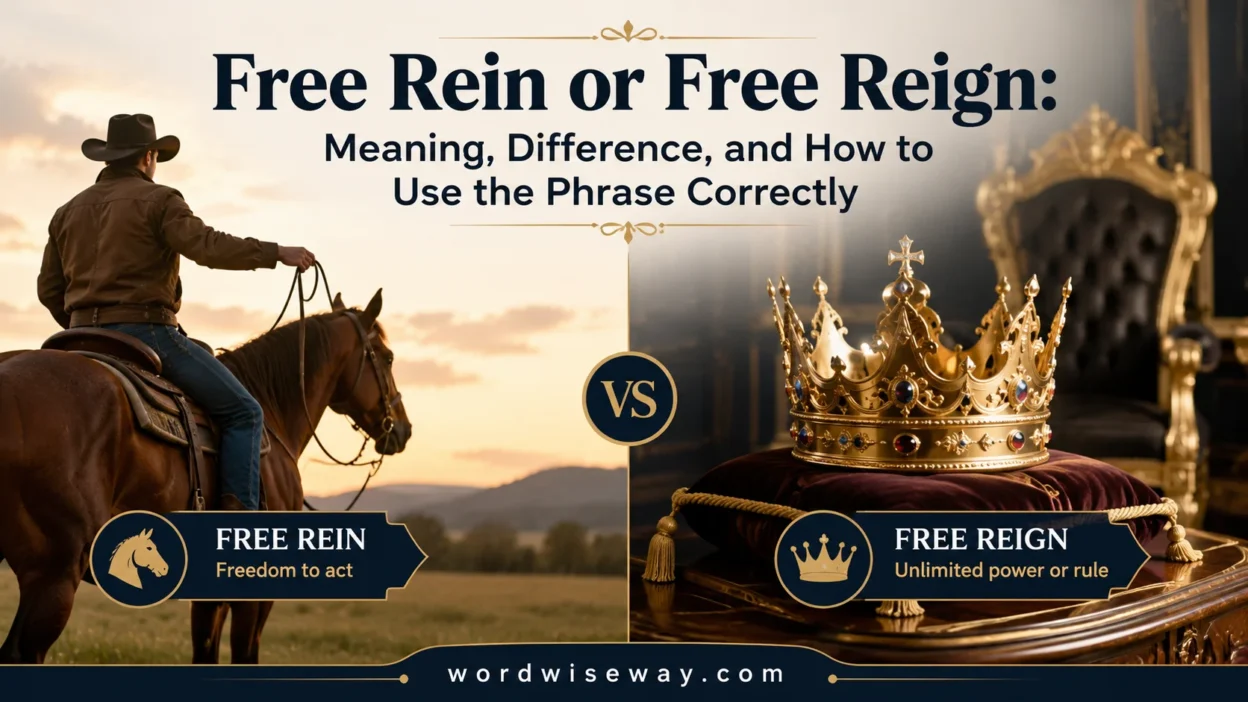
The correct phrase, free rein, means giving someone full freedom to act, decide, or create without restrictions.
Think of it as stepping back and letting someone take control completely.
Simple definition
Free rein = complete freedom or control over a task or situation
Where the phrase comes from
This is where things get interesting.
The phrase comes from horseback riding.
In riding, a rein is the strap a rider uses to control a horse. When the rider loosens the reins, the horse is no longer tightly guided. It can move more freely.
So historically:
- Tight reins → control and direction
- Loose reins → freedom of movement
- Free rein → total freedom
This physical image turned into a metaphor in English.
Modern meaning in everyday life
Today, “free rein” is used far beyond horses. It applies anywhere someone is given autonomy.
It often appears in:
- Business leadership
- Creative projects
- Parenting discussions
- Team management
- Education and training
Real-world examples of free rein
Here are natural, real-style examples:
- The director gave the designer free rein over the visual identity.
- The manager gave the team free rein to restructure the workflow.
- She had free rein to choose her research topic.
Notice something important. The phrase always signals trust + freedom + independence.
Free Reign Meaning: Why People Say It Although It’s Wrong
Now let’s talk about the version you’ll see everywhere online: free reign.
What people think it means
Most people assume:
- Reign = rule like a king or queen
- Free reign = ruling freely without restriction
That interpretation feels logical. It even sounds elegant.
But linguistically, it’s not the original phrase.
Why “free reign” is technically incorrect
The confusion comes from mixing two completely different words:
- Rein → horse control equipment
- Reign → ruling power of a monarch
They are unrelated in origin and meaning.
So when someone writes “free reign,” they are accidentally replacing the horse imagery with royal imagery.
That changes the metaphor completely.
Why the mistake became so common
Language evolves through repetition. Here’s how this error spread:
- People heard the phrase spoken aloud
- “Rein” and “reign” sound identical
- Writers guessed the spelling based on logic
- Social media amplified the incorrect version
- Eventually both versions circulated widely
Today, both appear online, but only one has historical accuracy.
Free Rein vs Free Reign: Clear Comparison
Sometimes a side-by-side view makes everything click.
| Feature | Free Rein | Free Reign |
| Correct usage | Yes | Common but incorrect |
| Origin | Horse riding metaphor | Misinterpretation |
| Literal idea | Loose control of reins | Royal rule analogy |
| Meaning | Full freedom or autonomy | Same idea, but wrong origin |
| Formal writing | Recommended | Avoid |
| Academic use | Correct | Not preferred |
| Everyday usage | Standard | Very common error |
The key takeaway:
They may look equal in meaning, but only free rein is historically and grammatically correct.
Why Free Rein Still Matters in Modern Writing
You might wonder: if people understand both, does it even matter?
Yes, it does. Especially in professional writing.
Using the correct phrase:
- Signals attention to detail
- Improves credibility
- Keeps writing linguistically accurate
- Avoids subtle errors in formal contexts
In contrast, using “free reign” in formal writing can look like a spelling mistake to editors or readers who know the origin.
When You Should Use Free Rein
Use free rein in situations where clarity and correctness matter.
Best contexts include:
- Business communication
- Academic writing
- Journalism
- Essays and exams
- Professional reports
Example in professional tone
- The company gave the marketing team free rein to design the campaign strategy.
This sounds natural, precise, and polished.
Why Free Reign Keeps Spreading Anyway
Even though it’s incorrect in origin, “free reign” is still everywhere. Here’s why it refuses to disappear.
1. Pronunciation trap
Both phrases sound identical. Your ear gives no clues.
2. Logical guesswork
People naturally connect “reign” with authority and control.
3. Internet repetition
Once a phrase becomes viral, corrections spread slower than mistakes.
4. Informal acceptance
Some dictionaries now list it as a variant due to common usage.
But here’s the important detail:
Common does not always mean correct.
Read More: Pick-Up vs Pickup vs Pick Up: Meaning, and Real Usage
Memory Trick to Never Confuse Them Again
This is the easiest mental shortcut you can use:
- Rein = horse = control = correct phrase
- Reign = king = unrelated = wrong context
Or even simpler:
If there’s a horse in the picture, it’s “free rein.”
That visual anchor sticks surprisingly well.
Real-Life Case Study: Writing in Business Context
Let’s look at how this plays out in real communication.
Scenario
A startup hires a design agency to create a new brand identity.
Option A (Correct usage)
“The startup gave the agency free rein over the branding direction.”
- Clear
- Professional
- Grammatically accurate
Option B (Common mistake)
“The startup gave the agency free reign over the branding direction.”
- Still understandable
- But may be flagged in editing
- Looks slightly informal or incorrect
In high-stakes writing, small differences like this matter more than people think.
Why Language Learns from Mistakes Like This
Here’s something interesting about English: it doesn’t stay fixed.
When enough people use a wrong version, it can become accepted over time. This is called language evolution through usage frequency.
That’s why:
- “Free reign” appears in dictionaries as a variant
- Many idioms have multiple accepted forms
- Informal writing often bends rules
Still, formal standards stick with the original: free rein.
Examples: Correct vs Incorrect Usage in Context
Let’s sharpen your instinct with real comparisons.
Correct usage
- She was given free rein to redesign the website.
- The coach gave players free rein during practice drills.
- He had free rein to explore creative ideas.
Incorrect usage
- She was given free reign to redesign the website.
- The coach gave players free reign during practice drills.
- He had free reign to explore creative ideas.
Same meaning. Different correctness.
Quick Reference Table for Everyday Use
| Situation | Use Free Rein? | Use Free Reign? |
| Formal writing | Yes | No |
| Casual speech | Yes | Yes (informal acceptance) |
| Academic essays | Yes | No |
| Social media posts | Yes | Common but optional |
| Professional emails | Yes | No |
Frequently Asked Questions
1. Is “free rein” or “free reign” the correct spelling?
Ans: The correct spelling is free rein. While both phrases are used in spoken English, only free rein is the accurate expression when referring to unlimited freedom of action.
2. What does the expression “free rein” mean?
Ans: It means to have complete liberty, freedom, or authority to act, think, or move as one chooses in a specific context or situation.
3. What are the origins of the phrase “free rein”?
Ans: The term comes from horse riding. Granting a horse a loose or “free” rein meant letting go of tight control, allowing the animal to choose its own pace and direction.
4. Why do so many people mistake it for “free reign”?
Ans: This is one of the most common mistakes because rein and reign are homophones—they sound exactly the same. Because a royal reign implies absolute power and control, people easily confuse the two meanings.
5. How can I remember the difference between rein and reign?
Ans: Think of the spelling: a rein guides an animal (like a horse), whereas a monarch’s reign rules over a country. If you are talking about letting someone take control, remember the horse metaphor.
6. Is there a third homophone that causes confusion?
Ans: Yes, “rain” is the third lookalike, which refers to weather precipitation. While it sounds the same, it is rarely confused in this specific phrase.
7. Is “free reign” ever acceptable in writing?
Ans: In formal or professional settings, misusing “free reign” is considered an error and can make your writing look careless. It is best to stick to free rein.
8. Can you give an example of “free rein” in a sentence?
Ans: “The CEO decided to give the creative team free rein to design the new marketing campaign.”
9. Why are these types of English sayings so difficult to master?
Ans: These expressions add a layer of confusion because their literal definitions don’t always align seamlessly with modern usage, turning them into a breeding ground for idiom mistakes.
10. Where can I find more guide points on correct usage?
Ans: Reading a comprehensive language guide or article can help clear up the confusion surrounding everyday words, ensuring your prose remains sharp and accurate.
Conclusion
Understanding Free Rein or Free Reign: Meaning, Difference, and correct usage ultimately comes down to mastering the historical origins of these English sayings. While the phonetic overlap of homophones frequently leads to common errors, recognizing that “reins” guide and “reigns” rule will protect your writing from looking careless. By implementing the correct usage of free rein, you preserve clarity and professionalism in any sentence you craft.

Emma Smith has dedicated 14 years to Princeton University’s English Department, mentoring students in textual interpretation, literary movements, and critical frameworks. Her research explores Shakespearean drama, Victorian serial fiction, postcolonial narrative theory, and manuscript studies and probing how literary forms evolve across cultures and centuries. Emma has delivered lectures at international humanities congresses and published findings in distinguished academic journals, underscoring her commitment to scholarly depth and vibrant teaching.