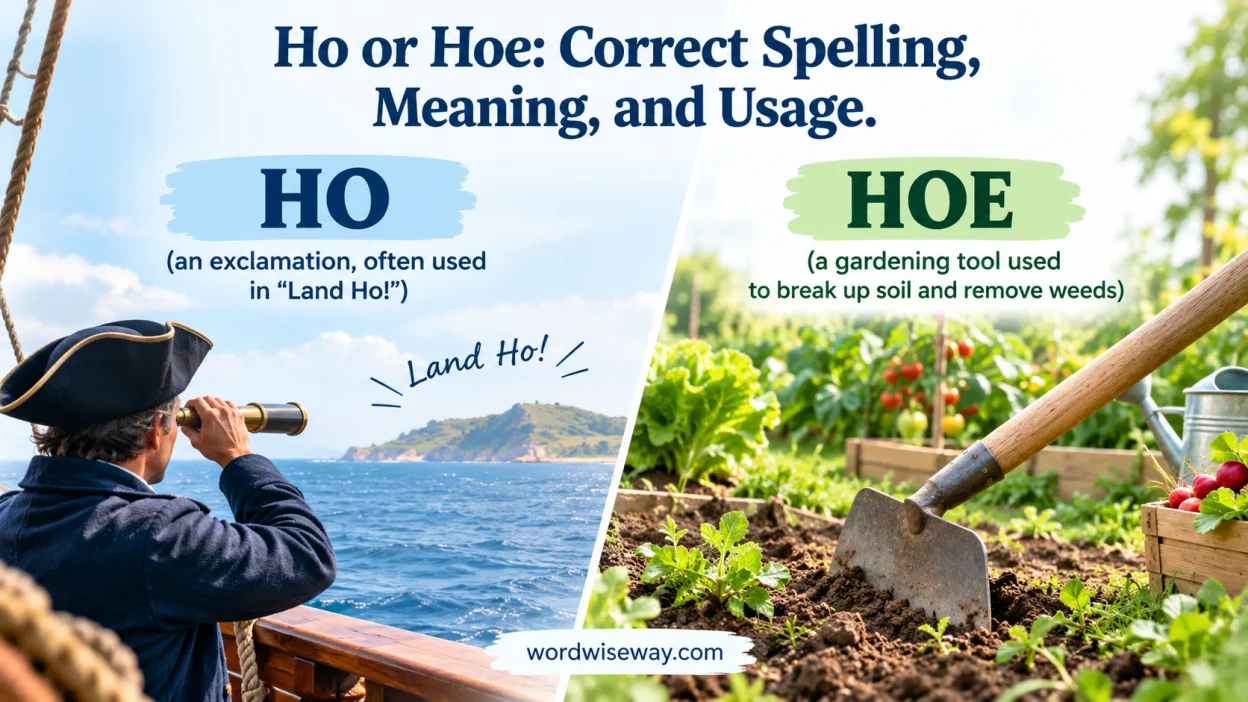
If you’re unsure about Ho or Hoe: Correct Spelling, Meaning, and Usage, focus on the meaning and usage. These words look and sound similar, but they have very different meanings. Hoe is a gardening tool used in farming, while ho is a slang term that can be offensive.
A small spelling change can completely change a sentence, causing confusion in texting, social media, informal writing, and conversation. Autocorrect errors, memes, and fast typing often make users mix them up. This article clears up the difference and helps you learn which form to choose.
The origin and usage remain useful in British English and American English. Knowing how each word is used helps you handle different situations, avoid common mistakes, and understand real-life examples. Search trends also show frequent searches for these terms. Using the correct use helps you avoid embarrassing spelling errors.
Quick Answer:
Hoe is the correct spelling when you mean a gardening or farming tool or the action of working soil with that tool.
Ho is a separate word. Historically, it has been used as an exclamation to call attention or announce something. The familiar expression “Land ho!” is a classic example. In modern slang, ho can also refer derogatorily to a woman, so that use should be treated carefully.
| Word | Main meaning | Part of speech | Example |
| Hoe | A tool for working soil | Noun | She picked up a hoe to remove the weeds. |
| Hoe | To work or cultivate soil | Verb | They hoe the garden every spring. |
| Ho | An old-fashioned exclamation | Interjection | “Land ho!” |
| Ho | A derogatory slang term | Noun | The slang term can be offensive. |
A simple rule works in most everyday situations: gardening and farming use “hoe.”
What Does Hoe Mean?
Hoe is a standard English word with both noun and verb uses. Its most familiar meaning relates to agriculture and gardening.
As a noun, a hoe is a hand tool designed for working soil. Traditional hoes generally have a blade or similar working surface attached to a handle. Gardeners use different designs depending on the task, including loosening soil, cutting weeds, making shallow planting furrows, and shaping soil around plants.
The tool has existed in various forms for thousands of years. Early agricultural societies developed simple digging and cultivating implements long before modern garden tools appeared. Today, the basic principle remains remarkably unchanged: a hoe lets you manipulate soil efficiently while standing upright.
For example:
The gardener used a hoe to clear weeds from the vegetable bed.
Here, hoe functions as a noun because it names the tool.
Hoe as a Noun
When hoe acts as a noun, it identifies the physical gardening or agricultural implement.
You might see the word in gardening instructions, farming guides, hardware descriptions, or conversations about growing plants.
Common examples include:
- garden hoe
- field hoe
- hand hoe
- cultivating hoe
- stirrup hoe
- scuffle hoe
Different hoe designs suit different jobs. A narrow blade can work well in tight spaces, while a wider blade may cover more ground during general cultivation.
Consider these sentences:
- She left the hoe beside the vegetable garden.
- The farmer repaired the wooden handle of his hoe.
- Use a hoe carefully around young plants.
- He bought a new hoe for the spring gardening season.
In each example, hoe names a physical tool.
Hoe as a Verb
Hoe also works as a verb. In this form, it means to work, cultivate, loosen, or clear soil with a hoe.
For example:
- We hoe the garden to control weeds.
- She hoed the soil around the plants.
- They spent the morning hoeing the vegetable rows.
The exact purpose depends on the context. A gardener might hoe to break up the surface of soil, remove young weeds, create shallow furrows, or improve the planting area.
The word therefore has a straightforward relationship between its noun and verb forms:
A hoe is the tool. To hoe is to use that tool.
That distinction makes the word easy to remember.
What Does Ho Mean?
Ho has meanings that aren’t connected to the gardening tool. Its history and modern usage make it especially important to consider context.
One established use is an old-fashioned interjection. In this role, ho can call attention to something or announce its appearance.
The expression “Land ho!” provides the best-known example. Historically, sailors could use such a cry after spotting land while at sea. The phrase now sounds strongly old-fashioned and often appears in historical fiction, adventure stories, jokes, or theatrical dialogue.
Ho as an Interjection
An interjection is a word or expression that communicates an exclamation, reaction, or call.
In older English, ho could serve this function. It doesn’t mean the same thing as hoe.
For example:
“Land ho!”
The speaker isn’t talking about gardening. The expression signals that land has been spotted.
Other historical constructions may use ho in a similar attention-getting way. Modern speakers rarely use the word this way in ordinary conversation unless they’re deliberately creating a historical, dramatic, humorous, or literary tone.
This distinction matters because modern readers can encounter ho in books, films, songs, or historical references without realizing that the word has an older function.
Ho as Modern Slang
Ho also appears as slang derived from a longer derogatory term used against women. In contemporary English, this usage can be insulting and demeaning.
That meaning has nothing to do with gardening.
Because slang depends heavily on context, tone, and social setting, using ho casually can cause offense even when the speaker doesn’t intend it. It’s particularly important to recognize this meaning when reading dialogue or interpreting informal online language.
A useful distinction is:
- Hoe → gardening, farming, soil, cultivation
- Ho → historical interjection or modern slang
Never assume that the two spellings are interchangeable simply because they may sound alike.
Key Differences
The clearest way to understand ho vs. hoe is to compare their meanings directly.
| Feature | Hoe | Ho |
| Gardening tool | Yes | No |
| Gardening verb | Yes | No |
| Soil cultivation | Yes | No |
| Historical interjection | No | Yes |
| Appears in “Land ho!” | No | Yes |
| Modern slang meaning | No | Yes |
| Common everyday use | Gardening and farming | Mostly specific contexts |
The extra e in hoe isn’t decorative. It identifies a different word.
If you write:
She used a ho to remove weeds.
you’ve chosen the wrong spelling for the gardening tool.
The correct sentence is:
She used a hoe to remove weeds.
That single letter changes the word and therefore changes the meaning.
Ho or Hoe: How to Choose the Correct Word
Choosing between ho and hoe becomes simple when you identify what the sentence discusses.
Use hoe when the context involves:
- gardens
- farms
- soil
- weeds
- crops
- cultivation
- planting
- gardening tools
- working the ground
Use ho when the context involves:
- the historical expression “Land ho!”
- older or literary language
- a specific slang reference
- a quotation where the original spelling must remain unchanged
A Simple Memory Trick
Think of the e in hoe as part of the tool’s identity.
If you’re talking about something you can hold in a garden and use against weeds, choose hoe.
If you’re looking at “Land ho!”, you’re dealing with the historical interjection ho.
This tiny context check can prevent a surprisingly common spelling mistake.
Examples of Hoe in Sentences
The following examples show how naturally hoe works as both a noun and a verb.
Hoe as a Noun
- The hoe hangs inside the garden shed.
- She used a hoe to loosen the compacted soil.
- Keep the hoe away from the seedlings.
- He sharpened the metal edge of the hoe.
- A lightweight hoe can make garden maintenance easier.
In each sentence, hoe names a tool.
Hoe as a Verb
- We hoe the garden to remove small weeds.
- Farmers traditionally hoe between rows of crops.
- She hoed the soil before planting the seeds.
- They spent the afternoon hoeing around the plants.
- The gardener carefully hoed around the young vegetables.
Here, hoe describes an action rather than an object.
How Do You Spell the Past Tense of Hoe?
The past tense of hoe is hoed.
For example:
She hoed the garden before planting the vegetables.
The present participle is hoeing:
They were hoeing the vegetable beds.
These forms can look unusual because English spelling doesn’t always behave intuitively when a word already ends in a vowel.
The common forms are:
| Form | Word |
| Base form | hoe |
| Third-person singular | hoes |
| Past tense | hoed |
| Past participle | hoed |
| Present participle | hoeing |
One especially common mistake is writing “hoeing” incorrectly by dropping the final e or creating an unnecessary spelling change. The standard form is hoeing.
Are Ho and Hoe Pronounced the Same?
In many varieties of English, ho and hoe have the same pronunciation. Both are generally pronounced with a long o sound.
That similarity explains much of the spelling confusion.
English contains many homophones, which are words that sound alike but have different spellings and meanings. Ho and hoe can function this way in pronunciation, even though their written forms and meanings differ.
Other familiar examples include:
- to / two / too
- there / their / they’re
- right / write
- flower / flour
The lesson is straightforward: sound alone doesn’t always tell you which spelling to choose.
When you hear someone say the word, context becomes your spelling guide. If they’re discussing weeds and soil, hoe is the obvious choice. If they’re quoting “Land ho!”, the spelling is ho.
Common Ho and Hoe Mistakes
Writing Ho for the Gardening Tool
This is probably the most important mistake to avoid.
Incorrect:
He grabbed a ho from the shed.
Correct:
He grabbed a hoe from the shed.
The gardening tool is always spelled hoe.
Writing Hoe in “Land Ho!”
The traditional expression uses ho, not hoe.
Correct:
“Land ho!”
Writing “Land hoe!” changes the expression into something that looks like a reference to a gardening tool.
Treating Ho and Hoe as Interchangeable
Although they can sound alike, they aren’t interchangeable in writing.
English spelling often preserves distinctions that pronunciation doesn’t. Context therefore matters just as much as sound.
Using Modern Slang Without Considering Its Meaning
The slang form of ho can be derogatory. A writer should understand that social meaning before using it in dialogue, commentary, or informal writing.
When discussing the term itself, quotation marks or an explanatory context can help readers understand that the word is being examined rather than casually directed at someone.
Hoeing, Hoed, and Other Forms of Hoe
The word hoe produces several useful grammatical forms.
Hoe can serve as the base verb:
Gardeners hoe between rows.
Hoed works as both the simple past and past participle:
She hoed the garden yesterday.
Hoeing is the present participle:
They are hoeing the soil.
The plural noun is hoes:
The shed contains several hoes.
These forms are worth learning because gardening articles and instructions frequently use the word as a verb rather than simply naming the tool.
Why the Difference Between Ho and Hoe Matters
Spelling isn’t merely about getting letters in the right order. In cases like ho and hoe, spelling determines meaning.
Imagine reading a gardening guide that says:
Use a ho to remove weeds.
You might understand the intended meaning from context, but the spelling still looks incorrect. The standard noun for the gardening tool is hoe.
Likewise, replacing ho with hoe in “Land ho!” creates a completely different visual impression.
This is why proofreading should consider meaning as well as individual letters. A spell checker may not always catch a wrong word when the incorrect spelling itself exists as a legitimate English word.
Quick Comparison
| Question | Correct answer |
| Which word means a gardening tool? | Hoe |
| Which word means to work soil with that tool? | Hoe |
| Which word appears in “Land ho!”? | Ho |
| Can both words sound alike? | Yes |
| Is “ho” the standard spelling for the garden tool? | No |
| Is “hoe” a verb? | Yes |
| What is the past tense of hoe? | Hoed |
| What is the -ing form? | Hoeing |
| Can modern “ho” be offensive? | Yes |
Read More: Roll or Die: Meaning, Definition, Usage, and Examples
FAQs
Is “ho” or “hoe” the correct spelling?
Both ho and hoe are correct spellings, but they have different meanings. Hoe usually refers to a gardening or farming tool, while ho is an informal slang term.
What does “hoe” mean?
Hoe is a tool used for gardening and farming. You can use it to loosen soil, remove weeds, or prepare ground for planting.
What does “ho” mean?
Ho is a slang word with several historical uses. In modern informal language, it can refer to a woman in a derogatory or offensive way, so you should use it carefully.
Why do people confuse ho and hoe?
People often confuse them because they sound similar when spoken. Fast typing, autocorrect, memes, and informal texting can make the spelling mix-up even more common.
Is “hoe” used in American English?
Yes. Hoe is standard in American English when referring to the gardening or farming tool. Its spelling does not change between American and British English.
Is “ho” considered offensive?
It can be. In modern usage, ho may be used as a derogatory slang term for a woman. Context matters, but it is generally safer to avoid using it to describe someone.
Can “hoe” be used as a verb?
Yes. Hoe can work as a verb when you mean working soil with a hoe. For example, a gardener might hoe a vegetable bed to remove weeds.
What is the easiest way to remember ho and hoe?
Think of the extra e in hoe as connected with equipment used on the earth. If you mean the gardening tool, hoe is the word you need.
Are ho and hoe pronounced the same?
In many varieties of English, ho and hoe are pronounced the same or nearly the same. Their spelling and meaning, rather than their pronunciation, provide the main distinction.
How can I avoid using ho or hoe incorrectly?
First, identify what you want the word to mean. Choose hoe for the farming or gardening tool, and be cautious with ho because its slang use can be offensive.
Conclusion
Understanding ho or hoe becomes much easier when you focus on the meaning behind each word. Hoe is the correct spelling for a gardening or farming tool, while ho has a completely different slang meaning that may be offensive. Although they can sound alike, their uses are not interchangeable.
The extra e in hoe gives you a useful visual clue when you’re writing about gardening, farming, or working with soil. If you’re typing quickly or relying on autocorrect, taking a moment to check the context can prevent an unnecessary spelling mistake. This small habit can make your writing clearer and more precise.
Whether you’re writing a sentence, posting on social media, or searching for the right word, context should guide your choice. Remembering the distinct meanings of ho and hoe will help you communicate more accurately and avoid confusing readers with an unintended word

Evelyn Shaw has spent 14 years at Yale University’s English Department, leading students through close readings, genre studies, and interpretive methodologies. Her scholarly interests include Renaissance drama, gothic fiction, feminist literary criticism, and archival research and examining how texts generate meaning across historical periods. Evelyn has presented at major academic conferences and published essays in peer-reviewed journals, reflecting her passion for rigorous analysis and student-centered learning.