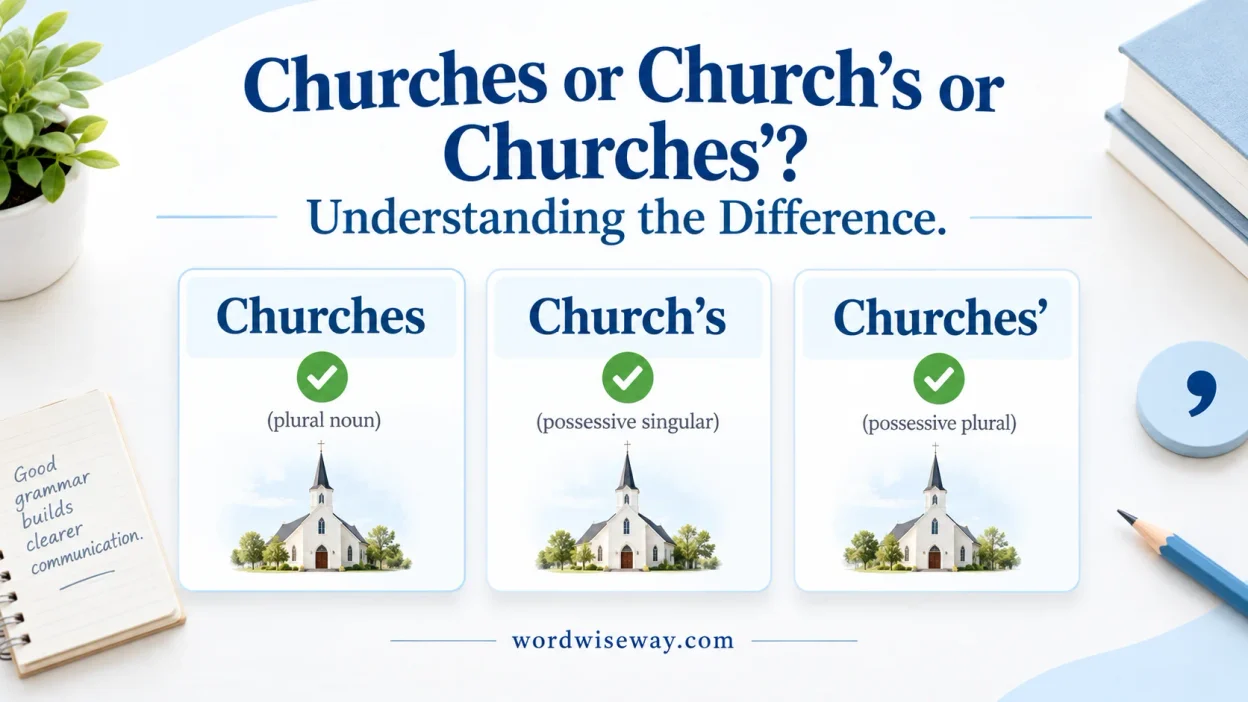
Churches or Church’s or Churches’ What’s the Difference? Learn how these forms differ and discover simple grammar rules that make your English writing clearer.
A church is a singular noun, while churches is its plural form. To show ownership, use church’s for one church and churches’ for multiple churches. The singular possessive places an apostrophe before the s, while the plural possessive places it after the s. These standard rules help you understand correct spelling, punctuation, and apostrophe placement. Luckily, this possessive grammar is easy to master once you recognize the difference between singular and plural forms.
Understanding possessive nouns makes language learning easier. For example, “The church’s entrance is open” shows ownership by one church. “The churches’ entrances are open” indicates ownership by multiple churches. When writing an article about these church-related words, follow these grammatical rules to improve your word usage and make your English writing clearer.
Quick Answer:
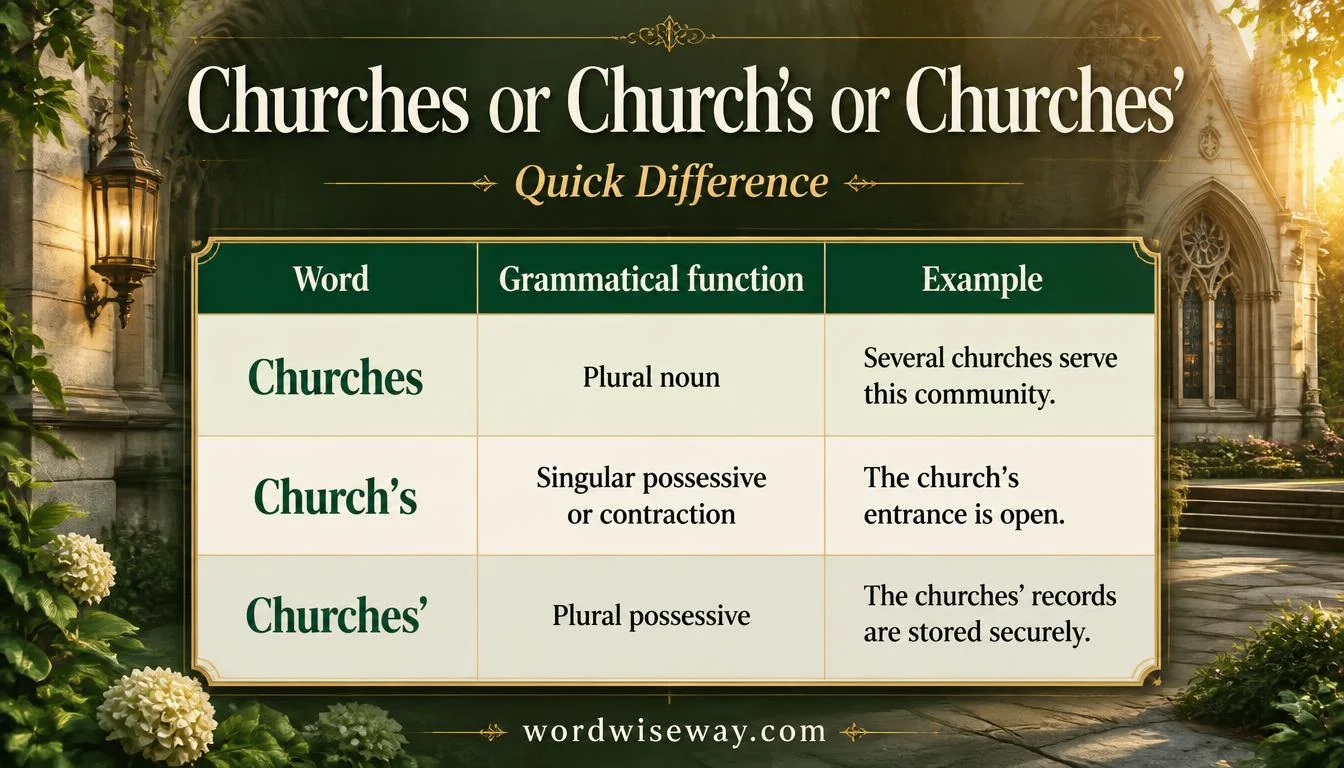
The correct choice depends on your intended meaning. Churches is the plural form of church, church’s indicates singular possession or a contraction, and churches’ indicates plural possession.
| Word | Grammatical function | Example |
| Churches | Plural noun | Several churches serve this community. |
| Church’s | Singular possessive or contraction | The church’s entrance is open. |
| Churches’ | Plural possessive | The churches’ records are stored securely. |
Here’s an easy way to remember the difference:
- Churches: More than one church.
- Church’s: Something belonging to or associated with one church.
- Churches’: Something belonging to or associated with multiple churches.
Notice where the apostrophe appears. In church’s, it comes before the final s. In churches’, it comes after the plural ending.
What Does Churches Mean?
The word churches is the standard plural form of church. Use it whenever you refer to two or more churches rather than one.
A church can refer to a religious building, a congregation, or an organized religious community. The intended meaning depends on the surrounding sentence. Adding -es makes the noun plural without expressing ownership.
For example:
- Our town has three churches.
- Several churches organized a community event.
- The churches serve different neighborhoods.
- Tourists visited the historic churches during their trip.
None of these examples requires an apostrophe because the sentences simply refer to multiple churches.
Churches as the Plural of Church
English forms many plural nouns by adding -s. However, nouns ending in sounds such as ch, sh, s, x, and z commonly take -es.
The word church follows this spelling pattern.
- One church becomes two churches.
- One bench becomes several benches.
- One dish becomes multiple dishes.
- One box becomes several boxes.
The ending -es helps form a plural that fits English spelling and pronunciation patterns.
Important: The letters es in churches do not indicate possession. They simply make the noun plural.
Incorrect: Our town has four church’s.
Correct: Our town has four churches.
The incorrect version suggests possession or a contraction rather than the ordinary plural form.
When to Use Churches in a Sentence
Use churches when discussing multiple buildings, congregations, organizations, or religious communities.
The noun can function as a subject, a direct object, or the object of a preposition.
As a subject:
- The churches offer different community programs.
- Several churches participate in the annual celebration.
As a direct object:
- The organization supports rural churches.
- The architect restored two historic churches.
After a preposition:
- The volunteers traveled between churches.
- The announcement was shared among local churches.
These examples show that the grammatical role can change while the spelling remains the same.
Churches vs. Church: Singular and Plural
The distinction between church and churches also affects subject-verb agreement. A singular subject generally takes a singular verb, while a plural subject takes a plural verb in the present tense.
| Singular | Plural |
| The church is open. | The churches are open. |
| The church has a library. | The churches have libraries. |
| This church serves the village. | These churches serve the villages. |
Pay attention to the subject rather than the nearest noun. This habit helps you avoid agreement errors in longer sentences.
For example, “The church near the three schools is open” uses is because church remains the subject. The plural noun schools does not change that relationship.
What Does Church’s Mean?
The form church’s has two common grammatical uses. It can show possession or association involving one church, and it can function as a contraction of church is or church has.
The context tells you which meaning the writer intends.
Church’s as the Singular Possessive Form
Use church’s when referring to something belonging to or associated with one church. The apostrophe followed by s marks the possessive form of this singular noun.
For example:
- The church’s roof needs repairs.
- The church’s history spans more than a century.
- The church’s entrance faces the main street.
- The church’s congregation organized a food drive.
- The church’s records include important historical documents.
In each example, the sentence refers to one particular church.
Possession does not always mean legal ownership. English also uses possessive forms to express relationships, responsibilities, characteristics, and associations.
Consider the sentence, “The church’s mission focuses on helping families.”
The mission is associated with the church, even though it isn’t a physical object the church owns.
This broader meaning makes the possessive form useful in discussions about history, leadership, services, policies, and community activities.
When to Use Church’s in a Sentence
Use church’s before a noun when you need to identify something associated with one church.
Common examples include:
- The church’s pastor: The pastor associated with that church.
- The church’s history: The history of that church.
- The church’s schedule: The schedule maintained by that church.
- The church’s property: The property belonging to or associated with that church.
- The church’s activities: Activities organized or offered by that church.
Compare these two sentences:
“The church has a garden.”
“The church’s garden attracts visitors.”
The first sentence simply states that a garden exists at the church or is associated with it. The second identifies the garden through its relationship with one particular church.
Both sentences are correct, but they communicate different grammatical relationships.
Church’s as a Contraction
The spelling church’s can also shorten church is or church has. This use differs from the possessive form, even though the written spelling looks identical.
Church’s = church is
- The church’s open today.
Meaning: The church is open today. - The church’s ready for the ceremony.
Meaning: The church is ready for the ceremony.
Church’s = church has
- The church’s welcomed several new members.
Meaning: The church has welcomed several new members. - The church’s completed its restoration project.
Meaning: The church has completed its restoration project.
These contractions are grammatically possible, although their naturalness depends on the sentence and writing style.
In formal writing, spelling out church is or church has may improve clarity. In conversational writing, contractions often sound more natural.
A useful test is to replace the apostrophe form with the full words. If the sentence still makes sense with church is or church has, the contraction may be correct.
For example, “The church’s roof needs repairs” becomes “The church is roof needs repairs” if you interpret it as a contraction. That version is incorrect, so church’s must be possessive.
What Does Churches’ Mean?
Churches’ is the plural possessive form of church. Use it when referring to something belonging to, shared by, or associated with two or more churches.
The word churches already contains the plural ending -es. To form its possessive, add an apostrophe after that existing ending.
For example:
- The churches’ histories differ considerably.
- The churches’ leaders attended the meeting.
- The churches’ community programs received additional support.
- The churches’ records were transferred to a secure archive.
- The churches’ properties require regular maintenance.
Each example refers to multiple churches rather than one.
Churches’ as the Plural Possessive Form
The general rule for most regular plural nouns is straightforward: when the plural already ends in s, add an apostrophe after the final s.
For example:
| Singular noun | Plural noun | Plural possessive |
| Church | Churches | Churches’ |
| School | Schools | Schools’ |
| Teacher | Teachers | Teachers’ |
| Company | Companies | Companies’ |
| Student | Students | Students’ |
The spelling changes because each form performs a different grammatical job.
Take the following examples:
- Plural: The churches welcomed visitors.
- Singular possessive: The church’s doors were open.
- Plural possessive: The churches’ doors were open.
The first sentence describes multiple churches. The second identifies the doors of one church. The third refers to the doors of multiple churches.
The plural possessive doesn’t require another s after the apostrophe because churches already has its complete plural ending.
When to Use Churches’ in a Sentence
Use churches’ when a sentence identifies something associated with several churches.
For example, a local organization might coordinate programs across different congregations. You could write, “The churches’ shared calendar lists every upcoming event.”
Here, churches’ identifies the calendar as something associated with multiple churches.
Other examples include:
- The churches’ annual reports were published together.
- The churches’ leaders discussed plans for a joint event.
- The churches’ contributions funded the community project.
- The churches’ historic buildings attract architecture enthusiasts.
- The churches’ policies differ on several administrative matters.
Notice that plural possession does not necessarily mean joint ownership. A phrase such as the churches’ histories can refer to the separate history of each church.
Context determines whether the relationship involves shared resources or individual items associated with multiple churches.
Churches’ vs. Church’s
The difference between these two forms becomes clearer when you identify how many churches the sentence describes.
| Church’s | Churches’ |
| Refers to one church | Refers to multiple churches |
| Apostrophe appears before the final s | Apostrophe appears after the plural ending |
| The church’s garden needs attention. | The churches’ gardens need attention. |
| The church’s records are complete. | The churches’ records are complete. |
| The church’s leaders met yesterday. | The churches’ leaders met yesterday. |
The final two examples use the same nouns, but the possessive form changes the number of churches involved.
If one church has a set of records, write the church’s records. If multiple churches have records, write the churches’ records.
One small punctuation mark can clarify the entire relationship.
Key Differences
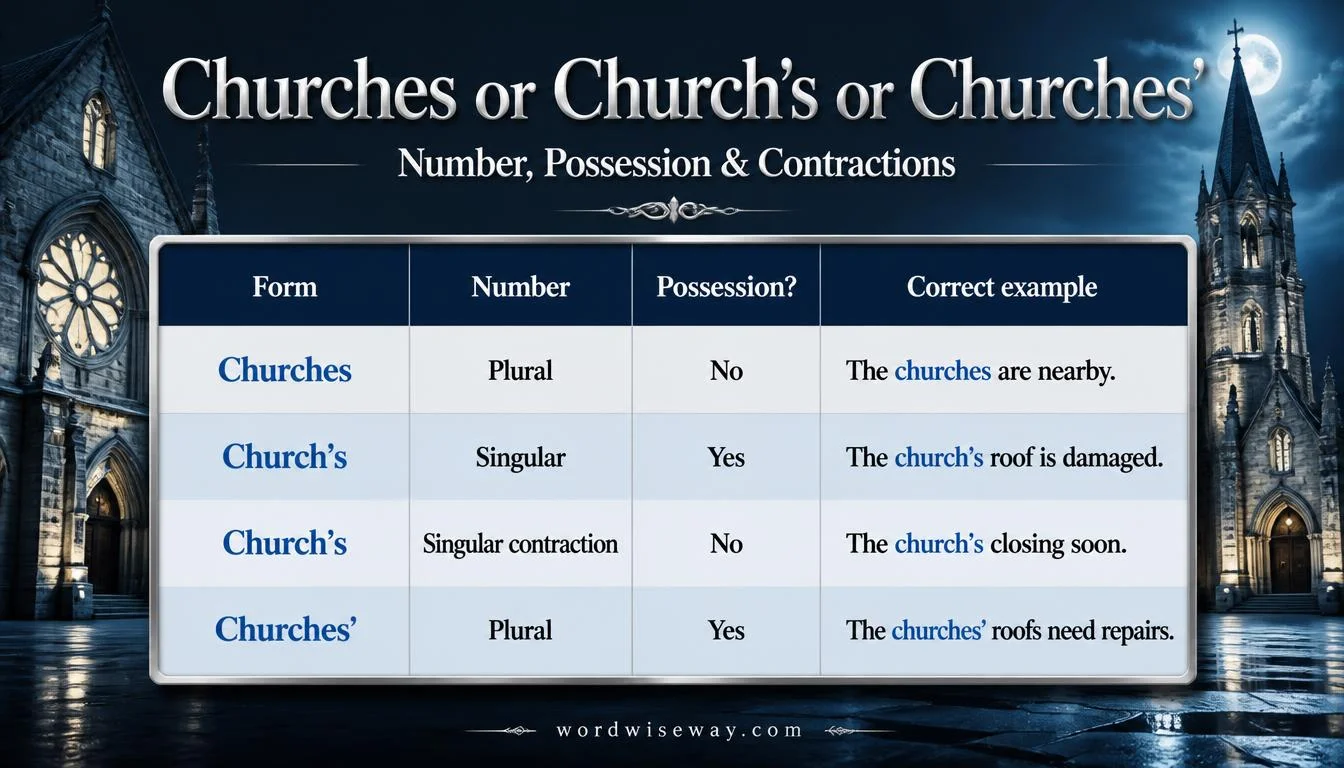
When comparing churches or church’s or churches’, focus on number and possession rather than appearance alone.
The word churches answers the question “How many churches?” The possessive form church’s answers “What belongs to or relates to one church?” Meanwhile, churches’ answers “What belongs to or relates to multiple churches?”
| Form | Number | Possession? | Correct example |
| Churches | Plural | No | The churches are nearby. |
| Church’s | Singular | Yes | The church’s roof is damaged. |
| Church’s | Singular contraction | No | The church’s closing soon. |
| Churches’ | Plural | Yes | The churches’ roofs need repairs. |
The contraction example uses informal wording for the church is closing soon. In formal writing, spelling out the words may be preferable.
A Practical Case Study
Imagine a town with three historic churches. A writer wants to describe their buildings, the history of one building, and a shared community event.
The writer might produce these sentences:
- “The churches attract visitors every summer.” This sentence uses the plural noun because it refers to all three churches.
- “The church’s bell tower dates back to the nineteenth century.” This sentence uses the singular possessive because it identifies one church’s bell tower.
- “The churches’ joint festival begins in June.” This sentence uses the plural possessive because the festival is associated with several churches.
The three sentences discuss the same general subject, yet each requires a different form.
The lesson: Decide whether you mean one church or several before deciding where the apostrophe belongs.
How to Use Churches, Church’s, and Churches’ Correctly
Understanding the rules is helpful, but seeing the forms in realistic sentences makes them easier to apply.
Examples of Churches in Sentences
Use churches whenever you refer to multiple churches without marking possession.
- Several churches opened their doors for the community event.
- The town’s oldest churches attract visitors interested in architecture.
- Local churches collected supplies for families affected by flooding.
- Two churches share a parking area near the town center.
- Historic churches often preserve valuable architectural details.
In each example, the noun identifies multiple churches. The sentence doesn’t use churches to mark ownership.
Examples of Church’s in Sentences
Use church’s when one church has, maintains, organizes, or is associated with something.
- The church’s library contains historical documents.
- The church’s roof was repaired last spring.
- The church’s weekly schedule includes several activities.
- The church’s leadership approved the renovation.
- The church’s community garden provides fresh produce.
You can also use the same spelling as a contraction when the sentence requires church is or church has.
- The church’s hosting a special event tonight.
- The church’s already completed the necessary repairs.
These contraction examples work in conversational English. For formal documents, the expanded forms may read more clearly.
Examples of Churches’ in Sentences
Use churches’ when the possessive relationship involves multiple churches.
- The churches’ representatives signed the agreement.
- The churches’ shared garden supplies vegetables to local families.
- The churches’ archives preserve valuable historical records.
- The churches’ annual meetings take place in September.
- The churches’ renovation projects require additional funding.
Remember that the plural possessive can describe either shared resources or separate items associated with different churches.
For instance, the churches’ gardens could mean several gardens, each associated with a different church. The surrounding text helps establish the intended meaning.
Common Mistakes to Avoid
Even experienced writers sometimes confuse plural nouns and possessive forms. Fortunately, a few simple checks can prevent most errors.
Using Church’s Instead of Churches
The most common mistake is adding an apostrophe when you simply want to make church plural.
Incorrect: Several church’s participate in the event.
Correct: Several churches participate in the event.
The first version doesn’t correctly express the intended plural noun. The second uses the standard plural spelling.
Remember: Adding an apostrophe doesn’t make a singular noun plural. The ending -es does that job.
Using Churches’ Instead of Church’s
This mistake occurs when writers use the plural possessive for something associated with one church.
Incorrect: The churches’ entrance needs repair.
Intended meaning: One church has an entrance that needs repair.
Correct: The church’s entrance needs repair.
However, the plural possessive is appropriate when multiple churches are involved.
Correct: The churches’ entrances need repair.
The difference depends on the number of churches, not merely the number of entrances.
Using Churches Instead of Churches’
Sometimes writers omit an apostrophe even when the sentence requires possession.
Compare these examples:
- Plural: The churches welcomed the visitors.
- Possessive: The churches’ welcome signs greeted visitors.
In the first sentence, churches identifies the organizations performing an action. In the second, churches’ identifies the signs associated with those organizations.
Without the apostrophe, the second sentence would lose its intended possessive structure.
Confusing Apostrophes With Plural Endings
Ordinary plural nouns generally don’t need apostrophes. Apostrophes serve other grammatical purposes, including possession and certain contractions.
| Incorrect | Correct | Reason |
| Three church’s | Three churches | Ordinary plural |
| Several church’s buildings | Several churches’ buildings | Plural possession |
| One churches’ entrance | One church’s entrance | Singular possession |
| The churches’s records | The churches’ records | Regular plural possessive |
One useful habit is to check the noun first. Determine whether it is singular or plural, then add an apostrophe only if the sentence requires possession or a contraction.
Churches’ or Churches’s: Which Is Correct?
The standard plural possessive form is churches’, not churches’s.
Because churches is already a regular plural ending in s, you add only an apostrophe to show possession.
Correct: The churches’ meeting begins at noon.
Incorrect: The churches’s meeting begins at noon.
The incorrect version adds an unnecessary s after the apostrophe.
This rule also applies to many other regular plural nouns:
- Teachers’ classrooms
- Students’ assignments
- Schools’ facilities
- Companies’ policies
- Churches’ activities
However, some irregular plural nouns form their possessives differently. For example, children becomes children’s because it doesn’t end in s.
The important distinction is whether the plural noun already ends in s.
Church’s or Church’: Which Is Correct?
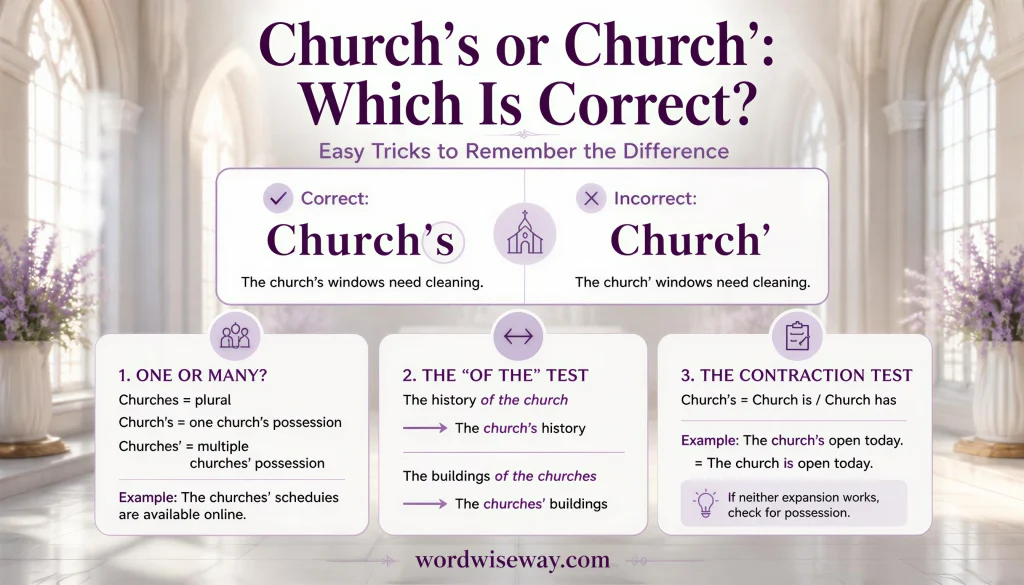
For the singular noun church, the standard possessive form is church’s.
Correct: The church’s windows need cleaning.
Incorrect: The church’ windows need cleaning.
The word church doesn’t end in s. Therefore, its singular possessive form takes an apostrophe followed by s.
Compare these forms:
- The church’s history
- The church’s entrance
- The church’s community programs
This differs from certain style conventions for singular nouns that already end in s, such as James. Different style guides sometimes treat those names differently. However, that variation doesn’t affect the standard spelling of church’s.
Easy Tricks
You don’t need a complicated grammar formula to choose the correct form. A quick decision process can help you identify the right spelling in seconds.
Use the One-Church-or-Multiple-Churches Test
First, determine whether you’re referring to one church or more than one.
If you mean multiple churches without possession, use churches.
Example: The churches are preparing for the celebration.
If you mean something associated with one church, use church’s.
Example: The church’s schedule includes a morning service.
If you mean something associated with multiple churches, use churches’.
Example: The churches’ schedules are available online.
This test works for most ordinary sentences involving the three forms.
Use the “Belonging To” Test
Another helpful technique is to rewrite the sentence using of the church or of the churches.
For example:
- The history of the church becomes the church’s history.
- The histories of the churches becomes the churches’ histories.
- The buildings of the churches becomes the churches’ buildings.
If you can express the intended relationship using of the church, the singular possessive may fit. If the relationship involves multiple churches, the plural possessive may be appropriate.
This test is a useful guide rather than an absolute rule. Possessives can express association, responsibility, and other relationships beyond literal ownership.
Check Whether Church’s Is a Contraction
If you’re unsure about church’s, replace it with church is or church has.
For example:
- The church’s open today. → The church is open today.
- The church’s completed the project. → The church has completed the project.
If the expanded sentence makes sense, the contraction may be correct.
However, “The church’s entrance is open” cannot mean “The church is entrance is open.” In that sentence, church’s expresses possession.
Read More: Yours or Your’s or Yours’ Correct Spelling and Usage Explained
FAQs
1. What Is the Difference Between Church, Church’s, and Churches’?
Church refers to one place of worship, while churches means more than one. Church’s shows ownership by one church, whereas churches’ shows ownership by multiple churches.
2. Is Church’s Singular or Plural?
Church’s is the singular possessive form of church. It shows that something belongs to one church, such as the church’s roof or the church’s entrance.
3. When Should I Use Churches’ in a Sentence?
Use churches’ when something belongs to two or more churches. For example, The churches’ gardens look beautiful means the gardens belong to multiple churches.
4. Does Churches’ Need an Apostrophe After the S?
Yes, churches’ needs an apostrophe after the final s. Since churches is already plural, you add only an apostrophe to show possession.
5. Is Churches’ the Same as Church’s?
No, these forms have different meanings. Church’s indicates ownership by one church, while churches’ indicates ownership by multiple churches.
6. What Is the Plural Form of Church?
The plural form is churches. Because the word ends in ch, you add -es rather than simply adding -s. For example, One church stands nearby, but three churches serve the town.
7. How Do I Show That Something Belongs to One Church?
Add an apostrophe and s to church to create church’s. For example, The church’s bell rings every Sunday shows that the bell belongs to one church.
8. How Do You Make Church Possessive When Talking About Several Churches?
First, change church to its plural form, churches. Then add an apostrophe after the final s. For example, The churches’ schedules differ this month.
9. What Are Common Mistakes When Using Church’s and Churches’?
A common mistake is using church’s for multiple churches or writing churches’s instead of churches’. Remember that one church takes church’s, while multiple churches take churches’.
10. How Can I Remember the Correct Apostrophe Placement?
Start by deciding whether you mean one church or several. For one church, write church’s. For multiple churches, write churches’. This simple check helps you avoid common grammar and punctuation mistakes.
Conclusion
Understanding the difference between church, churches, church’s, and churches’ becomes much easier when you focus on number and ownership. Church refers to one place of worship, while churches refers to several. When you need to show possession, the apostrophe helps readers understand who owns something.
Remember one simple rule: church’s shows ownership by one church, while churches’ shows ownership by multiple churches. For example, the church’s roof refers to one church, whereas the churches’ roofs refers to several churches. Correct apostrophe placement makes your sentences clearer and prevents common punctuation mistakes.
With regular practice, you’ll recognize these forms naturally in everyday reading and writing. Before adding an apostrophe, identify whether the noun is singular or plural. This small habit can strengthen your grammar skills and help you write with greater confidence. Once you understand the pattern, choosing the correct form becomes a straightforward part of English writing..

Emma Smith has dedicated 14 years to Princeton University’s English Department, mentoring students in textual interpretation, literary movements, and critical frameworks. Her research explores Shakespearean drama, Victorian serial fiction, postcolonial narrative theory, and manuscript studies and probing how literary forms evolve across cultures and centuries. Emma has delivered lectures at international humanities congresses and published findings in distinguished academic journals, underscoring her commitment to scholarly depth and vibrant teaching.