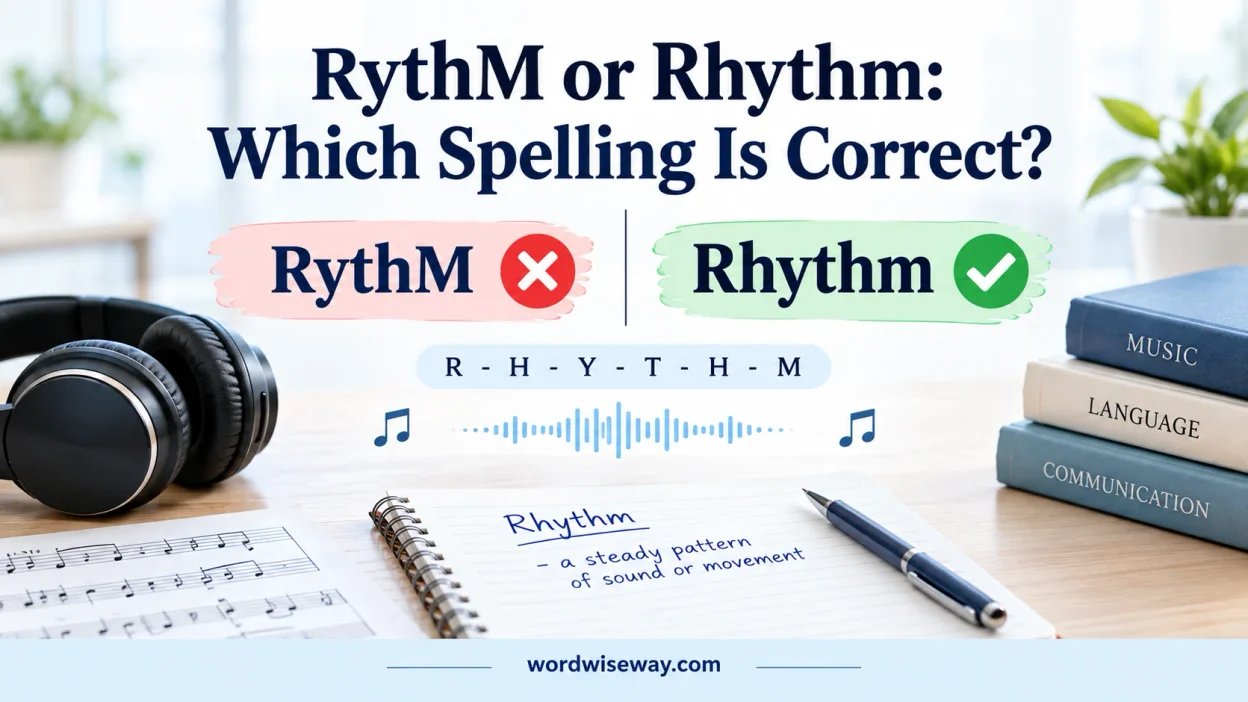
RythM or Rhythm: Correct Spelling, Meaning, and Usage can confuse English learners and native speakers because both forms look similar. The correct spelling is rhythm, while rythm is a spelling mistake. This confusion often appears in writing, especially for school, work, and everyday communication.
The meaning of rhythm is a repeated pattern of beats, sounds, movements, or events. English spelling rules can be tricky, and the unusual spelling patterns, pronunciation, and silent letters make this word harder to remember. The second h is an important tiny letter.
If you search rhythm or rythm online, you may notice this common mistake frequently. Learners, students, and content writers can avoid it by checking the correct word before submitting essays, emails, or other English writing. Using rhythm correctly improves clarity and professionalism.
Quick Answer
Rhythm is the correct standard English spelling.
RythM is not the standard spelling of the word. The unusual capitalization doesn’t create a separate standard English variant.
| Spelling | Correct in standard English? | Meaning |
| Rhythm | ✅ Yes | A pattern of sounds, movements, beats, or changes |
| RythM | ❌ No | Not the standard spelling of the word |
The correct spelling is:
R-H-Y-T-H-M
That’s six letters, with y doing something particularly useful because the word doesn’t contain the kind of ordinary vowel pattern many readers expect.
Cambridge Dictionary gives the US pronunciation as /ˈrɪð.əm/ and defines rhythm as a repeated pattern of sounds or beats, as well as a regular movement or pattern of change.
So if you’re choosing between RythM or Rhythm, use rhythm.
Why Is Rhythm the Correct Spelling?
The spelling rhythm is the established standard form of the English noun. Although its letter sequence looks peculiar to modern English readers, the spelling has a long history.
The word traces back through Latin rhythmus to Greek rhythmos, associated with measured movement, proportion, arrangement, and flow. English spelling changed over time, and historical forms included variations such as rithme.
That history helps explain why the modern spelling doesn’t look as straightforward as its pronunciation.
English spelling often preserves traces of older forms. Rhythm is a good example. Its spelling reflects its linguistic history rather than simply representing every sound with the letters a modern reader might expect.
The unusual part is the middle
Look closely at the word:
R H Y T H M
You might expect a vowel such as a, e, i, o, or u somewhere in the middle. Instead, the spelling uses y.
That’s one reason people invent or remember incorrect forms such as RythM. The brain tries to impose a familiar spelling pattern on an unfamiliar sequence.
However, the safest approach isn’t to spell rhythm by sound. Memorize its six-letter sequence instead.
What Does Rhythm Mean?
Rhythm has several closely related meanings, but they all involve some form of pattern, movement, timing, or repetition.
Cambridge Dictionary describes rhythm as a pattern of sounds, words, or musical notes used in music, poetry, and dancing. It also uses the word for regular movement and recurring patterns of change.
Rhythm in Music
In music, rhythm refers to the pattern created by sounds, beats, accents, and timing.
For example:
The drummer kept a steady rhythm throughout the song.
Here, rhythm describes the organized pattern of beats that gives the music movement and structure.
Rhythm isn’t exactly the same thing as tempo. Tempo concerns how fast or slowly music moves, while rhythm concerns the arrangement and timing of sounds within that movement.
Rhythm in Dance
Dance relies heavily on rhythm because movement often responds to a pattern of beats or sounds.
A dancer might follow a fast rhythm, slow rhythm, repeating rhythm, or complicated rhythm. The movement doesn’t simply happen randomly. It responds to timing.
For example:
The dancers moved in rhythm with the drums.
The phrase in rhythm means that the movement follows the relevant pattern or beat.
Rhythm in Speech
Rhythm also appears in spoken language.
When you speak, you don’t give every word exactly the same amount of emphasis. You naturally stress certain syllables and words while reducing others. Pauses and changes in pace also shape the rhythm of speech.
Consider the difference between a rushed sentence and one delivered with deliberate pauses. The words may remain identical, but the rhythm changes.
Writers can create a similar effect through sentence length, punctuation, repetition, and word choice.
Rhythm in Everyday Patterns
You don’t need a musical instrument to have rhythm.
People use the word for repeated patterns in ordinary life, too. Cambridge gives examples involving natural and biological patterns, including the recurring cycles of seasons and human sleep and waking.
For example:
- the rhythm of the seasons
- a daily rhythm
- a regular rhythm of work
- biological rhythms
- the rhythm of waves
In each case, the central idea is a recognizable pattern that unfolds over time.
What’s the Difference?
The difference is straightforward.
Rhythm is the standard English spelling.
RythM isn’t an alternative spelling with a different meaning. In ordinary English writing, it is simply an incorrect form of the word.
| Feature | Rhythm | RythM |
| Standard English spelling | ✅ | ❌ |
| Dictionary form | ✅ | ❌ |
| Refers to a pattern or beat | ✅ | ❌ |
| Appropriate in formal writing | ✅ | ❌ |
| Can appear as a stylized name or brand? | Possibly | Possibly |
That final point matters. Someone could deliberately choose RythM as a username, company name, product name, artistic title, or other stylized label. Proper names and brands can use unusual capitalization or spelling.
That doesn’t make RythM the standard spelling of the ordinary English word.
How Do You Pronounce Rhythm?
In US English, rhythm is pronounced /ˈrɪð.əm/. Cambridge identifies the first syllable as stressed and gives the same basic US pronunciation in its pronunciation entry.
The first sound begins with r, followed by the short vowel sound found in words such as sit. The th represents the voiced sound heard in this, rather than the unvoiced sound in think.
The final part is particularly interesting because the written m doesn’t follow a conventional full vowel letter in the spelling.
This mismatch between spelling and pronunciation is a major reason learners struggle with the word.
Rhythm pronunciation at a glance
| Item | Information |
| Word | rhythm |
| US pronunciation | /ˈrɪð.əm/ |
| Part of speech | Noun |
| Main idea | A pattern of sound, movement, or change |
| Stress | First syllable |
If you’re learning the word, don’t let its pronunciation trick you into inventing extra letters. Pronunciation can guide you, but it doesn’t always reveal English spelling.
Why Is Rhythm So Hard to Spell?
Some English words are difficult because their pronunciation contains sounds that spelling represents unpredictably. Rhythm takes this problem a step further because its written form looks unusual even before you say it aloud.
It has an unusual vowel pattern
The word contains y but no ordinary a, e, i, o, or u.
That makes it visually unusual:
R-H-Y-T-H-M
Many English words give readers a clearer vowel pattern. Rhythm doesn’t.
Pronunciation doesn’t reveal every letter
If you tried to spell rhythm entirely by listening to someone say it, you could easily produce a form that feels more intuitive but isn’t correct.
That’s a common spelling trap.
The spoken word doesn’t hand you the written sequence on a silver platter. You need to recognize the established spelling.
The letters can seem to be in the wrong order
The sequence rhyth- is unfamiliar to many readers. Once you know the correct pattern, however, it becomes much easier to recognize.
Think of the spelling as a fixed six-letter unit rather than something you reconstruct every time.
How to Remember the Spelling of Rhythm
The best way to remember rhythm is to attach the unusual letter pattern to something memorable.
Use a mnemonic for Rhythm
A well-known spelling mnemonic is:
Rhythm Helps Your Two Hips Move
The first letters give you:
R H Y T H M
That matches the spelling of rhythm.
This mnemonic works because it converts an awkward sequence of letters into a short sentence with a clear mental image.
Memorize the six-letter sequence
Another simple approach is to practice the exact sequence:
RH + Y + THM
The goal isn’t to pronounce those chunks as separate words. You’re simply giving your memory landmarks.
Once R-H-Y-T-H-M becomes familiar, you won’t need to reconstruct the spelling from pronunciation.
Connect the spelling with the meaning
You can also reinforce the spelling by using the word in real sentences.
For example:
The band found its rhythm after the first few minutes.
The rhythm of the rain made the room feel peaceful.
She quickly adjusted to the rhythm of the new routine.
Seeing the correct form repeatedly gives your visual memory more opportunities to lock it in.
Examples
The word appears in many kinds of writing, not just discussions about music.
Music
The drummer established a steady rhythm before the singer began.
The song has a fast rhythm that makes it difficult to sit still.
Dance
The dancers moved smoothly with the rhythm of the music.
She practiced until she could follow the rhythm without counting aloud.
Speech and writing
The short sentences give the paragraph a quick rhythm.
The poet carefully controlled the rhythm of each line.
Nature
The rhythm of the waves gradually became calming.
The changing rhythm of the seasons shapes many natural processes.
Everyday life
After a busy week, he finally returned to his normal rhythm.
It took several days to settle into the rhythm of the new schedule.
These examples show why the word has a broader meaning than simply “beat.” It can describe sound, movement, timing, repetition, and recurring patterns.
Common Spelling Mistakes
Because the word has an unusual structure, people may accidentally rearrange, remove, or add letters.
| Incorrect form | Correct form | What went wrong |
| RythM | Rhythm | Letters are arranged incorrectly and capitalization is unusual |
| Rythym | Rhythm | Extra letters create a more familiar-looking pattern |
| Rythm | Rhythm | The second h is missing |
| Rhythim | Rhythm | An extra vowel is inserted |
| Rhythum | Rhythm | The spelling tries to add a familiar vowel sound |
The important point is that these forms don’t represent standard spelling variants. Rhythm is the form to use in ordinary English writing.
Rhythm as a Noun and Related Word Forms
It is primarily used as a noun. However, several related forms appear regularly in English.
Rhythmic
Rhythmic is an adjective meaning characterized by rhythm or regular movement.
Cambridge defines rhythmic as describing something with a regular movement or repeated beat.
Example:
The rhythmic sound of the train made the journey relaxing.
Notice the spelling:
rhythm → rhythmic
The related adjective doesn’t simply add a suffix to produce an intuitively predictable form. Its spelling deserves attention too.
Rhythmically
Rhythmically is the adverbial form.
Example:
The machine moved rhythmically across the floor.
It describes an action performed with rhythm or in a rhythmic manner.
Rhythms
The plural of rhythm is rhythms.
Example:
Different cultures have developed distinctive musical rhythms.
The plural simply adds -s.
| Word | Part of speech | Example |
| rhythm | Noun | The rhythm changed suddenly. |
| rhythms | Plural noun | The rhythms were complex. |
| rhythmic | Adjective | The sound was rhythmic. |
| rhythmically | Adverb | The machine moved rhythmically. |
Rhythm vs. Beat, Tempo, Meter, and Cadence
These terms sometimes overlap, but they aren’t perfect substitutes.
| Word | General meaning |
| Rhythm | A pattern of sounds, beats, movements, or timing |
| Beat | A basic pulse or recurring unit of musical time |
| Tempo | The speed at which music or another timed activity proceeds |
| Meter | An organized pattern of beats or stresses, especially in music and poetry |
| Cadence | A particular pattern or flow of sound, speech, or musical phrasing |
For example, a song can have a particular tempo while containing a complicated rhythm.
Likewise, poetry can have a recognizable meter while the speaker’s delivery adds another layer of rhythm.
These distinctions matter because replacing every use of rhythm with beat can make your writing less precise.
Is “RythM” Ever Correct?
RythM can theoretically appear as a deliberately stylized name, title, username, product name, or brand.
However, that’s different from using it as the ordinary English noun.
If you’re writing:
The song has a strong RythM.
that’s incorrect standard spelling.
Write:
The song has a strong rhythm.
If a company or creative project officially chooses RythM as its name, its capitalization belongs to that specific name. You shouldn’t automatically transfer that styling to the ordinary word.
Rhythm in American English
For American English writing, the standard spelling remains rhythm.
There isn’t a standard American English spelling called RythM. Cambridge’s American Dictionary entry lists rhythm as the noun and gives the US pronunciation /ˈrɪð·əm/.
So whether you’re writing a school paper, website article, business document, or personal message, use:
rhythm
Not:
RythM
A Quick Way to Check Your Spelling
When you’re unsure, use this three-step check:
- Look for the Y: Does the word contain y?
- Check the order: Is it R-H-Y-T-H-M?
- Avoid adding a vowel: Don’t insert an extra a, e, i, o, or u because the pronunciation seems to need one.
A useful memory line is:
Rhythm Helps Your Two Hips Move
The first letters spell the word itself.
Read More: Tought or Taught: Correct Spelling,Meaning, and Usage
FAQs
Is “rythm” a correct spelling?
No. Rythm is a misspelling. The correct spelling is rhythm, with an h after the t.
Why is “rhythm” so difficult to spell?
Rhythm can feel difficult because its spelling doesn’t closely match its pronunciation. The word also contains silent letters that aren’t easy to notice when you say it aloud.
What does the word “rhythm” mean?
Rhythm refers to a repeated pattern of sounds, beats, movements, or events. You can use it when talking about music, poetry, dancing, or regular patterns in everyday life.
How can I remember the spelling of rhythm?
A simple trick is to remember the two h’s in rhythm. Break the word mentally into rhythm and focus on keeping the second h before the m.
Is “rhythm” used only in music?
No. Although rhythm is strongly associated with music, you can also use it for speech, poetry, movement, routines, and other repeated patterns.
Why do people write “rythm” instead of “rhythm”?
People often leave out the second h because they don’t hear it when they pronounce the word. Its unusual letter pattern can also make the shorter spelling seem natural.
Is rhythm a noun or a verb?
Rhythm is primarily used as a noun. It names a pattern or flow of sounds, movements, or events rather than describing an action.
Can I use “rhythm” in everyday writing?
Yes. Rhythm is a standard English word and works naturally in casual, academic, creative, and professional writing when you’re describing a repeated pattern or flow.
What is an example of rhythm in a sentence?
You could write, “The steady rhythm of the rain helped me relax.” Here, rhythm describes the repeated pattern of the raindrops.
What is the difference between “rhythm” and “rythm”?
There is no difference in meaning because rythm isn’t the standard spelling of the word. Rhythm is the correct form you should use in English writing.
Conclusion
The correct spelling is rhythm, not rythm. Although the word looks unusual and its pronunciation doesn’t reveal every letter, the second h is an essential part of its spelling. Remembering this small detail can help you avoid a common spelling mistake in everyday English writing.
Rhythm describes a repeated pattern of beats, sounds, movements, or events. You can use it in many contexts, from music and poetry to speech, exercise, routines, and natural patterns. Its meaning stays clear even when the context changes.
When you’re unsure whether to write rhythm or rythm, choose rhythm. A quick spelling check can save you from an avoidable error in an essay, email, assignment, or professional document. Once you become familiar with its unusual letter pattern, the correct spelling becomes much easier to remember.

Evelyn Shaw has spent 14 years at Yale University’s English Department, leading students through close readings, genre studies, and interpretive methodologies. Her scholarly interests include Renaissance drama, gothic fiction, feminist literary criticism, and archival research and examining how texts generate meaning across historical periods. Evelyn has presented at major academic conferences and published essays in peer-reviewed journals, reflecting her passion for rigorous analysis and student-centered learning.