Series or Series’s or Series’: Which Is Correct? Understanding English grammar helps you choose the right possessive form for each sentence. The word series keeps the same spelling in both singular and plural forms, unlike many other nouns. This individual noun requires careful attention to grammar rules, word usage, and punctuation to maintain grammatical accuracy when writing possessive words.
A useful explanation starts with noun ownership and how possessive nouns show a relationship between words. The standard rule for a possessive construction often uses an apostrophe and apostrophe s, although noun-specific rules can vary. In published writing, both series’s usage and series’ usage appear, depending on the chosen style guide.
This practical usage guide explores the series possessive, word forms, and noun possession. When writing possessives, consistency matters more than standardization across every publication. Following correct usage, correct spelling, and writing conventions makes your language clearer and strengthens your command of the English language.
Quick Answer:
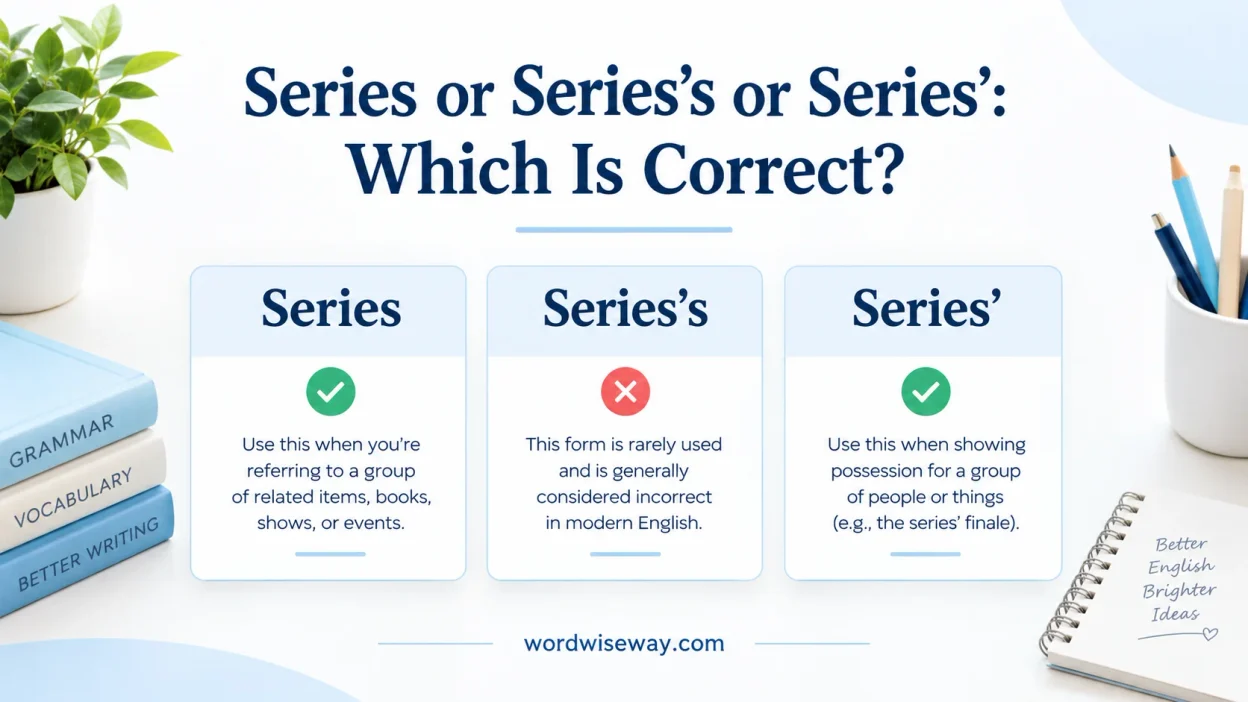
- Series: The standard form for both singular and plural nouns. Example: This series explores space.
- Series’s: A possessive form used by many style guides when one series owns or has something. Example: The series’s final episode surprised viewers.
- Series’: A possessive form accepted by styles that omit the additional s after a singular proper or common noun ending in s. Example: The series’ final episode surprised viewers.
The easiest rule to remember: Use series when you aren’t showing possession. When you need a possessive, follow your chosen style guide and remain consistent. In American English, both series’s and series’ appear in published writing, although different style guides prefer different forms.
What Does Series Mean?
The noun series describes a group of related things arranged or connected in some way. These things might follow a sequence, share a theme, or belong to the same collection.
For example, a series can refer to television episodes, books, scientific experiments, sporting games, or events. The exact meaning depends on the surrounding sentence.
Consider these examples:
- The documentary series examines ocean life.
- Our school organized a series of science workshops.
- The research team conducted several series of experiments.
- She borrowed a series of mystery novels from the library.
In each example, series identifies a connected group or sequence. The word doesn’t need a different ending when the number changes.
Series as a Singular Noun
Use series as a singular noun when you mean one collection, sequence, or program. Singular nouns generally take singular verbs, so the verb in your sentence should agree with the intended meaning.
Examples include:
- This series is popular among young readers.
- A new series has started on television.
- The series was published last year.
- Each series contains six lessons.
Notice how the verbs is, has, was, and contains signal singular agreement. The noun itself remains series.
You can also use articles and other determiners to clarify the number. Phrases such as a series, this series, and one series clearly indicate a singular meaning.
Series as a Plural Noun
The same noun can describe two or more collections. When series refers to multiple groups, it usually takes a plural verb.
Examples:
- These series are available online.
- Several series have explored the subject.
- The two series were released in different years.
- Both series contain useful information.
The surrounding words help readers understand that you’re discussing more than one collection. You don’t need to add -es or another ending to the noun.
For example, three series is correct, not three serieses in standard usage.
Why Series Has the Same Singular and Plural Form
English contains several nouns whose singular and plural forms are identical. Series belongs to this group, sometimes called zero-plural nouns because the plural doesn’t require an additional ending.
Other familiar examples include species and deer. Their forms remain unchanged when the number increases, although their grammatical agreement depends on the sentence.
| Singular use | Plural use |
| One series is available. | Two series are available. |
| This series has five episodes. | These series have five episodes each. |
| A species lives here. | Several species live here. |
| One deer crosses the road. | Three deer cross the road. |
The important distinction is between the noun’s spelling and its grammatical number. The spelling may stay the same even when the meaning changes from singular to plural.

Key Differences
The three forms become easier to distinguish once you separate ordinary naming from possession. An apostrophe doesn’t automatically make a noun plural. Instead, it can indicate that something belongs to or is associated with the noun.
| Form | Grammatical purpose | Example |
| Series | Singular or plural noun without possessive marking | The series is educational. |
| Series | Plural noun without possessive marking | Both series are educational. |
| Series’s | Possessive form under styles that add apostrophe + s | The series’s theme is memorable. |
| Series’ | Possessive form under styles that omit the extra s | The series’ theme is memorable. |
The final two examples express the same basic relationship. The difference lies in the punctuation convention, not the intended meaning.
When to Use Series
Use series when you’re naming a collection, discussing its content, or identifying multiple collections without expressing ownership.
Examples:
- I watched a new series last weekend.
- The series features twelve short episodes.
- Several series cover similar historical events.
- These series appeal to different audiences.
- Our teacher assigned a series of exercises.
The phrase a series of exercises doesn’t require an apostrophe because it doesn’t express possession. It identifies the type of collection.
A useful test is to ask whether the sentence simply names or describes a group. If it does, the ordinary form series is generally sufficient.
When to Use Series’s
Use series’s when you want to show that one series possesses, includes, or is associated with something and your chosen style follows the apostrophe-plus-s convention.
Examples:
- The series’s final episode answered several questions.
- The series’s popularity increased after the new season.
- The series’s main character changes throughout the story.
- The series’s production schedule affected its release date.
Here, the apostrophe marks a possessive relationship. The additional s follows the apostrophe because some major style guides recommend adding ’s to singular nouns ending in s.
The relationship doesn’t always involve literal ownership. A series cannot physically own an episode or a theme, but English commonly uses possessives to express association, inclusion, or a characteristic.
When to Use Series’
Use series’ when your style guide allows a singular noun ending in s to take an apostrophe without another s. This convention appears in established editorial styles.
Examples:
- The series’ final episode attracted considerable attention.
- The series’ central theme becomes clearer over time.
- The series’ original release date changed.
- The series’ characters develop throughout the story.
These examples communicate the same relationships as their series’s versions. Neither form automatically changes the noun into a plural.
Remember: The apostrophe’s position doesn’t tell you whether the series itself is singular or plural. Context determines number, while the style convention determines how the possessive is written.
Is Series’s Grammatically Correct?
Yes. Series’s is an accepted possessive form when you mean one series and follow the convention that adds ’s to singular nouns ending in s.
The word already ends in s, so the extra letter may look unnecessary. However, this spelling follows a common grammatical style rule rather than a rule that requires every possessive to look different.
How to Form the Possessive of a Singular Noun Ending in S
Many English style guides recommend adding an apostrophe and another s to a singular noun that ends in s. The goal is to form the possessive consistently, regardless of the noun’s final letter.
For example:
- The class’s schedule changed.
- The boss’s office is upstairs.
- The witness’s statement clarified the timeline.
- The series’s opening episode introduces the main characters.
Under this convention, series’s follows the same pattern as class’s and boss’s.
When you read the sentence aloud, you may hear an additional ending sound, depending on the word and your accent. That pronunciation consideration is one reason some writers prefer a different style for certain words ending in s.
Examples of Series’s in Sentences
The following examples show how series’s can express different kinds of association.
Possession or inclusion
- The series’s episodes follow a chronological order.
- The series’s soundtrack includes original compositions.
- The series’s opening credits list the production team.
Characteristics or themes
- The series’s humor appeals to a broad audience.
- The series’s tone becomes darker in later episodes.
- The series’s central message concerns personal responsibility.
Events or changes
- The series’s cancellation disappointed many viewers.
- The series’s popularity grew after its streaming release.
- The series’s conclusion resolved the central mystery.
In each sentence, series’s modifies a following noun or noun phrase. It tells the reader which collection the episodes, soundtrack, tone, or other feature belongs to.
When Style Guides Differ on Series’s
Possessive punctuation depends partly on editorial style. Some authorities favor ’s after singular nouns ending in s, while others permit or prefer a final apostrophe alone in certain cases.
For example, the Chicago-style approach generally adds ’s to singular nouns ending in s, which supports series’s. Other editorial conventions may prefer series’ in particular contexts.
This variation doesn’t mean that English has no grammatical principles. Rather, possessive punctuation has accepted style-based alternatives.
When you’re writing for a school, publisher, business, or website, check its preferred style. If no specific guide applies, choose one convention and use it consistently throughout the article.
Is Series’ Grammatically Correct?
Yes. Series’ is accepted as a possessive spelling under conventions that use only an apostrophe after certain nouns ending in s. It can express a relationship involving one series or, in appropriate contexts, multiple series.
The main challenge is distinguishing the grammatical meaning from the spelling convention. A final apostrophe doesn’t automatically make a noun plural.
Using Series’ as a Singular Possessive
A singular possessive refers to something associated with one series. Under a convention that omits the additional s, you can write series’.
Examples:
- The series’ final episode aired on Friday.
- The series’ creator discussed the original concept.
- The series’ soundtrack received positive reviews.
- The series’ main character appears in every episode.
Each example refers to one series. The possessive relationship connects that series to its episode, creator, soundtrack, or character.
To identify the intended number, look at the sentence as a whole. Words such as the, this, and its may help clarify the reference, although the surrounding context often provides the strongest clue.
Using Series’ as a Plural Possessive
A plural possessive indicates that something belongs to or is associated with multiple series. Because series already serves as the plural noun, the possessive form can also appear as series’.
Examples:
- The two series’ release dates differ by three months.
- Both series’ main characters face difficult choices.
- The competing series’ audiences overlap considerably.
In these sentences, two, both, and competing establish that the noun refers to multiple collections.
However, these examples reveal a potential ambiguity: series’ can represent either a singular possessive under one convention or a plural possessive. Readers must rely on context to determine the intended number.
When the meaning isn’t immediately clear, rewrite the sentence.
For example, instead of writing The series’ creators attended the event, you could write The creators of the series attended the event. If several series are involved, write The creators of both series attended the event.

Series’s vs. Series’: Which Form Should You Choose?
Both forms can be correct. Your choice depends on the style you follow and the context in which you’re writing.
| Situation | Possible form | Reason |
| One series, following a style that adds ’s | The series’s ending | Uses the singular possessive convention |
| One series, following a style that uses a final apostrophe | The series’ ending | Uses the alternative convention |
| Several series, showing association | The series’ endings | The plural meaning comes from context |
| No possession involved | The series ended | No apostrophe is needed |
For most general writing, consistency matters more than switching between accepted conventions. If you use series’s in one section and series’ in another for the same grammatical purpose, readers may wonder whether the meaning has changed.
How to Make Series Possessive
Forming the possessive correctly starts with one simple question: Are you referring to one series or several? After you identify the number, apply the punctuation convention required by your style guide.
Showing Ownership by One Series
When one series has a particular feature, use the singular possessive form.
Examples:
- The series’s title reflects its historical setting.
- The series’ title reflects its historical setting.
- The series’s cast includes several award-winning actors.
- The series’ cast includes several award-winning actors.
Both spellings in these pairs express the same meaning. The difference comes from the possessive style you follow.
A practical editing method is to replace the possessive phrase temporarily with of the series. For example, the series’s title becomes the title of the series. If the rewritten sentence preserves your intended meaning, you’ve probably identified a possessive relationship.
Showing Ownership by Multiple Series
When several series share or possess something, the noun remains series. The plural meaning comes from the surrounding sentence.
Examples:
- Both series have different endings.
- The endings of both series differ.
- The two series’ production teams met yesterday.
- The two series’ release dates overlap.
Notice that the first two examples don’t require apostrophes. They describe relationships without using possessive noun forms.
The final two examples use series’ to indicate association with multiple collections. Because series has identical singular and plural forms, words such as both and two help establish the intended meaning.
When ambiguity arises, an of phrase often provides a clearer alternative.
Distinguishing Possessive Forms From Ordinary Plurals
One of the most common grammar mistakes is adding an apostrophe when you simply mean more than one series.
Compare these sentences:
- Correct: Several series are available on the platform.
- Incorrect for an ordinary plural: Several series’ are available on the platform.
- Correct: The series’s final episode was memorable.
- Correct under an alternative possessive style: The series’ final episode was memorable.
The second example incorrectly uses an apostrophe to form an ordinary plural. Standard English doesn’t require one.
Keep this distinction in mind:
- Plural: More than one series.
- Possessive: Something associated with a series or several series.
- Contraction: A shortened form of two words, which isn’t relevant to the ordinary noun series.
The apostrophe belongs only where the grammatical construction calls for it.
Examples in Sentences
Examples make punctuation rules easier to apply because they show how each form works in real contexts. The following sentences cover common situations in schoolwork, publishing, entertainment, and everyday writing.
Examples of Series as a Singular Noun
Use series without an apostrophe when referring to one collection.
- The science series explains complex ideas in simple language.
- This series follows a group of students through college.
- A new series begins next month.
- The series contains ten episodes.
- Our teacher recommended a series about environmental science.
Each sentence refers to one collection. The singular verbs explains, follows, begins, and contains help signal that meaning.
Examples of Series as a Plural Noun
The same spelling works when you discuss multiple collections.
- Several series explore the history of ancient civilizations.
- These series are available in different formats.
- Both series contain useful lessons.
- Three series were released during the same year.
- The two series cover similar topics.
Here, plural determiners and verbs establish the number. The noun doesn’t need an additional ending.
Examples of Series’s Showing Possession
Use series’s when the singular possessive convention you follow calls for an additional s.
- The series’s opening scene establishes the main conflict.
- The series’s popularity increased after its television adaptation.
- The series’s characters become more complex over time.
- The series’s final chapter answers several questions.
- The series’s original format influenced later adaptations.
In each sentence, the possessive identifies a feature associated with one series. The relationship may involve ownership, inclusion, origin, or a characteristic.
Examples of Series’ Showing Possession
Use series’ when your chosen style permits the final-apostrophe convention.
- The series’ opening scene establishes the main conflict.
- The series’ popularity increased after its television adaptation.
- The series’ characters become more complex over time.
- The series’ final chapter answers several questions.
- The series’ original format influenced later adaptations.
These examples have the same intended meanings as the previous set. The punctuation changes, but the grammatical relationship remains intact.

Comparison Table
Use this table as a quick reference when editing an article, assignment, or professional document.
| Word form | Correct use | Example |
| Series | Singular noun | This series is educational. |
| Series | Plural noun | These series are educational. |
| Series’s | Singular possessive under the ’s convention | The series’s theme is memorable. |
| Series’ | Singular possessive under the final-apostrophe convention | The series’ theme is memorable. |
| Series’ | Plural possessive when context establishes multiple series | Both series’ themes are memorable. |
| Serieses | Not the standard plural form | Use series instead. |
| Series’s | Generally avoid the straight-apostrophe version in polished typography when a curly apostrophe is required by your publication | Follow your publication’s typography rules. |
Key takeaway: Series handles both singular and plural meanings. The two possessive spellings reflect different conventions, while context identifies the number.
Common Mistakes
Even experienced writers sometimes confuse these forms because the noun never changes its spelling. Fortunately, a few simple checks can prevent most errors.
Adding an Apostrophe to Form a Plural
An apostrophe doesn’t normally create a plural noun in standard English.
Incorrect: The streaming service added five new series’.
Correct: The streaming service added five new series.
The number five already makes the plural meaning clear. Adding an apostrophe creates an unnecessary punctuation mark.
The same principle applies to many other nouns. You wouldn’t normally write book’s when you mean several books or episode’s when you mean multiple episodes.
Confusing Plural Meaning With Possession
A noun can refer to several things without showing ownership. These two grammatical functions shouldn’t be confused.
Compare the examples:
- The series are popular. ✓
- The series’ popularity continues to grow. ✓
- The series’s popularity continues to grow. ✓
The first sentence uses series as a plural noun. The second and third use possessive forms to identify a characteristic of one or more series, depending on context.
To avoid confusion, ask whether the sentence needs to express possession or simply identify multiple collections.
Mixing Different Possessive Style Rules
Switching between series’s and series’ without a reason can make your writing look inconsistent.
For example:
The series’s first episode introduces the characters. Later, the series’ final episode resolves the mystery.
Both forms can be acceptable under their respective conventions. However, using them interchangeably for the same singular possessive purpose may distract readers.
A better approach is to choose one convention and apply it consistently:
- The series’s first episode introduces the characters. Later, the series’s final episode resolves the mystery.
- The series’ first episode introduces the characters. Later, the series’ final episode resolves the mystery.
Either version can work if it matches your publication’s style.
Using Series’s and Series’ Inconsistently
Consistency also matters when you’re writing about several related collections.
Consider this sentence:
Both series’ themes differ, but the first series’s ending resembles the second series’ ending.
The punctuation follows different patterns, and the sentence becomes harder to scan. A clearer revision would be:
The themes of both series differ, but their endings share similarities.
This version removes unnecessary possessive constructions while preserving the intended comparison.
Editing tip: Don’t force an apostrophe into every sentence. Sometimes rewriting the sentence produces clearer, more natural English.
How to Choose Between Series’s and Series’
Choosing between the two possessive spellings doesn’t need to become a lengthy grammar exercise. Identify the meaning, check the relevant style rules, and apply them consistently.
Follow Your Required Style Guide
If you’re writing for a school, employer, publisher, or news organization, check its editorial requirements first.
Different guides can handle nouns ending in s differently. For example, Chicago-style guidance generally adds ’s to singular nouns ending in s. Other conventions may use a final apostrophe in particular circumstances.
The important point is to follow the rules required for your assignment or publication rather than combining competing conventions.
Use One Possessive Style Consistently
Consistency makes writing easier to read and edit. Once you’ve selected a convention, apply it throughout the same document.
For example, if you choose series’s, use that form consistently for singular possessives:
- The series’s title is memorable.
- The series’s soundtrack complements the story.
- The series’s ending surprises viewers.
If your chosen style uses series’, apply that convention instead:
- The series’ title is memorable.
- The series’ soundtrack complements the story.
- The series’ ending surprises viewers.
Consistency doesn’t replace grammatical accuracy, but it makes your writing look more polished.
Check Whether the Word Shows Ownership
Before adding an apostrophe, determine what the sentence actually means.
Ask yourself:
- Am I talking about one series or several?
- Am I simply naming a collection?
- Am I showing possession, inclusion, or association?
- Does my chosen style add ’s or only an apostrophe?
- Would an of the series phrase make the meaning clearer?
For example, the series’s ending and the ending of the series express essentially the same relationship.
However, three series simply identifies three collections. It doesn’t need an apostrophe because no possessive relationship appears.
Read More: “Much More” Meaning and Correct Use With Helpful Examples
FAQs
1. Is series’s grammatically correct?
Yes, series’s is accepted in many style guides when forming the possessive of series. For example, “The series’s popularity surprised everyone.” However, some styles prefer series’, so follow your chosen style guide.
2. Is series’ correct for singular nouns?
Yes, series’ can be used as the possessive form of the singular noun series. For example, “The series’ final episode attracted millions of viewers.” Some publications prefer series’s instead.
3. Does series have the same singular and plural form?
Yes, series is both singular and plural. You can write “one series” or “three series” without changing the word’s spelling. The surrounding sentence tells readers which form you mean.
4. How do you make series possessive?
You can form the possessive as series’s or series’, depending on the style guide you follow. For example, “the series’s creator” and “the series’ creator” both express ownership or association.
5. Should I use series’s or series’ in formal writing?
Both forms appear in formal writing. Some style guides recommend adding ’s, even when a singular noun ends in s. Others allow a final apostrophe alone. Check your publication’s preferred rules and use one form consistently.
6. What is the plural possessive form of series?
The plural possessive can also be written series’s or series’, depending on the intended meaning and style convention. Since the singular and plural forms look identical, provide enough context to make the meaning clear.
7. Does series’s mean more than one series?
No, not necessarily. The spelling series’s indicates a possessive form under styles that add apostrophe-s, but it doesn’t tell readers whether series is singular or plural. The sentence provides that information.
8. What is the difference between series and series’?
Series is the basic noun, while series’ is a possessive form used by certain style conventions. For example, “The series ended” expresses no possession, while “the series’ ending” shows a relationship between the series and its ending.
9. Can I write series’s name in an essay?
Yes. You can write “the series’s name” if your chosen style guide uses apostrophe-s for possessives ending in s. If your institution follows a different convention, use the form it recommends.
10. How can I avoid mistakes when writing series possessives?
First, decide whether you need the ordinary noun or its possessive form. Next, check your style guide to choose between series’s and series’. Finally, read the whole sentence to ensure the intended meaning is clear and consistent.
Conclusion:
The choice between series, series’s, and series’ becomes easier when you understand how possessives work. Series keeps the same spelling whether you mean one series or several. However, adding an apostrophe changes its role in a sentence by showing ownership or a close relationship between two things. The right choice depends on how you’re using the word and which writing convention you follow.
Both series’s and series’ appear in English writing, but different style guides may favor different forms. For example, you might write “the series’s ending” or “the series’ ending” to describe the ending of a particular series. Neither form should be chosen randomly. Check the style guide required by your school, workplace, or publication, and apply its rules consistently throughout your writing.
When you’re unsure, focus on the sentence’s meaning before worrying about the apostrophe. Ask yourself what the word describes, then check whether you need a possessive form. A little attention to grammar, punctuation, and consistency can prevent unnecessary mistakes. Once you recognize how series works, you’ll find it much easier to use its possessive forms naturally in essays, articles, and everyday writing.punctuation convention. Once you understand that distinction, you’ll choose the right form with greater confidence.