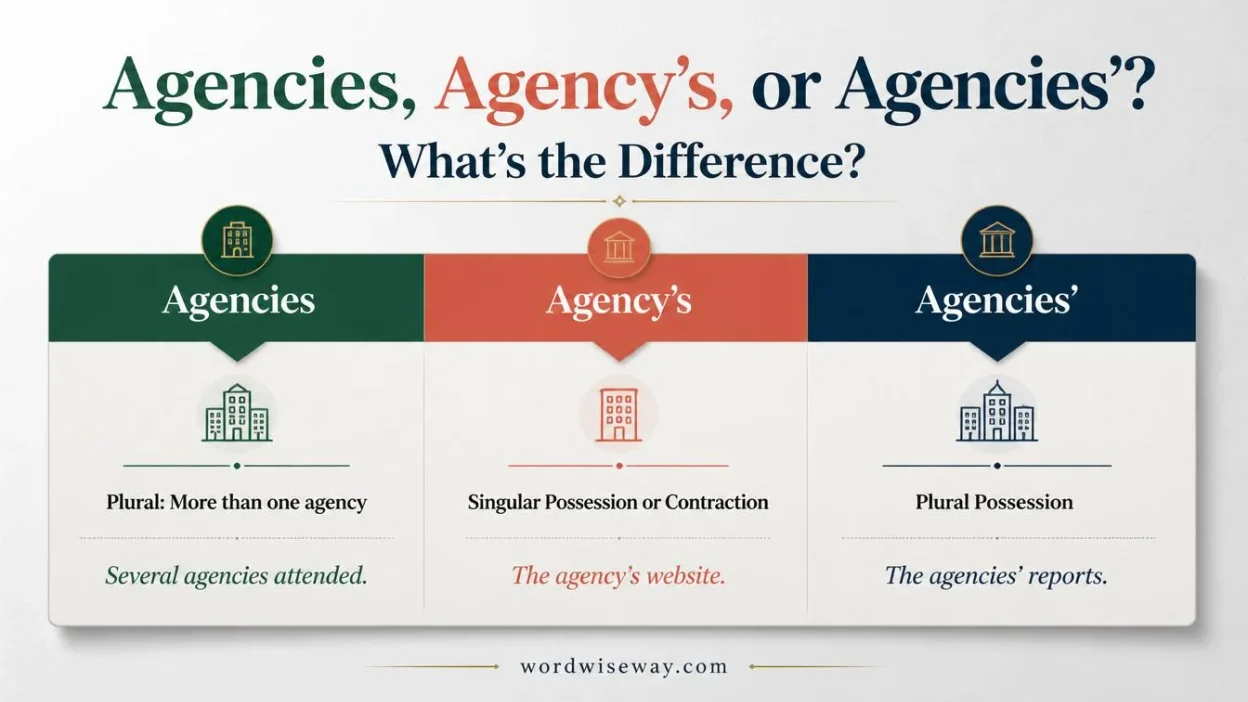
Agencies, Agency’s, or Agencies’? What’s the Difference? Understanding these forms helps you write clearly and avoid common grammar mistakes. The main difference involves ownership and whether the noun is singular or plural.
Use Agency’s when one agency owns something. For example, “The agency’s office is nearby.” The apostrophe comes before the s because agency is singular. This form follows standard English possessive rules.
Use Agencies’ when multiple agencies own something. For example, “The agencies’ offices are nearby.” Since agencies is already plural and ends in s, place the apostrophe after it. Learning these apostrophe rules makes your writing clearer and helps you choose the correct possessive form every time.
Quick Answer:
The main difference between agencies, agency’s, and agencies’ involves plurality, possession, and contractions.
| Word | Grammatical Function | Meaning | Example |
| Agencies | Plural noun | More than one agency | Several agencies submitted proposals. |
| Agency’s | Singular possessive or contraction | Something belonging to one agency, or agency is or agency has | The agency’s website needs an update. |
| Agencies’ | Plural possessive | Something belonging to multiple agencies | The agencies’ reports contain updated information. |
Remember these three rules:
- Agencies: Use this spelling when referring to two or more agencies without expressing possession.
- Agency’s: Use this spelling to show that something belongs to one agency. It can also represent agency is or agency has in appropriate sentences.
- Agencies’: Use this spelling when something belongs to two or more agencies.
For example, agencies describes multiple organizations, the agency’s policy identifies one organization’s policy, and the agencies’ policies identifies policies belonging to multiple organizations.
What Does Agencies Mean?
The word agencies is the plural form of the singular noun agency. It refers to two or more organizations, departments, or institutions that perform particular functions.
An agency might provide advertising services, manage government programs, arrange employment, or represent clients. When you discuss multiple organizations of this kind, you use agencies without an apostrophe.
For example, a company might hire three marketing agencies to promote different products. A government department might coordinate several environmental agencies to protect natural resources.
In both situations, agencies simply indicates that more than one agency exists. It doesn’t show ownership.
How to Spell the Plural of Agency
The spelling rule for agency follows a common pattern in English.
When a singular noun ends in a consonant followed by y, you usually change the y to ies to form its plural.
The transformation looks like this:
- Agency → Agencies
- Company → Companies
- Policy → Policies
- Industry → Industries
- Secretary → Secretaries
The same principle applies to many other nouns ending in consonant + y. However, nouns ending in a vowel followed by y generally form their plurals by adding s.
For example, boy becomes boys, while agency becomes agencies.
This distinction matters because the plural spelling comes before any possessive apostrophe. Once you understand how to form the plural, you can build the plural possessive correctly.
When Should You Use Agencies?
Use agencies whenever you want to describe multiple agencies without indicating that something belongs to them.
The word can serve several grammatical roles within a sentence. It can function as a subject, an object, or the object of a preposition.
Examples of agencies in different sentence structures:
- Subject: Several agencies provide support to small businesses.
- Direct object: The company contacted three advertising agencies.
- Object of a preposition: The proposal was reviewed by government agencies.
- General statement: International agencies often collaborate on complex projects.
Notice that none of these examples requires an apostrophe. The sentences describe multiple organizations rather than ownership.
Agencies Examples in Everyday Writing
The following examples demonstrate how agencies works in different contexts.
| Example Sentence | Why Agencies Is Correct |
| Several agencies attended the conference. | The sentence refers to multiple organizations. |
| Government agencies enforce different regulations. | The noun describes more than one government organization. |
| We compared five marketing agencies. | The word identifies multiple service providers. |
| Local agencies support families in need. | The sentence describes several local organizations. |
| International agencies shared their research. | The noun refers to multiple international organizations. |
Key takeaway: If you’re simply counting agencies or discussing them collectively, use agencies. Don’t add an apostrophe just because the word ends in s.
Common Mistake: Using Agency’s as the Plural
One frequent mistake is writing agency’s when you mean multiple agencies.
For example:
❌ The company contacted several agency’s.
✅ The company contacted several agencies.
The first sentence incorrectly uses a singular possessive form after several. The second sentence correctly uses the plural noun.
Here’s another example:
❌ Three agency’s attended the meeting.
✅ Three agencies attended the meeting.
The word three tells you that the sentence refers to multiple organizations. Therefore, the plural spelling agencies is appropriate.
Apostrophes don’t normally create plurals in English. They primarily indicate possession or omitted letters in contractions. Keeping that distinction in mind will help you avoid many common grammar mistakes.
What Does Agency’s Mean?
The spelling agency’s has two main grammatical uses: singular possession and contraction.
First, it can show that something belongs to one agency or relates to it. Second, it can represent agency is or agency has when the surrounding sentence supports that meaning.
Understanding the context is essential because the same spelling can communicate different ideas.
Agency’s as a Singular Possessive Noun
Use agency’s when something belongs to, comes from, or is associated with one agency.
To form the singular possessive, add an apostrophe and s to the singular noun agency.
The pattern is straightforward:
Agency + ’s = Agency’s
For example, the agency’s website means the website belonging to that agency. Similarly, the agency’s decision refers to a decision made by that organization.
Possession doesn’t always mean physical ownership. It can also express responsibility, association, authorship, or control.
Consider these examples:
- The agency’s office is located downtown.
- The agency’s annual report includes financial results.
- The agency’s director announced a new initiative.
- The agency’s responsibilities include public safety.
- The agency’s reputation depends on reliable service.
In each sentence, agency’s connects one agency to something associated with it.
When to Use Agency’s for Possession
The singular possessive form appears frequently in professional, academic, and everyday writing.
You might use it when discussing an organization’s policies, employees, services, records, or decisions.
| Example | What Agency’s Indicates |
| The agency’s website is under maintenance. | The website belongs to or is maintained by one agency. |
| We reviewed the agency’s proposal. | The proposal came from one agency. |
| The agency’s employees received additional training. | The employees work for one agency. |
| The agency’s policy changed last month. | The policy belongs to or governs one agency. |
| The agency’s decision surprised everyone. | One agency made the decision. |
These examples also show that the possessive noun can appear before different types of nouns.
It can describe a physical object, such as an office, or an abstract concept, such as a policy or responsibility. The essential point remains the same: the relationship involves one agency.
Agency’s as a Contraction of Agency Is
The word agency’s can also represent agency is. In this case, the apostrophe marks omitted letters rather than possession.
Contractions combine words to create shorter, more conversational expressions. English speakers commonly use contractions in everyday conversation, informal writing, and many forms of professional communication.
For example:
- The agency’s ready to announce its new program.
- The agency’s responsible for managing the project.
- The agency’s working with several local organizations.
- The agency’s currently reviewing applications.
In these sentences, agency’s means agency is.
You can test this usage by expanding the contraction.
Example:
Original: The agency’s reviewing the application.
Expanded: The agency is reviewing the application.
The expanded version preserves the original meaning and remains grammatically correct.
However, be careful with sentences where the contraction could be mistaken for possession. If clarity matters, spelling out agency is may help readers understand your meaning immediately.
Agency’s as a Contraction of Agency Has
In certain sentence structures, agency’s can also represent agency has.
This use generally appears when has functions as an auxiliary verb in a perfect-tense construction.
For example:
- The agency’s completed its initial review.
- The agency’s announced several new initiatives.
- The agency’s already submitted the required documents.
Here, the contraction expands to agency has.
Consider the first example:
Original: The agency’s completed its initial review.
Expanded: The agency has completed its initial review.
The present perfect construction indicates that the review is complete and relevant to the present situation.
Not every sentence containing agency’s can use agency has as its expansion. Context and sentence structure determine whether the contraction is correct.
For instance, the agency’s report expresses possession because agency’s modifies the noun report. It cannot naturally be expanded to the agency has report.
A useful test: Replace agency’s with agency is or agency has. If the expanded sentence makes grammatical sense and preserves the intended meaning, you’re probably using a valid contraction.
Agency’s vs. Agencies: Avoiding the Singular-Plural Mix-Up
One of the easiest ways to distinguish these spellings is to identify whether you’re discussing one organization or several.
Compare these sentences:
- Agency’s: The agency’s employees attended the training session.
- Agencies: Several agencies attended the training session.
The first sentence describes employees associated with one agency. The second describes multiple organizations attending the same event.
Now consider a slightly different pair:
- The agency’s website contains updated information.
- The agencies provide updated information.
In the first sentence, the apostrophe indicates possession. In the second, agencies simply identifies multiple organizations.
The key is to examine what the sentence actually communicates rather than choosing a spelling based on appearance alone.
What Does Agencies’ Mean?
The spelling agencies’ is the plural possessive form of agency. It indicates that something belongs to, comes from, or is associated with multiple agencies.
To form this possessive, first change agency to its plural form, agencies. Then place the apostrophe after the final s.
The spelling pattern is:
Agency → Agencies → Agencies’
This sequence is important because the plural form changes before the possessive apostrophe appears.
For example, the agencies’ reports means reports belonging to multiple agencies. In contrast, the agency’s report refers to a report associated with one agency.
When Should You Use Agencies’?
Use agencies’ when you want to show possession or association involving two or more agencies.
This form frequently appears in discussions about shared responsibilities, organizational policies, collective decisions, research findings, and administrative records.
Consider these examples:
- The agencies’ budgets increased this year.
- Both agencies’ websites provide public information.
- The agencies’ representatives attended the conference.
- We compared the agencies’ policies before making a recommendation.
- The agencies’ joint statement explained their shared position.
Each sentence connects something to multiple organizations.
Notice that agencies’ doesn’t necessarily mean the agencies jointly own one object. It can also indicate that separate items belong to separate agencies.
For example, the agencies’ websites may refer to each agency’s individual website. The possessive relationship applies to the group collectively without requiring shared ownership.
Agencies’ Examples in Different Contexts
The plural possessive form appears in many types of writing. Here’s how it works in practical situations.
| Example Sentence | Meaning |
| The agencies’ offices will close early. | The offices are associated with multiple agencies. |
| We examined the agencies’ annual reports. | The reports came from multiple agencies. |
| The agencies’ decisions affected local businesses. | Multiple agencies made decisions that affected businesses. |
| Both agencies’ directors approved the proposal. | The directors of both agencies approved it. |
| The agencies’ combined efforts improved coordination. | Multiple agencies contributed to the effort. |
The apostrophe belongs after the final s because agencies is already plural.
This rule applies even when the possessive noun appears before another plural noun. For example, the agencies’ employees refers to employees associated with multiple agencies.
Why Does the Apostrophe Come After the S?
English uses different apostrophe positions for singular and regular plural possessives.
A singular noun generally forms its possessive by adding ’s. A regular plural noun that already ends in s usually forms its possessive by adding only an apostrophe.
Compare the patterns:
| Form | Construction | Example |
| Singular noun | Agency | One agency |
| Singular possessive | Agency + ’s | The agency’s office |
| Plural noun | Agency → agencies | Several agencies |
| Plural possessive | Agencies + ’ | The agencies’ offices |
The difference becomes easier to see when you place the examples side by side.
One agency: The agency’s policy changed.
Multiple agencies: The agencies’ policies changed.
In the first sentence, the apostrophe appears before the s because the noun is singular. In the second, the apostrophe follows the final s because the noun is plural.
This is a standard English possessive pattern, not a special rule limited to agency.
Is Agencies’s Correct?
In standard English, agencies’s is incorrect for the ordinary plural possessive of agency.
The plural noun already ends in s, so you don’t add another s after the apostrophe.
Incorrect: The agencies’s reports were published yesterday.
Correct: The agencies’ reports were published yesterday.
The corrected version follows the standard rule for regular plural nouns ending in s.
For comparison, the singular possessive remains agency’s, while the plural possessive becomes agencies’. Neither form requires agencies’s.
Key Differences
Now that each spelling has been explained individually, it’s easier to compare them directly.
Although the three forms share the same root word, their grammatical functions differ. Choosing the right one depends on the number of agencies and whether you’re expressing possession or using a contraction.
| Feature | Agencies | Agency’s | Agencies’ |
| Base meaning | Multiple agencies | One agency’s possession, or a contraction | Multiple agencies’ possession |
| Grammatical function | Plural noun | Singular possessive or contraction | Plural possessive |
| Apostrophe required? | No | Yes | Yes |
| Refers to multiple agencies? | Yes | Not as a possessive noun | Yes |
| Indicates possession? | No | Yes, when possessive | Yes |
| Can be a contraction? | No | Yes | No |
| Example | The agencies met. | The agency’s policy changed. | The agencies’ policies changed. |
Compare the Three Forms in Similar Sentences
Looking at closely related examples can reveal exactly how the apostrophe changes meaning.
Example one: Offices
- The agencies opened new offices.
- The agency’s office opened early.
- The agencies’ offices opened early.
The first sentence describes multiple agencies opening offices. The second refers to an office associated with one agency. The third refers to offices associated with multiple agencies.
Example two: Reports
- The agencies submitted reports.
- The agency’s report contained new findings.
- The agencies’ reports contained new findings.
The first sentence identifies multiple agencies submitting reports. The second identifies a report associated with one agency. The third refers to reports associated with multiple agencies.
Example three: Policies
- The agencies changed their policies.
- The agency’s policy changed.
- The agencies’ policies changed.
Each sentence communicates a different relationship between the organizations and their policies.
These examples demonstrate why apostrophe placement matters. A tiny punctuation mark can change the number of owners described in a sentence.
How to Choose Between Agencies, Agency’s, and Agencies’
You don’t need to memorize dozens of complicated grammar rules to make the right choice. Instead, ask yourself three simple questions.
Are You Talking About More Than One Agency?
If you’re describing two or more agencies without showing possession, use agencies.
For example:
- Several agencies participated in the project.
- The company works with international agencies.
- Government agencies released new guidelines.
In each case, the word simply identifies multiple organizations.
A quick clue is the presence of words such as several, many, three, multiple, or both. These words often signal that you need a plural noun.
However, the surrounding sentence still matters because plural nouns can also appear in possessive constructions.
Does Something Belong to One Agency?
If you’re describing something associated with one agency, use agency’s.
For example:
- The agency’s website contains application forms.
- We reviewed the agency’s latest proposal.
- The agency’s employees received new equipment.
Ask yourself whether you could replace the possessive phrase with the website of the agency, the proposal of the agency, or the employees of the agency.
If that wording preserves the intended meaning, the singular possessive is likely correct.
Remember that agency’s can also represent agency is or agency has. Check the full sentence before deciding that the apostrophe indicates possession.
Does Something Belong to Multiple Agencies?
If the possessive relationship involves two or more agencies, use agencies’.
For example:
- The agencies’ offices share a parking lot.
- We reviewed the agencies’ recommendations.
- Both agencies’ directors signed the agreement.
Try replacing the possessive phrase with of the agencies. If the sentence retains its intended meaning, the plural possessive is likely appropriate.
For example, the recommendations of the agencies communicates the same basic relationship as the agencies’ recommendations.
Can Agency’s Be Expanded to Agency Is or Agency Has?
Before using agency’s as a contraction, test whether either expansion works.
| Contraction | Expanded Form | Correct Example |
| Agency’s = agency is | The agency is reviewing the request. | The agency’s reviewing the request. |
| Agency’s = agency has | The agency has completed its review. | The agency’s completed its review. |
Both examples use agency’s as a contraction rather than a possessive noun.
However, don’t force an expansion when the sentence doesn’t support it. In the agency’s report, the word agency’s expresses possession because it identifies the report’s relationship to one agency.
When a sentence could confuse your readers, writing the full phrase can make your meaning clearer.
Common Mistakes
Even experienced writers sometimes mix up these forms, especially when writing quickly. The following mistakes are easy to correct once you understand the underlying rules.
Using Agency’s as a Plural Noun
Incorrect: Several agency’s attended the conference.
Correct: Several agencies attended the conference.
The word several indicates multiple organizations, so the sentence requires the plural noun agencies.
Adding an Apostrophe to Agencies Without Possession
Incorrect: The government agency’s provide public services.
Correct: The government agencies provide public services.
In the corrected sentence, agencies functions as an ordinary plural noun. No possession exists, so no apostrophe is necessary.
Placing the Apostrophe Before the S in a Plural Possessive
Incorrect: The agencies’s policies differ.
Correct: The agencies’ policies differ.
Because agencies is already plural, the apostrophe goes after its final s.
Confusing Singular and Plural Ownership
Incorrect: The agencies’ website needs an update. (If you mean one agency’s website.)
Correct: The agency’s website needs an update.
However, if the website belongs to multiple agencies, the agencies’ website may be appropriate. The correct form depends on the intended relationship.
Misreading a Contraction as Possession
Consider this sentence:
The agency’s reviewing the applications.
Here, agency’s means agency is. It doesn’t mean that the applications belong to the agency.
Compare it with:
The agency’s applications are ready.
In this sentence, agency’s indicates possession or association. The applications belong to or are associated with one agency.
The word following agency’s and the sentence’s overall structure help establish the intended meaning.
Writing Agencies’s Instead of Agencies’
Incorrect: The agencies’s representatives attended the meeting.
Correct: The agencies’ representatives attended the meeting.
The plural noun already ends in s. Add only an apostrophe to create its standard possessive form.
Practice Exercises
Ready to test your understanding? Choose the correct form for each sentence. Pay attention to the number of agencies and the intended meaning.
Fill in each blank with agencies, agency’s, or agencies’.
- Several marketing ______ submitted proposals for the campaign.
- The ______ annual report includes its latest financial results. (One agency.)
- Both ______ representatives attended the conference.
- Government ______ provide a range of public services.
- The ______ reviewing the applications today. (Meaning: the agency is reviewing.)
- We compared the ______ policies before approving the partnership. (Multiple agencies.)
- The ______ completed its investigation. (Meaning: the agency has completed it.)
- Three international ______ collaborated on the project.
- The ______ website contains updated contact information. (One agency.)
- The ______ budgets were reviewed during the meeting. (Multiple agencies.)
Practice Exercise Answer Key
| Number | Correct Answer | Explanation |
| 1 | Agencies | The sentence refers to multiple marketing agencies. |
| 2 | Agency’s | The possessive form indicates that one agency has an annual report. |
| 3 | Agencies’ | The representatives are associated with both agencies. |
| 4 | Agencies | The word is an ordinary plural noun. |
| 5 | Agency’s | The contraction means agency is. |
| 6 | Agencies’ | The policies are associated with multiple agencies. |
| 7 | Agency’s | The contraction means agency has. |
| 8 | Agencies | The sentence identifies three organizations without expressing possession. |
| 9 | Agency’s | The website belongs to or is associated with one agency. |
| 10 | Agencies’ | The budgets are associated with multiple agencies. |
If you answered all ten correctly, you’ve mastered the main distinctions. If a few answers were tricky, revisit the singular possessive and plural possessive examples before moving on.
Read More: Forgot or Forgotten: Difference, Meaning, Rules, and Examples
FAQs
1. What Is the Difference Between Agency’s and Agencies’?
Agency’s shows ownership by one agency, while Agencies’ shows ownership by two or more agencies. The apostrophe changes position depending on whether the noun is singular or plural.
2. Is Agency’s Singular or Plural?
Agency’s is the singular possessive form of agency. It describes something belonging to one agency, such as an agency’s website, office, or employees.
3. When Should You Use Agencies’ in a Sentence?
Use Agencies’ when something belongs to multiple agencies. For example, “The agencies’ reports contain updated information.” The apostrophe comes after the final s.
4. Is Agencies’ the Correct Plural Possessive Form?
Yes, Agencies’ is the correct plural possessive form of agencies. Since the plural noun already ends in s, you add only an apostrophe to indicate ownership.
5. Why Does Agency’s Have an Apostrophe Before the S?
The word agency is singular and does not end in s. Standard English grammar forms its possessive by adding an apostrophe followed by s, creating agency’s.
6. Can You Use Agency’s and Agencies’ in the Same Sentence?
Yes, you can use both forms when discussing different types of ownership. For example, “The agency’s director attended the meeting with the agencies’ representatives.”
7. What Is the Difference Between Agencies and Agencies’?
Agencies is the regular plural form of agency and simply refers to more than one agency. Agencies’ is the plural possessive form, which indicates that something belongs to those agencies.
8. Does Agencies’s Follow Standard English Grammar Rules?
No, Agencies’s is generally incorrect when forming the possessive of the regular plural noun agencies. The correct form is Agencies’, with the apostrophe placed after the existing s.
9. How Can You Remember the Correct Apostrophe Placement?
Start by identifying whether you mean one agency or several agencies. For one agency, write agency’s. For multiple agencies, write agencies’. This simple check helps you avoid common punctuation mistakes.
10. What Are Some Examples of Agency’s and Agencies’?
Here are two examples that show the difference clearly:
- Agency’s: The agency’s new policy improves customer service.
- Agencies’: The agencies’ shared project supports local businesses.
The first sentence describes one agency’s policy, while the second refers to a project shared by multiple agencies.
Conclusion:
Understanding the difference between Agency’s and Agencies’ makes your writing clearer and helps you avoid common apostrophe mistakes. Both forms show ownership, but each applies to a different noun form. The key is to identify whether you are talking about one agency or several agencies.
Remember, agency’s refers to something belonging to one agency, while agencies’ indicates ownership by multiple agencies. For example, you would write “the agency’s decision” when discussing one agency and “the agencies’ decisions” when referring to several. These small punctuation differences can change how readers understand your sentence.
Whenever you feel unsure, check the noun before placing the apostrophe. If the noun is singular, use agency’s. If it is the regular plural agencies, use agencies’. With a little practice, choosing the correct possessive form will become a natural part of your everyday writing.

Amelia Sanders has spent 14 years in Harvard University’s English Department, helping students navigate literary analysis, interpretive theory, and narrative techniques. Her academic pursuits center on 18th-century British prose, romantic poetry, diasporic writing, and digital editing exploring how textual choices influence cultural perspectives. Amelia has spoken at major international meetings and contributed essays to respected academic volumes, demonstrating her dedication to thoughtful scholarship and effective teaching.