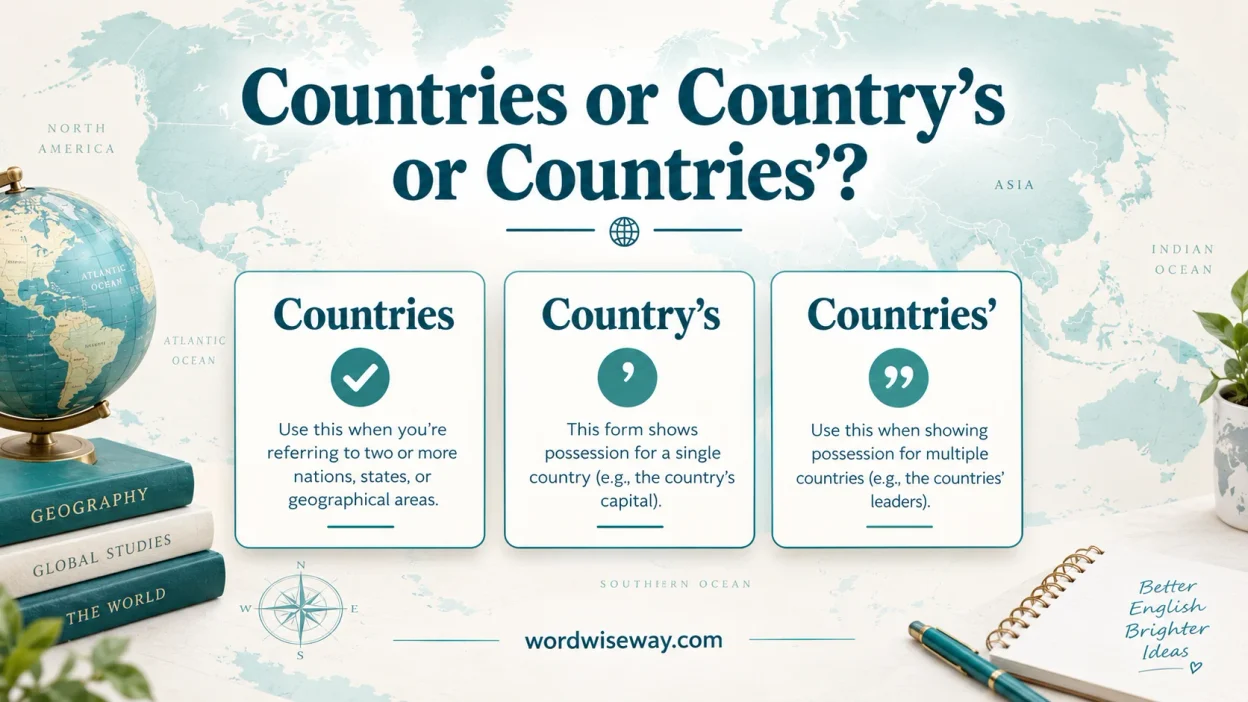
Countries or Country’s or Countries’? Difference and Usage explains how these word forms differ in English grammar and everyday writing. Countries is the plural form of country, referring to several nations. Country’s is the singular possessive form, showing ownership by one country. Countries’ is the plural possessive form, indicating possession by multiple countries.
These grammatical differences become clearer through simple sentences. For example, “The country’s flag looks beautiful” shows possession, while “The countries’ borders changed” demonstrates plural ownership. However, “Several countries signed the agreement” requires no apostrophe because it simply describes multiple nations. Correct apostrophe usage, spelling, and punctuation help maintain accuracy.
Understanding these possessive rules improves sentence structure, word choice, and writing accuracy. Practice these grammatical rules with examples to strengthen your English language skills and achieve correct usage in everyday communication.
Quick Answer:
- Countries is the plural form of country. Use it when referring to two or more countries. Example: Many countries celebrate national holidays.
- Country’s is the singular possessive form of country. Use it when something belongs to, relates to, or is associated with one country. Example: The country’s economy is growing.
- Countries’ is the plural possessive form of country. Use it when something belongs to, relates to, or is associated with multiple countries. Example: The countries’ leaders signed an agreement.
The easiest way to remember the difference is to identify two things: how many countries you’re discussing and whether you’re showing possession.
Countries: Meaning, Definition, and Examples
The word countries describes multiple countries rather than a single one. It’s a plural noun, and you don’t need an apostrophe when you’re simply referring to more than one country.
What Does Countries Mean?
Countries is the plural form of the noun country. A country is a geographical and political area that is generally understood as a nation or state, often with its own government and territory.
When you discuss several countries together, you use countries.
For example:
- Several countries participate in the international competition.
- European countries have different languages and cultural traditions.
- Many countries depend on international trade.
- The organization provides educational support across developing countries.
In each sentence, countries refers to multiple places. None of these examples needs an apostrophe because the word doesn’t express ownership.
Is Countries Singular or Plural?
Countries is always plural when used as the ordinary noun discussed here. Its singular form is country.
The spelling changes because English has a specific rule for many nouns ending in a consonant followed by y.
| Singular | Plural | Rule |
| Country | Countries | Change y to ies |
| City | Cities | Change y to ies |
| Family | Families | Change y to ies |
| Story | Stories | Change y to ies |
| Boy | Boys | Add s because y follows a vowel |
The distinction matters because you shouldn’t simply add s to every noun ending in y. When a consonant comes before the final y, the usual plural spelling changes to ies.
When to Use Countries
Use countries whenever you want to refer to multiple countries without indicating possession.
Common situations include:
- Geography: Several countries share a border.
- Travel: She visited three countries during her vacation.
- Education: Students study the history of different countries.
- Business: The company operates in five countries.
- International cooperation: Countries work together to address shared challenges.
Notice that the word remains countries even when the sentence includes something associated with those places. What matters is the grammatical role of the word itself.
For example, in countries with large populations, the noun simply identifies multiple countries. It doesn’t show that anything belongs to them.
Countries in Example Sentences
Here are more examples showing how countries works in everyday writing.
- Many countries have introduced new environmental policies.
- Some countries experience extreme weather during certain seasons.
- The researchers compared education systems across several countries.
- These countries share a common language.
- Developing countries may face different economic challenges from wealthier nations.
Quick test: If you can replace countries with nations without changing the basic meaning, you’re probably using the plural form correctly.
Country’s: Meaning, Definition, and Examples
An apostrophe changes the job of country when you write country’s. Instead of simply naming a country, this form indicates that something belongs to or is associated with one country.
What Does Country’s Mean?
Country’s is the singular possessive form of country. It commonly appears before a noun to show a relationship between one country and something connected with it.
Consider this sentence:
The country’s economy depends on agriculture.
Here, country’s indicates that the economy belongs to or is associated with one country.
Other examples include:
- The country’s capital attracts millions of visitors.
- The country’s history includes several important events.
- The country’s government announced a new policy.
- The country’s population has grown over time.
- The country’s national flag features distinctive colors.
In each example, the sentence refers to one country and something associated with it.
Is Country’s Singular Possessive?
Yes. Country’s is singular possessive because it refers to one country in a possessive relationship.
To form the singular possessive, add an apostrophe followed by s to the singular noun.
Country + ’s = Country’s
This rule applies even though country ends in y. You don’t change the y to ies because you’re not forming a plural noun.
Compare these sentences:
- The country’s flag is displayed outside the building.
- The countries display their flags outside the building.
The first sentence refers to a flag associated with one country. The second refers to multiple countries displaying their flags.
When to Use Country’s
Use country’s when one country owns, possesses, produces, controls, or is associated with something.
Common examples include:
- Government: The country’s parliament introduced a new law.
- Economy: The country’s exports increased last year.
- Culture: The country’s traditions attract international interest.
- Geography: The country’s coastline stretches for hundreds of miles.
- History: The country’s independence changed its political future.
- Education: The country’s school system serves millions of students.
Possession doesn’t always mean literal ownership. English also uses possessive nouns to express relationships, characteristics, and associations.
For instance, a country’s history isn’t a physical object that the country owns. The possessive form simply connects the history to that country.
Country’s in Example Sentences
Read these sentences carefully to see how the apostrophe changes the meaning.
- The country’s president addressed the nation.
- The country’s natural resources support several industries.
- We studied the country’s political system in class.
- The country’s climate varies between its regions.
- The country’s official language is widely spoken.
Each example refers to one country. The apostrophe followed by s marks the possessive relationship.
One additional detail is worth remembering: country’s can also represent a contraction of country is or country has in certain sentences.
For example, The country’s becoming more industrialized means The country is becoming more industrialized. This contracted use is less common in formal writing than the possessive use, but it’s grammatically possible.
Context tells you which meaning the writer intends.
Countries’: Meaning, Definition, and Examples
The form countries’ combines a plural noun with a possessive apostrophe. It indicates a relationship involving multiple countries rather than just one.
What Does Countries’ Mean?
Countries’ is the plural possessive form of country. Use it when something belongs to, concerns, or is associated with two or more countries.
For example:
The countries’ leaders attended the conference.
This sentence refers to leaders representing multiple countries. The apostrophe comes after the final s because countries is already plural.
Additional examples include:
- The countries’ economies depend on different industries.
- The countries’ representatives signed a joint declaration.
- The countries’ borders were shown on the map.
- The countries’ educational systems follow different standards.
- The countries’ governments agreed to share information.
The plural possessive form is especially useful when writing about international cooperation, shared responsibilities, and comparisons between nations.
Is Countries’ the Plural of Country?
No. Countries is the plural; countries’ is the plural possessive.
Adding an apostrophe doesn’t create another plural. Instead, it shows a possessive relationship after the plural form has already been created.
Follow these steps:
- Start with the singular noun: country.
- Change the final y to ies to form the plural: countries.
- Add an apostrophe after the final s to form the plural possessive: countries’.
The complete pattern looks like this:
| Form | Grammatical role | Example |
| Country | Singular noun | The country is peaceful. |
| Countries | Plural noun | The countries are peaceful. |
| Country’s | Singular possessive | The country’s flag is blue. |
| Countries’ | Plural possessive | The countries’ flags are blue. |
When to Use Countries’
Use countries’ when the possessive relationship involves more than one country.
For example:
- International relations: The countries’ representatives met to discuss trade.
- Environmental policy: The countries’ climate commitments differ.
- Economic cooperation: The countries’ trade agreements encourage cooperation.
- Geography: The countries’ shared border extends across the region.
- Education: The countries’ universities participated in a joint research project.
Remember that the noun following countries’ often helps you identify the possessive relationship. Words such as leaders, economies, policies, and borders frequently appear in these constructions.
However, the following noun isn’t always necessary. A possessive noun can sometimes stand alone when the meaning is clear from context.
Countries’ in Example Sentences
Compare these examples:
- The countries’ leaders discussed regional security.
- The countries’ populations speak several languages.
- Both countries’ economies rely partly on tourism.
- The countries’ decisions affected international trade.
- We compared the countries’ approaches to education.
In every sentence, the possessive relationship involves multiple countries.
A helpful clue appears in both countries’ economies. The word both makes it clear that two countries are involved, so the plural possessive form is appropriate.
Key Grammar Differences
The easiest way to distinguish these forms is to examine the number of countries and the meaning of the sentence. The apostrophe isn’t decorative punctuation. It helps readers understand the relationship between words.
Countries vs. Country’s
Although these forms look similar, they serve different grammatical purposes.
| Countries | Country’s |
| Plural noun | Singular possessive noun |
| Refers to two or more countries | Refers to one country and something associated with it |
| Doesn’t contain an apostrophe | Contains an apostrophe before s |
| Example: Countries signed the agreement. | Example: The country’s government signed the agreement. |
Remember: Use countries to count nations. Use country’s to connect something with one nation.
Countries vs. Countries’
The difference between these forms is equally important.
Countries simply identifies multiple countries, while countries’ shows possession or association involving multiple countries.
- Countries: Countries adopted new environmental standards.
- Countries’: The countries’ environmental standards differ.
In the first sentence, countries identifies the nations performing an action. In the second, countries’ connects the nations with their environmental standards.
Country’s vs. Countries’
Both forms indicate possession, but they differ in number.
- Country’s: One country’s economy is growing.
- Countries’: Several countries’ economies are growing.
The singular possessive places the apostrophe before s. The plural possessive places it after the s in countries.
Here’s another comparison:
| Singular possessive | Plural possessive |
| The country’s leader | The countries’ leaders |
| The country’s border | The countries’ borders |
| The country’s policy | The countries’ policies |
| The country’s culture | The countries’ cultures |
How Apostrophes Change the Meaning of Country
Apostrophes can change a sentence’s meaning without changing most of its spelling.
Consider these three examples:
- Countries have different traditions. Multiple countries have different traditions.
- The country’s traditions are distinctive. One country’s traditions are distinctive.
- The countries’ traditions are distinctive. The traditions associated with multiple countries are distinctive.
These differences become especially important in academic writing, news reports, business documents, and grammar tests.
Singular Possessive vs. Plural Possessive
A singular possessive describes a relationship involving one person, place, or thing. A plural possessive describes a relationship involving multiple people, places, or things.
For country, the rule is straightforward:
- Singular: country
- Singular possessive: country’s
- Plural: countries
- Plural possessive: countries’
First make the noun singular or plural. Then add the apostrophe in the correct position if you need the possessive form.
How to Make Country Plural and Possessive
English spelling rules can seem inconsistent until you separate plural formation from possession. Fortunately, the word country follows a familiar pattern.
What Is the Plural of Country?
The plural of country is countries, not countrys or country’s.
When a noun ends in a consonant followed by y, you generally change y to ies to make it plural.
Examples include:
- Country → Countries
- City → Cities
- Library → Libraries
- Party → Parties
- Dictionary → Dictionaries
However, when a vowel comes before the final y, you usually add s instead.
For example, boy becomes boys and day becomes days.
How to Make Country Possessive
To show possession involving one country, add an apostrophe and s to the singular noun.
Country → Country’s
Examples:
- The country’s population is increasing.
- The country’s flag represents its national identity.
- The country’s laws protect its citizens.
Don’t change country to countries before adding the possessive ending when you’re talking about just one country.
How to Make Countries Possessive
To form the plural possessive, start with the correct plural spelling and add an apostrophe after the final s.
Country → Countries → Countries’
Examples:
- The countries’ leaders attended the meeting.
- The countries’ economies depend on international trade.
- The countries’ cultural traditions differ significantly.
This sequence prevents a common mistake: placing the apostrophe before the s when the noun is already plural.
Why Country Changes to Countries Before Adding an Apostrophe
The plural and possessive rules perform two separate jobs.
First, countries tells the reader that more than one country is involved. Next, the apostrophe indicates a possessive relationship.
Therefore, countries’ combines a plural noun with a possessive marker. It doesn’t replace the plural form with a different spelling.
The Rule for Words Ending in Y
Use this simple reference table to remember the main patterns.
| Purpose | Correct form |
| One country | Country |
| More than one country | Countries |
| Something associated with one country | Country’s |
| Something associated with multiple countries | Countries’ |
The same distinction applies to other nouns with similar spelling patterns. For example, family, families, family’s, and families’ follow the same basic rules.
Real-Life Sentences
Grammar becomes easier to remember when you see how people use these forms in everyday situations.
Countries in Geography and Travel
Use countries when discussing several destinations or nations.
Examples:
- We visited three countries during our summer vacation.
- Several countries share the same mountain range.
- These countries attract visitors throughout the year.
Country’s in Government, Culture, and History
Use country’s when connecting a characteristic, institution, or historical event with one country.
Examples:
- The country’s constitution defines the powers of its government.
- The country’s traditional music reflects its cultural history.
- The country’s independence anniversary is celebrated each year.
Countries’ in International Relations and Global Issues
Use countries’ when describing something associated with multiple countries.
Examples:
- The countries’ trade policies influence regional markets.
- The countries’ governments agreed to exchange scientific information.
- The countries’ environmental commitments address shared concerns.
A Practical Case Study: Choosing the Correct Form
Imagine you’re writing a short paragraph about international education.
Here is an incorrect version:
Many country’s offer scholarships to international students. The countries education systems differ, and several countries’s universities cooperate on research.
Three different mistakes appear in this paragraph. Let’s correct them.
| Incorrect form | Correct form | Reason |
| Many country’s | Many countries | Many requires a plural noun. |
| The countries education systems | The countries’ education systems | The possessive relationship involves multiple countries. |
| Countries’s universities | Countries’ universities | The plural possessive takes an apostrophe after the existing s. |
The corrected paragraph reads:
Many countries offer scholarships to international students. The countries’ education systems differ, and several countries’ universities cooperate on research.
The paragraph now distinguishes plural nouns from plural possessives. That small change makes the meaning clearer.
Common Grammar Mistakes
Even experienced writers sometimes confuse these forms. A quick grammatical check can help you avoid the most common errors.
Using Country’s When You Mean Countries
Incorrect: Several country’s participated in the tournament.
Correct: Several countries participated in the tournament.
The word several indicates more than one, so you need the plural noun countries. No apostrophe is necessary because the sentence doesn’t express possession.
Using Countries’ When You Mean Country’s
Incorrect: The countries’ capital is located near the coast.
Correct, if you’re referring to one country: The country’s capital is located near the coast.
The plural possessive doesn’t fit a singular meaning. If multiple countries are involved, you could instead write: The countries’ capitals are located near the coast.
Adding an Apostrophe to a Regular Plural
Incorrect: Many country’s face economic challenges.
Correct: Many countries face economic challenges.
Ordinary plural nouns don’t need apostrophes. Save the apostrophe for possessive relationships or contractions.
Confusing Plural Nouns With Possessive Nouns
Incorrect: The countries have different governments when you mean that several countries’ governments differ.
Better: The countries’ governments differ.
The first sentence is grammatically correct but makes a different statement. The second directly connects the governments to multiple countries.
How to Avoid These Mistakes
Before choosing a form, ask yourself these questions:
- Am I talking about one country or several? Use country for one and countries for multiple countries.
- Am I showing a relationship or possession? If so, use the appropriate possessive form.
- Is the noun singular or plural? Write country’s for the singular possessive and countries’ for the plural possessive.
- Does the sentence sound right without the apostrophe? If you’re simply describing multiple countries, you probably don’t need one.
These checks take only a few seconds and can prevent confusing sentences.
Read More: Secretaries or Secretary’s or Secretaries’? What’s the Difference?
FAQs
1. What is the difference between Countries, Country’s, and Countries’?
Countries refers to more than one nation. Country’s shows ownership by one country, while Countries’ shows ownership by multiple countries.
2. When should I use Countries in a sentence?
Use Countries when discussing two or more nations without showing possession. For example, “Several countries participate in international trade.”
3. What does Country’s mean?
Country’s is the singular possessive form of country. It indicates that something belongs to one nation, as in “The country’s economy is growing.”
4. When do I use Countries’ instead of Country’s?
Use Countries’ when something belongs to multiple countries. For example, “The countries’ leaders attended the meeting.” Use Country’s for possession by just one country.
5. Does Countries’ always need an apostrophe after the s?
Yes, when you intend the plural possessive form. The apostrophe follows the s in Countries’ because the plural noun already ends in s.
6. Is Countries’ grammatically correct?
Yes, Countries’ is grammatically correct when indicating possession by multiple countries. For example, “The countries’ agreements supported regional cooperation.”
7. What is the plural form of Country?
The plural form is Countries. When changing country into its plural form, replace the y with ies because the word ends in a consonant followed by y.
8. How can I remember the difference between Country’s and Countries’?
Remember that Country’s refers to one country, while Countries’ refers to several countries. The apostrophe’s position helps you identify the intended possessive form.
9. Can I use Countries’s to show possession?
No, Countries’s is incorrect for standard English usage. Write Country’s for one country’s possession and Countries’ for possession by multiple countries.
10. What are common mistakes when using Countries, Country’s, and Countries’?
A common mistake is adding an apostrophe to Countries when no possession exists. Another is placing the apostrophe incorrectly. Check whether your sentence describes multiple nations, one owner, or several owners before choosing the correct form.
Conclusion:
Understanding the difference between Countries, Country’s, and Countries’ becomes much easier when you focus on their meanings. Countries refers to multiple nations, while Country’s shows that something belongs to one country. In contrast, Countries’ indicates ownership shared by or associated with several countries. Although these words look almost identical, their grammatical roles make a real difference in your writing.
The easiest way to remember these forms is to check whether your sentence expresses a plural noun or possession. For example, “Many countries signed the treaty” needs no apostrophe. However, “The country’s economy improved” refers to one nation, while “The countries’ economies improved” refers to several. These simple examples help you apply English grammar rules without second-guessing every sentence.
Whether you’re writing an academic assignment, a blog post, or an everyday message, choosing the correct form makes your meaning clearer. Pay attention to apostrophe placement, singular and plural nouns, and the context of each sentence. With a little practice, you’ll recognize the difference naturally and use Countries, Country’s, and Countries’ confidently in your everyday writing.

Emma Smith has dedicated 14 years to Princeton University’s English Department, mentoring students in textual interpretation, literary movements, and critical frameworks. Her research explores Shakespearean drama, Victorian serial fiction, postcolonial narrative theory, and manuscript studies and probing how literary forms evolve across cultures and centuries. Emma has delivered lectures at international humanities congresses and published findings in distinguished academic journals, underscoring her commitment to scholarly depth and vibrant teaching.