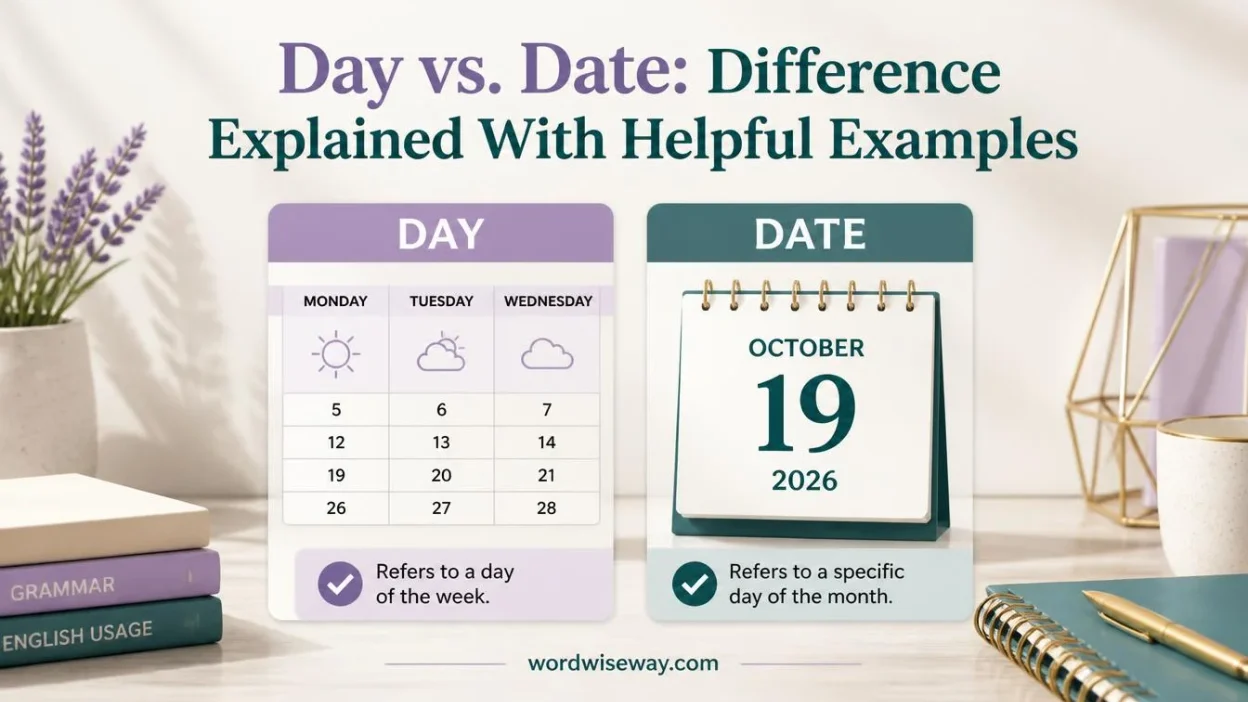
Day vs. Date: Difference Explained With Helpful Examples helps you understand how these two words refer to specific points in time but serve different purposes. A day identifies a weekday, such as Monday or Friday, while a date identifies a particular calendar day, such as October 14, 2026.
These words are not always synonymous, even when they refer to the same event. For example, if someone asks which day your appointment falls on, you might answer Wednesday. However, if they ask for the date, you should provide the calendar date. These helpful examples make the main difference easier to understand.
In everyday conversations, emails, and schedules, choosing the correct word prevents confusion. When arranging a meeting, ask whether someone needs the weekday or the calendar date. Understanding this simple distinction helps you share accurate information when planning appointments, organizing events, or discussing important dates with others.
Quick Answer:
Day refers to a named day of the week, such as Monday, or a period of time, such as a 24-hour day. Date identifies a particular calendar day, usually through a month, day number, and sometimes a year.
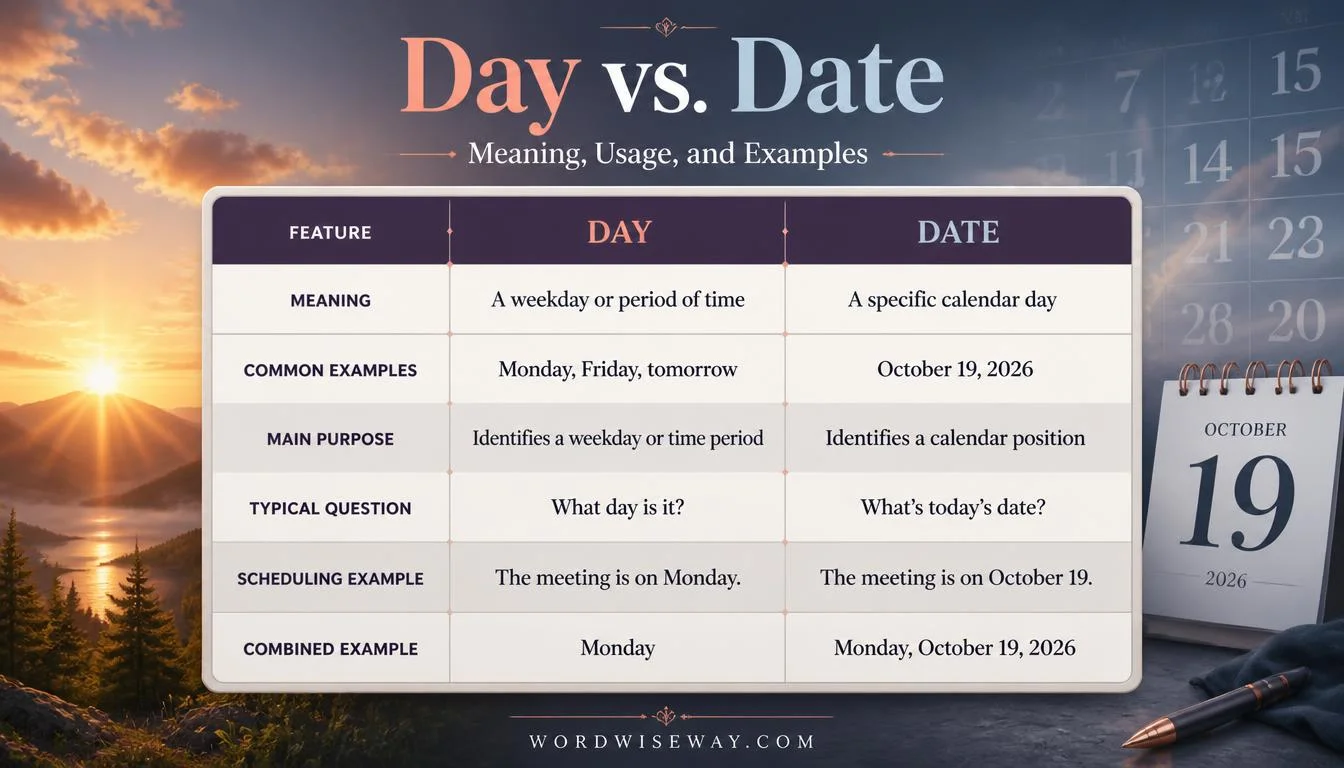
| Feature | Day | Date |
| Meaning | A weekday or period of time | A specific calendar day |
| Common examples | Monday, Friday, tomorrow | October 19, 2026 |
| Main purpose | Identifies a weekday or time period | Identifies a calendar position |
| Typical question | What day is it? | What’s today’s date? |
| Scheduling example | The meeting is on Monday. | The meeting is on October 19. |
| Combined example | Monday | Monday, October 19, 2026 |
Easy way to remember: A day tells you which weekday or time period you’re referring to. A date tells you which calendar day you mean.
For example:
- Day: Monday
- Date: October 19, 2026
- Day and date together: Monday, October 19, 2026
When you combine both terms, you provide a more complete description of a scheduled event.
What Does Day Mean?
Definition of Day
The word day has several related meanings. It can refer to one of the seven days of the week, a 24-hour period, or the portion of a day when the sun provides daylight.
The intended meaning depends on the context.
Consider these examples:
- Monday is my busiest day at work.
- The package should arrive in three days.
- We spent the day exploring the city.
- The day was sunny and warm.
In the first example, day refers to a weekday. In the second, it describes a period of time. The third refers to the general period of daily activity, while the fourth emphasizes daylight and weather conditions.
Although these meanings differ slightly, they share a common connection to time.
Day as a Weekday
When people discuss schedules, routines, and weekly plans, day often refers to a particular weekday.
The seven days of the week are:
- Monday
- Tuesday
- Wednesday
- Thursday
- Friday
- Saturday
- Sunday
Each name identifies a position within the familiar seven-day week.
For example, someone might say, “I’ll visit you on Thursday.” This statement identifies the weekday but doesn’t specify the calendar date.
If the visit is planned for October 22, 2026, the complete information becomes clearer: Thursday, October 22, 2026.
This distinction matters whenever a schedule involves a specific week. Without a date, the listener may need additional information to determine exactly when the visit will happen.
Day as a Period of Time
A day can also mean a period of 24 hours. This meaning appears frequently when discussing deadlines, durations, work schedules, and daily activities.
Examples include:
- The project will take five days.
- She checks her email twice a day.
- We stayed there for one day.
- The application must be submitted within seven days.
In these sentences, day measures time rather than identifying a specific date on the calendar.
However, the exact meaning can depend on context. A deadline of seven days might mean seven calendar days or seven business days, depending on the stated rules.
A calendar day generally refers to a particular date on the calendar. A 24-hour period measures elapsed time. These concepts often overlap, but they aren’t always interchangeable.
For example, a 24-hour period beginning at 3 p.m. on Monday ends at 3 p.m. on Tuesday. It doesn’t align perfectly with either calendar day.
Day as Daylight
The word day can also describe the period when a location receives daylight.
For example:
- The days become longer during summer in many northern regions.
- We prefer to travel during the day.
- The stars became visible after the day ended.
In these examples, day contrasts with night or describes changing daylight conditions.
This meaning differs from the calendar sense. A calendar day includes nighttime, even though people sometimes use day informally to mean daylight hours.
Common Expressions Using Day
Many everyday expressions contain the word day. Understanding them helps you use the word naturally.
| Expression | Meaning | Example |
| Every day | Each day | I practice English every day. |
| Day off | A day when you don’t work or attend regular duties | Friday is my day off. |
| Day by day | Gradually, as time passes | Her confidence improved day by day. |
| Daytime | The period when it’s light outside | The store receives most customers during daytime. |
| One day | An unspecified or particular day | One day, we’ll visit that museum. |
| All day | Throughout the day | He worked all day. |
One particularly common mistake involves every day and everyday.
- Every day means each day: “I read every day.”
- Everyday is an adjective meaning ordinary or routine: “These are my everyday shoes.”
The words sound similar, but their grammatical roles differ. Keeping that distinction in mind will improve your everyday writing.
What Does Date Mean?
Definition of Date
A date identifies a particular day within a calendar. In American English, people commonly express dates using the month, day number, and year.
For example:
- October 19, 2026
- January 1, 2027
- July 4, 2026
Each example identifies a particular calendar day.
Unlike the weekday name Monday, a complete date tells you where the day falls within a particular month and year.
For instance, October 19, 2026, identifies a different calendar day from October 19, 2025. The month and day number remain the same, but the year changes.
Dates help people record birthdays, plan appointments, track deadlines, document events, and organize information chronologically.
Examples of Date in Sentences
The following examples show how people use date when referring to specific calendar days.
- My exam date is October 19, 2026.
- Please write today’s date at the top of the form.
- We changed the meeting date because several people were unavailable.
- The application deadline is approaching, so confirm the submission date.
- Her birth date appears on her official documents.
In each sentence, date identifies a calendar position rather than simply naming a weekday.
Notice that the word can appear in several grammatical forms and phrases, including date of birth, due date, closing date, and departure date.
These expressions identify different kinds of events or deadlines. Their shared purpose is to connect an event with a particular calendar day.
Common Date Formats in American English
People can write the same date in several ways. The appropriate format depends on the document, audience, and purpose.
| Format | Example | Typical use |
| Month written in full | October 19, 2026 | Formal writing and clear communication |
| Abbreviated month | Oct. 19, 2026 | Informal writing and space-limited layouts |
| Numeric US format | 10/19/2026 | Forms and everyday records |
| Year-month-day format | 2026-10-19 | Data systems and standardized records |
In standard American prose, the usual format places the month before the day number. For example, write October 19, 2026, rather than 19 October 2026 when following conventional US style.
Numeric formats require more care because countries use different conventions.
For example, 04/05/2026 could mean April 5, 2026, in the United States or May 4, 2026, in a day-month-year system.
When confusion could affect travel arrangements, deadlines, or payments, spelling out the month is often the clearest option.
Date Can Have More Than One Meaning
Although this article focuses on calendar dates, date has other meanings in English.
For example, a date can refer to a planned social meeting or a romantic outing. The word can also refer to the edible fruit produced by certain palm trees.
Consider these sentences:
- “What’s the date of the conference?” refers to a calendar day.
- “We have a date on Saturday” refers to a planned social outing.
- “She added chopped dates to the recipe” refers to the fruit.
Context makes the intended meaning clear. In discussions about calendars, appointments, and deadlines, the calendar meaning is usually the relevant one.
Key Differences Explained
The easiest way to understand day vs. date is to examine the information each word provides.
A day can tell you the weekday or measure a period of time. A date identifies a particular position on the calendar.
Day vs. Date Comparison Table
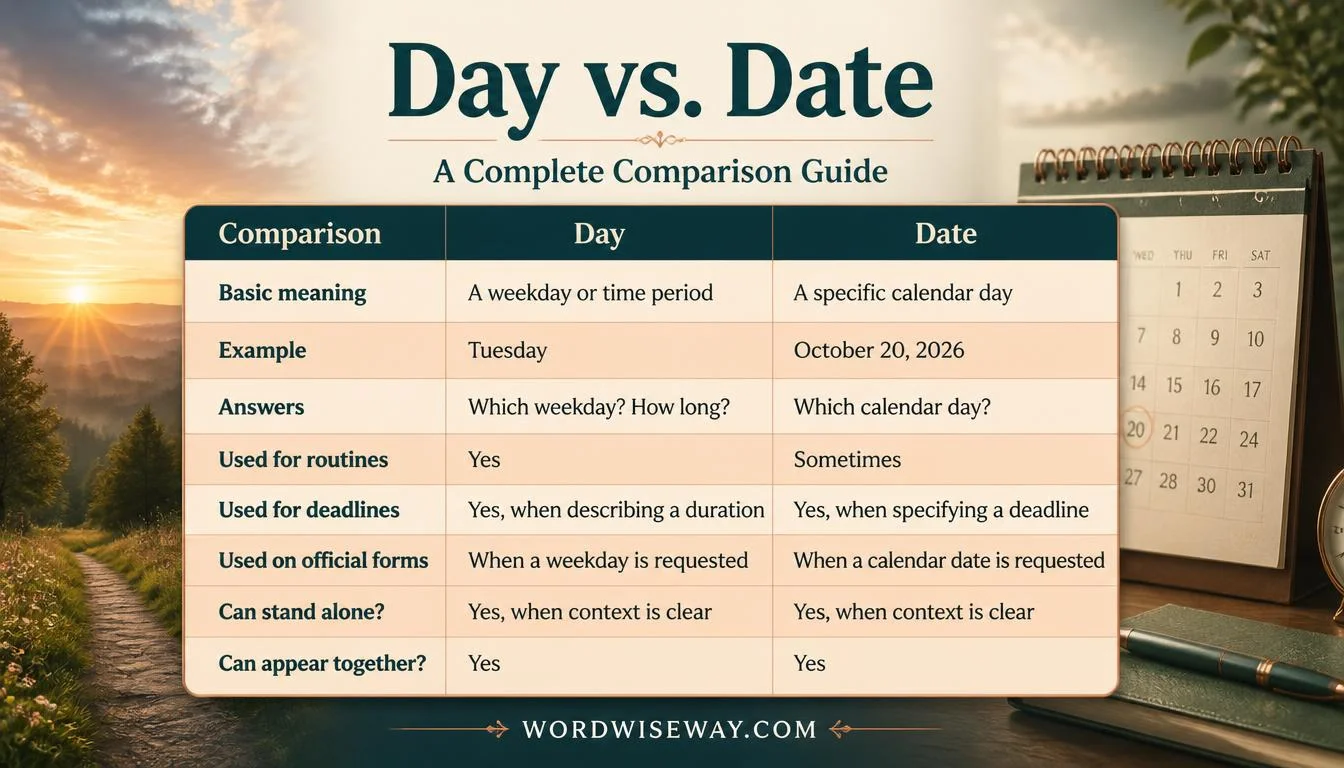
| Comparison | Day | Date |
| Basic meaning | A weekday or time period | A specific calendar day |
| Example | Tuesday | October 20, 2026 |
| Answers | Which weekday? How long? | Which calendar day? |
| Used for routines | Yes | Sometimes |
| Used for deadlines | Yes, when describing a duration | Yes, when specifying a deadline |
| Used on official forms | When a weekday is requested | When a calendar date is requested |
| Can stand alone? | Yes, when context is clear | Yes, when context is clear |
| Can appear together? | Yes | Yes |
For example, “The interview is on Tuesday” identifies a weekday. However, “The interview is on October 20, 2026” identifies a calendar date.
Neither sentence is inherently incorrect. Each provides different information, and the appropriate choice depends on what the listener needs to know.
Day vs. Date in Everyday Situations
The distinction becomes especially useful when you plan events or communicate schedules.
Birthday
- Day: My birthday falls on a Monday.
- Date: My birthday is October 19.
- Both: My birthday is Monday, October 19, 2026.
School examination
- Day: The examination takes place on Thursday.
- Date: The examination is scheduled for October 22, 2026.
- Both: The examination takes place on Thursday, October 22, 2026.
Work meeting
- Day: Let’s meet on Wednesday.
- Date: Let’s meet on October 21, 2026.
- Both: Let’s meet on Wednesday, October 21, 2026.
Travel arrangements
- Day: Our flight leaves on Friday.
- Date: Our flight leaves on October 23, 2026.
- Both: Our flight leaves on Friday, October 23, 2026.
These examples demonstrate a practical rule: use the weekday when that information is enough, the date when you need calendar precision, and both when clarity matters most.
Can a Day and a Date Refer to the Same Thing?
Yes. A weekday and a calendar date can refer to the same calendar day from different perspectives.
For example, October 19, 2026, falls on a Monday. The word Monday identifies the weekday, while October 19, 2026 identifies the calendar date.
The two expressions aren’t interchangeable, but they describe the same day on the calendar.
This distinction becomes important when an event occurs every week. Saying “The class takes place on Monday” describes a recurring weekday. Saying “The class takes place on October 19, 2026” identifies one particular occurrence.
If you want to remove uncertainty, combine both forms:
The class will take place on Monday, October 19, 2026.
This wording communicates the weekday and the exact calendar date in one clear sentence.
Why the Weekday Can Change From Year to Year
A calendar date doesn’t always fall on the same weekday every year.
For example, October 19, 2026, falls on a Monday, while October 19, 2027, falls on a Tuesday.
The reason involves how the calendar counts days across ordinary years and leap years. A common year contains 365 days, which equals 52 weeks plus one day. Consequently, the same date generally shifts forward by one weekday in the following year.
A leap year contains 366 days, or 52 weeks plus two days. That extra day affects the weekday shift across the calendar.
This is why a date alone doesn’t tell you the weekday unless you also know the year and consult a calendar or calculate it.
Examples in Sentences
Examples make the difference between these terms easier to remember. Pay attention to what each sentence communicates and why the chosen word fits.
Examples Using Day
Here are five sentences that use day correctly in different contexts.
- Monday is my favorite day of the week. The word identifies a weekday.
- We need three more days to finish the project. The word measures a period of time.
- She takes a day off after every major deadline. The word refers to a scheduled break.
- The weather remained pleasant throughout the day. The word describes a general period of daily activity.
- Which day works best for your appointment? The question asks about a suitable weekday or time.
In each example, day refers to a weekday, duration, or general period. None of the sentences requires a specific calendar date.
Examples Using Date
Now consider five sentences that use date to identify calendar information.
- The conference date is October 19, 2026. The word identifies a specific calendar day.
- Please enter your date of birth on the application. The phrase requests a birth date.
- We moved the appointment to a later date. The word refers to the calendar day assigned to the appointment.
- The payment due date is November 5, 2026. The phrase identifies the payment deadline.
- Can you confirm the departure date before booking the hotel? The question requests a specific calendar day.
These examples show that date often appears in administrative, professional, and planning contexts. It helps people connect an event or obligation with a precise calendar position.
Examples Using Both Day and Date
Sometimes, the clearest sentence includes both words. This approach works particularly well when you communicate schedules or confirm important events.
| Sentence | Meaning |
| The meeting is on Monday, October 19, 2026. | Monday gives the weekday, while the date identifies the exact day. |
| My examination falls on Thursday, October 22, 2026. | Both details identify the scheduled examination day. |
| The office will reopen on Tuesday, October 20, 2026. | The sentence communicates the weekday and reopening date. |
| Please confirm the day and date of your appointment. | The request asks for both pieces of information. |
| Our event is scheduled for Friday, October 23, 2026. | The combined information makes the schedule more precise. |
The main lesson is simple: combining a weekday with a calendar date can prevent misunderstandings, especially when people coordinate schedules across several weeks or months.
When to Use Day vs. Date
Choosing the right word becomes much easier when you focus on the information you want to communicate.
Use Day When Referring to a Weekday or Time Period
Choose day when you want to discuss a weekday, daily routine, duration, or period of daylight.
For example:
- “Which day is your English class?” asks about the weekday.
- “I’ll finish the task in two days” describes a duration.
- “We don’t work on Sundays” refers to a recurring weekly schedule.
- “The days are getting shorter” describes changing daylight hours.
You should also use day in familiar expressions such as day off, daytime, and every day.
Practical tip: If your sentence answers a question about a weekday or how long something takes, day may be the appropriate choice.
However, check the context. A sentence about a deadline may require a specific date even when it also mentions a number of days.
Use Date When Referring to a Specific Calendar Day
Use date when you need to identify a particular day on the calendar.
For example:
- “What’s the date of the appointment?”
- “The registration deadline is November 5, 2026.”
- “Please write the date on the document.”
- “Our departure date is December 12, 2026.”
In these examples, the calendar position matters more than the weekday name.
Dates are particularly important when completing official paperwork, arranging travel, submitting assignments, and managing financial deadlines.
Practical tip: If someone needs to know exactly when an event occurs, provide the date rather than only naming the weekday.
For important plans, include the year whenever leaving it out could cause confusion.
Use Both When You Need Complete Scheduling Information
When precision matters, provide the weekday and the date together.
Suppose you’re inviting colleagues to a meeting. Writing “Let’s meet on Friday” may work if everyone understands which Friday you mean. However, the message becomes clearer when you specify the full date.
Compare these examples:
- Less specific: “The workshop is on Tuesday.”
- More specific: “The workshop is on Tuesday, October 20, 2026.”
The second sentence removes uncertainty about the intended calendar day.
This approach is especially helpful for:
- Medical and professional appointments
- School examinations and assignment deadlines
- Business meetings and conferences
- Travel itineraries and hotel reservations
- Invitations and public events
One important detail remains: always verify that the weekday matches the date before sending a formal invitation or schedule.
Common Mistakes
Although the distinction is straightforward, several common mistakes can create confusion in everyday communication.
Confusing a Weekday With a Calendar Date
A weekday and a calendar date provide different information. Treating them as identical can leave the reader unsure about the intended schedule.
Consider this example:
Unclear: “My interview is on the 20th.”
The sentence doesn’t identify the month or year. Depending on the conversation, the reader may understand it, but the date lacks useful context.
Clearer: “My interview is on October 20, 2026.”
Most specific: “My interview is on Tuesday, October 20, 2026.”
The final version provides the weekday and the complete date.
Remember that the weekday alone may be sufficient for recurring events. A complete date becomes more useful when you discuss a single appointment or deadline.
Using an Incorrect Date Format
Date formats differ across countries, which can cause misunderstandings when people communicate internationally.
For example, consider the numeric date 05/06/2026.
- In the US month-day-year format, it means May 6, 2026.
- In the day-month-year format, it means June 5, 2026.
Both interpretations are possible without additional context.
To avoid confusion, write the month in words when communicating with people who use different date conventions.
For example, May 6, 2026, is clearer than 05/06/2026 for an international audience.
When working with software, databases, or technical records, a year-month-day format such as 2026-05-06 can also help maintain consistency.
Asking for the Wrong Information
Another common mistake involves asking a question that doesn’t match the information you actually need.
Compare these questions:
| Question | Information requested |
| What day is it? | Usually the weekday or, depending on context, the current day |
| What’s today’s date? | The current calendar date |
| What day of the week is the event? | The weekday on which the event occurs |
| What’s the date of the event? | The specific calendar day |
| How many days remain? | The time remaining until an event or deadline |
| What’s the day and date of the meeting? | Both the weekday and calendar date |
For example, if someone says, “The interview is on Thursday,” you can ask, “What’s the date?” when you need to know the exact calendar day.
If someone gives you October 22, 2026, but you need to know the weekday, ask, “What day of the week is that?”
Clear questions help you get the right information without unnecessary back-and-forth.
Forgetting the Year When It Matters
Leaving out the year isn’t always a mistake. In everyday conversations, people often say “October 19” because the year is already understood.
However, a missing year can cause problems when you discuss events that occur far in advance or refer to past records.
For example:
- Informal: “The party is on October 19.”
- More precise: “The party is on October 19, 2026.”
Use the full year when preparing official documents, scheduling future events, maintaining records, or communicating across different calendar years.
Day vs. Date in Questions and Conversations
Understanding how to ask about a day or date makes everyday communication more natural. The following examples show how to choose the right expression.
How to Ask About the Day
Use these questions when you want to know about a weekday, daily routine, or period of time.
- “What day is your appointment?”
- “Which day do you have off?”
- “What day does the course begin?”
- “How many days will the trip take?”
- “Do you work every day?”
Each question focuses on the weekday or a period of time.
For example, if a friend says, “I have a class next week,” you might ask, “Which day?” That question is enough if you’re only trying to identify the weekday.
However, if you need to attend the class at a particular time, you may also need its exact date and start time.
How to Ask About the Date
Use these questions when you need a specific calendar day.
- “What’s today’s date?”
- “What’s the date of your examination?”
- “When is the application deadline?”
- “Can you confirm the departure date?”
- “What date should I write on this form?”
These questions help you obtain precise calendar information.
For example, asking “When is your birthday?” allows someone to respond with a month and day. Asking “What day of the week is your birthday this year?” requests different information.
The wording of your question determines the type of answer you need.
How to Answer Day and Date Questions Clearly
A good answer gives the information the other person requested without unnecessary details.
Consider these examples:
Question: What day is the meeting?
Answer: It’s on Wednesday.
Question: What’s the date of the meeting?
Answer: It’s on October 21, 2026.
Question: What’s the day and date of the meeting?
Answer: It’s on Wednesday, October 21, 2026.
Notice how each answer matches the question. The final example includes both details because the question requests both.
In professional communication, complete answers are especially useful when several appointments or deadlines appear on the same schedule.
Day vs. Date in American English
American English follows familiar conventions for using these terms, especially when writing dates and completing forms.
Day and Date in American Usage
In American English, people commonly name weekdays directly and write calendar dates with the month first.
Examples include:
- “I’ll see you on Monday.”
- “The deadline is October 19, 2026.”
- “Our appointment is on Monday, October 19, 2026.”
When writing a full date in standard American prose, use a comma between the day number and year. When the date appears within a sentence, a comma generally follows the year if the sentence continues.
For example: “On October 19, 2026, the office will begin its new schedule.”
However, a numeric date on a form may follow a different formatting convention. Always follow the instructions provided by the organization or document.
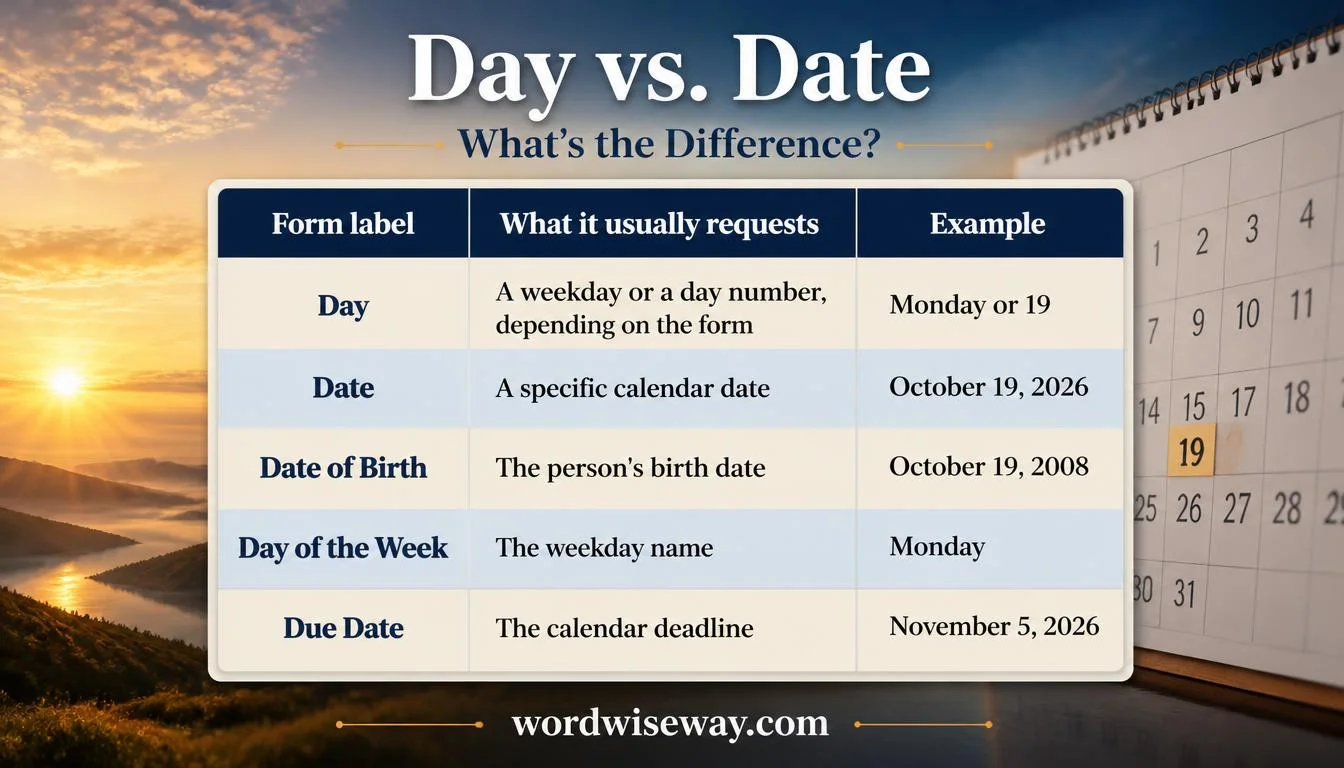
Day vs. Date on Forms and Documents
Forms often use labels such as Day, Date, and Date of Birth. Although these labels look similar, they request different information.
| Form label | What it usually requests | Example |
| Day | A weekday or a day number, depending on the form | Monday or 19 |
| Date | A specific calendar date | October 19, 2026 |
| Date of Birth | The person’s birth date | October 19, 2008 |
| Day of the Week | The weekday name | Monday |
| Due Date | The calendar deadline | November 5, 2026 |
The surrounding instructions determine the expected response.
For instance, a form asking for the day of birth may request only the day number, while a form asking for the date of birth usually expects the full date.
If a form provides separate boxes for month, day, and year, enter each component in its designated field. Don’t assume that every form uses the same format.
Read More: Words for When Someone Accuses You of What They Are Guilty Of
FAQs
1. What is the main difference between day and date?
A day usually refers to a day of the week, such as Monday or Friday. A date identifies a specific day on the calendar, such as October 14, 2026.
2. Is a day the same as a date?
No, they have different meanings. A day can identify a weekday, while a date specifies a particular calendar day using a month, day, and sometimes a year.
3. How do you use day and date in a sentence?
You can say, “My appointment is on Friday” to mention the day. To give the date, write, “My appointment is on October 16, 2026.”
4. Should I write the day or the date in an email?
It depends on the information your reader needs. Use the day to identify the weekday and include the date when you need to specify the exact calendar day.
5. Can the same date fall on different days?
Yes, the weekday changes from year to year. For example, October 14, 2026, falls on a Wednesday, while October 14, 2027, falls on a Thursday.
6. What does “day and date” mean on a form?
On a form, day usually means the weekday, while date means the specific calendar date. Some forms ask for both to record information accurately.
7. How do I ask someone for the day and date?
You can ask, “What day and date is the meeting?” This question requests both the weekday and the exact calendar date, helping everyone avoid confusion.
8. Is Monday a day or a date?
Monday is a day of the week, not a complete calendar date. To provide a full date, you need additional information, such as the month and day number.
9. Why is it important to know the difference between day and date?
Knowing the difference helps you schedule appointments, arrange meetings, complete forms, and communicate clearly. It also reduces misunderstandings when sharing deadlines or event details.
10. How can I remember the difference between day and date?
Think of day as the name of the weekday, such as Tuesday. Think of date as the calendar entry, such as October 20, 2026. This simple distinction makes both words easier to use correctly.
Conclusion
Understanding day vs. date makes everyday communication clearer and more accurate. Although both words refer to time, they provide different information. A day usually tells you the weekday, such as Monday or Friday, while a date identifies a specific calendar day, such as October 14, 2026. Knowing this simple difference helps you choose the right word in conversations, emails, and schedules.
The easiest way to remember the distinction is to connect a day with the week and a date with the calendar. For example, if someone asks when your appointment is, you can mention Wednesday as the day and October 14 as the date. Providing both details can prevent confusion when arranging meetings, planning events, or discussing deadlines.
Once you understand how these terms work, using them correctly becomes much easier. Pay attention to the question and consider whether the other person needs a weekday or an exact calendar date. With a little practice, you’ll communicate more confidently and avoid common mistakes when discussing important plans.

Evelyn Shaw has spent 14 years at Yale University’s English Department, leading students through close readings, genre studies, and interpretive methodologies. Her scholarly interests include Renaissance drama, gothic fiction, feminist literary criticism, and archival research and examining how texts generate meaning across historical periods. Evelyn has presented at major academic conferences and published essays in peer-reviewed journals, reflecting her passion for rigorous analysis and student-centered learning.