Our comprehensive guide titled Ladder vs Latter: Meaning, Difference, Examples, and Correct Usage explains why language learners experience trouble.
As someone who has spent years analyzing language patterns, I have watched enthusiastic learners and seasoned native speakers face serious trouble with these homophones during their early days of education.
Because this tricky duo of words can sound nearly identical, they cause a massive amount of confusion in both writing and speaking.
When navigating fast-paced British or American conversational contexts, their pronunciations easily blur together, turning English expression into a wild ride.In reality, these two words look similar, but they are entirely different.
Only a single letter sets them apart, yet they function as completely separate parts of speech and are never interchangeable.
One is a physical noun representing a wooden tool with rungs that you climb, while the other operates as an adjective pointing to the second of two things mentioned. Mastering this structural distinction is crucial because failing to use the right word completely alters your intended meanings.
Let’s make this incredibly simple and clear so you can confidently choose the proper option in any daily life situation.
The good news is that avoiding these mistakes is easy once you train your brain to think about the double ‘t’ in the latter part of a statement. Utilizing real-life examples to picture the difference will anchor these terms in your mind.
Relying on these handy tips ensures you will always produce a flawless text, leaving your audience focused on your message instead of a glaring typo.
Why This Confusion Happens So Often
At first glance, ladder and latter feel almost identical. Same starting letter. Similar rhythm. Even the double letters look like cousins.
That’s where the trouble begins.
People usually confuse ladder vs latter because:
- They look nearly the same when typed quickly
- Autocorrect sometimes picks the wrong one
- Pronunciation sounds similar in fast speech
- Many learners first encounter them in writing, not conversation
Here’s the funny part: your brain often guesses based on context. And if the context is unclear, it picks wrong.
For example:
- “I climbed the latter” looks acceptable at a glance
- But it actually sounds like you climbed a comparison word, not a tool
That tiny mistake can flip meaning completely.
So let’s fix it once and for all.
Quick Meaning Difference at a Glance
Before diving deep, here’s a clean breakdown of ladder vs latter meaning:
| Word | Type | Meaning | Example |
| Ladder | Noun (object) | A tool used for climbing | I used a ladder to reach the roof |
| Latter | Determiner / adjective | The second of two items | I had tea and coffee, I chose the latter |
Now lock this into your memory:
- Ladder = physical object
- Latter = choice or comparison
That one rule solves 80% of confusion instantly.
Ladder Meaning Explained in Simple Terms
Let’s start with the easier one: ladder.
A ladder is a physical structure that helps you move vertically. You climb it to reach something higher or descend safely.
Think of it as a human bridge between ground and height.
Everyday meaning of ladder
You’ll see ladders in:
- Construction sites
- Homes during repairs
- Fire escapes
- Gardens for picking fruit
- Libraries (rolling ladders for shelves)
Types of ladders
Different situations need different ladders:
- Step ladder: Self-supporting, used indoors
- Extension ladder: Long, adjustable, used for rooftops
- Rope ladder: Flexible, often used in ships or emergencies
- Platform ladder: Has a standing surface for stability
Ladder in sentences
Here’s how “ladder” naturally appears in real speech:
- “He placed the ladder against the wall before painting.”
- “She climbed the ladder carefully because it was wet.”
- “The firefighter used a ladder to reach the window.”
Simple truth about ladder
A ladder is always physical. If you cannot touch it or stand on it, it is not a ladder.
Latter Meaning Explained Without Confusion
Now let’s tackle the trickier one: latter.
The word “latter” does not refer to objects. It refers to order.
It means:
The second of two things mentioned earlier
That “two things” rule is extremely important.
Latter in real usage
You only use “latter” when:
- You mention two items
- You choose or refer to the second one
Examples of latter in context
- “I could travel by train or bus. I chose the latter.”
- “Between tea and coffee, I prefer the latter.”
- “She offered apples and oranges. I picked the latter.”
Key limitation of latter
This is where many people make mistakes:
- ❌ You cannot use “latter” for three options
- ❌ You cannot use it without introducing choices first
- ❌ You cannot use it as a standalone idea
If there is no pair, “latter” loses meaning.
Latter vs Later confusion
People also confuse latter vs later, but they are completely different:
- Latter = order (second of two)
- Later = time (in the future)
We’ll break that down soon.
Ladder vs Latter vs Later: The Triple Confusion Problem
This is where things get interesting. Many mistakes happen because these three words overlap in spelling and rhythm.
Let’s separate them clearly.
| Word | Meaning | Category | Example |
| Ladder | Climbing tool | Object | I climbed the ladder |
| Latter | Second of two items | Grammar reference | I chose the latter option |
| Later | At a future time | Time reference | I will call you later |
Easy mental map
Think like this:
- Ladder → space (up and down movement)
- Latter → choice (first vs second)
- Later → time (now vs future)
Once your brain locks this pattern, mistakes drop sharply.
Simple Memory Tricks That Actually Work
Let’s make this stick in your mind.
Trick for ladder
- “Ladder has double D like steps”
- Imagine D = steps going up
Trick for latter
- “Latter has TT like two things”
- It literally deals with two items
Trick for later
- “Later has E like event in time”
- Think future event happening later
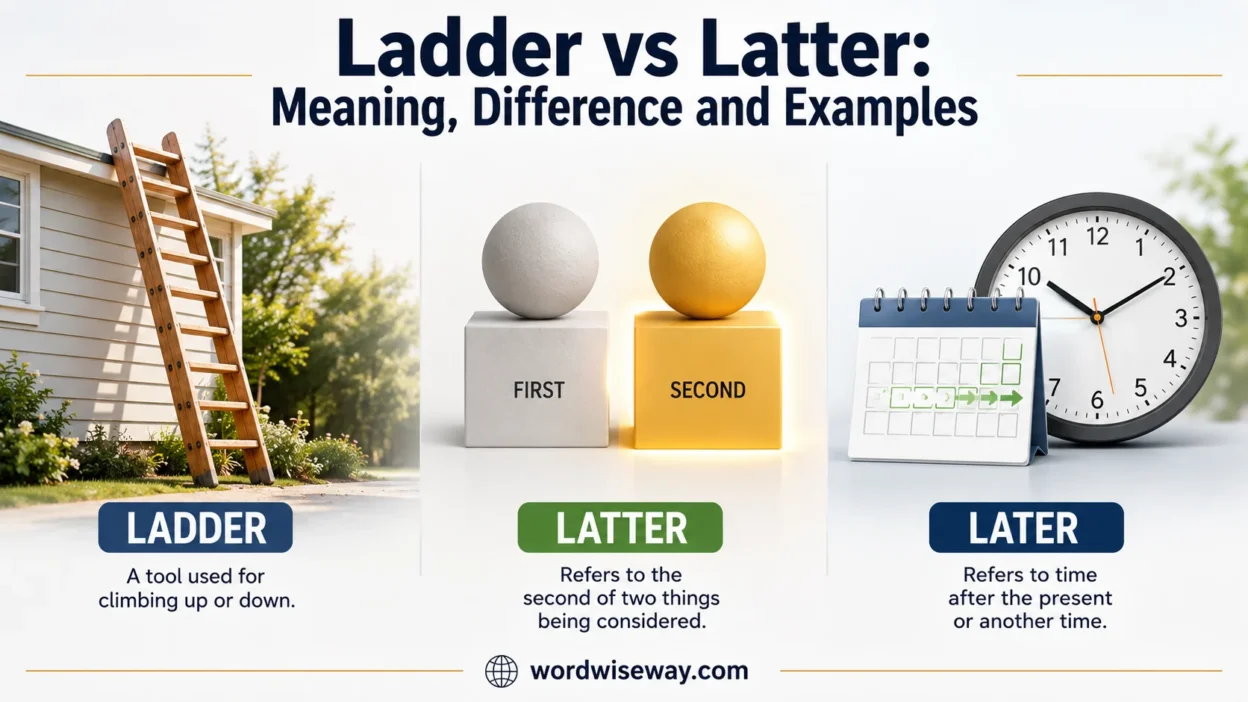
Visual memory trick
Picture this:
- A ladder leaning on a house
- Two objects with “latter” highlighting the second one
- A clock ticking forward for “later”
Your brain remembers images faster than rules.
Real-Life Ladder vs Latter Mistakes People Make
Let’s look at real-world confusion. These are not rare. They happen in emails, chats, and even professional writing.
Mistake in casual texting
- “I fixed the latter in the garage”
- Problem: You cannot fix a comparison word
Correct version:
- “I fixed the ladder in the garage”
Mistake in workplace writing
“I had two tasks: reporting and budgeting. I completed the ladder.”
This is a classic typo confusion.
Correct version:
“I had two tasks: reporting and budgeting. I completed the latter.”
Mistake in social media posts
“I climbed the latter to fix my roof.”
This turns a normal sentence into nonsense.
Correct version:
“I climbed the ladder to fix my roof.”
Why these mistakes happen
- Fast typing
- Predictive text errors
- Lack of context checking
- Over-reliance on spellcheck tools
Grammar Rules Behind Latter
To truly master ladder vs latter, you need to understand how “latter” works grammatically.
Rule one: always needs two items
You must introduce two things before using it.
Correct:
- “I like football and basketball. The latter is my favorite.”
Incorrect:
- “I like the latter.”
Rule two: refers only to second item
It never refers to the first option.
- First item = “former”
- Second item = “latter”
Example:
- “Tea and coffee were offered. The former was cold. The latter was hot.”
Rule three: cannot stand alone
Latter depends on context. Without it, the meaning collapses.
Case Studies: How Confusion Creates Real Errors
Let’s look at practical examples from real communication patterns.
Case study 1: Academic writing confusion
A student wrote:
“I studied biology and chemistry. I enjoyed the ladder more.”
What happened?
- The student meant “latter” but typed “ladder”
- The sentence now suggests climbing biology
Correct version:
“I studied biology and chemistry. I enjoyed the latter more.”
Case study 2: Workplace instruction error
Email line:
“Use the ladder method for reporting and analysis.”
Intended meaning:
“Use the latter method…”
Result:
Employees thought they needed a physical ladder.
Correct version:
“Use the latter method for reporting and analysis.”
Case study 3: Social media viral mistake
A post read:
“I had pizza and pasta. The ladder was amazing.”
People laughed because it sounded like pasta was a climbing tool.
Correct version:
“The latter was amazing.”
Read More: Inter vs Intra: The Complete Guide with Real Examples
Common Mistakes and How to Fix Them
Let’s break down frequent errors and quick fixes.
Mistake: mixing ladder and latter
Fix:
- Ask: Is it physical? → ladder
- Is it comparison? → latter
Mistake: confusing latter and later
Fix:
- If it’s time → later
- If it’s order → latter
Mistake: using latter without context
Fix:
- Always introduce two items first
Mistake: spelling errors
Fix:
- Slow down while typing
- Visualize meaning before writing
Practice Section: Test Your Understanding
Try choosing the correct word.
Question 1
I climbed the (ladder / latter) to fix the roof.
Question 2
I had tea and coffee. I chose the (ladder / latter).
Question 3
We will meet (later / latter) today.
Answers
- ladder
- latter
- later
FAQs
Is ladder a noun or an adjective?
Answer: Ladder is a noun. It refers to a climbing tool with rungs or, figuratively, a hierarchy such as a career ladder or corporate ladder.
Can the latter refer to more than two things?
Answer: No. Latter is used only when referring to the second of two people, items, or ideas. For lists of three or more, use last or final instead.
What is the opposite of latter?
Answer: The opposite of the latter is the former. Former refers to the first of two things mentioned, while latter refers to the second.
Why do ladder and latter sound so similar?
Answer: In many British and especially North American accents, the dd in ladder and the tt in latter are pronounced with a soft “d” sound, making the words sound almost identical in everyday speech.
What’s the easiest way to remember the difference?
Answer: Think of the letters. LaDDer has two D’s, which resemble the sides of a ladder. LaTTer has two T’s, reminding you of the second item in a pair.
Are ladder and latter homophones?
Answer: Yes. For many English speakers, especially in North America, they are considered homophones because they are pronounced the same despite having different meanings and spellings.
Can latter refer to a person?
Answer: Yes. After mentioning two people, you can use latter to refer to the second one. For example: “I spoke with Emma and Olivia; the latter approved the proposal.”
Can ladder and latter be used interchangeably?
Answer: No. They have completely different meanings and grammatical functions. Ladder is a noun, while latter refers to the second of two previously mentioned items.
Is confusing these words a serious writing mistake?
Answer: It can be. Mixing up ladder and latter in academic, business, or professional writing may distract readers and reduce your credibility, even if the intended meaning is clear.
Why do English learners often confuse these words?
Answer: They differ by only one letter and often share the same pronunciation. Regular practice with their meanings and sentence examples makes them much easier to distinguish.
Conclusion
Knowing the difference between ladder and latter helps you write with greater accuracy and confidence. Although these words often sound the same in conversation, they have entirely different meanings and uses. Ladder refers to a climbing tool or a hierarchy, while latter identifies the second of two people or things already mentioned. Remembering this simple distinction will help you avoid common mistakes and make your writing clearer, more polished, and more professional.

Amelia Sanders has spent 14 years in Harvard University’s English Department, helping students navigate literary analysis, interpretive theory, and narrative techniques. Her academic pursuits center on 18th-century British prose, romantic poetry, diasporic writing, and digital editing exploring how textual choices influence cultural perspectives. Amelia has spoken at major international meetings and contributed essays to respected academic volumes, demonstrating her dedication to thoughtful scholarship and effective teaching.