Have you ever stopped while writing an email, post, or article and wondered: is it truely or truly? Learning about Truly vs Truely: Correct Spelling, Meaning, and Usage Explained helps writers avoid errors and sound incredibly professional. You are not alone; this is one of the most searched spelling questions in English because translating true to truely seems logical.
The standard adverb form used to emphasize sincerity, accuracy, or intensity is truly, whereas truely is an incorrect variant that can harm your credibility. Instead, understanding the difference ensures your communication appears precise, grammatically correct, and professional without unprofessional spelling mistakes.
This text has been typed up to bring clarity to a word that is frequently misspelled by others, helping you clearly avoid errors, confidently apply the term in various contexts, ensure you make the right choice when it needs to be read, and describe honesty with absolute confidence.
Truly vs Truely: Why This Spelling Confusion Happens So Often
The confusion between truly vs truely usually starts with instinct rather than knowledge. English spelling doesn’t always follow sound logic, so your brain tries to “fix” words that already look complete.
Here’s what happens in your mind:
- You see the word true
- You want to turn it into an adverb
- You think: “add -ly → truely”
It feels right. It sounds right. But English disagrees.
Another reason this mistake spreads so widely is autocorrect and casual typing habits. People often type quickly on phones, and “truely” looks visually balanced, so it slips through unnoticed.
Even worse, you’ll occasionally see it online, which reinforces the mistake.
But let’s lock in the truth.
Truly vs Truely: The Correct Spelling You Should Always Use
Let’s keep this extremely clear.
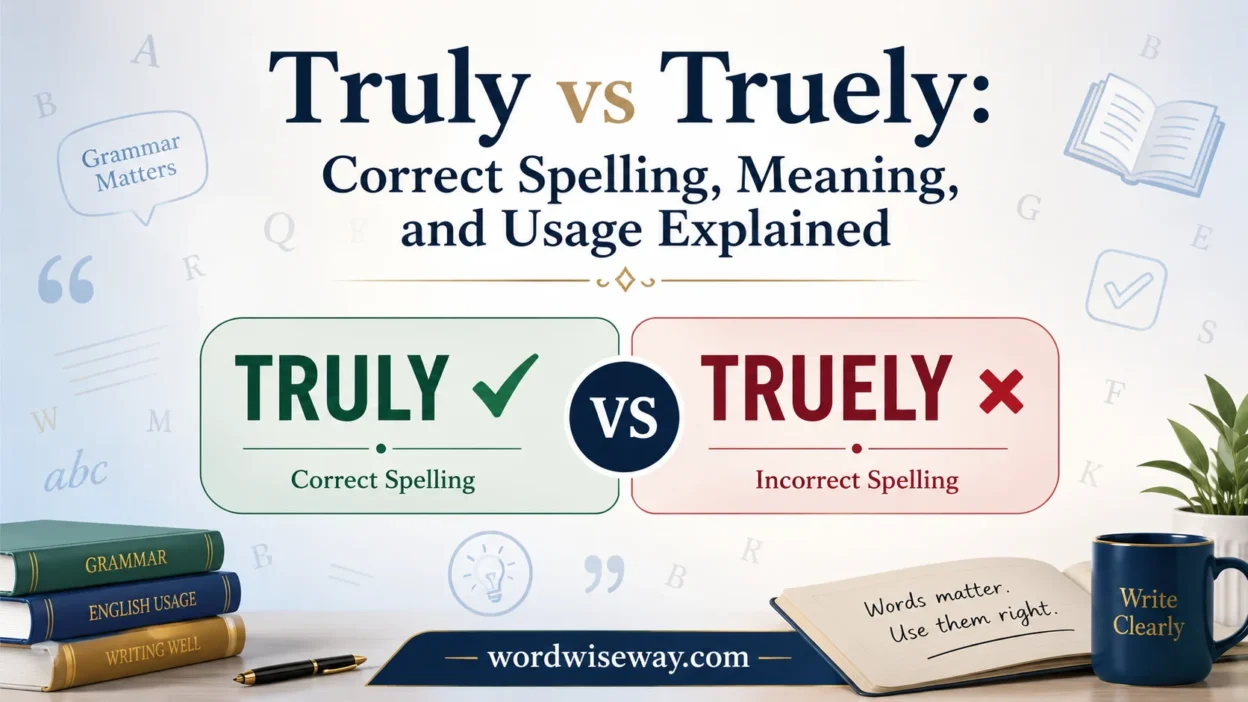
- ✔ Correct spelling: truly
- ✘ Incorrect spelling: truely
There are no exceptions in modern English where “truely” is acceptable.
The reason is simple grammar structure. When a word ends in a silent “e,” English often drops it before adding “-ly.”
So:
- true → truly
- not “truely”
Think of it as trimming extra letters for smoother pronunciation and cleaner spelling.
What Does “Truly” Mean in English?
The word “truly” is an adverb. It strengthens meaning and adds sincerity or emphasis to a statement.
Core meaning
- In a sincere, honest, or accurate way
- Completely or genuinely
Simple interpretation
When you say something is truly true, you’re not just stating it. You’re emphasizing that it is fully and genuinely the case.
Examples of “truly” in real life
- “I truly appreciate your help with this project.”
- “She was truly happy to see them again.”
- “That was truly a once-in-a-lifetime experience.”
Notice how “truly” adds emotional weight. It doesn’t just describe something. It intensifies it.
Tone variations of “truly”
| Context | Example | Meaning Effect |
| Emotional | “I truly miss you.” | Strong sincerity |
| Formal | “The results are truly significant.” | Professional emphasis |
| Casual | “That was truly funny.” | Light emphasis |
Why People Write “Truely”: The Real Reason Behind the Mistake
The mistake “truely” isn’t random. It follows a predictable pattern of English overgeneralization.
Here are the real causes:
1. Over-application of spelling rules
People know many words end in “-e” and keep it when adding suffixes:
- “safe → safely”
- “nice → nicely”
So they assume:
- “true → truely”
But English is inconsistent here.
2. Sound-based spelling logic
When spoken quickly, “truly” can sound like it has an extra vowel in some accents. That leads writers to insert an “e” that doesn’t belong.
3. Visual symmetry bias
“Truely” looks visually balanced. Two vowels feel stable to the eye, even though English doesn’t require it.
4. Internet reinforcement
Once a mistake appears online, it spreads. People copy it unconsciously, especially in informal writing like comments and captions.
Grammar Rule Behind “Truly vs Truely” Explained Simply
Let’s strip this down into a clean rule you can actually remember.
Rule
When a word ends in a silent “e,” drop the “e” before adding “-ly.”
Pattern examples
- true → truly
- due → duly
- whole → wholly (note: irregular case)
- sincere → sincerely
Important insight
English doesn’t always behave consistently, but this pattern is stable for “true.”
So the correct transformation is:
true + ly → truly
Not:
true + ly → truely ❌
How “Truly” Is Used in Real Communication
Let’s look at how people actually use this word in different writing environments.
Everyday conversation
- “I truly enjoyed the trip.”
- “That was truly unexpected.”
Here, “truly” acts like emotional seasoning. It adds flavor.
Professional writing
- “The findings are truly remarkable.”
- “We truly value your feedback.”
In formal settings, it adds credibility and emphasis without sounding emotional.
Creative writing
- “He was truly lost in the silence of the forest.”
- “It felt like a truly endless night.”
Here, “truly” enhances mood and atmosphere.
Common Mistakes with “Truly vs Truely”
Let’s highlight the errors people make most often.
Mistake 1: Adding unnecessary “e”
- ❌ truely
- ✔ truly
Mistake 2: Overusing “truly” for emphasis
Many writers sprinkle it everywhere:
- “I truly, truly, truly think…”
Better approach:
- Use once for impact, not repetition
Mistake 3: Confusing with similar words
| Word | Meaning |
| truly | sincerely, genuinely |
| really | in reality, very |
| honestly | truthful manner |
Each carries slightly different emotional weight.
Case Study: How Small Spelling Errors Change Perception
Let’s look at a real-world style scenario.
Scenario: Job application email
Candidate A writes:
“I truely appreciate the opportunity.”
Candidate B writes:
“I truly appreciate the opportunity.”
Outcome insight
Even though both messages express the same intent, Candidate B appears more polished.
Why?
- Correct spelling signals attention to detail
- Small errors can subtly affect credibility
Key takeaway
Tiny spelling mistakes don’t destroy meaning, but they can quietly influence perception.
Memory Tricks
Here are simple mental shortcuts that actually stick.
1. The “TRUE already has U” trick
You already have a “u” in “true.”
So you don’t need to add anything extra.
TRUE → TRULY
No extra “e” allowed.
2. The removal rule
Think of spelling like editing:
- Remove clutter
- Drop the “e”
- Add “ly”
3. Visual hook
Imagine a red pen crossing out the “e”:
truely ✘ → truly ✔
Quick Comparison Table: Truly vs Truely
| Feature | Truly | Truely |
| Spelling | Correct | Incorrect |
| Grammar status | Standard English | Error |
| Usage | Formal + informal | Not accepted |
| Dictionary entry | Yes | No |
| Example | “I truly agree.” | “I truely agree.” ❌ |
Real Usage Examples You Can Learn From
Let’s ground this in more practical sentences.
Emotional context
- “I truly believe in your success.”
- “She truly cares about her team.”
Descriptive context
- “That was truly impressive work.”
- “The view is truly breathtaking.”
Narrative context
- “He truly understood what had happened only later.”
- “It was truly the beginning of something new.”
Each sentence shows how the word strengthens meaning without changing structure.
Read More: Requester vs Requestor: Difference, Usage, and Correct Choice
Frequently Asked Questions
1. Is truly or truely the correct spelling?
The correct spelling is truly. The word truely is an incorrect variant and a common spelling mistake that should be avoided in all writing. Dropping the silent “-e” from the base word “true” before adding “-ly” is the standard rule in English grammar.
Because many other words ending in “-ly” keep their base spelling (like “lovely”), it is easy for a writer, student, or blogger to make this small mistake. However, because English spelling does not always follow logic, you must drop the “-e” to ensure your work looks polished, trustworthy, and professional.
2. What is the definition and meaning of truly?
The word truly is an adverb used to emphasize sincerity, honesty, accuracy, or intensity. It is employed to show that a statement is precise and matches the actual truth or reality of a situation.
Using the word correctly ensures your communication appears grammatically sound in both academic and workplace settings. It is the ideal term to describe genuine feelings or facts with proper credibility.
3. Why do people get confused between truly and truely?
This confusion arises because English pronunciation can be tricky, and silent letters or phonetic spellings often mislead writers. Since the base word is “true“, speakers wonder why they shouldn’t just add “-ly” to create “truely.”
Understanding this spelling difference helps you clearly avoid errors whenever you write. Recognizing that the “-e” must be dropped prevents this common slip-up from happening.
4. Is there a difference between British and American usage for truly?
No, there is absolutely no difference between British vs American usage for this word. Both language standards agree that truly is the only correct spelling, while truely is universally viewed as a grammar mistake.
Using the incorrect variant in either region will harm your credibility and make your text look unprofessional to readers. Always stick to truly regardless of your target audience.
5. How can a spelling mistake like truely affect my writing?
A simple spelling mistake can instantly change how polished and trustworthy your writing looks to others. In business and school, readers may erroneously discredit your issues or arguments if they spot basic typos.
Misusing this term can result in misunderstandings and damage your professional reputation. Choosing the correct spelling ensures that your communication appears precise and serious.
6. What are some real-life examples of truly in a sentence?
You can see real-life examples of this adverb in everyday communication to emphasize sincerity or accuracy. For instance: “I truly appreciate your help,” or “The data is truly accurate.”
Observing these sentences helps you confidently apply the word in various contexts whenever you need to express genuine feelings or facts in a letter, email, or post.
7. Does Google Trends data show people searching for truely?
Yes, if you explore Google Trends data, you will find that “truely” is one of the most searched spelling questions in the English language. Millions of users search for it to check which spelling they should use.
This high search volume shows that you are not alone if you have ever stopped to wonder about this word. This guide has been typed up to bring clarity and solve this confusion once for all.
8. How do silent letters in English contribute to this spelling error?
English spelling is notorious for containing silent letters that do not match their phonetic spellings, which frequently mislead even experienced writers. Because the “-e” in “true” is silent, it is easy to forget whether it should be dropped.
Unlike words like “safely” where the “-e” is kept, “truly” requires you to drop the silent vowel entirely. Recognizing these spelling quirks helps you understand the underlying logic and ensure you make the right choice.
9. What should I do if I struggle to remember the correct spelling?
If you frequently struggle to remember, associate truly with the word “truth,” which also does not have an “-e” after the “u”. Remembering that they share this visual trait can prevent you from choosing the incorrect variant.
Double-checking your work with a digital writing assistant ensures your writing looks polished and prevents unprofessional grammar mistakes before sending an important email or article.
10. How does using the correct spelling build trust with readers?
Using correct spelling is a fundamental way to build a trustworthy connection with your audience. It shows that you pay attention to detail and care about the quality of the communication you present to others.
When your text is free of errors, your arguments are clearly understood without distraction. By choosing truly, you ensure your work appears precise, allowing your honesty to shine through with absolute confidence.
Conclusion
In conclusion, choosing truly over truely is a simple yet vital step in keeping your writing polished and trustworthy. While keeping the “-e” from the base word seems logical, dropping it is the only correct way to ensure your communication appears precise and free of unprofessional grammar mistakes.
Taking the time to understand why this confusion arises helps writers, students, and professionals clearly avoid errors in both academic and workplace settings. By choosing the correct adverb, you can confidently apply this word in various contexts and express your honesty with absolute confidence whenever your text needs to be read.

Emma Smith has dedicated 14 years to Princeton University’s English Department, mentoring students in textual interpretation, literary movements, and critical frameworks. Her research explores Shakespearean drama, Victorian serial fiction, postcolonial narrative theory, and manuscript studies and probing how literary forms evolve across cultures and centuries. Emma has delivered lectures at international humanities congresses and published findings in distinguished academic journals, underscoring her commitment to scholarly depth and vibrant teaching.