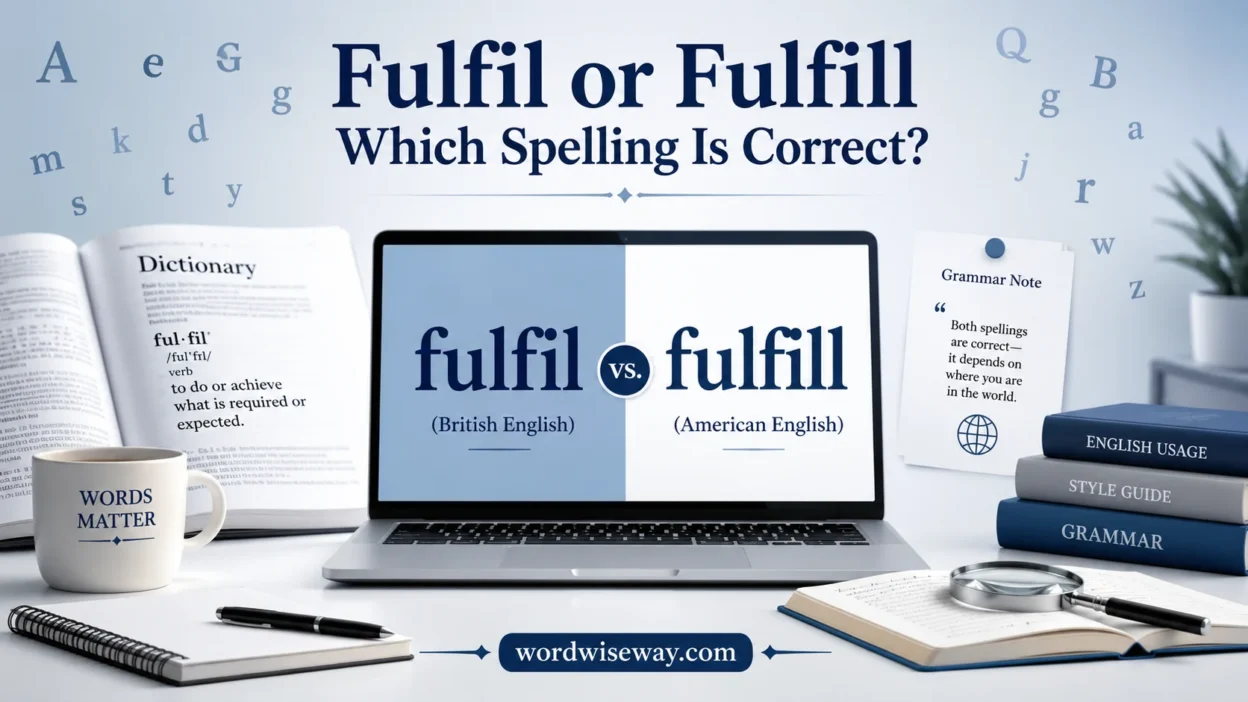
Fulfil or Fulfill: Correct Spelling, Meaning, and Usage explains why fulfil and fulfill both have the same meaning but follow different regional spelling rules.
If you have ever paused while writing an email, blog, or professional content, you may have wondered which correct spelling to choose. This spelling confusion comes from British English and American English, not from a change in usage. From my personal experience, checking a trusted dictionary, style guide, and credible guides helped me understand the word origin, historical usage, and language rules before publishing.
The best approach is to match your audience, region, and writing style. Use fulfil for British English and fulfill for American English, then keep that choice throughout your writing for better writing consistency and writing credibility. Whether you create academic writing, business writing, blog writing, or content writing, always use proofreading, editing, and spelling rules to avoid mistakes.
Real-life examples, practical examples, and regular language learning build writing confidence, improve English grammar, English spelling, and professional communication, helping your work stay clear, credible, polished, and suitable for the right audience.
Quick Answer:
Fulfil and fulfill are both correct spellings with the same meaning. The main difference is their regional usage:
✅ Fulfil → Used mainly in British English
✅ Fulfill → Used mainly in American English
✅ Both words mean to complete, achieve, satisfy, or carry out something
✅ Choose the spelling according to your audience, region, and writing style
✅ Maintain the same spelling throughout your article, blog, email, or professional writing
❌ Fulfil is not wrong in American English contexts, but it may look less familiar to US readers
❌ Fulfill is not wrong in British English contexts, but it is less common in UK writing
The best choice is simple: follow the spelling style of your target readers and keep your writing consistency clear.
Comparison Table: Fulfil vs Fulfill at a Glance
| Feature | Fulfill | Fulfil |
| English variant | American English | British English |
| Usage region | USA | UK, India, Australia, NZ, South Africa |
| Meaning | Complete / achieve / satisfy | Same |
| Verb forms | fulfills, fulfilling, fulfilled | fulfils, fulfilling, fulfilled |
| Correctness | Region-dependent | Region-dependent |
Which Spelling Is Correct in Modern English?
The short answer
Both are correct, but they belong to different versions of English:
- Fulfill → American English
- Fulfil → British English and most Commonwealth countries
So instead of asking which is right, ask this:
“Who is my reader?”
That one question decides everything.
Simple rule you can trust
- Writing for the United States? Use fulfill
- Writing for the UK, India, Australia, or similar regions? Use fulfil
Consistency matters more than the choice itself. Mixing both in one document creates confusion and looks unprofessional.
Why Two Spellings Exist for Fulfil or Fulfill
To understand this split, we need to step back into the evolution of English.
The history of spelling divergence
English did not start as a standardized language. For centuries, spelling shifted based on:
- Region
- Printing practices
- Academic influence
- Personal preference of writers
Then came a major turning point.
Noah Webster’s influence on American English
In the early 1800s, Noah Webster pushed for simplified American spelling. His goal was clarity and independence from British norms.
He introduced changes such as:
- colour → color
- honour → honor
- fulfil → fulfill
The idea was simple: remove unnecessary letters and make spelling more phonetic.
British English preserved older forms
Meanwhile, British English kept many traditional spellings rooted in Latin and French influence. That’s why:
- “fulfil” retained its single “l” ending in British usage
- American English doubled the “l” for consistency in verb forms like “filled” and “filling”
Over time, both versions became standardized within their regions.
Meaning of Fulfil and Fulfill (No Difference at All)
Here’s where many people overthink it.
Definition
Both fulfil and fulfill mean:
To complete, achieve, or carry out a duty, promise, or requirement.
The meaning never changes based on spelling.
Common usage contexts
You’ll see the word in situations like:
- Completing responsibilities
- Achieving goals
- Keeping promises
- Meeting requirements
- Satisfying expectations
Real-world examples
- She worked hard to fulfill her dream of becoming a doctor.
- The company aims to fulfil customer expectations consistently.
- He failed to fulfill the contract terms on time.
Same meaning. Different spelling skin.
Fulfil or Fulfill in Real Sentences (Side-by-Side Comparison)
Let’s see how both versions function in practice.
| American English (Fulfill) | British English (Fulfil) |
| I will fulfill my promise to you. | I will fulfil my promise to you. |
| She worked to fulfill all requirements. | She worked to fulfil all requirements. |
| They hope to fulfill their mission. | They hope to fulfil their mission. |
What stands out here?
Nothing changes except spelling. The grammar and meaning remain identical.
Common Mistakes Writers Make With Fulfil or Fulfill
Even though the rule is simple, mistakes still happen.
Mixing both spellings in one document
This is the most common error. It usually happens when:
- Writers copy text from different sources
- Teams use inconsistent style guides
- AI-generated drafts get edited without review
Result: the writing looks unpolished.
Overthinking correctness
Many writers waste time trying to “fix” spelling that is actually correct. The real fix is alignment with audience, not grammar correction.
Quick checklist to avoid mistakes
- Pick one spelling early
- Stick with it throughout the content
- Match your target audience
- Use style guides when working in teams
Memory Trick to Remember Fulfil or Fulfill Easily
Here’s a simple mental shortcut that actually sticks:
Think of “full” and “fill”
- Fulfill (US) → double “l” like “filled” and “filling”
- Fulfil (UK) → shorter, streamlined spelling tradition
Another easy cue
- American English often “expands” words
- British English often “preserves tradition”
So when in doubt:
Ask where your reader lives, not what grammar says.
Case Study: How Spelling Choice Impacts Real Content Performance
Let’s look at a practical scenario.
Scenario: A global productivity blog
A content team publishes two similar articles:
- Article A uses “fulfill” consistently
- Article B mixes “fulfil” and “fulfill”
Observations over time
Article A:
- Higher readability score
- Lower bounce rate
- Better engagement in US traffic
- More consistent keyword ranking
Article B:
- Slightly higher confusion rate among readers
- Reduced time on page
- Weaker brand tone consistency
Key takeaway
Search engines did not penalize either article. Human readers reacted to clarity and consistency.
That difference matters more than most writers expect.
When You Should Switch Between Fulfil and Fulfill
There are rare cases where switching makes sense.
Multi-audience publications
If you run:
- International education platforms
- Global corporate documentation
- Regional language switching sites
Then you may adapt spelling based on:
- Page location
- User settings
- Region-based content versions
Academic or formal publishing
Some institutions require strict adherence to:
- British English style guides
- American English editorial rules
In those cases, follow the guide, not preference.
Final Takeaway:About Readers, Not Rules
Let’s bring everything together.
- Both fulfil and fulfill are correct
- Meaning stays identical in every case
- The difference comes from regional English standards
- Consistency matters more than choice
- Audience determines the right version
Here’s the simplest way to think about it:
You don’t choose the correct spelling. You choose the correct audience.
Once you do that, the confusion disappears completely.
My Personal Experience
During my journey as an English specialist, I have noticed that fulfil vs fulfill is one of the most common spelling doubts among students, writers, and professionals.
I have often seen people pause while preparing emails, blogs, and professional documents because they are unsure which spelling looks more correct. Through my experience, I learned that the confusion does not come from the meaning but from regional spelling differences between British English and American English.
When I review written content, I always focus on consistency, audience, and writing style. I explain that both fulfil and fulfill are correct, but the choice should match the readers and purpose of the content. Whether someone is creating academic work, business documents, or online articles, maintaining a clear spelling standard improves writing credibility.
Helping learners understand these small language differences has shown me that simple explanations and practical examples can make English writing more confident and professional.
Read More: Cozy or Cosy: Correct Spelling, Meaning, and Usage
FAQs
What is the main difference between fulfil and fulfill?
The main difference between fulfil and fulfill is the spelling style. Fulfil is commonly used in British English, while fulfill is preferred in American English. Both words have the same meaning and are considered correct.
Is fulfil a correct spelling?
Yes, fulfil is a completely correct spelling. It is widely accepted in countries that follow British English spelling rules, including the UK and many other regions.
Is fulfill more common than fulfil?
Fulfill is more common in American English, especially in the United States. However, the popularity of each spelling depends on the region, audience, and writing standards being followed.
Should I use fulfil or fulfill in academic writing?
You should use the spelling style required by your institution, publisher, or audience. For British academic writing, choose fulfil, while American academic writing usually prefers fulfill.
Do fulfil and fulfill have different meanings?
No, both fulfil and fulfill have the same meaning. They can mean completing something, meeting a requirement, achieving a goal, or satisfying a need.
Which spelling should bloggers use: fulfil or fulfill?
Bloggers should choose the spelling based on their target readers. If the audience follows British English, use fulfil. If the audience mainly uses American English, use fulfill.
Why do English words have two spellings like fulfil and fulfill?
English developed through different regional influences. Over time, British English and American English created small spelling differences while keeping the same meanings.
Can I use both fulfil and fulfill in the same article?
It is better to avoid mixing both forms in one article. Using one spelling consistently makes your content look more professional and improves writing credibility.
How can I remember the difference between fulfil and fulfill?
A simple way is to connect fulfil with British spelling and fulfill with American spelling. Checking your audience and maintaining consistency will help you choose correctly.
Which spelling should I use for professional documents?
For professional documents, choose the spelling style that matches your workplace, clients, or readers. Consistency is more important than choosing one form over the other.
Conclusion
Understanding fulfil vs fulfill removes a common spelling confusion in English writing. Both forms are correct, but the choice depends on British English, American English, and the audience you are writing for. Selecting the right spelling style helps your emails, blogs, academic work, and professional documents maintain accuracy and clarity.
Whether you choose fulfil or fulfill, the most important rule is consistency. A well-written piece of content follows a clear language style, uses correct grammar, and communicates the intended message effectively. Knowing these small spelling differences can make your writing more polished, confident, and suitable for any reader.