The modern debate surrounding Requester vs Requestor: Difference, Usage, and Correct Choice challenges many writers.
Have you ever wondered whether to use requester or requestor in your everyday workplace communication? In my years of analyzing corporate documentation, I have found that choosing between each variant can seem tricky because both refer to someone or a person who makes or asks for something. While they mean the same thing, their spelling and meanings vary based on the context or specific industry standards. For general business writing, a standard email, or a corporate report, the clearer and more common choice is requester.
This proper word aligns perfectly with standard English grammar rules, bringing consistency and accuracy to your daily text, messages, and website content. However, your vocabulary decisions must adapt when entering more formal situations or highly specialized environments.
In fields like procurement, IT, and government, or within official enterprise software system configurations, requestor is a highly favored technical term. This less commonly used variant functions as a defined user role in technical documentation and records.
Requester vs Requestor: Why This Word Pair Confuses Writers
At first glance, this seems like a spelling mistake waiting to happen. But both forms are legitimate.
The confusion comes from three main sources:
- English allows multiple spellings for similar concepts
- Different industries develop their own terminology
- Style guides don’t fully agree on a single “official” version
Here’s the key idea:
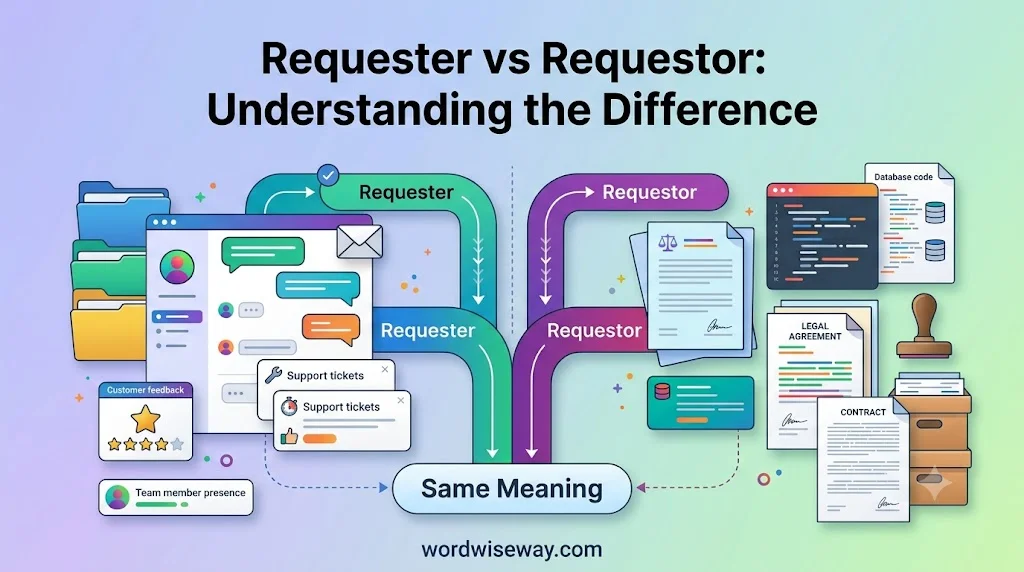
Both “requester” and “requestor” refer to a person who makes a request. The difference is not meaning, but usage environment.
Think of them like two doors leading into the same room. The room is identical. The hallway outside decides which door you use.
What “Requester” Means in English
Let’s start with the more common form: requester.
Definition of Requester
A requester is simply a person who makes a request for something.
That request could be:
- Information
- Service
- Access
- Support
- Approval
Where “Requester” Is Commonly Used
You’ll see “requester” in:
- Everyday English writing
- Customer service communication
- HR and workplace systems
- Academic writing
- Modern web applications
Example Sentences
- The requester submitted a form for document access.
- Each requester receives a confirmation email.
- The system notifies the requester when the ticket is resolved.
Why “Requester” Feels More Natural
It aligns with modern English patterns. Words ending in “-er” often describe people who perform an action.
For example:
- Teach → Teacher
- Build → Builder
- Request → Requester
So psychologically, “requester” feels intuitive and familiar.
What “Requestor” Means and Where It Comes From
Now let’s look at the less common but still valid form: requestor.
Definition of Requestor
A requestor also means a person who makes a request.
No difference in meaning. Only difference in usage tradition.
Where “Requestor” Is Commonly Used
This form shows up more in structured or formal environments:
- Legal contracts
- Government documents
- Insurance forms
- Database fields
- Software systems and APIs
Example Sentences
- The requestor must provide identification before approval.
- The system logs the requestor ID for auditing.
- Each requestor is assigned a tracking number.
Why “Requestor” Exists
This spelling often appears in environments where terminology was standardized early in system design.
Two reasons explain it:
- Legacy systems kept older or alternative spellings
- Technical language often prioritizes consistency over natural grammar
In short, “requestor” is not about English elegance. It is about system stability.
Requester vs Requestor: Are They Actually Different?
Here’s the simple answer:
No. They do not differ in meaning. They differ in usage context and convention.
Let’s break that down clearly.
Same meaning
Both refer to:
- A person making a request
- A party initiating an action or query
Different environments
- “Requester” → general English usage
- “Requestor” → formal, legal, technical usage
Different expectations
- Reader expects “requester” in everyday writing
- System or contract may require “requestor”
So the distinction is not linguistic. It is situational.
Where Each Version Appears in Real Life
This is where things become practical.
Everyday Communication
In emails, chats, and general writing, requester dominates.
Example:
- IT support ticket systems
- HR leave requests
- Customer service portals
People expect “requester” because it reads naturally.
Legal Writing
Legal documents often prefer a requestor.
Why?
- Legal language values consistency within a document
- Older legal templates still use established terms
- Systems often lock terminology once adopted
Example:
- “The requestor shall indemnify the provider…”
- “The requestor agrees to the terms herein…”
It sounds formal because it is formal.
Technical Systems and Software
In tech environments, both forms appear, but requestor is common in internal architecture.
You may see:
- requestor_id
- requestor_type
- requestor_role
Why developers use it:
- Database schemas are hard to change later
- Teams standardize naming early
- Internal consistency matters more than grammar style
Once a system goes live, changing terminology can break integrations.
Government and Administrative Use
Government forms vary widely.
- Some departments use “requester”
- Others stick with “requestor” for legacy alignment
This inconsistency is normal in large institutions.
Style Guide Perspectives on Requester vs Requestor
Different style guides don’t always agree.
Modern English Preference
Most contemporary dictionaries and writing guides lean toward:
Requester as the preferred modern form
Technical Acceptance
However:
- “Requestor” is still accepted in specialized contexts
- No major authority marks it as incorrect
Key Insight
Style guides care less about “right vs wrong” here and more about:
- clarity
- consistency
- audience expectations
Real-World Case Studies
Let’s ground this with realistic scenarios.
Case Study: Customer Support Platform
A SaaS company builds a ticketing system.
They choose:
- requester for UI labels
- requester_id for backend logs
Why?
- Users prefer readable language
- Developers need consistent database naming
Result: smooth user experience + stable backend design.
Case Study: Legal Contract System
A legal firm uses document templates created 15 years ago.
They consistently use:
- requestor throughout all agreements
Why they don’t change it:
- Hundreds of templates depend on the same wording
- Legal consistency reduces ambiguity in disputes
Result: stability beats modernization.
Case Study: Government Procurement Portal
A procurement system shows mixed usage:
- “requester” in public forms
- “requestor” in internal tracking
Why?
- Public-facing language is modernized
- Internal systems still rely on legacy naming
Result: dual-language ecosystem.
Common Mistakes Writers Make
Even experienced writers slip here.
Mixing both terms in one document
This creates inconsistency and confusion.
Bad example:
- The requester submits the form.
- The requestor ID is logged.
Better:
- Choose one form based on context and stick with it.
Assuming one is incorrect
Both are valid. The mistake is assuming only one is “real English.”
Copying system terminology blindly
Sometimes developers or templates use “requestor.” Writers copy it into general text without thinking.
That creates unnatural writing.
How to Choose Between Requester and Requestor
Here is a simple decision framework.
Use “Requester” when:
- Writing for general audiences
- Creating emails or reports
- Designing user-facing content
- Writing documentation for non-technical readers
Use “Requestor” when:
- Working with legal documents
- Matching existing system fields
- Writing database or API documentation
- Maintaining legacy terminology
Golden rule
Match the environment, not personal preference.
Quick Comparison Table
| Feature | Requester | Requestor |
| Meaning | Person making a request | Same meaning |
| Usage | General English | Legal/technical systems |
| Tone | Natural, modern | Formal, structured |
| Common in UI text | Yes | Rare |
| Common in databases | Sometimes | Very common |
| Style preference | Preferred today | Legacy accepted |
Linguistic Insight: Why Both Versions Exist
English does not evolve in a straight line. It grows like a city.
Some paths are planned. Others appear over time.
Here’s what happened with these two forms:
- “Requester” aligns with modern word formation patterns
- “Requestor” likely emerged from older formal or institutional usage
- Different industries standardized independently
Once industries lock in terminology, it rarely changes.
That is why both versions still exist today.
Why Consistency Matters More Than Choice
If there is one lesson to take away, it is this:
Consistency beats correctness debates in real writing.
Readers rarely care which form you choose. They care whether you use it consistently.
Inconsistent terminology signals:
- lack of attention
- unclear standards
- sloppy documentation
Consistent usage signals:
- clarity
- professionalism
- structured thinking
Read More: Analogy vs Allegory: Difference and Correct Usage
Frequently Asked Questions
Q1: What is the main difference between requester and requestor?
The primary difference lies in their usage environments and frequency. Requester is the more common and widely accepted spelling in general business writing and everyday workplace communication. On the other hand, requestor is a variant spelling that is usually found in highly specialized environments such as legal documents, procurement, and IT systems.
Q2: Is requestor grammatically incorrect?
No, it is not grammatically incorrect. Both terms refer to someone who asks for something. However, requester aligns more naturally with standard English grammar rules for adding suffixes to verbs, while requestor follows a Latin-based suffix trend often preferred in official terminology and formal situations.
Q3: Which spelling should I use in a standard business email?
For a standard email, corporate report, or general website content, you should use requester. Choosing this proper word brings consistency and clarity to your daily text and messages, making your writing look more polished and natural to the reader.
Q4: Why do IT and software systems use requestor?
In fields like IT and enterprise software system configurations, requestor functions as a defined user role. Organizations often follow these specific terminology preferences within their technical documentation to differentiate automated system roles from a physical person making a request.
Q5: When is requestor preferred over requester?
Requestor appears more often in official records, government contracts, and legal documents or court papers. If your industry standards or organizational guidelines explicitly dictate this spelling, using it ensures you match the expected professional tone of that field.
Q6: Do both words mean the same thing?
Yes, both forms mean the same thing semantically. They both describe a person who makes a request. The choice between them does not change the core meaning of your sentence, but it does impact the tone and styling of your documentation.
Q7: How do I maintain writing consistency across my team?
Writers and editors can avoid confusion by establishing clear organizational style guidelines. Deciding on a single word choice based on your target audience and document purpose ensures that everyone on your team produces accurate and standardized content.
Q8: Is requestor used in British English or American English?
Both regions recognize both spellings, but requester is universally more common in both American and British everyday communication. The divide is not strictly geographical; instead, it depends heavily on the specific industry or formal context you are writing for.
Q9: Can using the wrong variant confuse my readers?
While it rarely changes the semantic understanding of the text, mixing both spellings within the same document can harm your writing consistency. Sticking to one form based on your specific context helps you communicate with confidence and reduces noticeable spelling discrepancies.
Q10: Where can I verify which term my company prefers?
You should check your company’s internal style guide, product documentation, or existing contracts and records. Reviewing past examples of official communication will show you the established vocabulary preferences unique to your workplace.
Conclusion
Navigating the subtle differences between these two spellings ultimately comes down to understanding your specific audience, industry standards, and the formal nature of your writing. For everyday business communication, standard emails, and public-facing website content, sticking to the more common form is always a safe and grammatically sound choice. However, when drafting technical IT documentation, procurement forms, or official legal contracts, adopting the specialized variant ensures your work aligns with traditional professional expectations.
By paying close attention to contextual meanings and organizational guidelines, you can effortlessly eliminate confusion and maintain complete consistency across all your documents. Making a deliberate, informed choice between these terms not only improves your language accuracy but also enhances the overall clarity of your workplace communication. Ultimately, aligning your vocabulary with the established preferences of your field allows you to present your writing with the utmost confidence and professionalism.