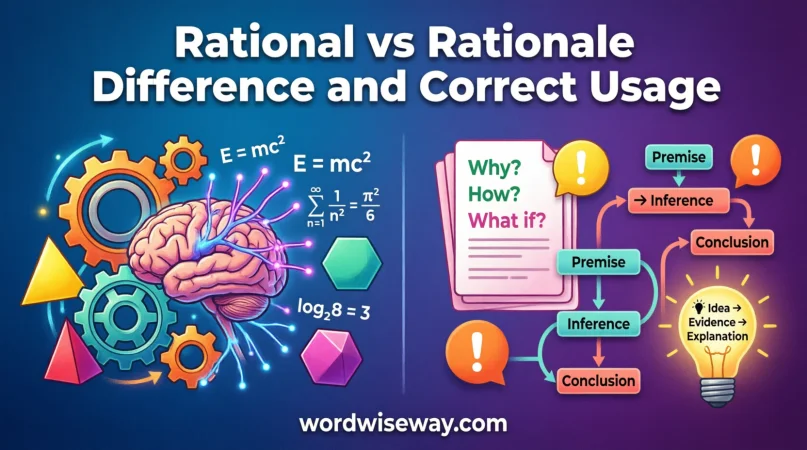
Rational vs Rationale: Difference and Correct Usage helps writers avoid common mistakes in academic, professional, and everyday communication. Although both words come from the Latin root ratio, they have different meanings and grammatical roles. Rational is an adjective used to describe logical thinking, reasonable behavior, or sound decisions, while rationale is a noun that explains the reason, purpose, or justification behind an action or belief.
Using these words correctly improves clarity and prevents confusion. Remember: rationale ends with “e” for explanation, while rational ends with “al” like logical. With practice and real-world examples, you can easily understand their difference and use each word confidently.
Understanding the difference between rational and rationale also helps you write stronger arguments, reports, and explanations. By recognizing when to describe a thought process and when to provide a reason behind it, you can communicate your ideas more accurately and avoid mistakes that affect the clarity of your message.
Rational vs Rationale: Why This Confusion Happen
Let’s be honest. These two words are linguistic twins at first glance. Same roots. Similar spelling. But they live completely different lives in language.
People mix them up for three main reasons:
- They sound almost identical when spoken
- They share a common idea of “reasoning”
- Auto-correct and AI writing tools sometimes misuse them in context
Here’s the twist: even experienced writers occasionally slip, especially when typing quickly or relying on suggestions.
Think of it like two roads that start at the same point but split immediately:
- One road is about thinking clearly
- The other is about explaining why something was done
Once you see that split clearly, everything becomes easier.
Rational vs Rationale: Clear Definitions That Stick
Let’s strip both words down to their core meaning.
Rational: Meaning and Use
The word rational describes how someone thinks or behaves.
It means:
- Logical
- Based on reason
- Not driven by emotion
- Clear-minded or sensible
It is mostly used as an adjective.
Examples:
- A rational decision
- A rational person
- A rational approach to a problem
You can think of it as describing the quality of thinking.
If a decision is rational, it follows logic instead of impulse.
Rationale: Meaning and Use
The word rationale is always about explanation.
It means:
- The reason behind something
- The justification for a decision
- The logic that explains an action
It is a noun.
Examples:
- The rationale for the policy
- The rationale behind the change
- A clear rationale was provided
Think of it as the story behind the decision.
Rational vs Rationale: The Key Difference in One Line
Here’s the simplest way to lock it in:
Rational describes thinking. Rationale explains decisions.
Or even shorter:
- Rational = logic in the mind
- Rationale = reason behind action
That’s the entire distinction in one mental switch.
Side-by-Side Comparison
Sometimes, a structured comparison makes everything click faster.
| Feature | Rational | Rationale |
| Part of speech | Adjective | Noun |
| Core meaning | Logical thinking or behavior | Explanation or justification |
| Focus | How someone thinks | Why something was done |
| Used for | People, decisions, actions | Policies, decisions, strategies |
| Substitution test | “logical” | “reason” |
| Example sentence | He made a rational choice | He explained the rationale |
A simple rule emerges here:
If you describe thinking, use rational.
If you describe reasoning behind something, use rationale.
Real-World Examples of Rational vs Rationale
Let’s bring this into real life because definitions alone don’t stick.
Everyday Life Example
Imagine you are choosing between two phones.
- You compare specs
- You check prices
- You ignore flashy ads
That is a rational decision.
Now imagine explaining your choice:
“My rationale for choosing this phone is better battery life and long-term durability.”
Same situation. Different word role.
Academic Writing Example
In school or university writing, this confusion shows up a lot.
Incorrect:
- “Provide a rational for your research”
Correct:
- “Provide a rationale for your research”
Why? Because the teacher wants your explanation, not your mental state.
Business Example
In a corporate meeting:
- “We made a rational decision based on data analysis.”
- “The rationale for the pricing strategy was explained in the report.”
One describes the decision quality. The other explains the reasoning behind it.
AI and Tech Example
With AI tools generating reports, this confusion is becoming more visible.
Example:
- AI might say: “The rational behind the model choice…”
Correct version:
- “The rationale behind the model choice…”
Small error. Big credibility impact.
Common Mistakes with Rational vs Rationale
Even strong writers fall into predictable traps.
Mistake 1: Using “rational” instead of “rationale”
This is the most common issue.
Wrong:
- What is the rational behind this strategy?
Correct:
- What is the rationale behind this strategy?
If you can replace the word with “reason,” you need rationale.
Mistake 2: Treating both as interchangeable
They are not interchangeable.
One is not a fancy version of the other. They serve different grammatical roles.
Mistake 3: Overthinking the spelling
People often pause mid-sentence and second-guess themselves.
Here’s a simple trick:
- Rational has -al → describes an adjective quality
- Rationale has -ale → ends like “explain” in sound pattern memory
It’s not perfect logic. But it helps your brain lock the distinction.
Memory Tricks for Rational vs Rationale
Let’s make this stick permanently.
The “Logic vs Reason” Trick
- Rational = logic in action
- Rationale = reason explained
If you can swap the word with “logical,” use rational.
If you can swap it with “reason,” use rationale.
The Sentence Test Trick
Try this:
- “Does this sentence need an explanation word?”
- Yes → rationale
- No → rational
Example:
- “She gave a ___ for her decision.”
You need explanation → rationale.
The Role Trick
- Rational = describes a person or mindset
- Rationale = describes a statement or explanation
Why Rational vs Rationale Matters More in 2026
This is not just grammar trivia anymore. The stakes are higher now.
1. AI-generated writing is everywhere
Tools like chatbots and writing assistants often blur subtle grammar differences. If you don’t correct them, errors slip into:
- Reports
- Emails
- Academic work
2. Professional communication is faster
People skim more than ever. A small mistake can signal carelessness.
3. Academic standards are stricter
Universities now use advanced detection tools that flag:
- Incorrect terminology
- Context misuse
- Inconsistent grammar patterns
4. Business clarity is critical
In decision-heavy environments, words like “rationale” are not optional. They are expected.
Case Study: How One Word Changes Meaning
Let’s look at a simple scenario.
Scenario: Marketing Campaign Approval
A team writes:
“The rational for this campaign is increased engagement.”
At first glance, it looks fine.
But here’s the issue:
- “Rational” implies thinking behavior
- It does not explain the reason
Now corrected:
“The rationale for this campaign is increased engagement.”
Now the sentence communicates clearly:
- Why the campaign exists
- What supports the decision
Impact
In real business settings:
- Misuse can confuse stakeholders
- It can weaken proposals
- It may reduce credibility in reports
One letter changes perception.
Quick Reference Cheat Sheet
Here’s a compact version you can reuse anytime.
- Rational → logical thinking, sensible behavior
- Rationale → explanation or justification
Quick test:
- Replace with “logical”? → rational
- Replace with “reason”? → rationale
Expert Tip:
Most mistakes happen when people focus on spelling instead of function.
Train your brain to ask:
- Am I describing thinking? → rational
- Am I explaining something? → rationale
Once you switch to function-based thinking, the confusion fades naturally.
Read More: Knaw or Gnaw: Correct Spelling, Meaning, and Usage
FAQs About Rational vs Rationale
1. What is the main difference between rational and rationale?
Rational is an adjective that describes something logical, reasonable, or based on good judgment. Rationale is a noun that refers to the reason, explanation, or justification behind a decision, action, or belief.
2. Is rational a noun or an adjective?
Rational is an adjective. It describes people, ideas, decisions, or actions that show logical thinking and careful reasoning.
3. Is rationale a noun or an adjective?
Rationale is a noun. It explains the reasoning or purpose behind something, such as a plan, policy, argument, or decision.
4. How can I remember the difference between rational and rationale?
A simple trick is to remember that rationale ends with “e” for explanation because it provides a reason or explanation. Rational ends with “al” like logical, making it an adjective that describes reasoning.
5. Can rational and rationale be used interchangeably?
No, they cannot be used interchangeably because they have different grammatical roles. Replacing one with the other can make a sentence incorrect or change its meaning.
6. What is an example of rational in a sentence?
Example: She made a rational decision after carefully reviewing all the facts.
Here, rational describes the decision as logical and reasonable.
7. What is an example of rationale in a sentence?
Example: The manager explained the rationale behind the new workplace policy.
Here, rationale refers to the explanation or reason for the policy.
8. Are rational and rationale pronounced the same way?
No, they have slightly different pronunciations. Rational is usually pronounced as “RASH-uh-nuhl,” while rationale is pronounced as “rash-uh-NAL.”
9. Why do people confuse rational and rationale?
People often confuse these words because they share the same Latin root and look similar. However, their meanings and uses are different because one describes reasoning while the other explains the reason behind something.
10. Which word should I use in academic writing: rational or rationale?
Use rational when describing logical thoughts, methods, or decisions. Use rationale when explaining the reasons or justification behind an argument, research method, or conclusion.
Conclusion
Understanding the difference between rational and rationale helps you communicate ideas with greater accuracy and confidence. While both words connect to reasoning, they serve different purposes: one describes logical thinking, and the other explains the reason behind it.
By remembering their grammatical roles and using simple memory tricks, you can avoid common mistakes in essays, reports, and professional writing. Clear word choices create stronger sentences and make your message easier for readers to understand.

Emma Smith has dedicated 14 years to Princeton University’s English Department, mentoring students in textual interpretation, literary movements, and critical frameworks. Her research explores Shakespearean drama, Victorian serial fiction, postcolonial narrative theory, and manuscript studies and probing how literary forms evolve across cultures and centuries. Emma has delivered lectures at international humanities congresses and published findings in distinguished academic journals, underscoring her commitment to scholarly depth and vibrant teaching.