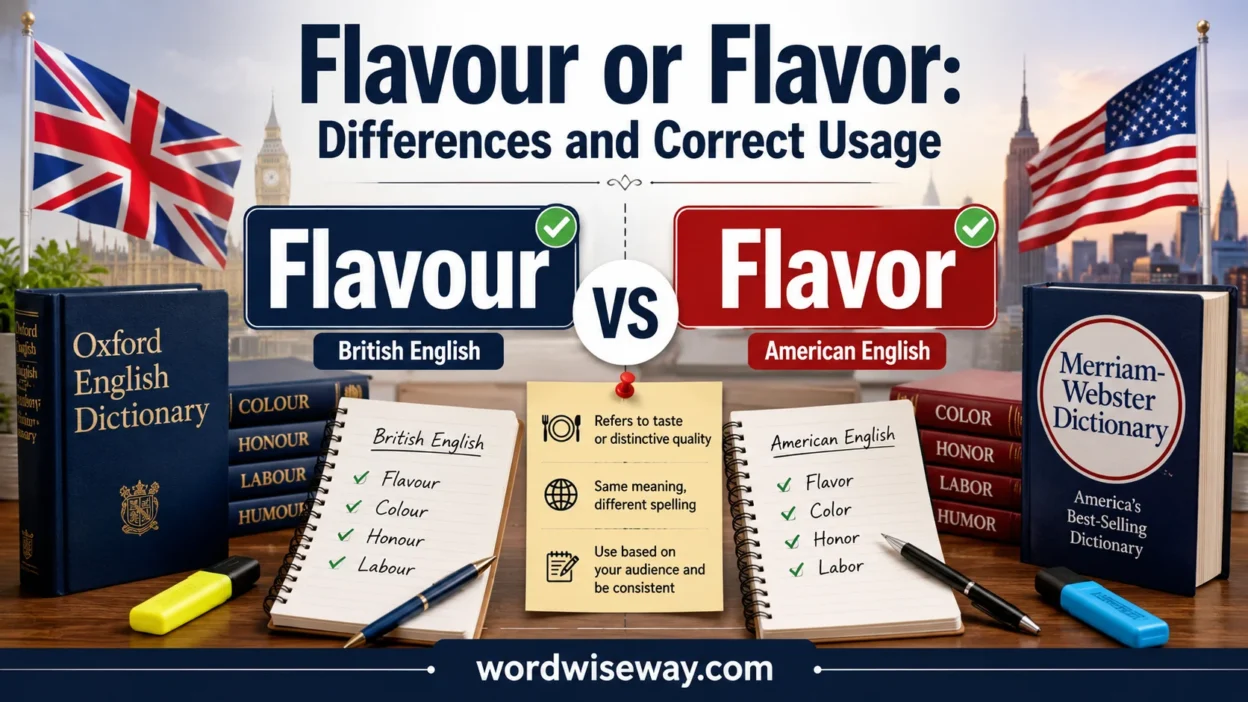
When I first started writing digital content for a global audience, a common question frequently arose: is it flavour or flavor? Flavour or Flavor: Differences and Correct Usage explains how these spellings evolved to help writers navigate regional distinctions. Both words refer to the taste of food or a figurative experience, but flavour is the British spelling while flavor is the American variant. Choosing the right form is essential for anyone producing high-quality, regionally aware content that maintains high credibility.
In my experience, readers get confused because the words look different but sound the same, creating confusion in emails, blogs, and social media posts. Whether you use the -or or -our spelling depends on the version of English your audience prefers. By staying aware of these grammar rules and usage patterns, you can confidently choose the correct spelling and avoid unprofessional mistakes.
Quick Answer
If you’re looking for the short answer, here it is:
| Word | English Variant | Common Countries |
| Flavour | British English | United Kingdom, Canada, Australia, New Zealand, Ireland |
| Flavor | American English | United States |
Both spellings refer to the same thing:
The distinctive taste, smell, or sensory quality of food, drinks, and other substances.
Neither spelling is more correct than the other.
The key is choosing the version that matches your audience.
For example:
- American readers expect flavor
- British readers expect flavour
- Canadian publications typically prefer flavour
- US brands almost always use flavor
A simple rule works well:
Write flavor for American audiences and flavour for British or Commonwealth audiences.
What Does Flavour or Flavor Mean?
Before exploring the spelling difference, it helps to understand the word itself.
The term refers to the combined sensory experience created by taste, smell, texture, and even temperature.
When people talk about flavor, they rarely mean taste alone.
For instance, if you have a cold and your nose is blocked, food often seems bland. That’s because smell contributes significantly to flavor perception.
Dictionary Meaning
Flavor/Flavour means:
- The distinctive taste of food or drink
- A characteristic quality or feature
- A particular atmosphere or feeling
- A variety or version of a product
Examples in Everyday Writing
Food:
- The soup has a rich flavor.
- The sauce adds extra flavour to the dish.
Business:
- The company launched a new flavor of energy drink.
- Several flavours were introduced for different markets.
Atmosphere:
- The city has a unique cultural flavor.
- The festival brought a local flavour to the event.
Notice that the meaning remains identical regardless of spelling.
The Origin of Flavour and Flavor
Language often tells fascinating stories.
The history of flavour and flavor stretches back hundreds of years and reveals how English evolved differently on opposite sides of the Atlantic.
Latin Roots
The word ultimately derives from the Latin term flare, meaning “to blow” or “to breathe.”
Over time, this evolved through Old French into forms related to aroma, scent, and taste.
Old French Influence
The Old French word flaur referred to scent, fragrance, or aroma.
Following the Norman Conquest of England in 1066, French heavily influenced English vocabulary.
Many culinary terms entered English during this period.
Middle English Development
As English developed, the word gradually evolved into various spellings before settling into the modern forms we recognize today.
Historical documents reveal numerous spellings, including:
- Flavour
- Flavor
- Flavoure
- Flauour
Spelling standardization was far less strict than it is today.
How the Spelling Split Happened
The difference between flavour and flavor emerged because British and American English followed different paths.
British English Preserved the “U”
Britain retained spellings influenced by French traditions.
As a result, many words continued using the “-our” ending:
- Colour
- Honour
- Labour
- Favourite
- Flavour
These spellings became the standard throughout the United Kingdom and many Commonwealth nations.
American English Simplified Many Words
During the late 18th and early 19th centuries, American lexicographers sought to simplify English spelling.
The most influential figure in this movement was Noah Webster.
Webster believed American English should develop its own identity.
As part of that effort, he encouraged simplified spellings.
Examples include:
| British English | American English |
| Colour | Color |
| Honour | Honor |
| Labour | Labor |
| Favourite | Favorite |
| Flavour | Flavor |
These reforms eventually became standard throughout the United States.
Why American English Uses “Flavor”
The American preference for flavor isn’t random.
It reflects a broader philosophy about language efficiency and standardization.
Noah Webster’s Influence
Webster published influential dictionaries that shaped American spelling conventions.
His goals included:
- Simplifying spelling
- Improving consistency
- Reducing unnecessary letters
- Creating a distinct American linguistic identity
Removing the silent “u” from words ending in “-our” fit perfectly with these objectives.
Modern American Usage
Today, virtually all American institutions use flavor.
This includes:
- Schools
- Universities
- Newspapers
- Government agencies
- Publishers
- Businesses
- Marketing firms
American readers generally expect this spelling.
Using flavour in US-focused content can appear unusual or foreign.
Why British English Uses “Flavour”
British English maintained traditional spellings rooted in historical conventions.
Historical Continuity
British dictionaries preserved many spellings that reflected French influences and established literary traditions.
As a result, words ending in “-our” remained standard.
Commonwealth Influence
Many countries historically connected to Britain adopted the same spelling standards.
These include:
- Canada
- Australia
- New Zealand
- Ireland
- South Africa
As a result, flavour remains the dominant spelling throughout much of the English-speaking world outside the United States.
Countries That Use Flavour vs Flavor
Understanding regional preferences can prevent embarrassing mistakes in international communication.
Global Usage Comparison
| Country | Preferred Spelling |
| United States | Flavor |
| United Kingdom | Flavour |
| Canada | Flavour |
| Australia | Flavour |
| New Zealand | Flavour |
| Ireland | Flavour |
| South Africa | Flavour |
Important Exception
Globalization has blurred some boundaries.
Large multinational companies sometimes use different spellings on different regional websites.
For example:
- US website: Flavor
- UK website: Flavour
- Australian website: Flavour
This localization improves user experience and aligns with regional expectations.
Flavour vs Flavor in Professional Writing
Professional communication requires consistency.
Using the wrong spelling isn’t usually a major error. However, switching between spellings in the same document can look careless.
Academic Writing
Academic institutions often specify preferred language standards.
If you’re writing for a US university:
- Use flavor
If you’re writing for a UK institution:
- Use flavour
Always follow the style guide provided by your institution.
Journalism
News organizations maintain strict editorial standards.
Major publications rarely mix spelling systems because consistency supports credibility.
Business Writing
Businesses should choose spelling based on their target market.
For example:
A New York food company should use flavor.
A London-based culinary magazine should use flavour.
Publishing
Publishers typically establish language preferences before production begins.
Changing spellings halfway through a manuscript creates editing problems and confuses readers.
Flavour vs Flavor in Digital Marketing
Should You Use Both Spellings?
Sometimes.
For global audiences, mentioning both spellings once can help clarify the distinction.
However, repeatedly alternating between flavor and flavour may weaken consistency.
A better strategy is choosing one primary spelling and using it throughout the article.
Common British and American Spelling Differences
The flavour versus flavor debate belongs to a larger pattern.
“-our” vs “-or” Words
| British English | American English |
| Flavour | Flavor |
| Colour | Color |
| Honour | Honor |
| Labour | Labor |
| Favourite | Favorite |
| Humour | Humor |
| Neighbour | Neighbor |
Other Common Differences
| British English | American English |
| Centre | Center |
| Theatre | Theater |
| Defence | Defense |
| Travelling | Traveling |
| Licence | License |
| Jewellery | Jewelry |
| Organise | Organize |
Recognizing these patterns makes it easier to adapt content for different audiences.
How to Choose the Correct Spelling
The easiest approach is audience-first writing.
Use “Flavor” When
- Writing for American readers
- Publishing in the United States
- Following American style guides
- Marketing products in the US
Use “Flavour” When
- Writing for UK readers
- Publishing in Britain
- Following British style guides
- Marketing products in Commonwealth countries
For International Content
Ask yourself:
Who is the primary audience?
Once you know the answer, stick with the spelling they expect.
Consistency builds trust.
Common Mistakes to Avoid
Many writers understand the difference but still make avoidable errors.
Mixing Spellings
Incorrect:
- The flavor of the product depends on its natural flavour compounds.
Correct:
- The flavor of the product depends on its natural flavor compounds.
- The flavour of the product depends on its natural flavour compounds.
Ignoring Regional Standards
A British audience may notice American spelling.
Similarly, American readers often notice British spellings.
Inconsistent Branding
Imagine a food company using:
- Flavor on packaging
- Flavour on its website
- Flavor in advertising
That inconsistency weakens brand identity.
Real-World Examples of Flavor and Flavour
Let’s look at practical applications.
Food Packaging
American products often display:
- Vanilla Flavor
- Natural Flavoring
- Artificial Flavor
British products commonly show:
- Vanilla Flavour
- Natural Flavouring
- Added Flavour
Restaurant Menus
US restaurants typically use flavor.
British restaurants usually use flavour.
Academic Publications
Universities generally follow national language standards.
A UK journal will likely use flavour.
An American journal will likely use flavor.
International Brands
Many global companies maintain separate regional content strategies.
This ensures customers see familiar spelling conventions.
Case Study: A Global Food Brand
Consider a hypothetical snack company selling products in both the United States and the United Kingdom.
Initial Problem
The company launched a single website using American spelling worldwide.
UK visitors noticed terms like:
- Flavor
- Favorite
- Color
Some users perceived the content as less localized.
Solution
The company created region-specific versions.
US Version:
- Flavor
- Favorite
- Color
UK Version:
- Flavour
- Favourite
- Colour
Result
The localized experience felt more natural to visitors.
Customer engagement improved because the content matched audience expectations.
The lesson is simple:
Language localization matters.
Expert Insight
“Good writing isn’t about choosing the universally correct spelling. It’s about choosing the spelling your audience expects.”
This principle applies to businesses, bloggers, marketers, educators, and students alike.
Readers notice consistency more than they notice which spelling system you choose.
Read More: Allude vs Elude: Meaning, Differences, and Usage
Frequently Asked Questions
Q1. Is flavor or flavour the correct spelling?
Both are correct! The right choice depends entirely on your audience. Flavour is the standard spelling in British English (as well as Australian and Canadian English), while flavor is the preferred spelling in American English.
Q2. Why does British English use “-our” while American English uses “-or”?
This spelling split traces back to the early 19th century. American lexicographer Noah Webster sought to simplify English spelling and make it more phonetic. He dropped the “u” from words like flavour, colour, and honour in his landmark 1828 dictionary, establishing the American convention we use today.
Q3. Do flavor and flavour mean the exact same thing?
Yes, they are identical in meaning. Both refer to the distinctive taste of food or drink, or a characteristic quality of an experience (e.g., “adding local flavor to the event”).
Q4. Which spelling is preferred in Canada and Australia?
Canada and Australia generally follow British spelling conventions and use flavour. However, Canadian English occasionally uses American spellings due to geographic proximity, though flavour remains the formal standard.
Q5. Are related words like “flavoring” and “flavored” also affected?
Yes, the spelling rule extends to all derivatives of the word.
- British/Commonwealth: flavouring, flavoured, flavourless, flavourful
- American: flavoring, flavored, flavorless, flavorful
Q6. Are “flavor” and “flavour” pronounced differently?
No. Flavor and flavour are pronounced the same way. The only difference is the spelling, which varies between American and British English. Regardless of which version you use, readers and speakers understand the word in exactly the same way.
Q7. How do I decide which spelling to use in business or academic writing?
Choose based on your primary audience or your organization’s style guide. If you are writing for a US-based client or university, stick to flavor. If your readers are international or based in the UK, go with flavour. The most important rule is to remain consistent throughout your entire document.
Q8. What are some other common words that follow this “-our” vs “-or” pattern?
Many words share this exact regional spelling difference. Some of the most common pairs include:
- Colour vs. Color
- Honour vs. Honor
- Labour vs. Labor
- Humour vs. Humor
- Harbour vs. Harbor
Q9. Does using the wrong spelling look unprofessional?
It can. Mixing British and American spellings within the same document signals inattentiveness to detail. Using the US spelling for a UK audience (or vice versa) can make your writing look out of touch with regional norms, which might reduce your credibility.
Q10. How can I make sure I always use the correct version?
The easiest way is to adjust your word processor’s spellcheck settings. Change your language setting to either “English (United States)” or “English (United Kingdom)” depending on who you are writing for, and let the software flag any inconsistent spelling choices for you.
Conclusion
Ultimately, deciding between flavour and flavor comes down to understanding your audience and respecting regional linguistic standards. While both spellings refer to the exact same sensory experience or characteristic quality, choosing the correct form is vital for maintaining professional credibility. Whether you are writing an academic paper, drafting a marketing campaign, or sending a business email, aligning your spelling with the geographic location of your readers ensures your content feels natural and polished rather than distracted or inconsistent.
In an increasingly connected digital world, adapting to these subtle spelling variations is a sign of a thoughtful and effective communicator. By configuring your word processor’s localized dictionary and staying mindful of derivatives like flavored or flavouring, you can easily avoid jarring spelling mix-ups. Embracing these minor differences not only sharpens your writing style but also ensures your global message is received with maximum clarity and authority, no matter where your readers reside.
Key Takeaways
- Flavor is the American English spelling.
- Flavour is the British English spelling.
- Both words have identical meanings.
- Pronunciation does not change.
- Audience location should determine your choice.
- Consistency matters more than preference.
- Businesses should localize spelling for international markets.

Evelyn Shaw has spent 14 years at Yale University’s English Department, leading students through close readings, genre studies, and interpretive methodologies. Her scholarly interests include Renaissance drama, gothic fiction, feminist literary criticism, and archival research and examining how texts generate meaning across historical periods. Evelyn has presented at major academic conferences and published essays in peer-reviewed journals, reflecting her passion for rigorous analysis and student-centered learning.