This helpful article focuses on Allude vs Elude: Meaning, Differences, and Usage to help any eager writer master daily English grammar and writing.
As an editor, I see countless beginners and seasoned professionals pause at keyboards, confused by these two troublesome verbs that look and sound identical due to a similar Latin origin and ending. Their meanings and actions differ completely and are absolutely not interchangeable; making the wrong choice in an academic paper or professional message can instantly hurt your credibility and lead to confusion.
Making a common mistake here is an incorrect habit that is easy to break once you train yourself to spot the difference in meaning and use this guide to make your emails, papers, and conversations clearly accurate so you can easily avoid mistakes that confuse readers and ensure your message is never misunderstood.
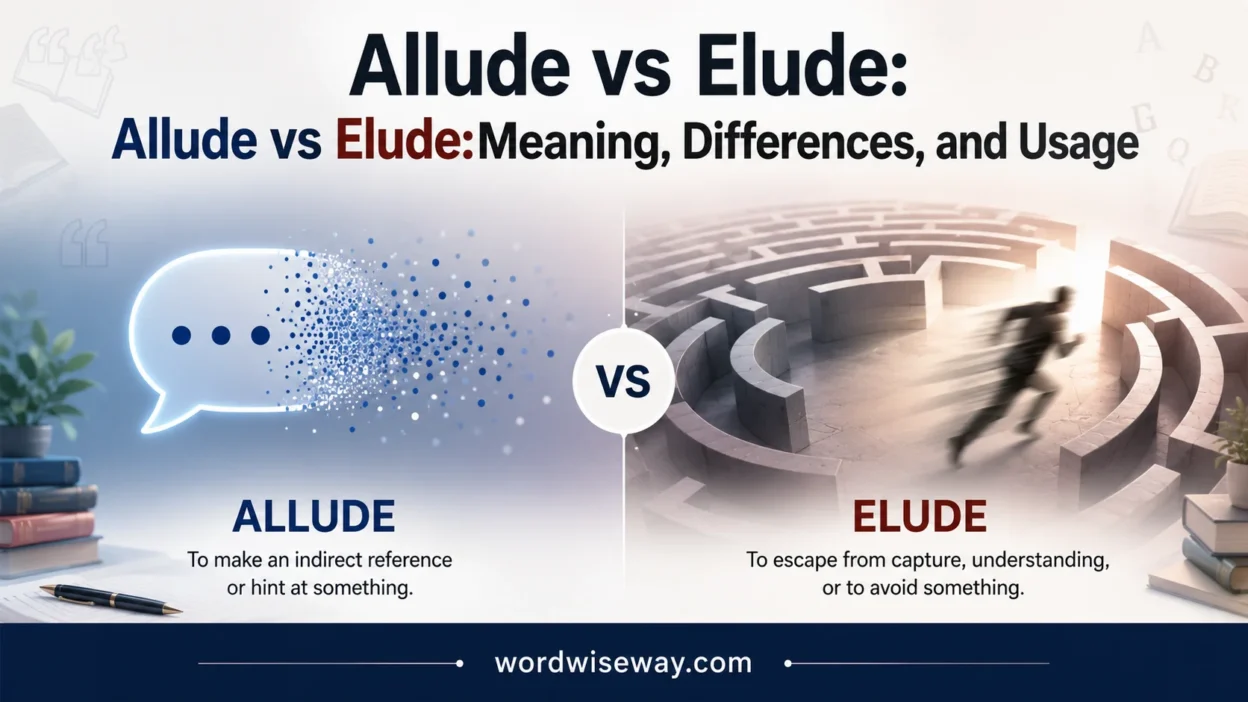
To keep speaking clear, we must understand the vital distinction and explain it in simple terms. To allude is to refer or mention something indirectly (indirect reference), while to elude means to escape, evade, or avoid being caught, or remain difficult to achieve or grasp.
Quick Answer:
- Allude is a verb that means to suggest, hint at, or refer to something indirectly without stating it outright.
- Elude is a verb that means to escape, avoid, or evade detection, capture, or complete understanding.
Why These Two Words Cause So Much Confusion
Language has a funny habit of hiding traps in plain sight. “Allude” and “elude” sit right at the center of one of those traps. They sound almost identical when spoken, they look similar when written, and yet they behave like completely different creatures in meaning.
You might read a sentence and pause. Did the writer mean hinting at something or escaping something? That tiny moment of doubt is exactly why mastering allude vs elude matters for clear communication.
Here’s the simple truth before we go deeper.
- Allude = indirect reference
- Elude = escape or avoid
That’s it at the core. But real mastery comes from understanding how these words move through real sentences, real contexts, and real thinking patterns. In this guide, we’ll break them apart, rebuild them, and lock them into your memory so they never mix again.
Quick Meaning Overview
Before the deep explanations, let’s anchor the basics in your mind.
When people confuse allude vs elude, they usually fail at one thing: context recognition. So let’s fix that fast.
Allude
- Means to hint at something indirectly
- You do not state it directly
- The listener or reader connects the dots
Elude
- Means to escape, avoid, or slip away from
- Something cannot be caught, understood, or reached
- It often creates a sense of frustration or difficulty
Simple Side-by-Side Clarity
- She alluded to her past mistake.
- The answer eludes her.
One is about subtle communication. The other is about escape or failure to grasp.
Allude Meaning Explained in Depth with Real Usage
Let’s slow down and explore allude properly because this is where most confusion begins.
What Does Allude Mean in Allude vs Elude Confusion?
To allude means to refer to something indirectly. You don’t say it outright. You suggest it in a way that requires interpretation.
Think of it like dropping breadcrumbs instead of giving a full map.
You are not stating the truth directly. You are pointing toward it gently.
How Allude Works in Real Life Communication
People use “allude” when they want to:
- Avoid being too direct
- Maintain politeness or subtlety
- Create literary or emotional depth
For example, instead of saying:
- “He lied during the meeting.”
You might say:
- “He alluded to information that wasn’t fully accurate.”
Same idea. Softer delivery.
Sentence Examples of Allude in Real Contexts
Here’s how it behaves naturally:
- The speaker alluded to political tension without naming it.
- The novel alludes to ancient mythology throughout the story.
- She alluded to personal struggles during the interview.
Notice something important. In each case, the meaning is indirect, not explicit.
Collocations You Will Actually See
These combinations appear often in real writing:
- allude to a problem
- allude to an event
- allude to a person
- allude to history
- allude to a theory
Common Mistakes with Allude
Writers often break it in two ways:
- Using it when they mean “escape”
- Using it too directly (which kills the meaning)
For example:
- Incorrect: The thief alluded the police
- Correct: The thief eluded the police
This mistake is the heart of allude vs elude confusion.
Elude Meaning Explained with Clear Real-World Thinking
Now let’s shift into the second half of the allude vs elude contrast.
What Does Elude Mean in Allude vs Elude Usage?
To elude means to escape, avoid, or remain out of reach. It can be physical, mental, or abstract.
Unlike “allude,” this word feels active. Something is slipping away.
Two Main Types of Elude Usage
Physical Escape
- A suspect eludes capture
- A bird eludes the hunter
- A criminal eludes police
Mental or Abstract Escape
- The answer eludes me
- Success eludes him
- Meaning eludes the reader
In both cases, there is frustration or difficulty involved.
How Elude Works in Real Communication
“Elude” often signals:
- Something is missing
- Something is hard to catch
- Something is just out of reach
It creates tension in the sentence.
Sentence Examples of Elude
- The solution continues to elude scientists.
- The suspect eluded authorities for weeks.
- The meaning of the poem eludes me.
Common Collocations for Elude
These are highly natural patterns:
- elude capture
- elude detection
- elude understanding
- elude explanation
- elude memory
Mistakes with Elude
Writers often misuse it like this:
- Incorrect: She eluded to her childhood
- Correct: She alluded to her childhood
Why? Because “elude” is not about hinting. It is about escaping.
This is where allude vs elude becomes crystal clear.
Allude vs Elude Key Differences Explained Simply
Let’s bring everything together in one clean comparison.
Meaning Comparison Table for Allude vs Elude
| Word | Core Meaning | Type of Action | Real Example |
| Allude | Indirect reference | Communication or hinting | She alluded to the issue |
| Elude | Escape or avoid | Physical or mental failure to grasp | The answer eludes me |
Conceptual Difference
Think of it like this:
- Allude = whispering toward meaning
- Elude = slipping away from reach
One speaks softly. The other runs away.
Emotional Tone Difference
- Allude feels subtle, intellectual, and indirect
- Elude feels frustrating, active, and unresolved
That emotional gap helps you remember allude vs elude instantly.
Real-World Usage Examples of Allude vs Elude
Let’s see how professionals and everyday speakers use both words.
Journalism Example
- The politician alluded to past corruption allegations during the debate.
- The suspect eluded arrest for nearly a month.
Same sentence structure. Totally different meaning.
Academic Writing Example
- The researcher alludes to earlier theories in physics.
- The explanation still eludes experts in the field.
Everyday Conversation Example
- He alluded to quitting his job but didn’t confirm it.
- The reason for her silence eludes me.
These examples show how flexible both words are when used correctly.
Memory Tricks to Master Allude vs Elude Forever
If grammar feels slippery here, don’t worry. Memory tricks fix that fast.
Sound-Based Trick
- Allude = A-LUDE → think “clue hidden inside”
- Elude = E-LUDE → think “escape route”
Action-Based Trick
Ask yourself:
- Is someone hinting? → Allude
- Is something escaping? → Elude
Quick Mental Test
Before choosing, pause and ask:
- Is this about communication or avoidance?
That one question solves most allude vs elude errors.
Common Mistakes Writers Make in Allude vs Elude Usage
Even experienced writers slip here.
1. Mixing Physical and Indirect Meaning
- Wrong: The idea alluded the scientist
- Correct: The idea eluded the scientist
2. Using Elude for Speech
- Wrong: She eluded to the issue
- Correct: She alluded to the issue
3. Overthinking Context
Sometimes writers freeze because both words “feel right.” The solution is simple. Focus on action type.
Practice Section: Test Your Understanding of Allude vs Elude
Try filling in the blanks:
- The detective said the suspect managed to ______ capture.
- The speaker ______ to economic challenges without naming them.
- The meaning of the poem ______ me completely.
- She ______ to her childhood memories during the interview.
Answers
- elude
- alluded
- eludes
- alluded
If you got most right, you’re already internalizing allude vs elude correctly.
Expert-Level Writing Tip for Allude vs Elude Mastery
Here’s a trick professional editors use.
Replace the word mentally:
- If you can replace it with “hinted at,” use allude
- If you can replace it with “escaped,” use elude
This substitution method removes guesswork completely.
Another useful habit is reading your sentence aloud. Your brain often catches wrong usage faster than your eyes.
Read More: Truly vs Truely: Correct Spelling, Meaning, and Usage Explained
FAQS
1. What is the main difference between allude and elude?
The primary difference lies in their actions. To allude means to make an indirect reference or hint at something without saying it directly. To elude means to escape, avoid, or slip away from someone, an object, or an idea.
2. What is a clear example of how to use “allude” in a sentence?
You use allude when you want to mention something subtly. For example: “During his speech, the mayor decided to allude to the upcoming budget cuts without naming them directly.”
3. What is a clear example of how to use “elude” in a sentence?
You use elude when describing something that gets away. For example: “The stealthy fox managed to elude the hunters by slipping into a hidden burrow.”
4. Why do writers often confuse allude and elude?
These words are easily confused because they are homophones—they sound almost identical when spoken aloud. They also share a similar spelling and a common Latin root, which tricks the brain into thinking they might mean the same thing.
5. Can allude and elude ever be used interchangeably?
No, they are never interchangeable. Using the wrong word will completely change the meaning of your sentence and can hurt your writing’s credibility.
6. Do these two words share the same Latin origin?
Yes, both words come from the Latin root ludere, which means “to play.” Allude comes from alludere (to play with/hint at), while elude comes from eludere (to play out of/escape).
7. What is an easy memory trick to tell allude and elude apart?
Think of the first letters:
- Allude = About (hinting about something).
- Elude = Escape (physically or mentally escaping).
8. Is the verb “allude” always followed by the preposition “to”?
Yes, in almost all modern contexts, allude requires the preposition “to” (e.g., “She alluded to her past experiences”). You cannot simply say “she alluded her past.”
9. Can “elude” be used for abstract things like thoughts, sleep, or success?
Yes, elude is frequently used for things you cannot physically touch. For example, you can say, “A good night’s sleep eludes me,” or “The answer to the riddle eluded the entire class.”
10. What are some common grammatical errors involving these terms in professional emails?
The most common mistake is writing “I wanted to elude to our meeting last week” when you actually mean allude (refer to). This mistake tells your reader that you wanted to “escape” the meeting rather than bring it up!
Conclusion:
In conclusion, mastering the distinction between allude and elude is a small but powerful way to elevate your writing and protect your professional credibility. Because these verbs share a similar Latin origin and sound nearly identical, it is incredibly easy for writers—especially beginners—to make a wrong choice and cause confusion. By remembering that to allude is to make an indirect reference, while to elude is to escape or avoid grasp, you can navigate your daily communication with total confidence and clarity.
Ultimately, taking a quick pause to think about the action you want to describe is the best guide to avoid these common mistakes. Training yourself to spot the difference in meaning ensures that your emails, academic papers, and daily conversations remain clearly accurate. With the simple memory tips and explanations outlined in this article, you can easily master this tricky grammar hurdle, ensuring your intended message is always understood and never eludes your audience.

Emma Smith has dedicated 14 years to Princeton University’s English Department, mentoring students in textual interpretation, literary movements, and critical frameworks. Her research explores Shakespearean drama, Victorian serial fiction, postcolonial narrative theory, and manuscript studies and probing how literary forms evolve across cultures and centuries. Emma has delivered lectures at international humanities congresses and published findings in distinguished academic journals, underscoring her commitment to scholarly depth and vibrant teaching.