Weird or Wierd? Correct Spelling, Meaning, and Usage explains the correct spelling and clears the confusion between weird and wierd.
Many learners and students make this common spelling mistake because both words have the same sound. The meaning of weird describes something unusual, strange, or extraordinary. A spellchecker often detects the wrong spelling, but understanding English spelling, word origin, pronunciation, and letter order helps improve spelling accuracy. The famous I before E except after C spelling rule also creates this spelling confusion.
Knowing the difference between wierd vs weird improves writing skills, professional writing, and written English. This article guide gives a quick answer, clear explanation, and useful guidance for correct usage. The correct word is always weird, so choose weird and use weird in academic writing, and daily communication. Learning grammar rules, vowel patterns, and spelling patterns helps English learners avoid common mistakes and build stronger language skills.
Quick Answer:
Let’s settle this immediately.
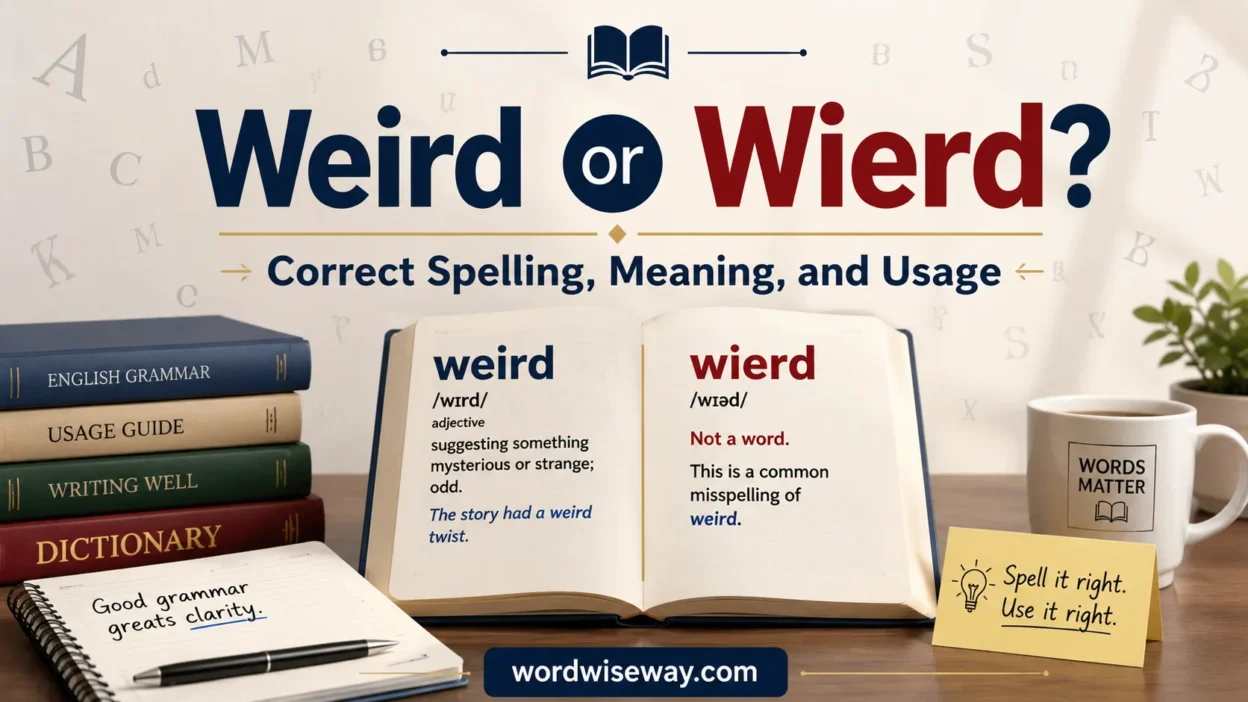
The correct spelling is: WEIRD
The incorrect spelling is: WIERD
That’s it. One vowel swap creates a mistake that has fooled writers for years.
The correct word weird describes something:
- Strange
- Unusual
- Unexpected
- Hard to explain
Example:
- “That situation felt weird.”
Now compare:
- ❌ “That situation felt wierd.” (Incorrect)
- ✔ “That situation felt weird.” (Correct)
The difference is small in shape but huge in correctness.
Quick Comparison Table:
| Word | Correct? | Meaning | Usage |
| weird | ✔ Yes | strange or unusual | all contexts |
| wierd | ❌ No | incorrect spelling | never use |
Simple. Clean. Final.
Why “Wierd” Looks Right But Is Always Wrong
Here’s where things get interesting.
Your brain doesn’t memorize spelling in a straight line. It stores sound patterns, not exact letter order. When you type quickly, your fingers often follow sound memory instead of visual memory.
And “weird” sounds like it could be spelled “wierd.”
That’s the trap.
Why this mistake happens:
- Fast typing without visual checking
- English vowel confusion (“ie” vs “ei” patterns)
- Auto-correct masking repeated mistakes
- Habit from incorrect online usage
English also makes it harder because many words follow the “i before e” rule, but not always. That inconsistency creates mental friction.
What “Weird” Actually Means
The word weird describes something that feels out of the ordinary.
But its meaning is richer than just “strange.”
Core meanings:
- Something unusual or unexpected
- Something difficult to understand
- Something slightly uncomfortable or unfamiliar
Everyday examples:
- “That noise sounded weird.”
- “He gave me a weird look.”
- “The weather feels weird today.”
You can use it in casual speech, storytelling, or even professional writing when appropriate.
The Origin of the Word “Weird” (Quick but Interesting History)
The word weird comes from Old English “wyrd.”
Originally, it meant:
- Fate
- Destiny
- Something controlled by unseen forces
Over time, the meaning shifted. Instead of fate, it began describing things that feel “out of normal human control,” which eventually became “strange or unusual.”
So when you say something is weird today, you’re indirectly referencing ancient ideas of fate and mystery.
Language is full of ghosts like that.
Why English Tricks You With “Weird vs Wierd”
English spelling is not always logical. It evolved from multiple languages, including:
- Old English
- Latin
- French
- Norse influences
Because of this mix, spelling rules often clash.
The famous “i before e” rule:
People try to apply:
“I before E except after C”
But “weird” breaks that rule completely.
That’s why learners often default to “wierd” without thinking.
Simple Trick to Remember the Correct Spelling
Here’s a memory trick that actually works:
Trick 1: The “We are I before E” rule breaker
- Weird = breaks the rule
- So it stands out
- And that makes it easier to remember
Trick 2: Visual chunking
Split the word:
- we + ir + d
Instead of: - wierd (which feels smooth but wrong)
Trick 3: Mental image trick
Imagine something so strange it “looks weird spelled correctly.”
Your brain starts linking correct spelling with the feeling of oddness.
Real-Life Examples of “Weird” in Action
Let’s ground this word in real communication.
Casual conversation:
- “That movie was weird but good.”
Storytelling:
- “A weird silence filled the room before the lights went out.”
Work communication:
- “We noticed a weird delay in the system response.”
Social media:
- “This is weirdly accurate.”
Each context shifts tone, but the spelling stays the same.
Common Mistakes People Make With “Weird”
Even fluent speakers slip up. Here’s why:
1. Typing too fast
Your fingers guess spelling based on sound.
2. Relying on autocorrect
You stop checking manually.
3. Visual memory confusion
“Wierd” looks symmetrical, so it feels correct at a glance.
4. Overthinking spelling rules
People try to force “i before e” everywhere.
Case Study: How a Small Spelling Error Changes Perception
Let’s imagine two emails:
Email A:
“That behavior seems weird and needs review.”
Email B:
“That behavior seems wierd and needs review.”
Even though the meaning is identical, Email B subtly feels less polished.
Why?
Because spelling errors create:
- Reduced trust
- Lower perceived attention to detail
- Slight distraction from the message
In professional writing, small details shape credibility more than people expect.
Weird in Everyday Language: Why It’s So Popular
The word “weird” is extremely flexible.
You can use it to describe:
- People
- Situations
- Objects
- Feelings
- Technology
That flexibility is why it appears constantly in speech and writing.
Examples:
- “That app behaves weird sometimes.”
- “I had a weird feeling about it.”
- “This weather is weird for June.”
It works because it’s simple and expressive.
Synonyms for Weird (And When to Use Them)
Sometimes you want variation in writing. Here are alternatives:
| Word | Meaning | Best Use |
| Strange | Neutral unusual | General use |
| Odd | Slightly unusual | Light tone |
| Bizarre | Very unusual | Strong emphasis |
| Eerie | Unsettling strange | Horror or mystery |
| Quirky | Charmingly unusual | Positive tone |
| Unusual | Neutral formal | Professional writing |
Example comparison:
- “That’s a weird idea.”
- “That’s a quirky idea.” (more positive)
- “That’s a bizarre idea.” (stronger tone)
Mini Practice Section: Test Yourself
Try these quickly.
Choose the correct spelling:
- w(e/i)rd behavior
- that was so w(e/i)rd
- something feels w(e/i)rd
Answers:
- weird
- weird
- weird
Fill in the blanks:
- That sound is ______.
- It feels ______ today.
- This is a ______ situation.
All answers: weird
Read More: Grammar or Grammer Correct Spelling, Meaning & Examples
FAQs
What is the correct spelling: weird or wierd?
The correct spelling is weird. The word wierd is a common spelling mistake and is not accepted as the standard spelling in modern English.
Why do people confuse weird and wierd?
People often confuse these words because they have the same pronunciation and look very similar. The confusion also happens because weird does not follow the common “I before E except after C” spelling pattern.
What does the word weird mean?
Weird means something unusual, strange, unexpected, or extraordinary. It can describe a situation, person, idea, feeling, or event that seems different from normal.
Is wierd a real English word?
No, wierd is not considered a correct English word. It is usually a typing mistake or spelling error caused by confusion about letter order.
How can I remember the spelling of weird?
A useful memory trick is to remember that weird has “ei” after the “w.” Practicing the correct spelling in sentences can also help you avoid mistakes.
Does weird have the same pronunciation as wierd?
Yes, both spellings may appear to have the same pronunciation, which is why many writers get confused. However, only weird is the correct spelling.
Can I use weird in formal writing?
Yes, you can use weird in formal and informal writing when describing something unusual or strange. It is commonly used in articles, essays, conversations, and professional communication.
Is weird related to British or American English differences?
No, the difference between weird and wierd is not about British English or American English. Both varieties of English use weird as the correct spelling.
Why does spellchecker correct wierd?
A spellchecker identifies wierd because it does not match the accepted spelling in English dictionaries. It suggests weird as the accurate alternative.
How can learning weird spelling improve writing?
Learning the correct spelling of words like weird improves spelling accuracy, writing skills, and communication. It helps learners create more professional and error-free content.
Conclusion
Understanding the difference between weird and wierd removes a common spelling confusion that affects many English learners and writers. Although both versions may look similar and sound the same, weird is the only correct spelling used in modern English. Learning its meaning, usage, and spelling pattern helps you write with more confidence.
Using the right spelling improves your overall language skills, professional writing, and everyday communication. By remembering the correct letter order and practicing the word regularly, you can easily avoid this common mistake and make your writing clearer.

Evelyn Shaw has spent 14 years at Yale University’s English Department, leading students through close readings, genre studies, and interpretive methodologies. Her scholarly interests include Renaissance drama, gothic fiction, feminist literary criticism, and archival research and examining how texts generate meaning across historical periods. Evelyn has presented at major academic conferences and published essays in peer-reviewed journals, reflecting her passion for rigorous analysis and student-centered learning.