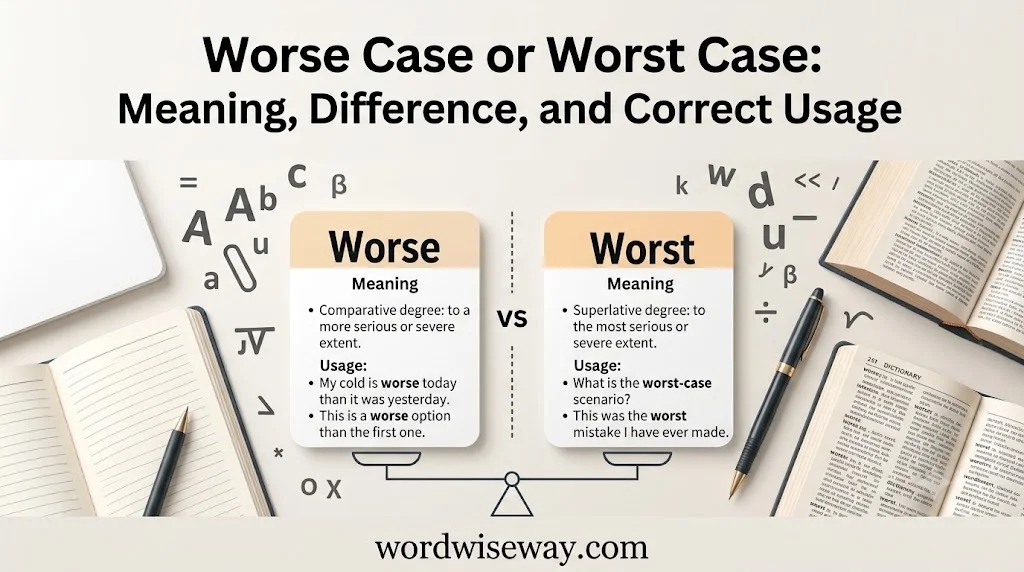
Choosing the correct phrase depends on whether you are comparing one negative situation to another, or describing the ultimate bad outcome. Worse Case or Worst Case: Meaning, Difference, and Usage is vital to understand for resolving everyday grammar mistakes. Using “worse case” is wrong unless making a direct comparison of two non-ideal scenarios. For a rock-bottom negative result, worst is the definitive meaning.
As native English speakers and professional writers, we face linguistic confusion with homophones words that sound alike but have different spellings and meanings. During a team meeting, a colleague mistakenly used “worse case” to describe a project delay. People frequently confuse these forms, treating them as interchangeable in everyday language. To understand this concept, we must look at comparative and superlative adjectives derived from the root word bad.
Making the right grammatical choice prevents common mistakes and minor spelling errors, ensuring your message and writing remain completely clear.
Understanding the Meaning of Worse
What Does Worse Mean?
The word worse is the comparative form of bad. It means something has become more unpleasant, harmful, difficult, or serious compared with another situation.
Think of worse as a word that needs a comparison partner. It usually answers the question:
“More bad than what?”
For example:
- The traffic today is worse than yesterday.
- This problem is worse than we expected.
- My headache became worse after working all night.
In each example, two conditions are being compared.
The first situation was already negative, but the second situation became more negative.
How Worse Works in a Sentence
The word worse usually appears when you compare:
- Two experiences
- Two choices
- Two conditions
- Two outcomes
- Two situations
Examples:
| Sentence | What Is Being Compared? |
| This movie is worse than the first one. | Two movies |
| The second plan is worse than the original plan. | Two plans |
| The weather became worse in the evening. | Earlier weather vs later weather |
Notice that worse does not describe the final level of negativity. It only shows that something has declined compared with something else.
Examples of Worse in Everyday Conversation
Imagine you have a small computer problem. At first, your laptop runs slowly. Later, it stops working completely.
You might say:
- “The problem got worse.”
Why?
Because the situation changed from bad to more serious.
Another example:
A company receives fewer sales this month than last month.
The manager might say:
- “Our sales performance is worse than last quarter.”
The word worse works because the manager compares two periods.
Understanding the Meaning of Worst
What Does Worst Mean?
The word worst is the superlative form of bad. It describes the highest degree of something negative.
While worse compares, worst ranks something as the most serious, unpleasant, or damaging option.
The question behind worst is:
“What is the most bad option possible?”
Examples:
- That was the worst mistake I ever made.
- Losing all customer data would be the worst outcome.
- Monday was the worst day of the week.
In these examples, the speaker is not comparing only two things. They are identifying the lowest point.
How Worst Works in a Sentence
The word worst often appears when discussing:
- The most serious problem
- The biggest mistake
- The hardest experience
- The most dangerous possibility
- The least desirable outcome
Examples:
| Sentence | Meaning |
| This is the worst decision we could make. | The most negative decision |
| The worst part was the delay. | The most unpleasant part |
| Losing the project would be the worst result. | The most damaging result |
Real-Life Example of Worst
Imagine a business preparing for unexpected problems.
Possible situations:
- A delivery arrives late.
- A customer cancels an order.
- The entire system crashes and all important information disappears.
The third situation represents the worst case because it creates the biggest problem.
Worse Case vs Worst Case: The Key Difference
Why “Worst Case” Is Correct
The phrase “worst case” means the most negative situation that could happen.
It is commonly used when people discuss risks, planning, emergencies, and possible outcomes.
The phrase follows a simple structure:
Worst + Case = The most serious possible situation
Examples:
- In the worst case, we may need to restart the project.
- The worst-case scenario involves losing important files.
- We should prepare for the worst case before making a decision.
The phrase works because the speaker refers to the final level of a problem, not a comparison.
Why “Worse Case” Is Usually Incorrect
The phrase “worse case” usually does not make grammatical sense because worse requires a comparison.
For example:
❌ We need a plan for the worse case.
This sentence creates a question:
Worse than what?
The listener expects another situation for comparison.
A correct version would be:
✅ We need a plan for the worst case.
The speaker means the most difficult situation that could happen.
When Could “Worse Case” Make Sense?
Although rare, “worse case” could technically appear if someone compares two cases.
For example:
- “The worse case happened during the second test.”
Here, the writer means one case was worse than another case.
However, this usage is uncommon and often sounds unnatural. In normal English writing, “worst case” is almost always the correct choice.
Worst Case Meaning and Common Uses
What Is a Worst-Case Scenario?
A worst-case scenario describes the most unfavorable outcome that could occur.
People use this idea to prepare for uncertainty. It does not mean the bad outcome will definitely happen. It simply means someone has considered the most serious possibility.
For example:
A website owner might think:
- Best case: Traffic increases quickly.
- Average case: Traffic grows slowly.
- Worst case: The website receives almost no visitors.
Thinking about the worst case helps people create backup plans.
Why People Use Worst-Case Planning
Worst-case thinking helps with:
- Risk management
- Emergency preparation
- Financial planning
- Business decisions
- Technology protection
- Personal organization
It allows people to ask:
“If everything goes wrong, what should we do?”
This question can prevent panic because a solution already exists before a problem appears.
Common Situations Where People Use “Worst Case”
Business Planning
Companies often analyze worst-case scenarios before launching products or making investments.
Example:
A company planning a new app might consider:
| Situation | Possible Outcome |
| Best case | Thousands of users join quickly |
| Expected case | Moderate growth occurs |
| Worst case | Users do not adopt the app |
This approach helps businesses prepare realistic strategies.
Financial Decisions
People use worst-case thinking when managing money.
Examples:
- What happens if income decreases?
- What happens if unexpected costs appear?
- What happens if an investment loses value?
A financial safety plan often considers the worst possible situation.
Technology and Data Protection
Technology professionals frequently prepare for worst-case events.
Examples include:
- Hardware failure
- Security problems
- Data loss
- System downtime
A backup system exists because organizations understand that the worst case can happen.
Everyday Life
People use the phrase naturally in daily conversations.
Examples:
- “Worst case, we can reschedule the trip.”
- “The worst case is that we arrive late.”
- “Let’s prepare for the worst case before leaving.”
These examples show that worst-case planning is not only for experts. Everyone uses it.
Worse vs Worst: Simple Comparison Table
| Word | Meaning | Grammar Type | Example |
| Worse | More bad compared with something else | Comparative adjective | This option is worse than the first one. |
| Worst | The most bad among all choices | Superlative adjective | This is the worst option available. |
| Worst case | The most negative possible situation | Common phrase | We must prepare for the worst case. |
| Worse case | A comparison between cases | Rare usage | This case is worse than the previous one. |
Remember: If you are talking about the most serious possible outcome, choose worst case.
How to Remember the Difference Between Worse and Worst
Many English learners confuse worse case and worst case because both words describe negative situations. The easiest way to remember the difference is to focus on whether you are comparing something or describing the maximum level of a problem.
A Simple Memory Trick: Worse Compares, Worst Ends the Scale
Think of a ladder of problems:
Good → Bad → Worse → Worst
Each step shows a higher level of difficulty.
- Bad describes a negative situation.
- Worse means something became more negative than before.
- Worst represents the lowest point on the scale.
For example:
- My internet connection is bad.
- My internet connection became worse after the update.
- Losing all my files would be the worst situation.
The word worse shows movement downward. The word worst shows the final destination.
The Comparison Test
Before using worse, ask yourself:
“Am I comparing two things?”
If yes, use worse.
Examples:
✅ This restaurant is worse than the one we visited yesterday.
✅ The second option is worse than the first option.
✅ The traffic today is worse than usual.
You are comparing one thing with another.
Now ask:
“Am I talking about the most negative possibility?”
If yes, use worst.
Examples:
✅ Losing the entire project would be the worst outcome.
✅ That was the worst mistake of my career.
✅ We should prepare for the worst-case scenario.
A Quick Grammar Shortcut
Use this simple formula:
| Question | Correct Word |
| Is something more bad than another thing? | Worse |
| Is something the most bad option possible? | Worst |
This small trick solves most confusion.
Common Mistakes With Worse Case and Worst Case
Using “Worse Case” Instead of “Worst Case”
This is the most common mistake.
Many people write:
❌ We should prepare for the worse case.
The problem is that worse needs a comparison. The sentence does not explain what the case is worse than.
The correct version is:
✅ We should prepare for the worst case.
Here, the meaning is clear: prepare for the most difficult possible situation.
Confusing Worse and Worst in Everyday Writing
People often mix these words because they sound similar.
Here are some common mistakes:
| Incorrect | Correct | Reason |
| This is the worse mistake I made. | This is the worst mistake I made. | It is the biggest mistake, not a comparison. |
| The situation became worst. | The situation became worse. | The situation changed negatively compared with before. |
| Prepare for the worse scenario. | Prepare for the worst scenario. | It means the most negative possibility. |
Using Worst When a Comparison Is Needed
The opposite mistake also happens.
Example:
❌ This year was worst than last year.
The word than signals a comparison, so worse should be used.
Correct:
✅ This year was worse than last year.
Another example:
❌ My second attempt was worst than my first attempt.
Correct:
✅ My second attempt was worse than my first attempt.
Worse Case or Worst Case in Professional Writing
Using the correct phrase matters in professional communication. A small grammar mistake can affect how polished your writing appears.
Businesses, researchers, engineers, and managers often use worst-case scenario when discussing risks.
Business and Workplace Examples
Companies regularly evaluate possible problems before making decisions.
For example, a marketing team launching a new campaign might create different predictions:
| Scenario | Meaning |
| Best-case scenario | The campaign performs better than expected |
| Expected scenario | The campaign performs normally |
| Worst-case scenario | The campaign fails to produce results |
A project manager might write:
“The team has prepared backup plans for the worst-case scenario.”
This sentence clearly explains that the team is ready for the most difficult outcome.
Technology Examples
Technology companies often prepare for worst-case situations because digital systems can fail unexpectedly.
Examples:
- A server stops working.
- Important files become unavailable.
- A software update creates problems.
- A security issue affects operations.
A technology team might say:
“Regular backups protect the company from the worst-case scenario.”
The phrase shows planning and prevention.
Academic and Formal Writing Examples
Students and researchers may use worst-case language when discussing possible outcomes.
Examples:
- “The worst-case scenario could affect the accuracy of the results.”
- “Researchers considered the worst possible outcome before starting the experiment.”
In formal writing, accuracy matters because unclear wording can distract readers from the main idea.
Worst Case vs Worst-Case: Understanding the Hyphen
Many writers also wonder whether they should write:
- worst case
- worst-case
Both forms can be correct, but they appear in different situations.
When to Use “Worst-Case” With a Hyphen
Use worst-case when it works as an adjective before a noun.
Examples:
✅ worst-case scenario
✅ worst-case outcome
✅ worst-case estimate
✅ worst-case situation
The hyphen connects the words because together they describe another noun.
Example:
“The company created a worst-case plan.”
Here, worst-case describes the type of plan.
When to Use “Worst Case” Without a Hyphen
Use worst case when it acts as a noun phrase.
Examples:
✅ In the worst case, we will cancel the event.
✅ The worst case would cost more money.
✅ We prepared for the worst case.
Here, the phrase stands alone instead of describing another word.
Easy Hyphen Rule
Remember:
Before a noun → use worst-case
After a noun or by itself → use worst case
Examples:
| Correct Usage | Explanation |
| worst-case scenario | Describes scenario |
| worst-case prediction | Describes prediction |
| In the worst case | Phrase stands alone |
| The worst case happened | Phrase acts as a noun |
Real-Life Examples of Worst-Case Thinking
Worst-case planning helps people make smarter decisions. It does not mean expecting failure. Instead, it means preparing for unexpected challenges.
Case Study: Website Owner Preparing for Traffic Problems
Imagine someone launches a new website.
Possible outcomes:
| Situation | Result |
| Best case | Thousands of visitors arrive |
| Normal case | Traffic grows gradually |
| Worst case | The website gets very little traffic |
A smart website owner creates backup strategies:
- Improve content quality.
- Study visitor behavior.
- Adjust marketing methods.
- Continue improving the website.
The worst-case scenario becomes a preparation tool instead of a source of fear.
Case Study: Small Business Planning
A small business owner wants to open a new store.
Before investing money, they consider:
Best case:
- Customers arrive quickly.
- Sales increase.
- The business expands.
Expected case:
- Growth happens slowly.
- Profit takes time.
Worst case:
- Sales remain low.
- Expenses become difficult to manage.
By thinking about the worst case, the owner can create solutions before problems appear.
Case Study: Personal Planning
A traveler preparing for a trip might consider:
- Flight delays.
- Weather problems.
- Lost reservations.
The worst-case scenario might involve missing an important event.
A prepared traveler creates solutions:
- Keeps important documents available.
- Arrives early.
- Has backup options.
Planning for the worst case creates confidence.
Read More: Set vs Sit: Differences, and Correct Usage
Frequently Asked Questions
1. What is the main difference between “worse” and “worst”?
Ans: “Worse” is a comparative adjective used to compare two things (e.g., “This storm is worse than yesterday’s”). “Worst” is a superlative adjective used to describe the absolute lowest or most negative item in a group of three or more things (e.g., “This is the worst storm of the year”).
2. Is the phrase “worse case scenario” grammatically correct?
Ans: No, it is generally incorrect. The correct phrase is “worst-case scenario” because you are referring to the absolute most negative possible outcome out of all potential choices, requiring the superlative form.
3. When can “worse case” be used correctly?
Ans: It is only correct when you are directly comparing two specific cases side-by-side. For example: “We reviewed two accident reports, and this is the worse case of the two.”
4. Are “worse” and “worst” homophones?
Ans: No, they are not homophones. While they sound alike in casual speech, they have distinct ending sounds and entirely different grammatical functions.
5. Why do people frequently confuse these two words?
Ans: Writers often face linguistic confusion because both words deal with negative states and stem from the same root. Additionally, people sometimes drop the “t” sound at the end of “worst” when speaking quickly, leading to spelling mistakes.
6. How can I easily remember which word to use?
Ans: Remember that worse compares two things (both words contain the letter ‘e’). Worst states the absolute limit of badness (both words end in the letter ‘t’).
7. Can “worse” and “worst” be used as nouns?
Ans: Yes, they can function as nouns when preceded by an article or pronoun. For example, “The worst is yet to come,” or “Changes shifted the situation from bad to worse.”
8. Is “worse” always followed by the word “than”?
Ans: In comparative sentences, “worse” is usually followed by “than” when the second item is explicitly named (e.g., “Plan A is worse than Plan B”). However, it can stand alone if the comparison is implied.
9. What are the root words for comparative and superlative adjectives?
Ans: The root modifier is the positive adjective “bad.” When things get progressively more negative, the chain moves from bad (positive) to worse (comparative) to worst (superlative).
10. Does mixing up these terms change the meaning of a sentence?
Ans: Yes, it changes the meaning entirely. Using “worse” tells the reader you are weighing two options, while using “worst” signals that you are discussing the absolute final limit of a negative result.
Conclusion
Mastering the distinction between these two common adjectives is a foundational step toward clearer, more professional communication. Because linguistic confusion with words derived from “bad” occurs so frequently in everyday language, taking the time to pause and analyze your sentence structure prevents minor spelling mistakes from clouding your message. Whether you are dealing with a routine project delay or drafting a critical report, choosing the correct phrase ensures your audience understands the exact severity of the situation you are describing.
Ultimately, eliminating grammatical errors is less about memorizing rigid rules and more about protecting the integrity of your writing. A single misplaced letter can inadvertently signal to a reader that you are comparing two isolated scenarios when you actually meant to highlight a definitive, rock-bottom negative result. By keeping these simple comparative and superlative guidelines in mind, writers can confidently navigate their daily vocabulary and maintain absolute clarity in every sentence they produce.

Emma Smith has dedicated 14 years to Princeton University’s English Department, mentoring students in textual interpretation, literary movements, and critical frameworks. Her research explores Shakespearean drama, Victorian serial fiction, postcolonial narrative theory, and manuscript studies and probing how literary forms evolve across cultures and centuries. Emma has delivered lectures at international humanities congresses and published findings in distinguished academic journals, underscoring her commitment to scholarly depth and vibrant teaching.