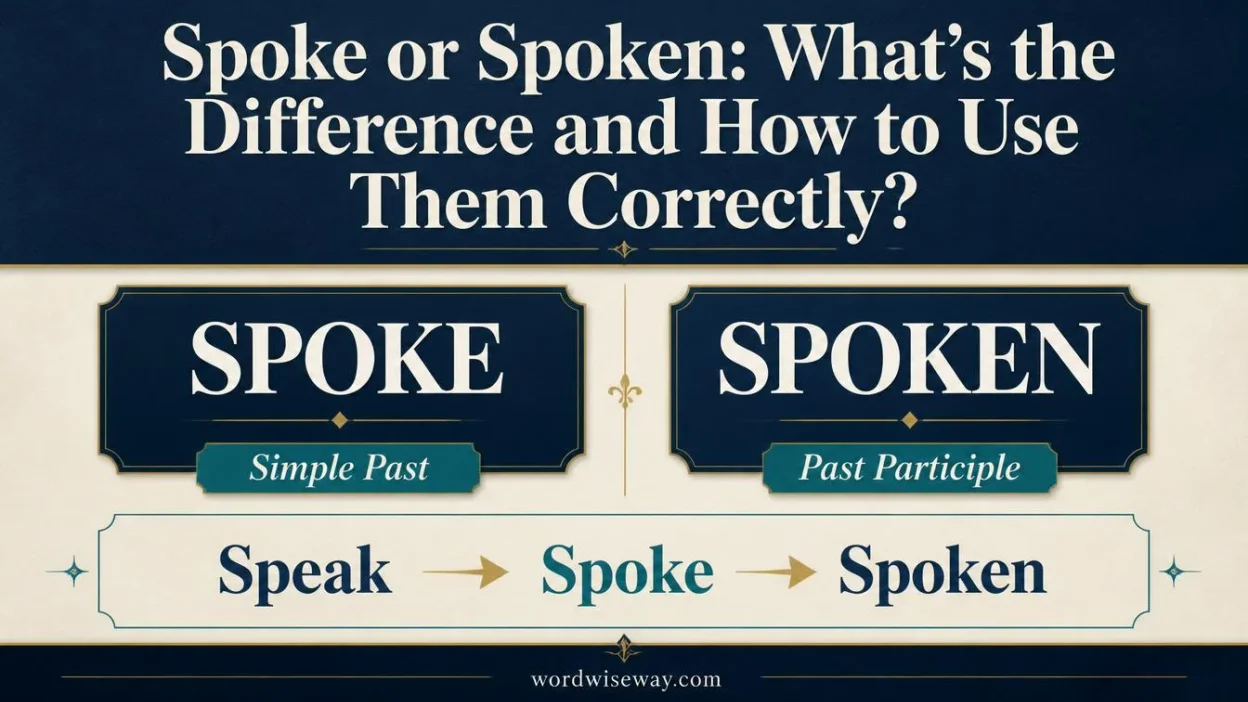
Spoke or Spoken: Difference and How to Use Them Correctly? explains two verb forms that often confuse English learners when discussing past actions.The past tense can feel tricky when you try to wrap your head around English verb forms. This article explores the past tense of speak and explains how its two different past tense forms work.
Understanding the difference between spoke and spoken helps you describe speaking in the past while following the correct grammatical rules. This English grammar usage guide supports your language learning, improves your English usage, and builds confidence with correct usage.
If you learn English, studying sentence examples and getting regular practice with English verbs can make these forms easier to remember.Spoke is the simple past tense and simple past form of speak. Use it for completed past actions and past events. For example, “I spoke to my teacher yesterday.”
However, spoken is the past participle and past participle form of this irregular verb. It requires an auxiliary verb or helping verb, such as have, has, or had, to create a grammatically correct sentence. For example, “I have spoken to my teacher.” You can also say, “She has spoken to the class,” or “They had spoken before the meeting.”
These examples demonstrate how verb conjugation, tense forms, verb agreement, and sentence structure support correct grammar. Learning the verb forms of speak, including speak spoke spoken, helps you avoid common grammar mistakes and improve your writing and speaking.
Apply these grammar tips to remember the difference between spoke and spoken and use them correctly in everyday speech and spoken language.
Quick Answer:
Spoke is the simple past tense of speak, while spoken is its past participle. Use spoke when describing a completed conversation or speaking action in the past. Use spoken with auxiliary verbs such as has, have, and had to form perfect tenses. You can also use spoken in passive constructions and certain adjective phrases.
Compare these examples:
- Spoke: I spoke to my teacher yesterday.
- Spoken: I have spoken to my teacher already.
- Spoken: The announcement was spoken clearly.
- Spoken as an adjective: English is a widely spoken language.
The key difference is simple: spoke usually stands as the main verb in a simple past sentence, while spoken generally needs another verb or functions as an adjective.
What Is the Difference Between Spoke and Spoken?
Although spoke and spoken share the same base verb, they aren’t interchangeable. English uses different verb forms to show when an action happens and how that action fits into a sentence.
Spoke: The Simple Past Tense of Speak
Spoke describes an action that happened and ended in the past. It is the simple past form of speak and doesn’t normally require a helping verb in affirmative statements.
For example:
- I spoke with my cousin last night.
- She spoke confidently during the meeting.
- We spoke about our weekend plans.
- The manager spoke to the employees after lunch.
Each sentence describes a speaking action that occurred in the past. The verb spoke carries the past-tense meaning by itself.
You can also use spoke when the exact time isn’t stated, provided the sentence describes a completed past action.
Example: He spoke about his experience during the interview.
The sentence doesn’t identify a particular date or time. However, spoke still presents the interview as a past event.
Spoken: The Past Participle of Speak
Spoken is the past participle of speak. Unlike spoke, it generally doesn’t express simple past tense by itself.
Instead, spoken commonly appears with auxiliary verbs to form perfect tenses or passive constructions.
Consider these examples:
- I have spoken to the principal.
- She had spoken to her parents before leaving.
- The instructions were spoken aloud.
- They have spoken about this issue several times.
In the first sentence, have spoken forms the present perfect tense. In the second, had spoken forms the past perfect tense. The third uses the passive voice, while the fourth describes an experience involving repeated conversations.
The word spoken also appears in adjective phrases, such as spoken English and spoken instructions.
Key Grammar Differences
The easiest way to distinguish these words is to examine their grammatical roles.
| Feature | Spoke | Spoken |
| Verb form | Simple past | Past participle |
| Main use | Describes a completed past action | Forms perfect tenses and passive constructions |
| Common pattern | Subject + spoke | Subject + has/have/had + spoken |
| Passive construction | Not normally used as the past participle | Often follows a form of be |
| Example | She spoke clearly. | She has spoken clearly. |
| Adjective use | Rare in ordinary modern usage | Common, as in spoken language |
Remember that these patterns explain the most common uses. English grammar also allows other constructions, including modal verbs and adjective phrases.
When to Use Spoke
Use spoke when you want to describe a speaking action in the simple past tense. It works in statements, questions, negative sentences, and reported speech.
Spoke in the Simple Past Tense
The simple past tense describes an action that happened at an earlier time. The action may have lasted a few seconds or continued for much longer.
Examples include:
- I spoke to my neighbor this morning.
- Daniel spoke at the school assembly.
- They spoke quietly during the movie.
- We spoke about our future plans.
In each example, spoke identifies an action that took place in the past.
You don’t need to add have or had to these sentences. Doing so would change the grammatical structure and potentially the meaning.
Incorrect: I have spoke to Daniel.
Correct: I spoke to Daniel.
Also correct: I have spoken to Daniel.
The last two sentences are both grammatical, but they use different tenses. The simple past presents the conversation as a past event, while the present perfect connects the past action to the present.
Spoke With a Specific Past Time
When a sentence identifies a finished time in the past, the simple past is generally the appropriate choice.
Common time expressions include yesterday, last week, two days ago, and in 2022.
For example:
- I spoke to my professor yesterday.
- She spoke at the conference last Friday.
- We spoke about the assignment two hours ago.
- He spoke to the customer in 2024.
These examples connect the speaking action to a specific past period.
Compare the following sentences:
Simple past: I spoke to her yesterday.
Present perfect: I have spoken to her.
The first sentence identifies when the conversation happened. The second reports the experience without specifying a finished time.
Spoke in Negative Sentences
To make a simple past sentence negative, use did not or its contraction, didn’t, followed by the base verb speak.
Examples:
- I didn’t speak during the meeting.
- She did not speak to the receptionist.
- They didn’t speak about the disagreement.
- We did not speak to anyone after the event.
Notice that the verb following didn’t is speak, not spoke.
Incorrect: He didn’t spoke to me.
Correct: He didn’t speak to me.
This rule applies to regular and irregular verbs alike. The auxiliary did already carries the past-tense meaning, so the main verb returns to its base form.
Spoke in Questions
Questions in the simple past usually begin with did when they ask whether someone performed an action.
Examples:
- Did you speak to your teacher?
- Did she speak during the presentation?
- Why did they speak so quietly?
- When did he speak to the manager?
The main verb remains speak after did.
Incorrect: Did you spoke to her?
Correct: Did you speak to her?
However, questions don’t always need did. In a question using the present perfect, use have or has with spoken.
For example: Have you spoken to her?
Spoke in Reported Speech
Reported speech communicates what someone said without necessarily repeating their exact words.
When the reporting verb describes a past event, spoke can introduce the reported statement or conversation.
Examples:
- Maria spoke about the new schedule.
- The teacher spoke to us about the examination.
- He spoke to his parents about changing schools.
You can also use spoke in a sentence that reports someone’s words indirectly.
Direct speech: Emma said, “I need more time.”
Reported speech: Emma spoke to her supervisor and explained that she needed more time.
Here, spoke describes the conversation, while needed reports the situation in the past.
When to Use Spoken
Use spoken when the sentence requires the past participle of speak. This form commonly appears with perfect-tense auxiliaries, passive constructions, and adjective phrases.
Spoken With Has, Have, or Had
The verbs has, have, and had can work with spoken to form perfect tenses.
Choose the auxiliary according to the sentence’s subject and time reference.
- Has spoken: She has spoken to the director.
- Have spoken: They have spoken about the problem.
- Had spoken: He had spoken to the doctor before the appointment.
The present perfect uses has or have with the past participle. It often connects a past action to the present, reports an experience, or describes an action with present relevance.
The past perfect uses had with the past participle. It shows that one past action happened before another past event.
For example:
Present perfect: I have spoken to the admissions office.
Past perfect: I had spoken to the admissions office before the deadline arrived.
The second sentence establishes a relationship between two past events. The conversation happened before the deadline arrived.
Spoken in the Present Perfect Tense
The present perfect follows this structure:
Subject + has/have + spoken
Use it when a past speaking action matters to the present, describes an experience, or has occurred during a period that remains relevant.
Examples:
- I have spoken to the new instructor.
- She has spoken publicly several times.
- We have spoken about this matter before.
- They have spoken with the client already.
The present perfect doesn’t normally combine with a specific, finished past-time expression such as yesterday.
Incorrect in standard usage: I have spoken to her yesterday.
Correct: I spoke to her yesterday.
Also correct: I have spoken to her recently.
The distinction isn’t about whether the action has ended. Both forms can describe completed actions. The difference lies in how the sentence relates the action to time and context.
Spoken in the Past Perfect Tense
The past perfect describes an action that happened before another point or event in the past.
Its structure is:
Subject + had + spoken
Examples:
- I had spoken to the manager before the store closed.
- She had spoken to her parents before making the decision.
- They had spoken about the project before the meeting began.
- We had spoken to the landlord before signing the agreement.
In each sentence, the speaking action happened first. Another past event provides the reference point.
Compare these sentences:
Simple past: I spoke to the manager before the store closed.
Past perfect: I had spoken to the manager before the store closed.
Both sentences are grammatically correct. The simple past presents the sequence clearly through before. The past perfect emphasizes that the conversation was already complete at the relevant past point.
You don’t need the past perfect every time two past events appear in one sentence. Use it when the earlier timing needs emphasis or clarification.
Spoken in the Passive Voice
The passive voice shifts attention from the person performing an action to the person or thing receiving it.
With spoken, passive constructions often use a form of be, such as is, was, or were.
Examples:
- The announcement was spoken clearly.
- The words were spoken in a calm voice.
- English is spoken in many countries.
- The instructions were spoken slowly.
In these sentences, the subject receives or represents the speaking action rather than performing it.
However, English speakers often prefer said, delivered, or communicated in certain contexts.
For example, “The announcement was delivered clearly” may sound more natural when referring to a formal announcement. “The words were spoken softly” works well when the manner of speaking matters.
Choose the verb that best expresses the intended meaning rather than forcing spoken into every passive sentence.
Spoken as an Adjective
Spoken can describe something related to speech rather than writing.
Common examples include:
- Spoken English
- Spoken instructions
- Spoken communication
- Spoken language
- Spoken answers
Consider this sentence: Spoken English often differs from formal written English.
Here, spoken describes the type of English being discussed. It doesn’t form a perfect tense because no auxiliary verb is completing a verbal construction.
Another example is “The course focuses on spoken communication.”
The word spoken tells readers that the course emphasizes communication through speech. It functions as a descriptive modifier.
Example Sentences
Examples from everyday situations make the difference easier to recognize. The same topic can use either form depending on the sentence structure.
Everyday Conversations
Imagine that two friends are discussing a conversation they had earlier.
- Spoke: I spoke to Sarah after class.
- Spoken: I have spoken to Sarah about the assignment.
- Spoke: He spoke to me on the phone last night.
- Spoken: We had spoken before we joined the same team.
The first and third examples describe past events. The second connects an earlier conversation to the present, while the fourth places one conversation before another past event.
School and Workplace Communication
The distinction also appears in academic and professional writing.
| Situation | Correct sentence | Why it works |
| A completed class discussion | The student spoke during class. | Spoke expresses simple past tense. |
| A completed conversation with present relevance | The student has spoken to the instructor. | Has spoken forms the present perfect. |
| An earlier conversation | The employee had spoken to the supervisor before lunch. | Had spoken forms the past perfect. |
| A formal announcement | The message was spoken aloud. | Was spoken uses the passive voice. |
| A language course | The program teaches spoken English. | Spoken functions as an adjective. |
These examples show why context matters. You can’t select the correct form by looking at the subject alone. You must examine the surrounding verbs and the meaning of the sentence.
Formal Writing and Reported Speech
Formal writing often uses both forms to describe conversations, interviews, and statements.
For example:
- The researcher spoke with several participants.
- The researcher has spoken with several participants.
- The researcher had spoken with the participants before collecting the final responses.
- The instructions were spoken aloud during the demonstration.
Each sentence serves a slightly different purpose.
The simple past presents a completed event. The present perfect reports an experience or action connected to the present. The past perfect establishes an earlier event, while the passive construction emphasizes the instructions rather than the speaker.
Comparison Table
Use this table as a quick reference when editing your writing.
| Sentence | Correct form | Explanation |
| I ___ to him yesterday. | Spoke | A specific finished past time calls for the simple past. |
| I have ___ to him already. | Spoken | The present perfect requires a past participle. |
| She had ___ to the teacher before class. | Spoken | The past perfect uses had plus a past participle. |
| They ___ during the meeting. | Spoke | The sentence describes a simple past action. |
| English is widely ___. | Spoken | The word describes language used in speech and forms a passive construction. |
| Did you ___ to your friend? | Speak | After did, use the base form. |
| He didn’t ___ to me. | Speak | After didn’t, use the base form. |
| She has never ___ publicly. | Spoken | The present perfect requires the past participle. |
| We ___ about it last week. | Spoke | Last week identifies a finished past period. |
| By then, I had already ___. | Spoken | Had requires the past participle in the past perfect. |
The table also highlights an important point: some sentences require neither spoke nor spoken. After did or didn’t, use speak.
Common Mistakes
Even experienced English learners sometimes confuse irregular verb forms. Most mistakes happen when a writer overlooks the auxiliary verb or chooses a tense that doesn’t fit the intended meaning.
Using Spoken Without an Auxiliary Verb
In ordinary standard English, spoken doesn’t normally function alone as the simple past tense of speak.
Incorrect: Yesterday, I spoken to my teacher.
Correct: Yesterday, I spoke to my teacher.
However, spoken can appear without has, have, or had when it functions as an adjective or in a construction that uses another auxiliary.
For example, “The words spoken during the ceremony were meaningful” is correct. Here, spoken during the ceremony describes the words.
Therefore, the useful rule is not that spoken always needs has, have, or had. It needs the grammatical structure appropriate to its role.
Using Spoke After Has, Have, or Had
The perfect tenses require a past participle after has, have, or had.
Incorrect: She has spoke to the principal.
Correct: She has spoken to the principal.
Incorrect: We had spoke before the event.
Correct: We had spoken before the event.
Remember the verb sequence:
Speak → Spoke → Spoken
The first form is the base form, the second is the simple past, and the third is the past participle.
Learning this sequence helps prevent similar errors with other irregular verbs.
Confusing Simple Past and Past Participle Forms
Some English verbs use the same form for their simple past and past participle. For example, walked serves both purposes for the regular verb walk.
However, speak changes its form:
- Present or base form: speak
- Simple past: spoke
- Past participle: spoken
Because these forms differ, you must pay attention to the tense.
Incorrect: They have spoke about the issue.
Correct: They have spoken about the issue.
Incorrect: I spoken to her last night.
Correct: I spoke to her last night.
The helping verb and the time reference provide useful clues when choosing the correct form.
Using the Wrong Form in Questions and Negative Sentences
Questions and negative sentences in the simple past use did with the base verb.
| Incorrect | Correct |
| Did she spoke to you? | Did she speak to you? |
| I didn’t spoken to him. | I didn’t speak to him. |
| Why did he spoke so loudly? | Why did he speak so loudly? |
| They didn’t spoke during class. | They didn’t speak during class. |
When a question uses the present perfect, however, spoken is correct.
For example: “Have they spoken to you?”
The difference comes from the auxiliary verb. Did takes the base form, while have takes the past participle.
Different Sentence Structures
Recognizing sentence patterns makes verb choices more automatic. Instead of memorizing every possible example, learn how the forms behave in common structures.
Affirmative Sentences
Affirmative sentences state that an action happened or that a situation exists.
Simple past:
- I spoke to the receptionist.
- She spoke clearly during the interview.
Perfect tenses:
- I have spoken to the receptionist.
- She had spoken clearly before the recording began.
Use spoke for the simple past. Use spoken after the appropriate perfect-tense auxiliary.
Negative Sentences
Negative sentences show that an action didn’t happen or that a situation hasn’t occurred.
Simple past:
- I didn’t speak to the receptionist.
- She didn’t speak during the interview.
Present perfect:
- I haven’t spoken to the receptionist.
- She hasn’t spoken during the interview.
Notice the contrast between didn’t speak and haven’t spoken. Each auxiliary requires a different verb form.
Questions
Questions follow the same grammatical patterns.
Simple past:
- Did you speak to the receptionist?
- Why did she speak so quietly?
Present perfect:
- Have you spoken to the receptionist?
- Why has she spoken so quietly?
If you understand which auxiliary the sentence uses, you can usually identify the correct verb form immediately.
Sentences With Modal Verbs
Modal verbs include can, could, will, would, should, and must. They generally take the base form of the verb that follows them.
Examples:
- I can speak to the manager.
- She will speak at the event.
- You should speak clearly.
- They could speak to the teacher tomorrow.
In perfect constructions with modals, use have followed by the past participle.
Examples:
- I could have spoken to him earlier.
- She should have spoken more clearly.
- They might have spoken about the issue already.
Incorrect: I should have spoke to him.
Correct: I should have spoken to him.
The modal is followed by have, and have is followed by the past participle spoken.
Spoke, Spoken, and Speak: What’s the Difference?
Understanding all three forms gives you a complete picture of how the verb works.
Speak: The Base Form and Present Tense
Speak is the base form of the verb. Use it with modal verbs, after do and did, and in the present tense with subjects such as I, you, we, and they.
Examples:
- I speak English every day.
- They speak to their neighbors regularly.
- Did you speak to the instructor?
- She can speak three languages.
With he, she, or it in the simple present, use speaks.
For example: “He speaks English at work.”
Spoke: The Simple Past Form
Spoke describes a speaking action in the simple past.
Examples:
- I spoke to him yesterday.
- She spoke at the ceremony.
- They spoke about the new policy last week.
Use spoke without a helping verb in ordinary affirmative simple past sentences.
Spoken: The Past Participle Form
Spoken appears in perfect tenses, passive constructions, and descriptive phrases.
Examples:
- I have spoken to him.
- She had spoken before the meeting began.
- The message was spoken aloud.
- Spoken communication requires careful listening.
These examples demonstrate that spoken can function as part of a verb phrase or as a modifier.
The Complete Verb Forms at a Glance
| Form | Grammatical role | Example |
| Speak | Base form | I speak clearly. |
| Speaks | Simple present, third-person singular | She speaks clearly. |
| Spoke | Simple past | She spoke yesterday. |
| Spoken | Past participle | She has spoken already. |
| Speaking | Present participle or gerund | She is speaking now. |
Learning these five forms will help you use speak correctly in a wide range of sentences.
How to Remember Spoke vs. Spoken
You don’t need a complicated grammar formula to remember the difference. A few simple patterns can help you choose the correct form quickly.
A Simple Rule for Choosing the Correct Word
Start by checking the sentence for a helping verb.
- If you’re describing a completed past action, consider spoke.
- If you see has, have, or had, use spoken for the perfect form.
- If you see did or didn’t, use speak.
- If the word describes a type of language or communication, spoken may function as an adjective.
For example:
“I ___ to my teacher yesterday.”
The word yesterday identifies a finished past time, so the correct answer is spoke.
Now consider:
“I have ___ to my teacher.”
The auxiliary have signals the present perfect, so the correct answer is spoken.
Finally:
“Did you ___ to your teacher?”
The auxiliary did requires the base form, so the correct answer is speak.
A Quick Tense-Based Memory Trick
Memorize this short sequence:
Speak → Spoke → Spoken
Think of it as three stages of the same verb:
- Speak: The base form used in the present and other constructions.
- Spoke: The simple past form.
- Spoken: The past participle used in perfect tenses and other constructions.
You can reinforce the pattern with a single example:
- Today, I speak to my teacher.
- Yesterday, I spoke to my teacher.
- I have spoken to my teacher already.
Read the examples aloud and pay attention to the helping verbs. With practice, the correct form will become easier to recognize.
Read More: Students or Student’s or Students’? Complete Grammar Guide
FAQs
1. Is It Spoke or Spoken?
Both words are correct, but they serve different grammatical purposes. Spoke is the simple past tense of “speak,” while spoken is its past participle. For example, “I spoke to him yesterday” is correct, as is “I have spoken to him.”
2. What Is the Difference Between Spoke and Spoken?
The main difference is how you use each word in a sentence. Spoke describes a completed past action without needing an auxiliary verb. Spoken usually works with a helping verb, such as have, has, or had, to form perfect tenses.
3. Is Spoke the Past Tense of Speak?
Yes, spoke is the simple past tense of “speak.” Use it when someone said something or had a conversation in the past. For example, “She spoke to her teacher after class.”
4. Is Spoken the Past Tense of Speak?
No, spoken is the past participle of “speak,” not its simple past tense. It usually needs a helping verb to form a complete verb phrase. For example, “They have spoken about the problem.”
5. Should I Say I Have Spoke or I Have Spoken?
You should say “I have spoken.” The present perfect tense uses have or has followed by the past participle. Since “spoken” is the past participle of “speak,” it is the grammatically correct choice.
6. Is It I Spoke to Him or I Spoken to Him?
The correct sentence is “I spoke to him.” The simple past tense does not require a helping verb in this sentence. However, you can say “I have spoken to him” because have supports the past participle “spoken.”
7. Can I Use Spoken Without a Helping Verb?
Yes, spoken can appear without a helping verb in certain grammatical structures. For example, “The words spoken during the meeting were inspiring” uses “spoken” to describe the words. However, in a perfect tense, it needs a helping verb.
8. What Are the Three Forms of the Verb Speak?
The three main forms are speak, spoke, and spoken. “Speak” is the base form, “spoke” is the simple past tense, and “spoken” is the past participle. Learning these forms helps you build correct sentences in different tenses.
9. Is It Has Spoke or Has Spoken?
“Has spoken” is correct. Use has with the past participle “spoken” when talking about an action connected to the present. For example, “He has spoken to the manager.” Avoid “He has spoke” in standard English.
10. How Can I Remember When to Use Spoke or Spoken?
Remember this simple pattern: spoke works independently for a simple past action, while spoken usually pairs with a helping verb in perfect tenses. Practice sentences such as “I spoke yesterday” and “I have spoken already.” With regular practice, choosing the correct form becomes easier.
Conclusion
Understanding the difference between spoke and spoken becomes easier when you learn how each form works in a sentence. Spoke is the simple past tense of “speak,” so you use it to describe completed actions in the past.
For example, “I spoke to my friend yesterday.” On the other hand, spoken is the past participle, which usually needs a helping verb such as have, has, or had. You can say, “I have spoken to my friend” to express the same general idea with a different tense.With regular practice, choosing the correct form becomes easier.
The easiest way to remember these verb forms is to connect them with their sentence patterns. Use spoke when describing a past conversation without an auxiliary verb, and use spoken when forming perfect tenses or other grammatical structures that require a past participle.
For instance, “She spoke at the meeting” and “She has spoken at the meeting” are both correct, but their grammatical structures differ. Paying attention to these patterns can help you avoid common English grammar mistakes and improve your speaking and writing.
Ultimately, learning spoke or spoken does not require memorizing complicated grammar rules. Start by practicing short sentences, notice which helping verbs appear before “spoken,” and check how “spoke” describes past actions.
Read examples aloud and use both forms in your everyday writing. With consistent practice, you will develop a clearer understanding of verb tenses and feel more confident choosing the correct form whenever you talk about something someone said in the past.

Amelia Sanders has spent 14 years in Harvard University’s English Department, helping students navigate literary analysis, interpretive theory, and narrative techniques. Her academic pursuits center on 18th-century British prose, romantic poetry, diasporic writing, and digital editing exploring how textual choices influence cultural perspectives. Amelia has spoken at major international meetings and contributed essays to respected academic volumes, demonstrating her dedication to thoughtful scholarship and effective teaching.