Students or Student’s or Students’? Complete Grammar Guide explains how apostrophes show ownership in English grammar. Choosing the correct form depends on whether you mean one student or several students.
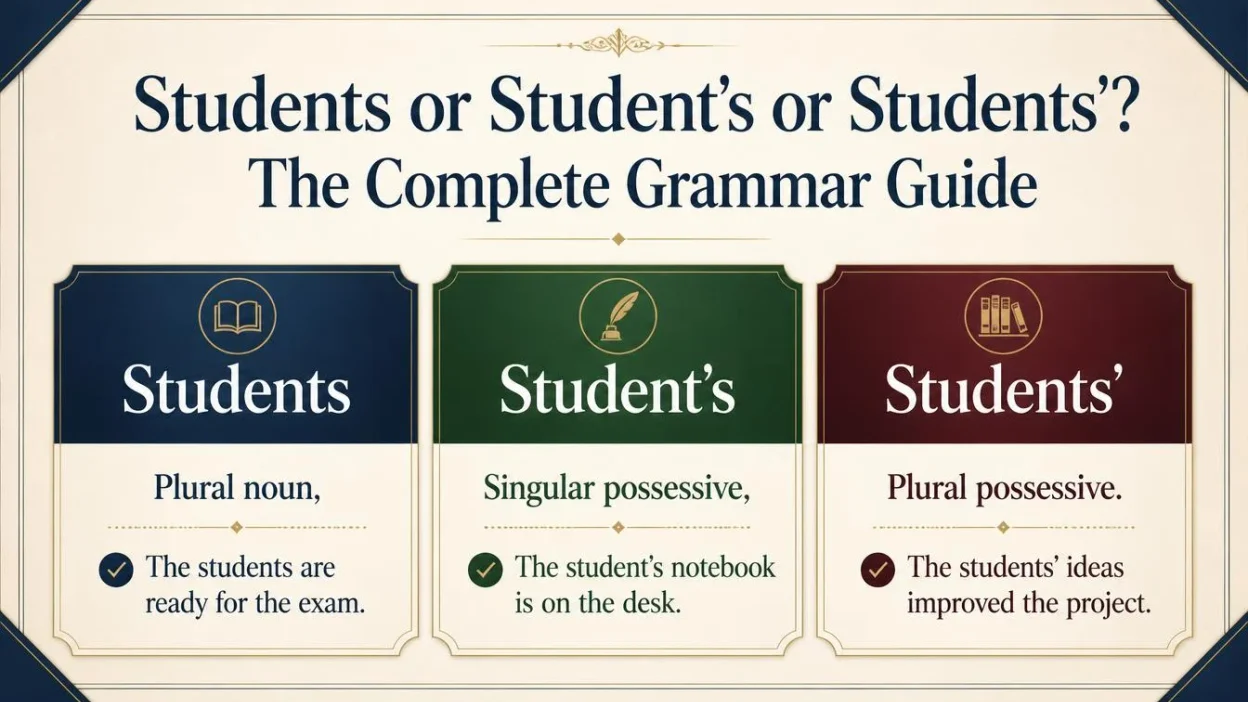
Use student’s for singular possession because the singular noun student takes an apostrophe and s. For example, student’s notebook means one student owns the notebook. Use students’ for plural possession when students already ends in s. The apostrophe goes after the final s, as in students’ notebooks.
Students without an apostrophe is simply the plural form. Remember, apostrophes show possession, not plurality. These simple punctuation rules help you avoid mistakes and make your English writing clearer.
Quick Answer:
The difference between students, student’s, and students’ comes down to number and possession.
| Word | Meaning | Example |
| Students | Two or more learners | The students entered the classroom. |
| Student’s | Something belonging to one student | The student’s notebook is on the desk. |
| Students’ | Something belonging to multiple students | The students’ notebooks are on the desk. |
Remember these three simple rules:
- Use students when referring to more than one student without indicating possession.
- Use student’s when something belongs to one student.
- Use students’ when something belongs to two or more students.
Quick tip: The apostrophe’s position matters. In student’s, it appears before the final s. In students’, it comes after the final s.
What Does Students Mean?
The word students is the regular plural form of the singular noun student. It refers to two or more people who study at a school, college, university, or another educational institution.
You don’t need an apostrophe to make most regular nouns plural. Simply add -s to the singular form.
For example:
- One student attended the lecture.
- Three students attended the lecture.
- Several students completed the assignment.
- The students waited outside the examination room.
In each sentence, students refers to multiple people. None of these examples requires an apostrophe because the noun doesn’t indicate ownership.
Students as a Plural Noun
A plural noun names more than one person, place, thing, or idea. In this case, students identifies multiple learners.
You can use students in several grammatical roles.
As a subject:
Students need regular practice to improve their writing.
Here, students performs the action expressed by the verb need.
As an object:
The teacher helped the students with their homework.
In this sentence, students receives the action of the verb helped.
After a preposition:
The teacher spoke to the students after class.
Here, students follows the preposition to.
Notice that the word remains students in all three examples. Its grammatical role changes, but its plural meaning stays the same.
When to Use Students Without an Apostrophe
Use students when you mean multiple learners without expressing ownership.
Consider these examples:
- The students are preparing for their final exams.
- Many students prefer studying in quiet environments.
- Our school welcomes students from different backgrounds.
- The students discussed the assignment during lunch.
- Several students volunteered to organize the event.
Each sentence refers to students rather than something belonging to them.
A common mistake is adding an apostrophe whenever a noun ends in s. However, plural nouns don’t need apostrophes simply because they’re plural.
Incorrect: The student’s are waiting outside.
Correct: The students are waiting outside.
The corrected sentence uses the ordinary plural because it refers to multiple people.
Examples of Students in Sentences
Here are additional examples that show how to use students correctly.
| Sentence | Why Students Is Correct |
| The students arrived early. | The sentence refers to multiple learners. |
| Several students asked questions. | The noun is plural, not possessive. |
| Students should review their notes. | The sentence makes a general statement about learners. |
| The teacher praised the students. | The students receive the action. |
| Many students enjoy group projects. | The sentence refers to more than one student. |
Remember: If you can replace students with learners without changing the intended meaning, you probably need the plural noun rather than a possessive form.
What Does Student’s Mean?
The word student’s is the singular possessive form of student. It shows that something belongs to, relates to, or is associated with one student.
To form the singular possessive, add an apostrophe followed by s.
Student + ’s = Student’s
For example:
- The student’s backpack is missing.
- I read the student’s essay.
- The student’s opinion changed the discussion.
- The student’s desk is near the window.
Each sentence connects something with one student.
The possessive relationship doesn’t always involve physical ownership. A student’s opinion, experience, or responsibility can also be associated with that individual.
Student’s as a Singular Possessive
A singular possessive noun identifies a relationship between one person and something connected to them.
For example, consider this sentence:
The student’s assignment received an excellent grade.
The word student’s indicates that the assignment belongs to or was completed by one student.
Now compare it with this sentence:
The students’ assignment received an excellent grade.
The second sentence suggests that multiple students share responsibility for the assignment.
The apostrophe changes the meaning by identifying the number of people associated with the noun.
Here are more examples:
- The student’s handwriting was easy to read.
- My student’s progress has improved this semester.
- The student’s question helped everyone understand the lesson.
- The student’s computer needs an update.
- The student’s attendance record is complete.
In each example, student’s connects the following noun or idea to one student.
How to Form the Singular Possessive of Student
Forming the singular possessive is straightforward. Start with the singular noun and add ‘s.
| Singular Noun | Singular Possessive | Example |
| Student | Student’s | The student’s book is open. |
| Teacher | Teacher’s | The teacher’s instructions were clear. |
| Doctor | Doctor’s | The doctor’s office is nearby. |
| Writer | Writer’s | The writer’s article was published. |
| Friend | Friend’s | My friend’s bicycle is new. |
The same general rule applies to most singular nouns, including nouns that end in s, although some style guides differ on the preferred treatment of certain names.
For the word student, the standard form is student’s, with the apostrophe before the final s.
Examples of Student’s in Sentences
The following sentences demonstrate how student’s works in different contexts.
| Sentence | Meaning |
| The student’s phone rang during class. | One student has a phone that rang. |
| I checked the student’s homework. | The homework is associated with one student. |
| The student’s answer was correct. | One student’s answer was correct. |
| The student’s parents attended the meeting. | The parents are associated with one student. |
| The student’s performance improved. | The performance relates to one student. |
Pay attention to the difference between the noun and the possessive form.
- Student: One learner.
- Student’s: Something associated with one learner.
This distinction becomes especially useful when writing about assignments, grades, responsibilities, and personal belongings.
What Does Students’ Mean?
The word students’ is the plural possessive form of student. It shows that something belongs to or is associated with multiple students.
To form the plural possessive, begin with the regular plural students and add an apostrophe after the final s.
Students + ’ = Students’
For example:
- The students’ classroom is on the second floor.
- The students’ projects impressed the judges.
- The students’ opinions differed considerably.
- The students’ books were arranged on the shelves.
Each sentence connects something with more than one student.
The important point is that students’ already contains the plural ending. You don’t add another s after the apostrophe.
Students’ as a Plural Possessive
Use students’ when the possessive relationship involves multiple students.
For example:
The students’ questions helped clarify the lesson.
This sentence indicates that several students asked questions.
Compare it with:
The student’s question helped clarify the lesson.
In the second sentence, the question belongs to or comes from one student.
The difference isn’t merely punctuation. It changes the number of students involved.
Plural possessives can describe shared or individual relationships within a group. For example, the students’ classroom may refer to a classroom used by the students, while the students’ opinions refers to opinions expressed by multiple students.
Here are additional examples:
- The students’ examination results arrived yesterday.
- The students’ uniforms were ready for the ceremony.
- The students’ research projects covered different topics.
- The students’ questions revealed a misunderstanding.
- The students’ contributions improved the discussion.
In each example, the possessive form relates something to multiple students.
How to Form the Plural Possessive of Students
Follow these two steps:
- Step one: Make the singular noun plural by adding -s.
- Step two: Add an apostrophe after the final s.
The process looks like this:
| Form | Example | Function |
| Singular | Student | One learner |
| Plural | Students | Multiple learners |
| Singular possessive | Student’s | Something associated with one learner |
| Plural possessive | Students’ | Something associated with multiple learners |
This pattern applies to many regular plural nouns.
For example:
- Teachers → teachers’ lounge
- Players → players’ equipment
- Writers → writers’ workshop
- Employees → employees’ benefits
However, irregular plural nouns follow a different pattern when forming possessives. Words such as children and people don’t end in s, so their possessive forms take ‘s: children’s toys and people’s opinions.
That distinction helps explain why the apostrophe goes after the s in students’ but before the s in children’s.
Examples of Students’ in Sentences
Use these examples to see how the plural possessive works in everyday writing.
| Sentence | Why Students’ Is Correct |
| The students’ bags were outside. | The bags are associated with multiple students. |
| We reviewed the students’ assignments. | The assignments belong to or were completed by multiple students. |
| The students’ classroom was renovated. | The classroom is associated with the group. |
| The students’ ideas inspired the project. | Multiple students contributed ideas. |
| The students’ parents attended the event. | The parents are associated with multiple students. |
One useful reminder: Plural possession doesn’t always mean that everyone owns an identical item. It can also indicate a relationship between a group and a place, activity, responsibility, or collection of work.
Key Differences
The easiest way to distinguish these forms is to examine two things: how many students the sentence refers to and whether the sentence expresses possession.
| Feature | Students | Student’s | Students’ |
| Number | More than one | One | More than one |
| Possessive? | No | Yes | Yes |
| Apostrophe placement | No apostrophe | Before s | After s |
| Example | Students are studying. | The student’s book is open. | The students’ books are open. |
Let’s examine the differences in context.
Difference in Meaning and Usage
Consider these three sentences:
- Students study in the library. This describes multiple learners.
- The student’s book is on the table. This identifies a book associated with one learner.
- The students’ books are on the table. This identifies books associated with multiple learners.
The first sentence doesn’t indicate possession. The other two use possessive nouns.
Context also matters when you encounter a sentence without an obvious ownership relationship. For example, the student’s experience refers to one student’s experience, while the students’ experience can refer to the experience of a group.
Neither possessive form automatically means that the students jointly own something. It can simply connect an idea or characteristic to the people involved.
Difference in Apostrophe Placement
Apostrophe placement follows a predictable pattern for this regular noun.
- Student’s: The noun is singular, so the apostrophe comes before the possessive s.
- Students’: The noun is plural and already ends in s, so the apostrophe follows it.
- Students: The noun is plural but not possessive, so no apostrophe appears.
Think of the apostrophe as a small grammatical signpost. It helps readers understand the relationship between the noun and the words around it.
Compare these examples:
| Correct Form | Example |
| Students | The students finished their work. |
| Student’s | The student’s work was excellent. |
| Students’ | The students’ work was excellent. |
The final two sentences are both correct, but they communicate different information about how many students the work relates to.
How to Choose the Correct Form
When you’re unsure, use this simple decision process.
Question one: Are you talking about more than one student without indicating possession?
Use students.
Example: The students are preparing for the competition.
Question two: Does something belong to or relate to one student?
Use student’s.
Example: The student’s presentation begins at noon.
Question three: Does something belong to or relate to multiple students?
Use students’.
Example: The students’ presentations begin at noon.
If you’re still uncertain, remove the possessive noun temporarily and identify the number of people involved. Then decide whether the sentence needs to show possession.
This quick check can prevent many common apostrophe errors.
When to Use Students, Student’s, or Students’
Understanding the basic definitions is useful, but applying them in real sentences makes the rules easier to remember.
Use Students When Referring to Multiple People
Use students when discussing learners as a group or referring to multiple individuals without expressing possession.
Examples:
- Students must submit their applications before Friday.
- The students gathered in the auditorium.
- Many students enjoy practical learning activities.
- Our teacher encouraged students to ask questions.
- The students worked together on the science experiment.
Notice that some sentences contain words such as their. That doesn’t make students possessive. The noun remains plural, while their expresses the relevant relationship.
Use Student’s When One Student Owns Something
Use student’s when the possessive relationship involves one student.
Examples:
- The student’s answer earned full credit.
- I borrowed the student’s calculator.
- The student’s project needs a few changes.
- The student’s name appears on the certificate.
- We discussed the student’s learning goals.
A useful way to check these sentences is to replace student’s with the student’s own where the meaning allows it.
For example, “The student’s calculator is missing” becomes “The student’s own calculator is missing.” The possessive relationship remains clear.
However, possession can include more than physical ownership. A student’s learning goals or academic progress also relate to that individual.
Use Students’ When Multiple Students Own Something
Use students’ when something belongs to or is associated with multiple students.
Examples:
- The students’ assignments are ready for grading.
- The students’ team won the competition.
- The students’ questions prompted a useful discussion.
- The students’ belongings were kept in a safe place.
- The students’ academic progress was reviewed.
Consider this example:
The students’ assignments were collected after class.
The plural possessive tells readers that the assignments relate to multiple students. It doesn’t necessarily mean that the students wrote one assignment together. Each student may have submitted an individual assignment.
This distinction is important because plural possession can describe separate items belonging to different members of a group, not just jointly owned items.
Common Mistakes to Avoid
Apostrophe mistakes often occur when writers focus on how a word looks instead of what the sentence means.
The following errors are especially common.
Using Student’s Instead of Students
Incorrect: The student’s attended the workshop.
Correct: The students attended the workshop.
The incorrect sentence uses a possessive form even though it simply refers to multiple learners.
To correct it, remove the apostrophe and use the regular plural noun.
More examples:
- Incorrect: The student’s are preparing for exams.
- Correct: The students are preparing for exams.
- Incorrect: Several student’s participated in the activity.
- Correct: Several students participated in the activity.
The word several already indicates a plural quantity. Therefore, the noun should be students, not student’s.
Using Students Instead of Student’s
Incorrect: The students notebook is missing.
Correct: The student’s notebook is missing.
If the notebook belongs to one student, the sentence needs the singular possessive form.
Compare these examples:
- The student’s notebook is missing. One student’s notebook is missing.
- The students’ notebooks are missing. Multiple students’ notebooks are missing.
The second sentence uses the plural possessive because it refers to multiple students.
Placing the Apostrophe Incorrectly in Students’
Incorrect: The students’s classroom is clean.
Correct: The students’ classroom is clean.
The incorrect version adds an unnecessary possessive s after the plural noun. Because students already ends in s, the plural possessive normally requires only an apostrophe.
The same principle applies to other regular plural nouns:
- Teachers’ meeting
- Players’ uniforms
- Employees’ schedules
- Students’ projects
Remember that the plural ending and possessive marker perform different jobs. You need both, but you don’t need to add another s.
Confusing Plural Nouns With Possessive Nouns
Sometimes a sentence contains a plural noun near another noun, which can make apostrophe placement confusing.
Compare these examples:
- The students completed the assignment.
- The student’s assignment was complete.
- The students’ assignments were complete.
In the first sentence, students is the subject. The second, student’s identifies the assignment associated with one student. In the third, students’ identifies assignments associated with multiple students.
A helpful proofreading technique is to ask yourself: Does this noun simply name people, or does it connect those people to something else?
That question usually reveals whether an apostrophe is necessary.
Real-Life Examples
Real-life examples help you recognize these forms without having to stop and recall every grammatical rule.
Examples Related to Schoolwork and Assignments
Schoolwork provides a clear way to compare all three forms.
| Sentence | Correct Form | Explanation |
| Students submitted their essays. | Students | Multiple learners perform an action. |
| The student’s essay was interesting. | Student’s | One student’s essay is being described. |
| The students’ essays were interesting. | Students’ | Essays associated with multiple students are being described. |
| Students prepared for the test. | Students | The sentence refers to multiple learners. |
| The student’s test score improved. | Student’s | One student’s score is being discussed. |
| The students’ test scores improved. | Students’ | Scores associated with multiple students are being discussed. |
These examples also show why the noun following the possessive form can provide a useful clue.
Words such as essay, score, notebook, and assignment often appear in possessive constructions. However, you must still examine the sentence’s intended meaning.
Examples Related to Belongings and Ownership
Possessive forms commonly appear when discussing personal belongings.
Consider the following examples:
- Students left their bags near the entrance.
- The student’s bag was left near the entrance.
- The students’ bags were left near the entrance.
The first sentence simply describes multiple students and their bags. The second identifies one student’s bag. The third refers to bags associated with several students.
The distinction also works with shared spaces and resources:
- Students use the computer lab after school.
- The student’s computer is being repaired.
- The students’ computer lab is undergoing renovation.
The final example associates the lab with a group of students. It doesn’t necessarily establish that those students legally own the room.
Examples Related to Classrooms and Group Activities
Group activities often involve both plural nouns and possessive nouns.
For example:
The students gathered to discuss their project.
Here, students refers to multiple learners. The word their indicates that the project is associated with them.
Now consider:
The student’s project received special recognition.
This sentence focuses on one student’s project.
Finally:
The students’ project received special recognition.
This sentence indicates that the project is associated with multiple students, perhaps because they worked together.
Notice how the grammatical form changes the information readers receive. The words may look similar, but the number of students involved can change the meaning of the entire sentence.
How to Remember the Difference?
You don’t need to memorize a long list of rules to use these forms correctly. A simple number-and-possession check will usually do the job.
The One-Student Ownership Rule
When one student owns or is associated with something, use student’s.
Examples:
- The student’s jacket
- The student’s homework
- The student’s opinion
- The student’s responsibility
Remember the pattern: one student + possession = student’s.
The Multiple-Students Rule
When you’re talking about multiple students without expressing possession, use students.
Examples:
- Students are learning.
- Students completed the survey.
- Students attended the lecture.
- The students asked questions.
Remember the pattern: multiple students + no possessive relationship = students.
The Apostrophe Placement Trick
When multiple students are associated with something, use students’.
Examples:
- The students’ jackets
- The students’ homework
- The students’ opinions
- The students’ responsibilities
Remember the pattern: multiple students + possession = students’.
Here’s one final comparison:
| Meaning | Correct Phrase |
| Multiple learners | Students |
| One learner’s belongings | Student’s belongings |
| Multiple learners’ belongings | Students’ belongings |
A short memory trick can help: No apostrophe for the ordinary plural, apostrophe before the final s for one student’s possession, and apostrophe after the final s for multiple students’ possession.
Read More: Can You Start a Sentence With “While”? Grammar and Examples
FAQs
1. Is it students, student’s, or students’?
All three forms are correct, but they have different meanings. Students means more than one student, student’s shows ownership by one student, and students’ shows ownership by multiple students.
2. When should I use student’s with an apostrophe?
Use student’s when something belongs to one student. For example, “The student’s backpack is under the desk” means one student owns the backpack.
3. When is students’ the correct form?
Use students’ when something belongs to two or more students. For example, “The students’ classroom is clean” refers to a classroom shared by multiple students.
4. Is students’ singular or plural possessive?
Students’ is the plural possessive form. The word students is already plural, so you place the apostrophe after the final s to show ownership.
5. Does students need an apostrophe?
No, students does not need an apostrophe when you simply mean multiple learners. For example, “The students are studying for their exams” correctly uses the plural noun.
6. What is the difference between student’s and students’?
The difference is the number of owners. Student’s refers to one student, while students’ refers to multiple students. The apostrophe’s position helps you identify the intended meaning.
7. Is students’s grammatically correct?
No, students’s is not the standard form. Since students is already plural and ends in s, you normally add only an apostrophe to show possession: students’.
8. How do I make student possessive in a sentence?
Add an apostrophe and s to the singular noun student. For example, “The student’s answer was correct.” This construction shows that the answer belongs to one student.
9. Can I use students’ before a plural noun?
Yes, you can use students’ before a noun to show that something belongs to multiple students. For example, “The students’ books were on the table.” The apostrophe indicates plural possession.
10. How can I remember the difference between students and students’?
Remember that students simply means more than one student, while students’ shows ownership. If you are talking about students themselves, no apostrophe is needed. If you are describing something they own or share, add an apostrophe after the final s.
Conclusion
Understanding the difference between students, student’s, and students’ makes your English writing clearer and more accurate. Although these words look similar, each one serves a different purpose. Students refers to more than one learner, student’s shows possession by one student, and students’ indicates ownership by multiple students.
The easiest way to remember these grammar rules is to identify the number of owners first. If one student owns something, write student’s. If several students own something, write students’. When you simply talk about a group of learners, use students without an apostrophe. A few simple examples can help you recognize the correct form whenever you write a sentence.
Correct apostrophe usage may seem like a small detail, but it can make a meaningful difference in your communication. Whether you are writing school assignments, emails, or academic articles, choosing the right possessive form helps you express your ideas precisely. Keep practicing these examples, and the difference between students or student’s or students’ will soon become easier to remember and apply.

Emma Smith has dedicated 14 years to Princeton University’s English Department, mentoring students in textual interpretation, literary movements, and critical frameworks. Her research explores Shakespearean drama, Victorian serial fiction, postcolonial narrative theory, and manuscript studies and probing how literary forms evolve across cultures and centuries. Emma has delivered lectures at international humanities congresses and published findings in distinguished academic journals, underscoring her commitment to scholarly depth and vibrant teaching.