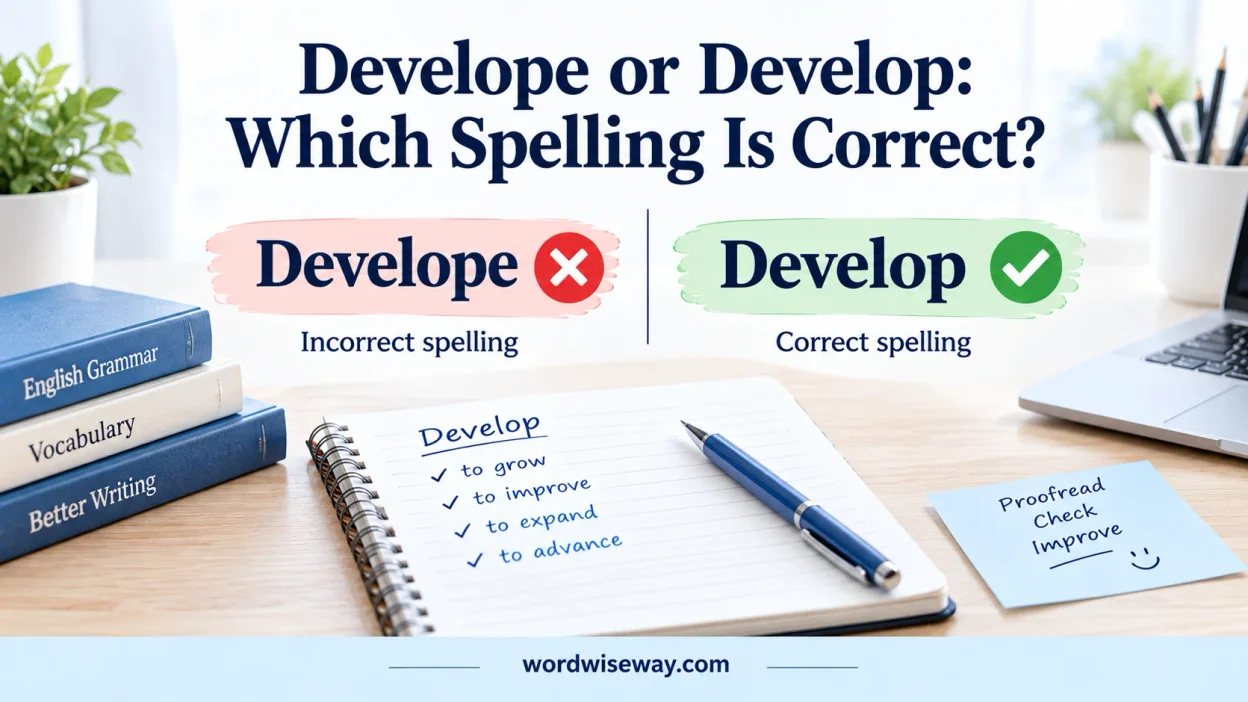
Develope or Develop: Correct Spelling, Meaning and Usage can confuse English learners, students, writers, and professionals. When writing an email, school paper, or social media post, you may ask yourself whether develop or develope is correct. The correct spelling is develop, while develope is a common mistake.
The silent “e” can make the wrong spelling seem natural, especially because many English words end with e. However, learning the difference helps you avoid wrong spelling, improve writing, and build writing confidence. Simple memory tricks can help you remember the correct word.
Accurate English spelling matters in emails, school assignments, blog posts, social media captions, business communication, and academic work. Understanding British English, American English, everyday usage, and practical examples helps you use the word naturally and avoid grammar mistakes.
Quick Answer:
Develop is the correct spelling.
Develope is a misspelling.
| Spelling | Correct? | Word Type | Meaning |
| Develop | ✅ Yes | Verb | To grow, improve, create, build, or change |
| Develope | ❌ No | Incorrect spelling | Not the standard English form |
For example:
- ✅ I want to develop my writing skills.
- ❌ I want to develope my writing skills.
- ✅ The company plans to develop a new application.
- ❌ The company plans to develope a new application.
So if you’re choosing between the two, there’s no need to hesitate.
Use develop.
What Does Develop Mean?
Develop is a versatile verb with several related meanings. It can describe something growing naturally, becoming more advanced, being created, or changing over time.
For example:
You can develop your communication skills through regular practice.
Here, develop means to improve or strengthen an existing ability.
Now consider this sentence:
The company plans to develop a new mobile application.
In this context, develop means to create and build something.
The word can also describe something that begins to happen:
A problem developed during the project.
Here, developed means that the problem began to appear.
Common Meanings of Develop
The meaning depends on the context, but develop commonly refers to:
- Growing: becoming larger, stronger, or more advanced.
- Improving: building a skill, ability, or quality.
- Creating: designing or producing something new.
- Expanding: taking an idea or plan and adding more detail.
- Acquiring: beginning to have a habit, interest, feeling, or characteristic.
- Beginning to experience: starting to have a problem or condition.
- Changing: progressing from one stage to another.
- Building: constructing or improving land, buildings, or other physical projects.
- Processing: producing a visible image from traditional photographic film.
That’s why develop appears in such a wide range of subjects.
Develop as a Verb
Develop is primarily a verb. It can describe an action performed by a person, company, team, system, or even a situation.
For example:
She wants to develop her graphic design skills.
The subject, she, performs the action.
You can also use develop without a direct object:
The situation developed quickly.
Here, the verb describes how the situation changed rather than an action performed directly on another object.
This flexibility makes develop useful in both everyday and professional writing.
Why Is “Develope” Incorrect?
The simplest explanation is that develope isn’t the standard spelling of the verb.
There’s no final e after the p.
The correct base word is:
develop
Not:
develope
This may seem like a tiny difference, but one extra letter changes the word into a spelling error.
English spelling often creates this kind of confusion because similar-looking words don’t always follow identical patterns. A writer might remember words such as create or improve and assume that develop should also end with e.
It doesn’t.
The Correct Spelling Pattern
Remember this family of words:
develop → develops → developed → developing
The central spelling remains develop.
Compare the forms:
| Incorrect | Correct |
| develope | develop |
| developeing | developing |
| developes | develops |
Once you remember the base form, these related mistakes become much easier to avoid.
Key Difference
The difference is straightforward.
Develop is a standard English verb.
Develope is not the standard spelling of that verb.
| Feature | Develop | Develope |
| Standard spelling | ✅ | ❌ |
| Verb | ✅ | ❌ |
| Means to grow or improve | ✅ | ❌ |
| Means to create or build | ✅ | ❌ |
| Past form | Developed | ❌ |
| -ing form | Developing | ❌ |
There isn’t a special situation where develope becomes correct. If you mean the verb referring to growth, creation, improvement, or change, write develop.
Develop Examples in Sentences
The easiest way to understand develop is to see how it behaves in different contexts.
Develop a Skill
You can develop a skill through practice, study, repetition, or experience.
You can develop your writing skills by reading regularly.
She wants to develop her programming abilities.
Students develop stronger research skills through practice.
In these examples, develop means to build or improve an ability.
Develop an Idea
Ideas can also develop.
The writer continued to develop the main idea.
We need more information to develop the proposal.
The concept developed into a detailed plan.
Here, the word describes the process of taking something basic and making it more complete.
Develop a Product
Businesses frequently use develop when discussing products and services.
The company plans to develop a new smartphone application.
Engineers are developing a more efficient system.
The team developed a new tool for students.
In this context, development can involve research, planning, design, testing, modification, and production.
Develop a Habit
You can also develop a habit over time.
He developed a habit of reading before bed.
She wants to develop better study habits.
The word itself doesn’t tell you whether the habit is positive or negative. The rest of the sentence provides that meaning.
Develop a Problem
Interestingly, develop can describe the beginning of something unwanted.
The computer developed a serious problem.
Cracks began to develop in the wall.
The project developed several unexpected issues.
In these sentences, develop means that something started to exist or appear.
Develop an Interest
People can also develop interests.
She developed an interest in astronomy.
He developed a strong interest in web development.
The meaning here is that the interest gradually began or became stronger.
Correct Forms of Develop
Knowing the related forms helps you avoid more than just the develope mistake.
Develop
Develop is the base form.
I want to develop my technical skills.
They plan to develop a new website.
You commonly use the base form after words such as to, can, will, should, and want to.
Develops
Develops is the third-person singular present form.
She develops websites for small businesses.
The company develops educational software.
A good idea sometimes develops gradually.
The word simply takes -s.
Developed
Developed is the simple past and past participle form.
The team developed a new strategy.
She developed strong writing skills.
The application has developed into a useful tool.
The base spelling remains intact before -ed.
Developing
Developing is the present participle and gerund form.
They are developing a new website.
She is developing her design skills.
Developing good habits takes time.
A common mistake is writing developeing. That’s incorrect.
The correct form is:
developing
Not:
developeing
Development
Development is a noun related to develop.
The website is still under development.
The project’s development took several months.
Skill development requires regular practice.
It refers to the process or result of developing something.
Developer
Developer refers to a person or organization that develops something.
The software developer fixed the problem.
The company hired a web developer.
In technology, developer commonly refers to someone who designs, builds, tests, or maintains software.
Common Mistakes
The spelling develope isn’t the only mistake people make. Several related forms can cause trouble.
Develope
Incorrect:
❌ I want to develope my skills.
Correct:
✅ I want to develop my skills.
The final e doesn’t belong there.
Developeing
Incorrect:
❌ They are developeing a new application.
Correct:
✅ They are developing a new application.
Start with develop and add -ing.
Developes
Incorrect:
❌ The company developes educational software.
Correct:
✅ The company develops educational software.
The third-person singular form uses -s, not -es.
Developed
Incorrect:
❌ The team developed a new system.
Correct:
✅ The team developed a new system.
The word isn’t spelled develope before adding -d. The base remains develop.
Develop vs. Improve
Develop and improve often appear in similar sentences, but they don’t always carry exactly the same idea.
Improve focuses strongly on making something better.
I want to improve my writing.
Develop can emphasize building or strengthening something over time.
I want to develop my writing skills.
You can use both words in many situations, but develop often suggests a process of growth or formation.
For example:
She improved her coding skills.
This emphasizes a better level of performance.
She developed her coding skills.
This emphasizes the process of building those skills.
The distinction isn’t absolute. Context determines the most natural choice.
Develop vs. Create
Create usually focuses on bringing something into existence.
The designer created a new logo.
Develop can describe the broader process of building, refining, and improving something.
The designer developed a new branding concept.
Think of create as focusing on the act of bringing something into existence, while develop can cover the longer journey that follows.
For example, a team might create an initial idea and then spend months developing it.
Develop vs. Grow
Grow and develop overlap when something changes over time.
The plant grew quickly.
The plant developed stronger roots.
Grow often emphasizes increase in size, amount, or maturity. Develop can emphasize progression, formation, or advancement.
You might say:
Her business grew rapidly.
You could also say:
Her business developed into a successful company.
Both sentences describe change, but the focus differs slightly.
Develop in Different Contexts
One reason develop is so useful is its ability to fit many subjects.
| Context | Example | Meaning |
| Education | Students develop research skills. | Build an ability |
| Technology | Developers develop new software. | Create or build |
| Business | The company developed a new strategy. | Create or refine |
| Personal growth | She developed confidence. | Gain or strengthen |
| Habits | He developed a reading habit. | Begin to acquire |
| Problems | A problem developed overnight. | Begin to appear |
| Ideas | The concept developed gradually. | Become more complete |
| Construction | The company plans to develop the property. | Build or improve |
| Photography | The photographer developed the film. | Process film |
This wide range of meanings makes the word common in both casual and professional writing.
A Practical Case Study: Using Develop Correctly
Imagine a student who wants to become a software developer.
At first, the student knows only basic computer concepts. They begin learning programming and gradually gain new abilities.
You could write:
The student wants to develop programming skills.
After several months, the student creates an application.
The student developed a mobile application.
While working on another project, the student continues improving the application.
The student is developing a new version of the application.
Eventually, the student becomes more experienced.
Their programming skills have developed considerably.
The noun also fits naturally:
Their professional development continued through practical projects.
And the person can be described as a:
software developer
One word family covers the entire progression.
How to Remember Develop, Not Develope
The simplest trick is to memorize the base form:
develop
Don’t mentally add an e.
A useful phrase is:
Develop your skills.
The phrase gives you both the correct spelling and a common use.
You can also memorize this word family:
develop → develops → developed → developing → development → developer
Notice the shared beginning:
develop-
That pattern acts like a spelling anchor.
Whenever you feel tempted to write develope, stop and return to the base form.
Develop.
Quick Facts
- Develop is a verb.
- Develope is an incorrect spelling in standard English.
- Developed is the past-tense form.
- Developing is the present participle and gerund form.
- Develops is the third-person singular present form.
- Development is a related noun.
- Developer is a related noun for a person or organization that develops something.
- Develop can describe growth, improvement, creation, formation, or change.
- The word appears frequently in education, business, technology, science, construction, photography, and everyday communication.
Correct and Incorrect Examples
| Incorrect | Correct |
| I want to develope my skills. | I want to develop my skills. |
| They will develope a new product. | They will develop a new product. |
| She is developeing her idea. | She is developing her idea. |
| The company developes software. | The company develops software. |
| He developed a new method. | He developed a new method. |
| We need to develope this plan. | We need to develop this plan. |
| The idea is still developeing. | The idea is still developing. |
The pattern is consistent. The correct base form is always develop.
Read More: Sherbert or Sherbet: Correct Spelling, Meaning and Usage
FAQs
Is “Develop” or “Develope” the Correct Spelling?
“Develop” is the correct spelling in modern English. “Develope” is a misspelling and shouldn’t be used in standard writing.
What Does the Word “Develop” Mean?
“Develop” generally means to grow, improve, create, or cause something to progress over time. Its exact meaning depends on the context.
Why Do People Spell “Develop” as “Develope”?
The mistake often happens because many English words end with a silent “e.” This pattern can make adding an “e” to “develop” seem logical, even though it’s incorrect.
Is “Develope” a Word in English?
No. “Develope” isn’t the standard modern English spelling. You should use “develop” instead.
How Can I Remember the Spelling of Develop?
A simple memory trick is to remember that “develop” ends with “op,” not “ope.” Writing the word several times in context can also reinforce the correct spelling.
Is Develop Used in Both British and American English?
Yes. “Develop” is the standard spelling in both British English and American English. There’s no regional spelling change that adds an “e.”
Can I Use Develop in Formal Writing?
Yes. “Develop” is suitable for formal writing, including school assignments, academic papers, professional emails, reports, and business communication.
What Are Some Common Uses of Develop?
You can use “develop” when talking about creating skills, improving something, growing an idea, forming a habit, or designing something new. The surrounding sentence determines its specific meaning.
Is Develop a Verb or a Noun?
“Develop” is a verb. It describes an action or process, such as developing a skill, developing a plan, or developing a new product.
How Can I Avoid the Mistake “Develope”?
Check the final letters before submitting your writing. If you’re using the verb meaning to grow, create, or improve, write “develop,” without an extra “e” at the end.
Conclusion
The confusion between develop and develope is easy to clear up once you remember the correct form. Develop is the standard spelling, while develope is a common spelling mistake. The extra “e” may look tempting, but it doesn’t belong at the end of the word.
Knowing this small difference can make your everyday writing cleaner and more confident. Whether you’re preparing a school assignment, sending an email, writing a blog post, or creating a social media caption, using the correct spelling helps your message look polished and professional.
The easiest way to remember it is simple: develop ends with “op.” Keep that pattern in mind whenever you hesitate, and you’ll be less likely to second-guess the spelling. With regular use, the correct form will become automatic.

Amelia Sanders has spent 14 years in Harvard University’s English Department, helping students navigate literary analysis, interpretive theory, and narrative techniques. Her academic pursuits center on 18th-century British prose, romantic poetry, diasporic writing, and digital editing exploring how textual choices influence cultural perspectives. Amelia has spoken at major international meetings and contributed essays to respected academic volumes, demonstrating her dedication to thoughtful scholarship and effective teaching.