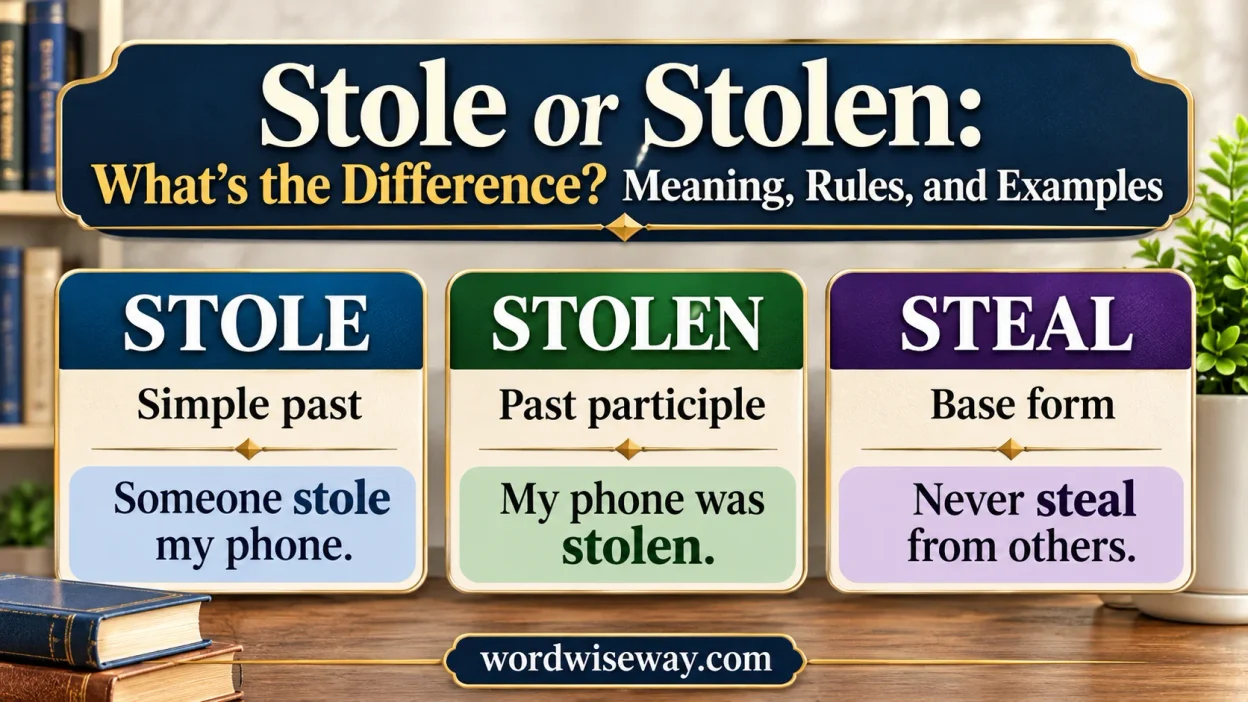
Stole or Stolen: Difference, Meaning, Rules, and Examples explains how these two verb forms work in English grammar. Stole is the simple past tense of steal, while stolen is its past participle. Both describe past actions, but their grammatical uses differ. Understanding these verb forms helps you write clear, correct sentences.
Use stole when describing a completed action in the past. For example, “She stole my book” and “They stole the bag” are correct sentences. Stole works as the main verb without a helping verb. It follows the rules for irregular verbs, so you cannot form it by simply adding -ed to steal.
Use stolen with a helping verb in perfect tenses. For example, “She has stolen my book” uses the present perfect tense, while “He had stolen the wallet” uses the past perfect. Remember, “He stolen the wallet” is incorrect because it lacks an auxiliary verb.
Quick Answer:
Stole is the simple past tense of steal. Use it to describe an action that happened in the past.
Stolen is the past participle of steal. Use it with helping verbs in perfect tenses and passive constructions. It can also describe a noun.
| Word | Verb form | When to use it | Example |
| Stole | Simple past tense | Describing a completed past action | Someone stole my wallet yesterday. |
| Stolen | Past participle | Forming perfect tenses | Someone has stolen my wallet. |
| Stolen | Past participle in passive voice | Focusing on the person or thing affected | My wallet was stolen. |
| Stolen | Adjectival use | Describing something taken unlawfully | The police recovered the stolen wallet. |
Easy rule to remember: Use stole for a simple past action and stolen after helping verbs such as has, have, had, was, and were when the sentence requires a past participle.
What Does Stole Mean?
Stole is the simple past tense of the irregular verb steal. It describes an action that happened in the past, whether the action occurred yesterday, last year, or at another completed time.
Unlike regular verbs that form their past tense by adding -ed, the verb steal changes to stole. You cannot form its standard past tense by adding -ed.
Consider these examples:
- Someone stole my bicycle last night.
- The child stole a cookie from the kitchen.
- A stranger stole her handbag on the train.
- The comedian stole the audience’s attention.
- The talented singer stole the show.
In the first three examples, stole describes taking something without permission. In the last two, it has a figurative meaning. The comedian and singer impressed people so much that they captured everyone’s attention.
Examples of Stole in Sentences
Looking at different sentence patterns makes the meaning of stole easier to understand.
| Example | Explanation |
| My brother stole my favorite pen. | Describes a completed past action. |
| Someone stole the packages from our porch. | Identifies an action that occurred in the past. |
| The thief stole several valuable paintings. | Describes unlawful taking. |
| Her performance stole the spotlight. | Uses stole figuratively to mean attracted attention. |
| The dog stole a piece of chicken from the table. | Describes taking something in a playful or informal context. |
| Who stole my notebook? | Uses stole in a direct question about a past event. |
Notice that stole can appear in statements and questions. Its grammatical role remains the same because it expresses the simple past tense.
When to Use Stole
Use stole when you want to describe a past action without forming a perfect tense or passive construction.
1. When describing a completed past event
Use stole with past-time expressions such as yesterday, last week, and two days ago.
- Someone stole my luggage yesterday.
- The burglar stole several items last weekend.
- She stole my umbrella two hours ago.
These expressions identify when the action happened. The simple past tense fits naturally because the sentences report past events.
2. When telling a story
The simple past tense helps move a narrative forward by presenting actions in sequence.
For example:
“Jake entered the room, noticed the open window, and realized someone stole his laptop.”
Here, stole reports an event in the story. In polished writing, the surrounding timeline may determine whether the simple past or past perfect is more appropriate.
3. When asking questions with did
Questions using did require the base form steal, not stole.
- Correct: Did someone steal your phone?
- Incorrect: Did someone stole your phone?
Why? The auxiliary verb did already marks the past tense. Adding stole would mark the past twice.
The same rule applies to negative sentences:
- Correct: She did not steal the money.
- Incorrect: She did not stole the money.
Remember that did takes the base form of the main verb.
What Does Stolen Mean?
Stolen is the past participle of steal. A past participle is a verb form used with auxiliary verbs to build certain grammatical structures.
Unlike stole, stolen generally cannot function alone as the main verb in a standard finite clause. It usually needs a helping verb or appears in a participial phrase.
For example:
- She has stolen my keys.
- They had stolen the documents before the security team arrived.
- My bicycle was stolen outside the library.
- The stolen artwork was eventually recovered.
Each sentence uses stolen differently. In the first two, it helps form perfect tenses. The third, it appears in a passive construction. In the fourth, it describes the artwork.
Examples of Stolen in Sentences
The following examples show how stolen works in different grammatical patterns.
| Example | Grammatical use |
| He has stolen my headphones. | Present perfect tense |
| They have stolen several bicycles. | Present perfect tense |
| Someone had stolen the files before the investigation began. | Past perfect tense |
| The car was stolen from the parking lot. | Simple past passive |
| The paintings were stolen during the night. | Simple past passive |
| The stolen jewelry was found in a suitcase. | Adjectival use |
| The missing documents may have been stolen. | Modal perfect passive |
These examples demonstrate why stolen cannot simply replace stole in every sentence about the past.
When to Use Stolen
Use stolen when the grammatical structure calls for a past participle or when you want to describe something taken unlawfully.
1. After has, have, or had
Perfect tenses combine a form of have with a past participle.
- She has stolen my notebook.
- We have stolen nothing.
- The suspect had stolen the car before dawn.
The helping verb determines the tense, while stolen supplies the main verb’s past participle form.
2. In passive constructions
Passive voice emphasizes the person or thing affected by an action rather than the person performing it.
- My phone was stolen.
- Several paintings were stolen from the museum.
- The missing bicycle has been stolen.
The typical pattern is a form of be followed by the past participle. Depending on the sentence, the construction can express different tenses.
3. When describing an object
The word stolen can modify a noun.
- The police recovered the stolen vehicle.
- She reported her stolen passport.
- Investigators searched for the stolen documents.
In these examples, stolen describes the condition or history of the noun. It functions as an adjective-like participle rather than the main verb of a finite clause.
Key Differences
Although stole and stolen come from the same verb, they serve different grammatical purposes. Understanding these differences helps you choose the correct word without relying on guesswork.
| Feature | Stole | Stolen |
| Verb form | Simple past | Past participle |
| Main purpose | Reports a past action | Forms perfect tenses and passive constructions |
| Used with has/have/had | No, not in standard perfect-tense constructions | Yes |
| Used in passive voice | No, not as the required past participle | Yes |
| Used to describe a noun | Not normally with the meaning of unlawfully taken | Yes |
| Example | Someone stole the bag. | Someone has stolen the bag. |
The most important distinction is grammatical, not simply chronological. Both words can refer to events that happened in the past, but they do not fit into the same sentence structures.
Stole vs. Stolen in Past-Tense Sentences
Compare these sentences:
- Someone stole my phone.
- Someone has stolen my phone.
Both sentences describe a theft. However, they present the event through different grammatical structures.
In the first sentence, stole is the simple past tense. It reports the event as a past occurrence.
In the second sentence, has stolen is the present perfect tense. The sentence connects a past event to the present, often because the result matters now.
For example, you might say, “Someone has stolen my phone,” when you have just discovered that it is missing and are explaining your current problem.
By contrast, “Someone stole my phone yesterday” places the event within a specific past-time frame.
Important: The present perfect does not always mean the action happened recently. It can describe an earlier event when its connection to the present remains relevant.
Stole vs. Stolen in Passive Voice
Passive voice is one of the clearest situations in which stolen is necessary.
Consider these sentences:
- Correct: The wallet was stolen.
- Incorrect: The wallet was stole.
The subject, the wallet, receives the action rather than performing it. The verb was combines with the past participle stolen to form the passive construction.
Compare the active and passive versions:
| Voice | Example | Focus |
| Active | Someone stole the wallet. | The person performing the action |
| Passive | The wallet was stolen. | The item affected by the action |
| Active | Someone has stolen the documents. | The person who took them |
| Passive | The documents have been stolen. | The missing documents |
Both voices can communicate the same basic event. Your choice depends on what you want to emphasize.
Stole vs. Stolen as Adjectives
The word stolen can describe a noun, while stole normally functions as a verb.
Consider these examples:
- The stolen bicycle was returned to its owner.
- Police recovered the stolen money.
- She replaced her stolen passport.
- The stolen identity was used to open fraudulent accounts.
In each example, stolen modifies a noun and identifies something taken unlawfully.
You would not normally write “the stole bicycle” to convey the same meaning. That construction uses the wrong form of the verb.
One useful distinction is that stolen can appear before a noun or after a linking verb in a suitable context.
For example, “The bicycle was stolen” uses stolen in a passive construction. In “The bicycle remained stolen for several days,” the word describes the bicycle’s continuing status, although the sentence sounds less natural than alternatives such as “The bicycle remained missing.”
Common Mistakes
Even experienced English speakers sometimes confuse irregular verb forms. These common mistakes become easier to avoid once you recognize the structure behind each sentence.
Using Stole After Has, Have, or Had
The verbs has, have, and had take a past participle when they form perfect tenses.
Incorrect: She has stole my bag.
Correct: She has stolen my bag.
The problem is the verb form. Has establishes the perfect-tense construction, so the main verb must use stolen.
More examples:
- Incorrect: They have stole the equipment.
- Correct: They have stolen the equipment.
- Incorrect: He had stole the documents.
- Correct: He had stolen the documents.
A simple check helps: when has, have, or had functions as the auxiliary in a perfect tense, use stolen.
Using Stole Instead of Stolen in Passive Voice
Passive constructions require the appropriate past participle.
Incorrect: My bicycle was stole.
Correct: My bicycle was stolen.
Here, was is a form of the verb be. It combines with stolen to form the simple past passive.
Additional examples:
- Incorrect: The money was stole from the drawer.
- Correct: The money was stolen from the drawer.
- Incorrect: Their bags were stole at the station.
- Correct: Their bags were stolen at the station.
The subject does not need to identify the person responsible. That is one reason passive voice is useful when the person who performed the action is unknown or unimportant.
Using Stolen as the Simple Past Tense
The past participle stolen cannot normally replace the simple past form stole in an ordinary active statement.
Incorrect: He stolen my wallet yesterday.
Correct: He stole my wallet yesterday.
The corrected sentence uses stole as the main verb. It does not need an auxiliary verb because the simple past tense already expresses the past action.
Compare these patterns:
- She stole the necklace.
- She has stolen the necklace.
- The necklace was stolen.
Each sentence is correct because the verb form matches its grammatical structure.
Confusing Stole and Stolen in Questions
Questions provide another useful way to test your understanding.
Compare:
- Did he steal the money?
- Has he stolen the money?
- Was the money stolen?
All three questions are grammatically correct, but each follows a different pattern.
Did he steal the money? uses did with the base form steal.
Has he stolen the money? uses has with the past participle stolen.
Was the money stolen? uses was with the past participle in a passive construction.
Avoid writing “Did he stole the money?” because did already marks the past tense. Also avoid “Has he stole the money?” because the perfect-tense construction requires stolen.
Stole, Stolen, and Steal: Understanding All Three Forms
To master stole and stolen, it helps to understand the complete set of principal verb forms.
The verb steal is irregular. Its forms do not follow the usual pattern of adding -ed to make the simple past and past participle.
| Verb form | Grammatical use | Example |
| Steal | Base form | Never steal someone else’s property. |
| Steals | Third-person singular present | He steals food from the kitchen. |
| Stole | Simple past | He stole a sandwich yesterday. |
| Stolen | Past participle | He has stolen a sandwich before. |
| Stealing | Present participle or gerund | He was stealing food when someone noticed. |
Learning this pattern prevents confusion in many everyday situations.
When to Use Steal
Use steal as the base form of the verb. It appears in infinitives, after modal verbs, and in certain present-tense constructions.
Examples include:
- Base form: Some people steal unattended packages.
- Infinitive: He tried to steal a bicycle.
- Modal verb: You must not steal from others.
- Question with did: Did someone steal your bag?
- Negative with do: They do not steal from customers.
Notice that the main verb remains steal after did, do, and modal verbs such as must.
The third-person singular present tense uses steals: “She steals the spotlight whenever she performs.”
How the Three Forms Work in Sentences
The easiest way to understand the forms is to follow one action through different sentence structures.
| Sentence | Verb form | Reason |
| They steal cars. | Steal | Simple present |
| They stole a car yesterday. | Stole | Simple past |
| They have stolen a car. | Stolen | Present perfect |
| They had stolen a car before noon. | Stolen | Past perfect |
| A car was stolen yesterday. | Stolen | Simple past passive |
| They might steal a car. | Steal | Base form after a modal verb |
| They were stealing a car. | Stealing | Past continuous |
These patterns apply to other irregular verbs, although each verb has its own forms. For instance, write, wrote, and written follow a similar distinction between the base form, simple past, and past participle.
Stole vs. Stolen in American English
In standard American English, stole is the simple past tense of steal, and stolen is its past participle.
This distinction is grammatical rather than regional. American speakers do not generally use stole and stolen as interchangeable alternatives.
The same standard forms appear in British English:
- American English: Someone stole my phone.
- British English: Someone stole my phone.
- American English: My phone has been stolen.
- British English: My phone has been stolen.
Differences in accent or informal speech do not change the standard written forms.
If you are writing an essay, business email, report, or article, follow the same basic rules regardless of which variety of English you use.
How to Remember the Difference?
A simple memory trick can help you choose the correct form quickly.
Think of stole as the past-action form and stolen as the helping-verb form. This shortcut works for many common sentences, although stolen also appears in passive constructions and as an adjective.
Use these patterns as a quick reference:
- Someone stole it. Simple past.
- Someone has stolen it. Present perfect.
- Someone had stolen it. Past perfect.
- It was stolen. Passive voice.
- The stolen item. Adjectival use.
- Did someone steal it? Question using did.
When you are uncertain, look at the words surrounding the verb.
If the sentence uses has, have, or had to form a perfect tense, choose stolen. If it uses a form of be to form the passive voice, choose stolen. Or if you are describing a straightforward past action, stole is usually the correct choice.
Practice:
Test your understanding with these sentences. Choose the form that completes each sentence correctly.
- Someone _____ my lunch yesterday.
- She has _____ my favorite pen.
- The bicycle was _____ outside the store.
- Did he _____ the documents?
- They had _____ the car before the police arrived.
- The _____ painting was returned to the gallery.
- Who _____ the last cookie?
- Several packages have been _____ from the porch.
Answers and Explanations
| No. | Correct answer | Explanation |
| 1 | Stole | The simple past describes a completed event. |
| 2 | Stolen | Has forms the present perfect with a past participle. |
| 3 | Stolen | Passive voice requires the past participle. |
| 4 | Steal | Did takes the base form of the verb. |
| 5 | Stolen | Had forms the past perfect with a past participle. |
| 6 | Stolen | The word describes the painting. |
| 7 | Stole | The question asks about a past action. |
| 8 | Stolen | Have been forms the present perfect passive. |
If you missed any answers, review the sentence patterns rather than memorizing isolated examples. Understanding the structure makes the correct form easier to recognize next time.
Read More: Spoke or Spoken: Difference and How to Use Them Correctly?
FAQs
1. Is Stole or Stolen Correct?
Both stole and stolen are correct, but they serve different grammatical purposes. Use stole for the simple past tense and stolen as the past participle.
2. What Is the Difference Between Stole and Stolen?
Stole describes an action that happened in the past, while stolen usually appears with a helping verb in perfect tenses. For example, “She stole my bag” and “She has stolen my bag.”
3. Is Stole the Past Tense of Steal?
Yes, stole is the simple past tense of steal. For example, “He stole a bicycle yesterday.”
4. Is Stolen the Past Participle of Steal?
Yes, stolen is the past participle of steal. You can use it with helping verbs, as in “They have stolen the keys.”
5. Can You Use Stolen Without a Helping Verb?
In standard perfect-tense sentences, stolen needs a helping verb. However, it can also describe a noun, as in “The stolen wallet was found.”
6. Should You Say “I Stole” or “I Have Stolen”?
Both are correct. Use “I stole” for a simple past statement and “I have stolen” when using the present perfect tense.
7. Is “He Has Stole” Grammatically Correct?
No, “He has stole” is incorrect in standard English. The correct sentence is “He has stolen” because has requires the past participle.
8. What Is the Past Perfect Form of Steal?
The past perfect form is had stolen. For example, “She had stolen the money before anyone noticed.”
9. Is Stole a Regular or Irregular Verb Form?
Stole belongs to the irregular verb steal. Its forms change from steal to stole to stolen, rather than following the usual -ed pattern.
10. How Can You Remember When to Use Stole or Stolen?
Remember this simple pattern: use stole for a direct statement about the past, and use stolen with helping verbs such as has, have, or had. Reading examples and writing your own sentences will help you remember the difference.
Conclusion
Choosing between stole and stolen becomes much easier once you understand their roles. Although both come from the verb steal, they cannot replace each other in every sentence. Stole describes an action that happened in the past, while stolen usually needs a helping verb to complete its meaning.
The easiest way to remember the difference is to look at the words around the verb. If you’re describing a past event, use stole, as in “Someone stole my phone.” If you’re using has, have, or had, choose stolen, as in “Someone has stolen my phone.” This simple check can help you avoid common grammar mistakes.
Ultimately, learning these two verb forms is about more than memorizing rules. It’s about recognizing how English sentences fit together. Pay attention to examples when reading, and practice using stole and stolen in your own sentences. With regular practice, you’ll choose the correct form more naturally and express past events with greater confidence.