Wore or Worn: Meaning, Difference and Correct Usage explains how these verb forms differ and how to use them correctly in everyday English. Understanding their meanings helps you avoid common grammar mistakes and write clearer sentences.
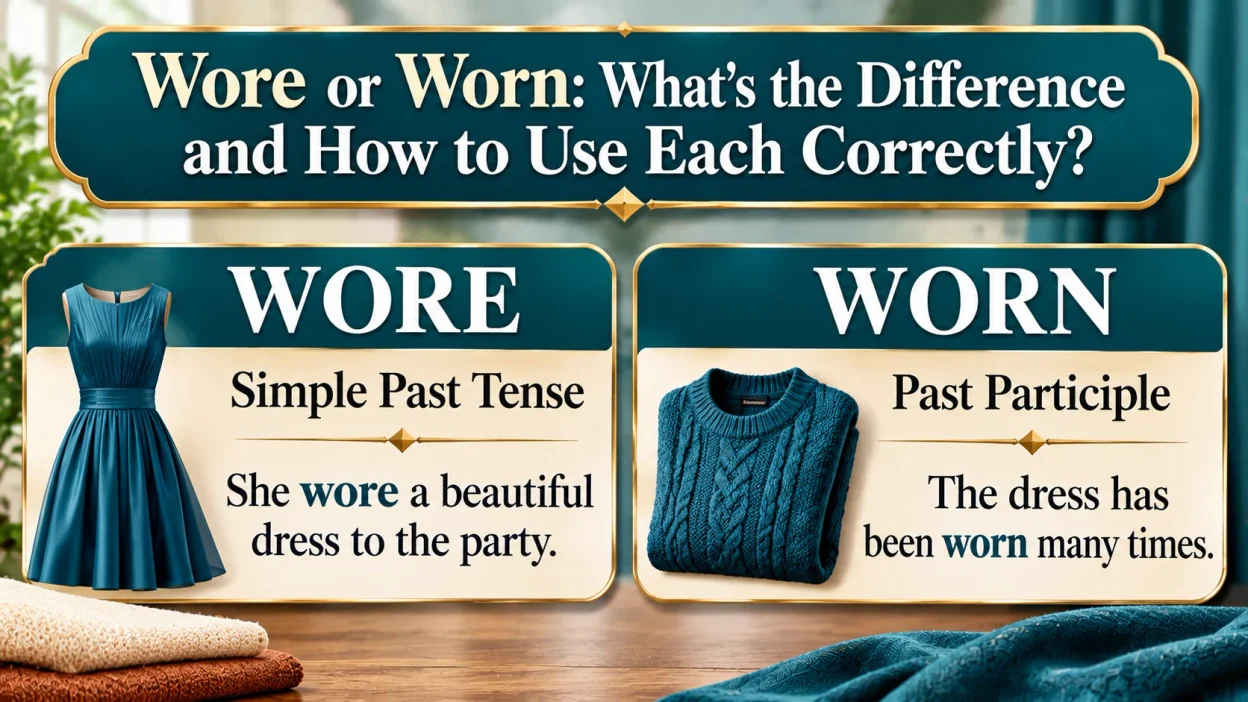
Wore is the simple past tense of wear. Use it to describe a completed action in the past. For example, “She wore a blue dress yesterday.” It works as the main verb without an auxiliary verb.
Worn is the past participle of wear. It usually appears with a helping verb in perfect tenses. For example, “She has worn that dress before.” Remember, use wore for simple past actions and worn with helping verbs in perfect constructions.
Quick Answer
Wore is the simple past tense of wear. Use it to describe an action that happened in the past.
Worn is the past participle of wear. Use it with helping verbs such as have, has, and had in perfect tenses. It also appears in passive constructions and can function as an adjective.
Compare these examples:
- Wore: She wore a blue dress to the wedding.
- Worn: She has worn that blue dress several times.
In the first sentence, wore describes a completed past action. In the second, has worn connects a past action to the present.
Here’s a quick comparison:
| Feature | Wore | Worn |
| Grammatical form | Simple past tense | Past participle |
| Main purpose | Describes a past action | Forms perfect tenses and passive constructions |
| Common pattern | Subject + wore | Subject + have/has/had + worn |
| Example | He wore a jacket yesterday. | He has worn that jacket before. |
| Can function as an adjective? | No, not in standard adjective use | Yes, as in “worn shoes” |
Easy rule to remember: You wore something yesterday, but you may have worn it many times.
What Does Wore Mean?
Wore is the simple past tense of wear. You use it when talking about something that happened in the past, such as putting on clothing, using an accessory, or displaying a particular expression.
The verb wear has several meanings. It can describe clothing, accessories, facial expressions, and even the gradual damage caused by friction or repeated use. The word wore carries these meanings into the past.
For example:
- She wore her favorite sweater to school yesterday.
- He wore glasses throughout his college years.
- They wore matching uniforms during the competition.
- The child wore a big smile throughout the party.
- The river wore away the rocks over many years.
Notice that each sentence describes a past action or process. You don’t need have, has, or had before wore when using it as the main verb in the simple past tense.
When Should You Use Wore in a Sentence?
Use wore when you want to describe a past event directly. It often appears alongside time expressions such as yesterday, last week, in 2024, or when I was younger.
Consider these examples:
- I wore my new shoes yesterday.
- She wore a traditional outfit to the celebration.
- We wore raincoats during the storm.
- My grandfather wore the same watch for decades.
These sentences describe actions that occurred in the past. The verb doesn’t need another helping verb to express that time.
However, a specific past-time expression isn’t always necessary. You can also use wore when the context already makes the timing clear.
For example, “She wore a red coat” is grammatically complete even without saying when she wore it.
Wore Examples in Everyday English
The meaning of wore extends beyond clothing. Here are examples of its common uses.
| Meaning | Example sentence |
| Clothing | He wore a black shirt to work. |
| Accessories | She wore silver earrings to dinner. |
| Glasses | My teacher wore reading glasses. |
| Facial expression | He wore a worried expression. |
| Gradual erosion | The flowing water wore away the stone. |
| Repeated use | The machine wore down the surface over time. |
The key is to recognize wore as the simple past form of wear, regardless of which meaning the sentence expresses.
What Does Worn Mean?
Worn is the past participle of wear. Unlike wore, it usually needs a helping verb when you use it to form a perfect tense.
For example, consider these sentences:
- I have worn this jacket before.
- She has worn glasses since childhood.
- They had worn their costumes before the show started.
- By Friday, he will have worn the uniform for a full week.
In each example, worn works with another verb to express the grammatical tense. The helping verb changes, but the past participle remains the same.
The word worn also appears in passive constructions and adjective phrases. These uses follow different patterns, so understanding the context matters.
When Should You Use Worn in a Sentence?
Use worn when a sentence requires the past participle of wear. This commonly happens after have, has, or had.
For example:
- I have worn these shoes many times.
- She has worn that necklace since graduation.
- He had worn the uniform before joining the team.
- We have worn similar outfits at previous events.
Compare the following sentences:
- Correct: She wore the dress yesterday.
- Correct: She has worn the dress before.
- Incorrect: She has wore the dress before.
The third sentence uses the simple past form where the past participle belongs. In standard English, has must be followed by worn in this construction.
Worn as an Adjective
Sometimes, worn describes an object’s condition rather than forming a verb tense. In this case, it acts as an adjective.
For example:
- He carried a worn leather bag.
- The old carpet looks worn.
- She found a worn paperback on the shelf.
- Their furniture appeared worn after years of use.
Here, worn describes something that shows signs of use, age, or damage.
This meaning is particularly common when discussing clothing, shoes, furniture, books, and other objects that deteriorate over time.
Important distinction: In “She has worn those shoes,” worn is part of a verb phrase. In “Those shoes look worn,” it describes the shoes’ condition.
Worn in Passive Constructions
The past participle worn also appears in passive sentences. These constructions emphasize the clothing or item rather than the person who wore it.
For example:
- The uniform was worn by every team member.
- These costumes were worn during the performance.
- The medal has been worn by several previous winners.
In these sentences, forms of be combine with worn to create passive constructions. The person performing the action may appear after by or remain unstated.
Compare these two examples:
- Active: The players wore their uniforms.
- Passive: The uniforms were worn by the players.
Both sentences describe the same basic event. However, the active version emphasizes the players, while the passive version emphasizes the uniforms.
When to Use Wore vs. Worn
The easiest way to choose between wore and worn is to examine the structure of your sentence. Instead of relying on what sounds right, identify the verb form the sentence requires.
Use Wore for the Simple Past Tense
Choose wore when describing a past action without a perfect-tense helping verb.
For example:
- I wore my favorite jacket to the concert.
- She wore comfortable shoes during the trip.
- They wore matching shirts at the family gathering.
- He wore his grandfather’s watch to the ceremony.
Each sentence describes an action that took place in the past.
You can also use wore when describing an ongoing process that happened over a period of time, provided the sentence uses the simple past form.
For example, “Years of use wore down the wooden steps” describes gradual deterioration that occurred over time.
Use Worn After Have, Has, or Had
The words have, has, and had commonly signal that you need a past participle.
Use have worn or has worn for the present perfect tense. This tense often connects a past experience or action to the present.
Examples:
- I have worn this coat for three winters.
- She has worn braces before.
- They have worn these uniforms at every tournament.
Use had worn for the past perfect tense. This construction describes an action that happened before another past event.
For example:
“She had worn the dress before she attended the wedding.”
The wearing happened before the wedding. The past perfect construction makes that sequence clear.
| Construction | Example | Purpose |
| Have worn | I have worn these shoes before. | Past experience relevant to the present |
| Has worn | She has worn the uniform all week. | An action or situation connected to the present |
| Had worn | He had worn the jacket before it was repaired. | An earlier past action |
| Will have worn | By Monday, she will have worn it five times. | An action completed by a future point |
Remember that these examples illustrate common uses. The precise meaning depends on the sentence and its context.
Use Worn in Passive Constructions
Use worn when the sentence follows a passive pattern, such as was worn, were worn, or has been worn.
Examples:
- The costume was worn during the school play.
- The jackets were worn by the volunteers.
- The uniform has been worn by generations of students.
The important point is that the past participle follows the appropriate form of be. You don’t replace worn with wore in these constructions.
Use Worn as an Adjective
Choose worn when describing an object’s condition.
Examples:
- The worn shoes needed new soles.
- She kept her worn notebook for sentimental reasons.
- The armchair looked worn around the edges.
You can often replace worn with a more specific descriptive word, depending on the meaning. For example, frayed describes fabric with loose threads, while faded describes a loss of color.
However, these words aren’t exact synonyms. Choose the adjective that best describes the object’s condition.
Different Verb Tenses
Understanding the main forms of wear makes it easier to use both words correctly. The verb is irregular, so its past forms don’t follow the usual pattern of adding -ed.
Here are the principal forms and related constructions.
| Verb form or tense | Example |
| Base form | I wear comfortable shoes. |
| Third-person singular | She wears comfortable shoes. |
| Simple past | She wore comfortable shoes yesterday. |
| Present perfect | She has worn comfortable shoes before. |
| Past perfect | She had worn comfortable shoes earlier. |
| Future perfect | She will have worn comfortable shoes by then. |
| Present progressive | She is wearing comfortable shoes. |
| Past progressive | She was wearing comfortable shoes. |
| Passive construction | Comfortable shoes were worn by the participants. |
Notice that wore appears in the simple past tense. Meanwhile, worn appears in perfect tenses and passive constructions.
The progressive forms use wearing, not wore or worn, because they describe actions in progress.
What Are the Three Forms of Wear?
The three principal forms are:
- Wear: Base form and present-tense form.
- Wore: Simple past tense.
- Worn: Past participle.
For example:
- Present: I wear a watch every day.
- Past: I wore a watch yesterday.
- Present perfect: I have worn this watch for years.
These three forms are worth memorizing because they follow an irregular pattern. Standard English doesn’t use weared as the simple past or worned as the past participle.
Common Mistakes
Even experienced English learners sometimes mix up these forms. Most mistakes happen when writers overlook the helping verb or assume that irregular verbs follow the same rules as regular verbs.
Using Wore After Have, Has, or Had
One of the most common errors is using wore after a helping verb that requires a past participle.
- Incorrect: I have wore this jacket before.
- Correct: I have worn this jacket before.
The same rule applies to has and had.
- Incorrect: She has wore those shoes several times.
- Correct: She has worn those shoes several times.
- Incorrect: He had wore the uniform before.
- Correct: He had worn the uniform before.
Why does this happen? Writers sometimes remember that wore refers to the past and use it whenever a sentence describes an earlier action. However, verb tense depends on sentence structure, not simply on whether an action happened before now.
Using Worn Without the Required Verb
Another mistake is using worn as the main verb in a simple past sentence.
- Incorrect: She worn a blue dress yesterday.
- Correct: She wore a blue dress yesterday.
The simple past tense of wear is wore. The past participle worn generally needs an appropriate helping verb when functioning as part of a verb phrase.
However, worn can appear without have, has, or had when it functions as an adjective.
For example, “Her shoes looked worn” is correct because worn describes the shoes’ condition.
Confusing Worn With Weared or Worned
English has many regular verbs that form their past tense by adding -ed. For example, walk becomes walked, and clean becomes cleaned.
However, wear is an irregular verb.
| Incorrect form | Correct form |
| Weared | Wore |
| Worned | Worn |
| Have wore | Have worn |
| Had wore | Had worn |
Avoid creating forms by applying regular verb rules to wear. Memorizing its three principal forms will help you avoid these errors.
Confusing Worn as an Adjective With Worn as a Verb
The same word can serve different grammatical purposes.
Consider these sentences:
- The shoes are worn.
- The shoes were worn by the athletes.
- The athletes wore the shoes yesterday.
In the first sentence, worn describes the shoes’ condition. In the second, it forms part of a passive construction. In the third, wore is the simple past tense.
Recognizing the sentence structure helps you understand why each form works.
Easy Ways to Remember Wore vs. Worn
Grammar becomes easier when you have a simple rule to follow. Instead of memorizing lengthy explanations, use these practical techniques.
Remember the Wear, Wore, Worn Pattern
Start by memorizing the three principal forms:
Wear → Wore → Worn
Then compare them with another irregular verb:
- I see the bird.
- I saw the bird yesterday.
- I have seen the bird before.
The same pattern applies to wear:
- I wear this jacket.
- I wore this jacket yesterday.
- I have worn this jacket before.
Just as you say have seen rather than have saw, you say have worn rather than have wore.
Look for Helping Verbs
When you’re unsure which form to use, look for have, has, or had.
If one of these verbs forms a perfect-tense construction, use worn.
For example:
- She has ___ the dress before.
- She ___ the dress yesterday.
The first sentence needs worn. The second needs wore.
This quick check works in many everyday writing situations.
Check Whether You’re Describing an Object
If you’re describing something that shows signs of age or use, worn may be the right adjective.
For example:
- The shoes look worn.
- The book has a worn cover.
- The old sofa appears worn.
You don’t need have, has, or had to use worn this way.
However, remember that context matters. A sentence can use worn as a verb form or an adjective, depending on its structure.
Wore or Worn: Practice Exercises
Now it’s time to put the rules into practice. Choose wore or worn to complete each sentence.
- She ___ her favorite sweater yesterday.
- I have ___ these shoes many times.
- The carpet looks badly ___.
- He had ___ the uniform before the ceremony.
- They ___ matching shirts at the event last week.
- Have you ever ___ a traditional costume?
- The old jacket was ___ during the final performance.
- My brother ___ glasses when he was younger.
- She has ___ that necklace since graduation.
- The leather bag looked ___ after years of use.
Read More: Buses or Bus’s or Bus’? Difference and Correct Usage
FAQs
1. What Is the Main Difference Between Wore and Worn?
Wore is the simple past tense of wear, while worn is its past participle. Use “I wore a jacket yesterday” for a past action and “I have worn this jacket before” for an experience.
2. Is Wore or Worn Correct in English?
Both words are correct, but they serve different grammatical purposes. Choose wore for simple past sentences and worn when a helping verb forms a perfect tense.
3. Should I Say I Wore It or I Have Worn It?
Both expressions are correct. “I wore it” refers to a completed past action, often at a specific time. “I have worn it” connects the experience to the present without specifying when it happened.
4. Can I Use Worn Without a Helping Verb?
Yes, worn can appear without a helping verb in certain constructions, especially before a noun or in passive phrases with omitted context. For example, “The worn shoes need replacing.” However, it usually needs a helping verb when forming a perfect tense.
5. Is Wore a Regular or Irregular Verb Form?
Wore is an irregular verb form. The verb wear does not form its past tense by simply adding -ed. Instead, its principal forms are wear, wore, and worn.
6. Which Is Correct: She Has Wore or She Has Worn?
“She has worn” is correct because has requires the past participle worn in this perfect-tense construction. “She has wore” is grammatically incorrect in standard English.
7. How Do I Remember When to Use Wore and Worn?
A simple trick is to check the words around the verb. If you’re describing a past action directly, use wore. If you see has, have, or had forming a perfect tense, use worn.
8. Is “Had Wore” Correct or Should I Use “Had Worn”?
Use had worn. The word had forms the past perfect tense and must be followed by the past participle worn. For example, “She had worn her uniform before the ceremony.”
9. What Is the Difference Between Worn and Wearing?
Worn is the past participle of wear, while wearing is its present participle. Compare “He has worn that shirt before” with “He is wearing that shirt now.” The first describes a previous experience, while the second describes an ongoing action.
10. Can Wore and Worn Be Used in the Same Sentence?
Yes, both can appear in one sentence when the grammar calls for them. For example, “She wore the coat yesterday that she had worn during last winter.” Here, wore describes a past action, while had worn shows an earlier action relative to another past event.
Conclusion
Understanding wore and worn becomes easier when you focus on how each word works in a sentence. Both come from the verb wear, but they cannot always replace each other. Choosing the right form helps you express past actions clearly and avoid common English grammar mistakes.
Remember, wore describes an action in the simple past, such as “I wore my favorite jacket yesterday.” Worn is the past participle, as in “I have worn this jacket many times.” Words like has, have, and had often signal that you need worn to form a perfect tense.
The best way to remember the difference is to practice with everyday examples. Before choosing a word, check whether you’re describing a completed past action or using a perfect-tense construction. With regular practice, you’ll learn to use wore or worn naturally and confidently in both speaking and writing.

Emma Smith has dedicated 14 years to Princeton University’s English Department, mentoring students in textual interpretation, literary movements, and critical frameworks. Her research explores Shakespearean drama, Victorian serial fiction, postcolonial narrative theory, and manuscript studies and probing how literary forms evolve across cultures and centuries. Emma has delivered lectures at international humanities congresses and published findings in distinguished academic journals, underscoring her commitment to scholarly depth and vibrant teaching.