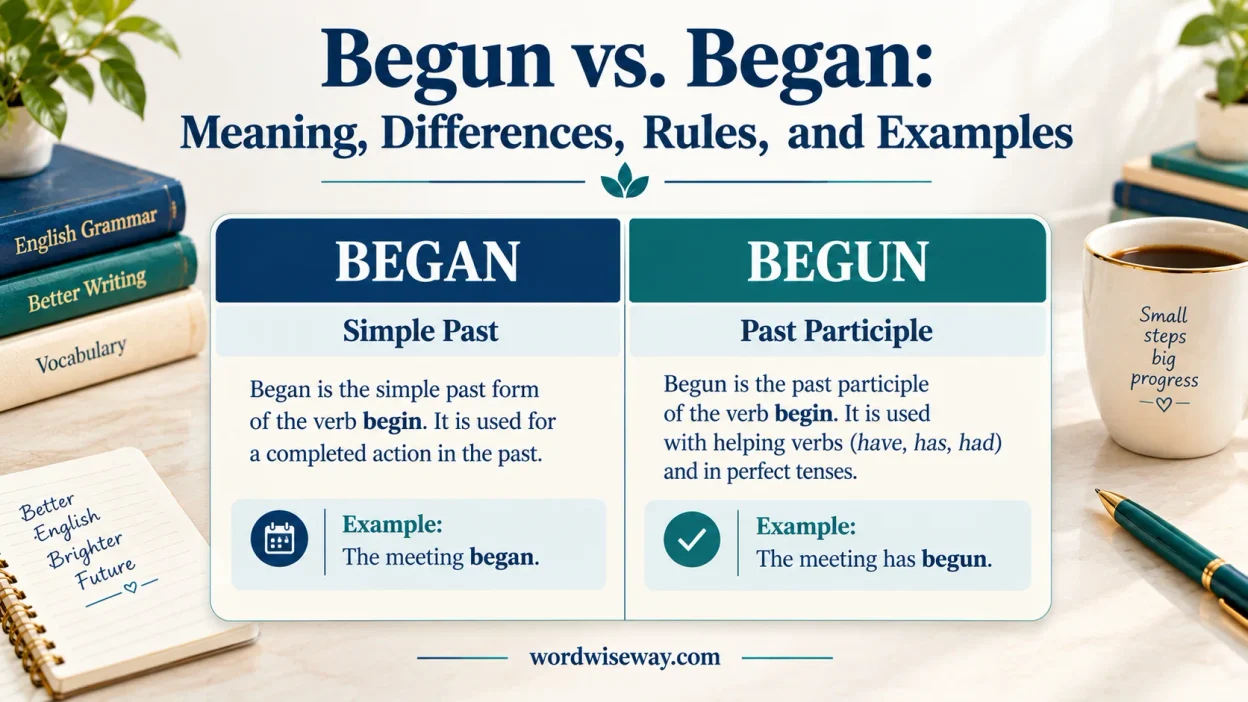
In English grammar, begin is an irregular verb with three forms: begin, began, and begun. In Begun vs. Began: Meaning, Differences, Rules, and Examples, understanding these forms helps you follow grammatical rules and choose the correct verb.
Use began as the simple past tense when describing a completed action. For example, “She began her homework yesterday.” It describes something that started at a specific time in the past without a helping verb. This usage makes sentence structure clear and grammatically correct.
Use begun as the past participle with have, has, or had. For example, “They have begun the project” connects a past action to the present, while “They had begun before noon” links two past events. Remember, began stands alone as the simple past form, while begun needs a helping verb in these verb phrases.
Quick Answer:
Began is the simple past tense of begin. Use it when describing an action that started in the past.
Begun is the past participle of begin. It usually appears with auxiliary verbs such as has, have, or had to form perfect tenses.
| Word | Verb form | Common sentence pattern | Example |
| Began | Simple past tense | Subject + began | She began her homework yesterday. |
| Begun | Past participle | Subject + has/have + begun | She has begun her homework. |
| Begun | Past participle | Subject + had + begun | She had begun her homework before dinner. |
Easy way to remember: Use began for a straightforward past-tense statement. Use begun after has, have, or had in perfect-tense constructions.
For example:
- Correct: The concert began at seven.
- Correct: The concert has begun.
- Incorrect: The concert has began.
- Incorrect: The concert had began.
The distinction isn’t about the meaning of starting something. It concerns how the verb fits into the sentence.
What Does Began Mean?
Began is the simple past tense of the verb begin. It describes an action that started at an earlier time. In a standard affirmative sentence, began can function as the main verb without an auxiliary verb.
For example, “The class began at eight” tells you when the class started. The sentence doesn’t need has, have, or had because the simple past tense already expresses the action.
You can use began in conversations, stories, reports, and descriptions of past events. The important point is that the sentence describes a past action rather than using a perfect-tense construction.
When to Use Began
Use began in these common situations.
When describing a completed past action
Use began when you’re reporting that something started in the past.
- The movie began after the announcements.
- He began learning Spanish last summer.
- The company began operations in 2018.
Each sentence reports a starting point in the past without using a perfect-tense auxiliary.
When mentioning a specific past time
Expressions such as yesterday, last week, and in 2022 often appear with the simple past.
- The meeting began yesterday.
- Construction began in March.
- The competition began two hours ago.
These time expressions help establish when the action occurred. However, the time expression alone doesn’t determine the tense. The sentence’s meaning and grammatical structure still matter.
When telling a story or describing events in sequence
Writers frequently use began to move a narrative forward.
Consider this example:
“Rain began falling shortly after sunset. The streets grew quiet, and the shopkeepers closed their doors.”
The simple past tense presents the events as part of a past sequence. This makes began a natural choice for storytelling.
When describing a past change or development
You can also use began to describe the point when a situation started changing.
- The weather began to improve in the afternoon.
- She began working at the hospital after graduation.
- The discussion began with a question about the budget.
In each example, began identifies the start of an action, activity, or process.
Examples of Began in Sentences
The following examples show how began works in different contexts.
| Context | Example sentence | Why began is correct |
| Education | The lesson began at nine. | It describes a past event. |
| Work | I began a new project last Monday. | The action started in the past. |
| Weather | Snow began falling before sunrise. | It describes the start of a past event. |
| Personal experience | She began exercising regularly last year. | It reports a past change in routine. |
| Storytelling | The crowd began cheering when the team arrived. | It moves the past narrative forward. |
| Business | The store began trading in April. | It identifies when operations started. |
Notice that began can appear before another verb ending in -ing or before an infinitive with to.
Both constructions are grammatical:
- She began reading the book.
- She began to read the book.
The choice usually depends on style and context rather than a difference in basic meaning.
Using Began in Questions and Negative Sentences
Questions and negative statements often use the auxiliary verb did. When did appears, the main verb returns to its base form, begin.
Correct examples include:
- Did the meeting begin on time?
- She didn’t begin her assignment until Monday.
- Why did the rain begin so suddenly?
Avoid these incorrect forms:
- Incorrect: Did the meeting began on time?
- Incorrect: She didn’t began her assignment until Monday.
- Incorrect: Why did the rain began so suddenly?
The rule is straightforward: After did or didn’t, use begin, not began or begun.
The auxiliary did already carries the past-tense marking. Adding another past-tense form to the main verb would break the standard grammatical pattern.
What Does Begun Mean?
Begun is the past participle of begin. Unlike began, it generally appears with an auxiliary verb when it forms a complete verb phrase in a sentence.
The most familiar patterns use has, have, or had:
- The project has begun.
- The students have begun their research.
- The team had begun training before the tournament.
These sentences use different perfect tenses. The auxiliary verb helps establish the relationship between the starting action and another time or event.
For example, “The project has begun” connects the past start with the present. By contrast, “The project had begun before the manager arrived” places the start before another past event.
When to Use Begun
With has or have in the present perfect tense
Use has begun with third-person singular subjects, such as he, she, it, or a singular noun. Use have begun with I, you, we, they, and plural nouns.
Examples:
- The semester has begun.
- My brother has begun a new job.
- We have begun preparing for the event.
- The children have begun their lessons.
The present perfect often describes a past action that matters now or a development that has occurred by the present.
For instance, “The meeting has begun” tells someone that the meeting is underway. The exact starting time isn’t the main focus.
With had in the past perfect tense
Use had begun when you want to show that an action started before another past event or reference point.
Examples:
- The film had begun before we entered the theater.
- She had begun cooking when the guests arrived.
- The company had begun hiring before the new office opened.
The past perfect helps readers understand the order of events. Without it, the timeline might be less explicit.
Compare these sentences:
“The guests arrived, and dinner began.”
“Dinner had begun before the guests arrived.”
The first presents two past events. The second explicitly establishes that dinner started earlier.
In passive constructions
Begun can also appear in passive-voice constructions with forms of be.
For example:
- The investigation was begun in January.
- The process has been begun by the new committee.
These sentences are grammatically possible, although many writers prefer more natural alternatives:
- The investigation began in January.
- The new committee has started the process.
The active versions are often clearer and more direct. Nevertheless, understanding the passive pattern helps you recognize begun in formal or specialized writing.
In participial phrases
The past participle can also appear in phrases that describe a noun or provide additional information.
For example:
“Begun in early spring, the restoration continued throughout the summer.”
Here, begun in early spring describes the restoration. It doesn’t function as a complete finite verb phrase by itself.
This distinction explains why begun can appear without has, have, or had in some grammatical structures. The auxiliary requirement depends on how the participle functions in the sentence.
Examples of Begun in Sentences
| Sentence | Grammatical pattern | Meaning |
| The show has begun. | Has + begun | The show has started by now. |
| They have begun the investigation. | Have + begun | The investigation is underway. |
| The storm had begun before midnight. | Had + begun | The storm started before a past reference point. |
| She has begun writing her report. | Has + begun | She has started the activity. |
| The repairs were begun last month. | Were + begun | Someone started the repairs. |
| Begun as a small experiment, the project eventually expanded. | Participial phrase | The phrase describes how the project started. |
These examples illustrate an important principle: begun isn’t simply a more formal version of began. It has a different grammatical role.
Key Differences at a Glance
Although began and begun come from the same verb, they aren’t interchangeable in standard English.
The easiest way to distinguish them is to examine the words surrounding the verb. Sentence structure usually reveals which form you need.
| Feature | Began | Begun |
| Verb form | Simple past | Past participle |
| Typical use | Reports a past starting action | Forms perfect tenses or participial constructions |
| Common pattern | The event began. | The event has begun. |
| With has | Incorrect in standard perfect-tense use | Correct: has begun |
| With have | Incorrect in standard perfect-tense use | Correct: have begun |
| With had | Incorrect in standard past-perfect use | Correct: had begun |
| After did | Use the base form begin instead | Use the base form begin instead |
Compare Began and Begun in Similar Sentences
Looking at paired examples makes the difference easier to recognize.
Example: A school lesson
- The lesson began at eight o’clock.
- The lesson has begun, so please take your seat.
The first sentence reports a past starting time. The second announces that the lesson has started and is relevant now.
Example: A business project
- The company began the project last year.
- The company has begun the next phase.
The first emphasizes when the project started. The second uses the present perfect to report progress up to the present.
Example: A family event
- The celebration began after dinner.
- The celebration had begun before we reached the house.
The first describes a past event. The second places the beginning before another past event.
These differences matter because verb forms help readers understand timing, sequence, and context.
Examples in Different Tenses
Understanding the tenses behind these words will help you choose the correct form without memorizing dozens of separate rules.
Simple Past: Began
The simple past describes an action or event that occurred in the past.
Pattern: Subject + began
Examples:
- The workshop began at noon.
- My interest in science began during childhood.
- The new policy began last January.
The simple past works well when the sentence presents the starting action as a past event.
Present Perfect: Has or Have Begun
The present perfect connects a past action with the present or describes an experience or development up to now.
Pattern: Subject + has/have + begun
Examples:
- The application period has begun.
- We have begun reviewing the documents.
- Several schools have begun offering the new course.
The present perfect doesn’t automatically mean an activity continues at this moment. It indicates a connection between the past event and the present context.
For example, “The investigation has begun” establishes that the investigation started. It doesn’t necessarily tell you whether investigators are working at this exact second.
Past Perfect: Had Begun
The past perfect establishes that one past action occurred before another past reference point.
Pattern: Subject + had + begun
Examples:
- The presentation had begun before the director arrived.
- She had begun her research before choosing a final topic.
- The roadwork had begun when the city announced the detour.
The past perfect is particularly useful when the sequence of past events matters.
However, you don’t need it in every sentence containing two past actions. Use it when you need to clarify which event happened first or when the context calls for that relationship.
Future Perfect: Will Have Begun
The future perfect also uses begun, even though it refers to a future point.
Pattern: Subject + will have + begun
Examples:
- By Monday, the course will have begun.
- The team will have begun construction before the end of the month.
This construction describes an action that will have started by a specified future time.
It also demonstrates why begun isn’t simply a past-tense word. It’s a past participle that appears in several grammatical constructions, including those referring to the future.
Common Mistakes
Even experienced writers sometimes mix up irregular verb forms. Fortunately, most mistakes involving began and begun follow a few predictable patterns.
Using “Has Began” Instead of “Has Begun”
Incorrect: The conference has began.
Correct: The conference has begun.
Why? The present perfect requires has followed by the past participle. Because begun is the past participle of begin, it’s the correct choice.
Using “Had Began” Instead of “Had Begun”
Incorrect: The meeting had began before noon.
Correct: The meeting had begun before noon.
Why? The past perfect follows the pattern had + past participle. Therefore, had begun is correct.
Using “Have Began” Instead of “Have Begun”
Incorrect: We have began the assignment.
Correct: We have begun the assignment.
Why? The auxiliary have requires the past participle in the present perfect construction. Use begun, not began.
Writing “Did Began” or “Didn’t Begun”
Incorrect: Did the ceremony began on time?
Correct: Did the ceremony begin on time?
Incorrect: They didn’t begun the work.
Correct: They didn’t begin the work.
Why? In questions and negatives with did, the main verb takes its base form. That form is begin.
Using “Begun” Alone in a Simple Past Sentence
Incorrect: We begun the journey yesterday.
Correct: We began the journey yesterday.
Why? The sentence uses the simple past without an auxiliary verb. In standard English, the simple past form is began.
Remember that begun can appear without a perfect-tense auxiliary in participial phrases and other nonfinite structures. The mistake occurs when you use it as the main verb of an ordinary simple past statement.
How to Remember Begun vs. Began
You don’t need to memorize a long list of grammar rules to choose correctly. A simple three-word sequence gives you a reliable starting point.
Begin → Began → Begun
These are the three principal forms of the verb begin.
- Begin: The base form, as in “We begin work at nine.”
- Began: The simple past, as in “We began work yesterday.”
- Begun: The past participle, as in “We have begun work.”
Use the Auxiliary Verb Trick
When you’re unsure whether to use began or begun, check the words before the verb.
If the sentence uses has, have, or had to form a perfect tense, choose begun.
If the sentence uses the simple past without an auxiliary, choose began.
Compare these examples:
| Sentence | Correct form | Reason |
| The game ___ at six. | Began | Simple past |
| The game has ___. | Begun | Present perfect |
| The game had ___ already. | Begun | Past perfect |
| The game will have ___. | Begun | Future perfect |
| Did the game ___ on time? | Begin | Base form after did |
One important detail: auxiliary verbs can serve different purposes. For example, did takes the base form begin, while has takes the past participle begun in the perfect tense. Focus on the complete grammatical pattern rather than the presence of an auxiliary alone.
Begin, Began, and Begun: All Three Verb Forms Explained
To understand began and begun fully, it helps to examine all three principal forms of the verb.
Begin: The Base Form
Begin is the base form. You use it in the present tense with plural subjects and with I and you. It also follows modal verbs and the auxiliary did.
Examples:
- I begin my classes at nine.
- They begin the project tomorrow.
- You should begin reading now.
- Did she begin the assignment?
Notice that begin can refer to the future when the context supports that meaning. In “They begin the project tomorrow,” the present simple describes a scheduled future event.
Began: The Simple Past Form
Began describes a starting action in the past.
Examples:
- I began my classes at nine yesterday.
- They began the project last month.
- She began reading after lunch.
Unlike regular verbs, which often form the simple past by adding -ed, begin changes its form to began.
Begun: The Past Participle
Begun appears in perfect-tense constructions and other structures that require a past participle.
Examples:
- I have begun my classes.
- They had begun the project before the deadline changed.
- She will have begun reading by noon.
The form doesn’t change according to the subject in these constructions. You write has begun, have begun, and had begun, not has beguns or had began.
Here’s the complete comparison:
| Base form | Simple past | Past participle |
| Begin | Began | Begun |
| I begin work. | I began work. | I have begun work. |
| We begin the lesson. | We began the lesson. | We have begun the lesson. |
| She begins the lesson. | She began the lesson. | She has begun the lesson. |
English contains many irregular verbs with different past forms. Learning these three forms together makes it easier to recognize the correct pattern whenever you write about starting something.
Began vs. Begun in American English
In standard American English, the grammatical distinction between began and begun remains the same.
Use began for the simple past and begun as the past participle. Neither word replaces the other simply because a sentence sounds more formal or conversational.
For example, an American speaker might say:
- The store began accepting orders on Monday.
- The store has begun accepting orders.
- The store had begun accepting orders before the announcement.
All three sentences follow standard American English grammar.
In casual conversation, speakers sometimes use nonstandard forms such as has began. However, these forms aren’t considered correct in standard edited American English. For school assignments, professional documents, and published writing, follow the standard distinction.
Began vs. Begun in Professional and Academic Writing
Choosing the right verb form helps you communicate timelines accurately. This matters in professional reports, academic essays, project updates, and everyday workplace communication.
In Business Reports
Use began when reporting a specific past event.
“The company began operations in January 2025.”
Use begun when the sentence calls for a perfect tense.
“The company has begun expanding its regional operations.”
The first sentence identifies when operations started. The second emphasizes a development that has occurred by the present.
In Academic Writing
Academic writing often discusses research activities, historical events, and developments over time.
Consider these examples:
- The researchers began collecting data in September.
- The researchers have begun analyzing the results.
- The researchers had begun their analysis before the second experiment.
Each sentence expresses a different time relationship. Selecting the correct form helps readers follow the research process without confusion.
In Emails and Project Updates
The same distinction applies to routine workplace messages.
Examples:
- “The training session began at 10 a.m.”
- “We have begun reviewing your application.”
- “The team had begun testing the software before the deadline changed.”
These examples demonstrate how a small grammatical choice can make a timeline clearer. Rather than choosing a word based on how formal it sounds, choose the form that matches the sentence’s tense.
A Practical Case Study: Choosing Between Began and Begun
Imagine that a project manager needs to explain the progress of a website redesign. The project started last week, and the team has now moved into testing.
The manager writes three sentences:
A: “The redesign began last Monday.”
B: “The team has begun testing the new website.”
C: “The team had begun testing before the client requested another change.”
All three sentences are correct, but each serves a different purpose.
Sentence A uses the simple past to identify when the redesign started. B uses the present perfect to report progress up to the present. Sentence C uses the past perfect to establish that testing started before another past event.
Now consider this incorrect version:
“The team has began testing the new website.”
The sentence needs begun because has introduces a present-perfect construction.
The lesson is simple: Choose the verb form that matches the grammatical structure, not just the meaning you want to express.
Read More: As Of vs. As At vs. As From: Meaning, Differences, and Examples
FAQs
What Is the Main Difference Between Begun and Began?
Began is the simple past tense of begin, while begun is its past participle. Began can stand alone as the main verb, but begun usually needs a helping verb.
Is Began the Past Tense of Begin?
Yes, began is the simple past tense of begin. For example, “She began reading a new book yesterday.”
Is Begun Grammatically Correct?
Yes, begun is correct when used with a suitable helping verb. For example, “The lesson has begun.”
Should I Use Began or Begun With Have?
Use begun with have. For example, “We have begun our assignment.” The phrase “have began” is incorrect in standard English.
Can I Use Begun Without a Helping Verb?
In standard verb phrases, begun generally needs a helping verb such as have, has, or had. You should not use it alone to express the simple past tense.
Which Sentence Is Correct: The Show Began or the Show Begun?
“The show began” is correct because began expresses the simple past tense. You could also say, “The show has begun,” because has supports the past participle.
What Are the Three Forms of the Verb Begin?
The three main forms are begin, began, and begun. Begin is the base form, began is the simple past tense, and begun is the past participle.
Is Had Begun Correct English?
Yes, had begun is correct. It describes an action that happened before another past event, as in “The guests had begun eating before we arrived.”
How Can I Remember When to Use Began and Begun?
Remember this simple rule: use began for a past action and begun with have, has, or had. Practicing short sentences can help you remember the difference.
Why Do People Confuse Begun and Began?
People often confuse these words because both describe the start of an action. However, their grammatical roles differ, so checking for a helping verb can help you choose the correct form.
Conclusion
Understanding begun vs. began becomes easier when you focus on how each word works in a sentence. Both words come from the verb begin, but they serve different grammatical purposes. Once you recognize their forms, choosing the right word becomes a natural part of writing and speaking English.
Remember, began describes an action that started in the past, such as “The meeting began at noon.” In contrast, begun usually appears with helping verbs like have, has, or had, as in “The meeting has begun.” These simple examples show why the two forms cannot always replace each other.
The easiest way to improve is to practice using both words in your own sentences. Check whether the sentence needs a simple past verb or a past participle with a helping verb. With regular practice, you can avoid common grammar mistakes and use began and begun with greater confidence.

Amelia Sanders has spent 14 years in Harvard University’s English Department, helping students navigate literary analysis, interpretive theory, and narrative techniques. Her academic pursuits center on 18th-century British prose, romantic poetry, diasporic writing, and digital editing exploring how textual choices influence cultural perspectives. Amelia has spoken at major international meetings and contributed essays to respected academic volumes, demonstrating her dedication to thoughtful scholarship and effective teaching.