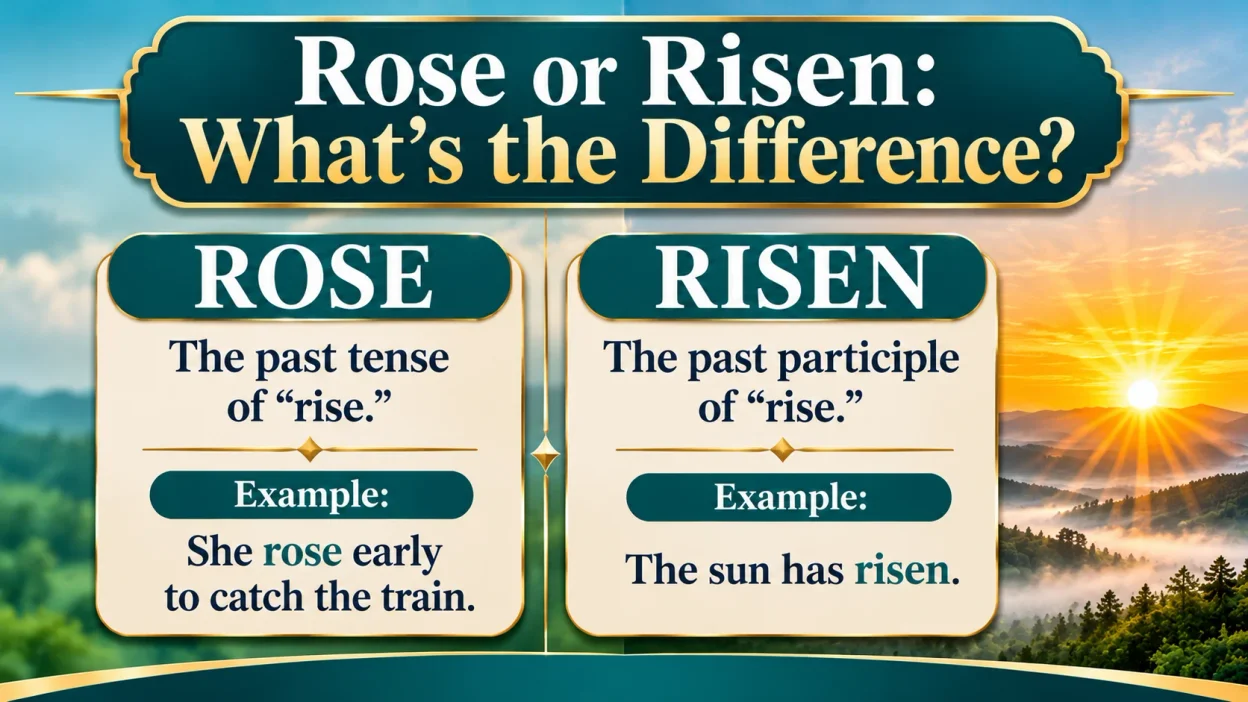
Rose or Risen: Difference, Meaning, and Examples explains the difference between these two verb forms, including their meanings, grammar rules, and correct usage in everyday English.
Rose is the simple past tense of rise. It describes an action that happened and finished in the past. For example, “The sun rose early this morning.” You can also use rose when prices increased last year or someone got out of bed. It works as a main verb without a helping verb.
Risen is the past participle of rise. It usually appears with helping verbs such as has, have, or had. For example, “Prices have risen this year.” You can also say, “The water level had risen overnight.” Remember this simple rule: use rose for completed past actions and risen with the appropriate helping verb.
Learning these forms helps you avoid common grammar mistakes, write accurate sentences, and communicate confidently in spoken and written English.
Quick Answer:
Rose is the simple past tense of rise, while risen is its past participle. Use rose to describe something that happened in the past. Use risen when the sentence requires a past participle, usually with a helping verb such as has, have, or had.
Consider these examples:
- Rose: The sun rose above the mountains yesterday.
- Risen: The sun has risen above the mountains.
- Rose: Grocery prices rose last month.
- Risen: Grocery prices have risen since last month.
Both words describe upward movement or an increase. However, the grammatical structure determines which form you need.
| Feature | Rose | Risen |
| Verb form | Simple past tense | Past participle |
| Base verb | Rise | Rise |
| Common pattern | Subject + rose | Subject + has/have/had + risen |
| Example | The river rose overnight. | The river has risen overnight. |
| Main purpose | Reports a past event | Forms perfect tenses and other participial constructions |
Remember this sequence: rise → rose → risen. Each form has its own grammatical role.
What Does Rose Mean?
Rose is the simple past tense of the verb rise. It describes an upward movement, an increase, or a change that occurred in the past.
The verb rise has several meanings. A person can rise from a chair, smoke can rise from a fire, and temperatures can rise during the afternoon. Prices, expectations, and emotions can also rise.
When you use rose, you’re placing the action in the past.
How to Use Rose in a Sentence
In an affirmative simple past sentence, rose usually works as the main verb without a helping verb.
Here are several examples:
- The sun rose at 6:15 a.m.
- Maya rose from her chair to greet the visitors.
- The temperature rose throughout the afternoon.
- The river rose after several hours of heavy rain.
- Demand for electric cars rose last year.
- Tension between the two teams rose during the final minutes.
Each sentence describes an action or change that happened in the past. The word rose carries the past-tense meaning on its own.
Rose in Different Situations
The word rose works in many everyday contexts. Understanding these uses makes the verb easier to recognize.
Sunrise and movement: The sun rose over the eastern hills.
This sentence describes the sun appearing above the horizon.
Prices and costs: The cost of groceries rose in December.
Here, rose describes an increase in prices.
People and posture: Everyone rose when the speaker entered the room.
In this example, rose means that everyone stood up.
Water and temperature: The water level rose after the storm.
The sentence reports an increase in the water level.
Emotions and tension: Her excitement rose when she heard the announcement.
Here, rose describes an increase in an emotional state.
Although the situations differ, the grammatical rule remains the same. Use rose when the sentence needs the simple past form of rise.
Rose in Negative Sentences and Questions
English uses the helping verb did to form most simple past questions and negative statements. When did appears, the main verb returns to its base form, rise.
Correct examples:
- She did not rise when the alarm rang.
- Did the temperature rise yesterday?
- The sun didn’t rise until later that morning.
- Why did the water level rise so quickly?
Incorrect examples:
- She did not rose when the alarm rang.
- Did the temperature rose yesterday?
- Why did the water level rose so quickly?
Why are these incorrect? The helping verb did already marks the past tense. Therefore, the main verb must use its base form rather than rose.
What Does Risen Mean?
Risen is the past participle of rise. A past participle is a verb form used in perfect tenses and certain other grammatical constructions.
Unlike rose, risen generally cannot serve as the main verb in an ordinary affirmative simple past sentence. It commonly appears with has, have, or had to form perfect tenses.
For example:
- The sun has risen above the horizon.
- Food prices have risen this year.
- The river had risen before the rescue team arrived.
- She has risen from her seat.
- The company’s reputation has risen over time.
Notice that the helping verb changes according to the sentence, but risen stays the same.
How to Use Risen in a Sentence
Three common patterns will help you use risen correctly.
Present perfect: has/have + risen
Use the present perfect when a past event connects to the present or when the time frame remains relevant.
Examples:
- The temperature has risen since sunrise.
- Prices have risen considerably this year.
- The sun has risen, and the sky is getting brighter.
- Interest in the program has risen over the past few months.
Past perfect: had + risen
Use the past perfect to show that an event or change happened before another past event.
Examples:
- The river had risen before the rain stopped.
- The sun had risen by the time we reached the beach.
- The cost of materials had risen before the company revised its budget.
Perfect infinitive: to have + risen
The past participle also appears in perfect infinitive constructions.
Examples:
- The temperature seems to have risen overnight.
- The water appears to have risen several inches.
- The number of applications appears to have risen recently.
In each example, risen remains the past participle even though the sentence uses a different grammatical construction.
Can You Use Risen Without Has, Have, or Had?
Yes. Although risen frequently follows has, have, or had, those aren’t its only possible grammatical partners.
Consider this sentence:
“The sun, risen above the hills, illuminated the valley.”
Here, risen above the hills describes the sun. It functions as a participial phrase rather than a complete verb phrase in the present perfect.
This distinction matters because the rule isn’t that risen must always follow has, have, or had. The real rule is that risen is a past participle, so the sentence must use it in a grammatical construction that accepts a past participle.
The Key Differences
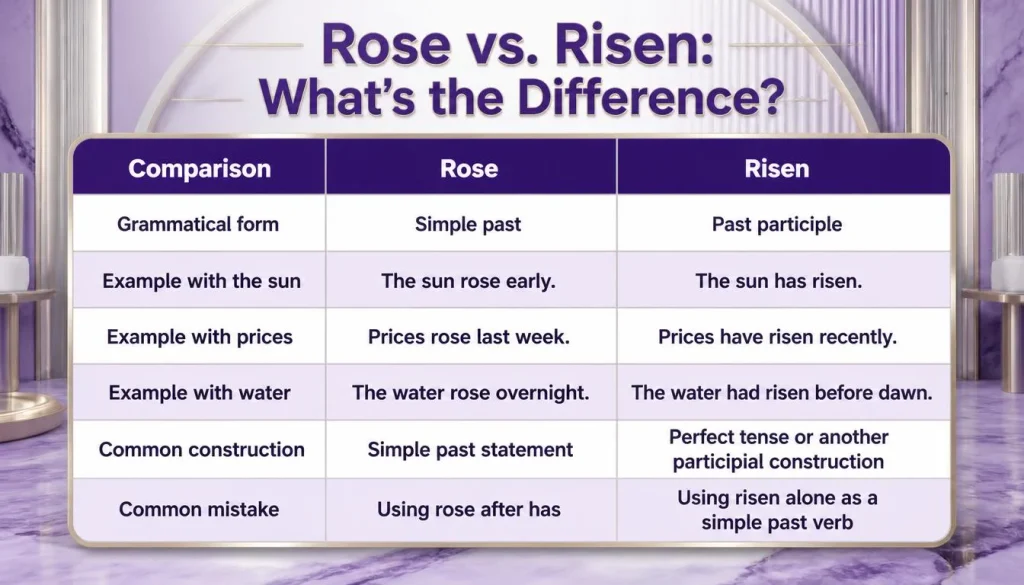
The main difference between rose and risen concerns their grammatical forms, not their basic meanings. Both relate to rise, which describes upward movement or an increase.
However, each form fits a different sentence structure.
| Comparison | Rose | Risen |
| Grammatical form | Simple past | Past participle |
| Example with the sun | The sun rose early. | The sun has risen. |
| Example with prices | Prices rose last week. | Prices have risen recently. |
| Example with water | The water rose overnight. | The water had risen before dawn. |
| Common construction | Simple past statement | Perfect tense or another participial construction |
| Common mistake | Using rose after has | Using risen alone as a simple past verb |
Rose vs. Risen in Past Events
A simple past sentence presents an event as something that happened in the past.
For example:
“The temperature rose by five degrees yesterday.”
The sentence reports a past change. The word rose is the main verb, and yesterday identifies when the change occurred.
Now consider this version:
“The temperature has risen by five degrees since morning.”
The present perfect connects the earlier change to the current time frame. The sentence focuses on the change measured from morning until now.
The distinction isn’t simply that one event has finished and the other hasn’t. Both changes may be complete. The difference lies in how the speaker presents the event and how the sentence’s tense works.
Rose vs. Risen in Past Perfect Sentences
The past perfect places one past event before another past reference point.
Compare these sentences:
- The sun rose before we reached the beach.
- The sun had risen before we reached the beach.
Both sentences are grammatical, but they emphasize the timeline differently.
The first uses the simple past to report the sunrise. The second explicitly marks the sunrise as already completed before the group arrived.
Use the past perfect when the earlier-than-another-past-event relationship matters to your explanation.
Rise, Rose, Risen: All the Main Verb Forms
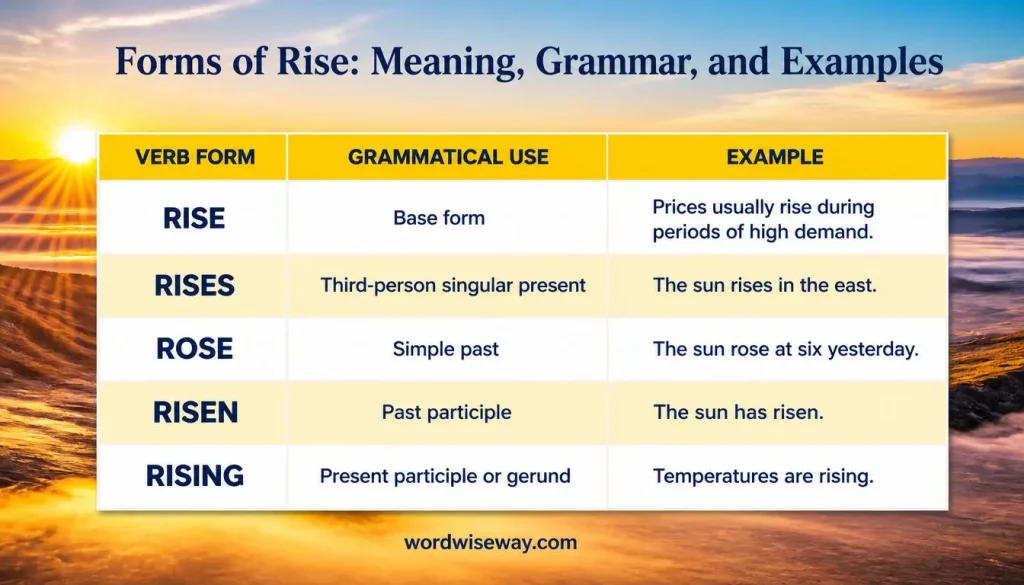
The verb rise is irregular, which means it doesn’t form its past tense by simply adding -ed. Its principal forms are rise, rose, and risen.
| Verb form | Grammatical use | Example |
| Rise | Base form | Prices usually rise during periods of high demand. |
| Rises | Third-person singular present | The sun rises in the east. |
| Rose | Simple past | The sun rose at six yesterday. |
| Risen | Past participle | The sun has risen. |
| Rising | Present participle or gerund | Temperatures are rising. |
How the Five Forms Work
Rise: Use the base form after modal verbs such as will, can, and should, and after did in questions and negative statements.
- Prices may rise again.
- We watched the balloon rise.
- Did the water level rise?
Rises: Use this form with singular third-person subjects in the simple present.
- The sun rises early in summer.
- The cost of fuel rises when demand increases.
Rose: Use it for affirmative simple past statements.
- The balloon rose into the air.
- Temperatures rose during the afternoon.
Risen: Use it as a past participle.
- The balloon has risen above the trees.
- Temperatures have risen since noon.
Rising: Use it in continuous verb forms or as a gerund.
- The balloon is rising.
- Rising temperatures can affect local weather conditions.
Learning all five forms helps prevent confusion beyond the original rose or risen question.
When to Use Rose in a Sentence
Choose rose when the sentence needs the simple past form of rise.
A useful pattern is:
Subject + rose + additional information
Examples:
- The smoke rose from the chimney.
- My younger brother rose early yesterday.
- The price of rice rose last month.
- The river rose after the storm.
- The audience rose to applaud the performers.
The subject can be a person, a physical object, a measurable quantity, or an abstract idea.
Time Expressions Commonly Used With Rose
Certain expressions frequently appear in simple past sentences because they identify a completed period.
Examples include:
- Yesterday
- Last night
- Last week
- Two hours ago
- In 2024
- When the storm began
For instance, “The water level rose two hours ago” places the event in the past.
However, don’t choose rose just because a sentence contains a past-time expression. The full grammatical structure still determines the correct form.
Rose in Questions and Negative Statements
The base form rise follows did.
| Sentence type | Correct example |
| Affirmative | The sun rose early. |
| Negative | The sun did not rise early. |
| Question | Did the sun rise early? |
| Negative question | Didn’t the sun rise early? |
The pattern is straightforward: use rose in an affirmative simple past statement, but use rise after did.
When to Use Risen in a Sentence
Use risen when the sentence requires the past participle of rise. The most common constructions are has risen, have risen, and had risen.
Use Has Risen With Singular Subjects
Use has risen with singular third-person subjects such as he, she, it, and singular nouns.
Examples:
- The sun has risen above the hills.
- The price of bread has risen again.
- The river has risen since yesterday.
- Her confidence has risen after months of practice.
In each sentence, has acts as the helping verb, and risen supplies the past participle.
Use Have Risen With Plural Subjects
Use have risen with I, you, we, they, and plural nouns.
Examples:
- Prices have risen in several stores.
- Temperatures have risen throughout the week.
- Water levels have risen after heavy rainfall.
- Applications have risen since the program opened.
The subject determines whether you use has or have. The participle remains risen.
Use Had Risen for an Earlier Past Event
Use had risen when you need to show that an increase or upward movement happened before another past event.
Examples:
- The river had risen before the rain stopped.
- Prices had risen before the new policy took effect.
- The sun had risen when the hikers reached the summit.
The past perfect often helps readers follow the order of events in a longer explanation.
Rose vs. Risen in Different Contexts
The difference becomes easier to understand when you apply both forms to familiar situations.
Rose or Risen for the Sun and Moon
Use rose to describe a sunrise or moonrise in a simple past statement.
- The sun rose at 6:10 yesterday.
- The moon rose above the trees last night.
Use risen when the sentence calls for a past participle.
- The sun has risen above the horizon.
- The moon had risen before the clouds appeared.
The choice depends on the sentence structure, not on the sun or moon itself.
Rose or Risen for Prices and Costs
Prices can rise over time, making this a common context for both forms.
- Grocery prices rose last month.
- Grocery prices have risen since January.
- The cost of electricity had risen before the company announced its discount.
The first example reports a past increase. The second connects an earlier increase to the present. The third places the increase before another past event.
Rose or Risen for Temperature and Water Levels
Weather reports often describe temperatures, rivers, and floodwaters using rise.
Examples:
- The temperature rose by three degrees yesterday.
- The temperature has risen since sunrise.
- The river rose rapidly after the storm.
- The river had risen above its usual level before dawn.
These examples show why context matters. A sentence can describe the same kind of physical change while requiring different verb forms.
Rose or Risen for People Getting Up
The verb rise can also describe someone standing up or getting out of bed.
- She rose from her chair to greet her guests.
- He rose early yesterday morning.
- She has risen from her seat.
- He had risen before the rest of the family woke up.
In everyday American English, people often say got up when talking about leaving bed. However, rose and risen are also correct when the sentence structure supports them.
Rose or Risen for Popularity and Emotions
The verb rise doesn’t always describe physical movement. It can also describe an increase in popularity, confidence, tension, or interest.
For example:
- Public interest rose after the announcement.
- Her confidence has risen since she started practicing.
- Tension rose during the debate.
- Expectations had risen before the event began.
These sentences follow the same grammatical rules as examples involving the sun, water, or prices.
Common Mistakes
Even experienced writers sometimes confuse irregular verb forms. These are the mistakes worth watching for.
Using Rose After Has, Have, or Had
Incorrect: The temperature has rose since morning.
Correct: The temperature has risen since morning.
Why? In the present perfect, has requires the past participle risen, not the simple past rose.
Using Risen as the Simple Past
Incorrect: The sun risen at six yesterday.
Correct: The sun rose at six yesterday.
Why? The sentence needs a simple past verb. It doesn’t contain a helping verb or another construction that supports risen.
Using Rose After Did
Incorrect: Did the river rose overnight?
Correct: Did the river rise overnight?
Why? The helping verb did carries the past-tense marking. The main verb must appear in its base form.
Assuming Risen Always Means an Unfinished Action
Incorrect idea: Risen always describes something that is still moving upward.
Correct understanding: Risen is a grammatical form, not a guarantee that movement continues.
For example, “The water has risen” can describe an increase that has already stopped. The sentence presents the change through the present perfect construction.
Confusing Rise With Raise
Incorrect: The manager rose the prices.
Correct: The manager raised the prices.
Why? Rise generally describes something moving upward or increasing. Raise describes someone or something causing another thing to move upward or increase.
This distinction is especially important when discussing prices, hands, salaries, and other things someone deliberately lifts or increases.
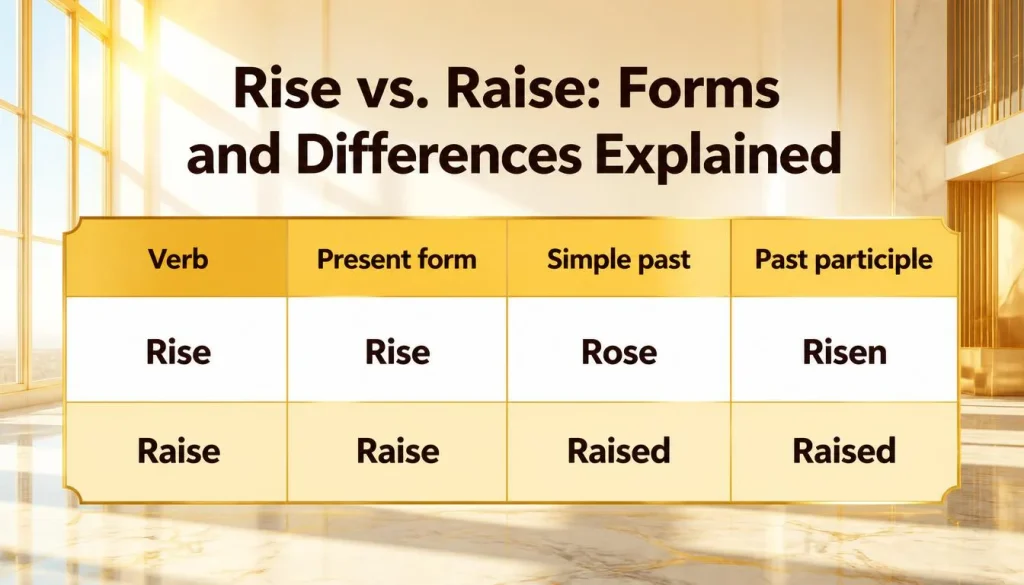
Rose vs. Risen vs. Raised
Although rose, risen, and raised may appear in similar sentences, they belong to two different verbs. Understanding that difference helps you avoid another common grammar mistake.
Rise describes upward movement or an increase. Raise describes the act of lifting or increasing something.
| Verb | Present form | Simple past | Past participle |
| Rise | Rise | Rose | Risen |
| Raise | Raise | Raised | Raised |
Compare these examples:
- The balloon rose into the sky.
- The child raised the balloon above her head.
- Water levels have risen after the rain.
- Heavy rainfall has raised the water level.
In the first and third sentences, the subject moves upward or increases. In the second and fourth, the subject causes something else to move upward or increase.
A quick test can help: ask yourself whether the subject is rising or raising something else.
Easy Ways to Remember
You don’t need to memorize complicated grammar terminology to choose the correct form. A few simple habits can make the distinction stick.
Remember the Three Forms of Rise
Start with the basic sequence:
Rise → Rose → Risen
- Rise: Present or base form. Example: Prices rise every year.
- Rose: Simple past. Example: Prices rose last year.
- Risen: Past participle. Example: Prices have risen this year.
Practice saying the three forms together. Repeated exposure helps you recognize the correct pattern when writing.
Check for a Helping Verb
Look at the words immediately before the verb.
- The sun rose early.
- The sun has risen early.
- The sun had risen before we arrived.
If the sentence uses has, have, or had to form a perfect tense, choose risen.
However, remember that risen can also appear in other participial constructions, such as “the sun, risen above the hills.”
Use a Simple Decision Rule
When you’re unsure which word to use, follow these steps:
- Identify the base verb: rise.
- Check whether the sentence needs a simple past verb or a past participle.
- Use rose for the simple past.
- Use risen when the construction requires the past participle.
- Read the sentence again to make sure the grammar works.
For example, if you write “The river has ___,” the present perfect construction calls for risen. If you write “The river ___ yesterday,” the simple past calls for rose.
Practice:
Test your understanding with these ten sentences. Choose the correct form for each blank.
- The sun ___ behind the mountains yesterday.
- The temperature has ___ considerably since morning.
- Water levels ___ after the heavy rainfall.
- She had ___ from her chair before anyone spoke.
- The cost of groceries ___ last month.
- Public interest has ___ since the announcement.
- Did the balloon ___ above the trees?
- The river had ___ before the rescue team arrived.
- Prices ___ sharply during the previous winter.
- The smoke has ___ from the chimney.
Answers and Explanations
- Rose: The sentence describes a past event.
- Risen: The present perfect uses has plus the past participle.
- Rose: The sentence reports a past increase.
- Risen: The past perfect uses had plus the past participle.
- Rose: The simple past describes the increase last month.
- Risen: The sentence uses the present perfect.
- Rise: The helping verb did requires the base form.
- Risen: The sentence uses the past perfect.
- Rose: The sentence describes an increase during a past period.
- Risen: The present perfect uses has plus the past participle.
If you missed any answers, focus on the sentence structure rather than the meaning alone. The meaning of rise remains similar across these examples, but the grammatical form changes.
Read More: 6 More Formal Ways to Say “Please Provide” With Examples
FAQs
1. What Is the Main Difference Between Rose and Risen?
Rose is the simple past tense of rise, while risen is its past participle. Use rose for an action that happened in the past, such as “The sun rose early.” Use risen with a helping verb, as in “The sun has risen.”
2. Is Rose or Risen Correct in English?
Both words are correct, but they fit different sentence structures. You can say, “The temperature rose yesterday,” or “The temperature has risen today.” The right choice depends on the tense and the helping verb used in your sentence.
3. Is Rose the Past Tense of Rise?
Yes, rose is the simple past tense of rise. It describes an upward movement or an increase that happened in the past. For example, “The balloon rose into the sky” shows movement that took place earlier.
4. Is Risen the Past Tense of Rise?
No, risen is the past participle of rise, not its simple past tense. It usually works with has, have, or had. For example, “The river has risen after the rain” uses risen correctly.
5. Should I Write Rose or Has Risen?
Use rose when describing a completed past action, especially with a specific past time. Use has risen when describing a change connected to the present. For example, “Prices rose last month” and “Prices have risen recently” are both correct.
6. Can I Use Risen Without a Helping Verb?
In standard English, risen generally needs a helping verb to form a complete verb phrase. For example, “The sun has risen” is correct. Simply writing “The sun risen” is grammatically incorrect because the required helping verb is missing.
7. What Are Some Everyday Examples of Rose and Risen?
You might say, “I rose early to study,” when describing something you did yesterday. You could also say, “I have risen early all week,” when describing a pattern continuing into the present. These examples show how context affects verb choice.
8. Do Rose and Risen Have Different Meanings?
Both words come from rise and can describe upward movement, growth, or an increase. Their basic meaning stays similar, but their grammatical roles differ. Rose refers to the simple past, while risen usually appears in perfect-tense constructions.
9. Is “Prices Have Rose” Correct?
No, “Prices have risen” is the correct form in standard English. The verb have needs the past participle risen, not the simple past rose. You can write, “Prices rose last year,” without a helping verb.
10. How Can I Remember When to Use Rose or Risen?
Remember the three main forms: rise, rose, risen. Use rise for the present, rose for the simple past, and risen with a helping verb in perfect tenses. Practicing short sentences will help you choose the correct form naturally.
Conclusion
Choosing between rose and risen becomes much easier when you understand how each word works. Both come from the verb rise, but they serve different grammatical purposes. Rose is the simple past tense, while risen is the past participle. Knowing this basic difference helps you recognize the correct form when describing upward movement, personal actions, or increases in prices.
The easiest way to remember the rule is to look at the other words in your sentence. Use rose for a completed action in the past, such as “The sun rose at six.” Use risen with a helping verb, such as “The sun has risen.” These small examples show how verb forms and sentence structure work together. Once you recognize the pattern, choosing the right word becomes more natural.
Whether you’re writing a school assignment, creating an article, or speaking in everyday conversations, using rose and risen correctly makes your English clearer. You don’t need to memorize complicated grammar explanations to get started. Practice a few sentences, pay attention to helping verbs, and check the time being described. With regular use, you’ll avoid common mistakes and feel more confident using both words in spoken and written English.

Evelyn Shaw has spent 14 years at Yale University’s English Department, leading students through close readings, genre studies, and interpretive methodologies. Her scholarly interests include Renaissance drama, gothic fiction, feminist literary criticism, and archival research and examining how texts generate meaning across historical periods. Evelyn has presented at major academic conferences and published essays in peer-reviewed journals, reflecting her passion for rigorous analysis and student-centered learning.