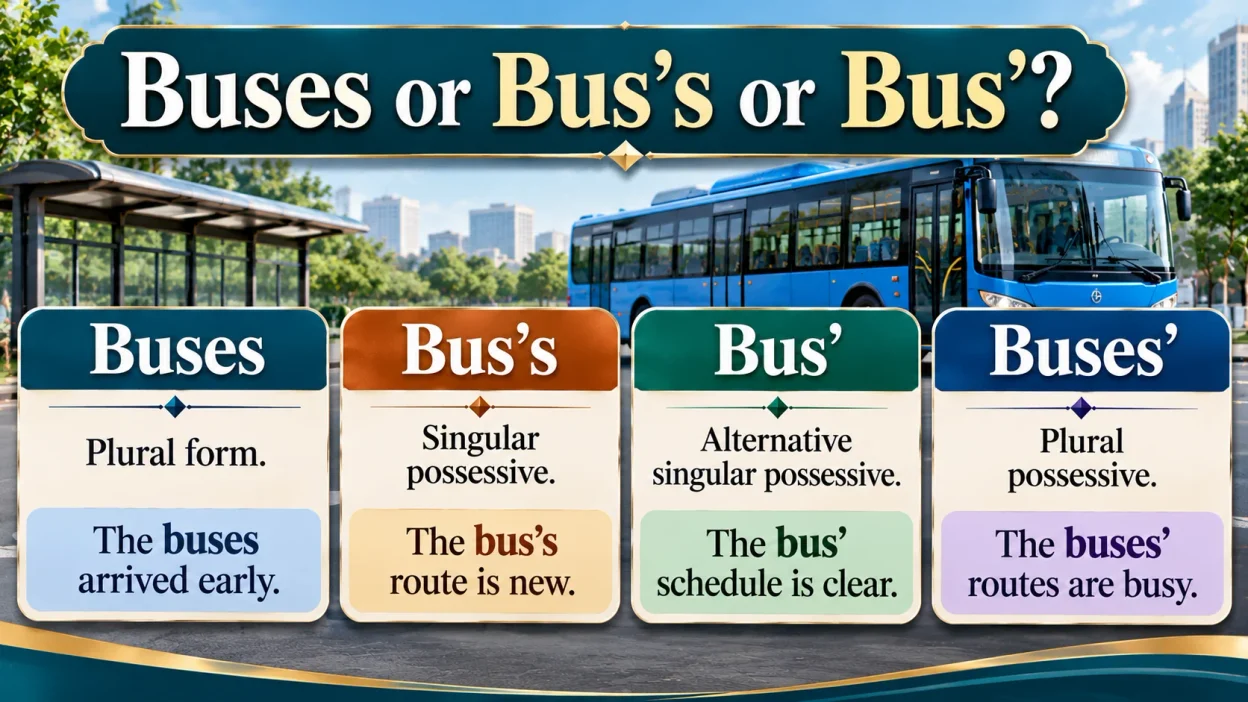
Buses or Bus’s or Bus’? Difference and Correct Usage explains the difference between buses, bus’s, and bus’. These forms may seem confusing because bus already ends with the letter S. However, understanding basic English grammar and possessive rules makes their correct usage easier.
The plural form is buses, meaning more than one bus. The possessive form is usually bus’s, which shows ownership or possession by one bus. To create this singular possessive, add an apostrophe and S to the end of the word. This follows standard grammatical rules for singular nouns.
Some style guides accept bus’, especially when the following word starts with S. However, bus’s is standard in modern American English. Learning these spelling, punctuation, and grammar rules helps you choose the correct form for each sentence.
Quick Answer:
Buses is the standard plural of bus. Bus’s is the standard singular possessive form in most writing styles, while bus’ is an accepted alternative in some style guides. Buses’ is the plural possessive form.
Here’s a quick comparison:
| Form | Meaning | Example |
| Bus | One vehicle | The bus stopped outside. |
| Buses | More than one vehicle | The buses arrived early. |
| Bus’s | Something associated with one bus | The bus’s engine needs repair. |
| Bus’ | Alternative singular possessive | The bus’ engine needs repair. |
| Buses’ | Something associated with multiple buses | The buses’ schedules changed. |
For most everyday and formal writing, use buses for the plural, bus’s for singular possession, and buses’ for plural possession.
What Does Buses Mean?
Buses is the standard plural form of the noun bus. Use it when you’re talking about two or more buses.
To form the plural, add -es to bus. This spelling follows the common English rule for nouns ending in -s, -sh, -ch, -x, or -z.
Examples of Buses in Sentences
- The buses leave the station every fifteen minutes.
- Several buses were waiting outside the school.
- The city plans to add more buses to its public transportation system.
- We saw three buses parked near the stadium.
- School buses help students travel safely to class.
- The buses arrived late because of heavy traffic.
- Many buses operate on this route throughout the day.
In each sentence, buses simply means more than one bus. No apostrophe is necessary because the word doesn’t express possession.
When Should You Use Buses?
Use buses whenever you need the ordinary plural noun.
For example:
- Correct: The buses are ready for departure.
- Incorrect: The bus’s are ready for departure.
The second sentence is incorrect because bus’s doesn’t form the plural. The apostrophe changes the word’s grammatical function instead of making it plural.
Remember this simple rule: one bus, two buses.
What Does Bus’s Mean?
Bus’s is the singular possessive form of bus. It usually shows that something belongs to, forms part of, or is associated with one bus.
To form the singular possessive, add an apostrophe and s to the singular noun.
The rule works even when the noun already ends in s. Therefore, bus’s is the standard choice in many modern writing styles.
Examples of Bus’s in Sentences
- The bus’s engine made an unusual noise.
- The bus’s door opened automatically.
- The bus’s driver checked the mirrors before leaving.
- The bus’s interior was clean and comfortable.
- The mechanic inspected the bus’s brakes.
- The bus’s destination appeared on the front display.
- The bus’s maintenance record showed several recent repairs.
Each sentence refers to one particular bus. The apostrophe indicates a possessive relationship between the bus and the following noun.
For example, in “The bus’s engine made an unusual noise,” the engine belongs to or is part of one bus.
When Should You Use Bus’s?
Use bus’s when you’re discussing a feature, component, or characteristic of a single bus.
Consider these examples:
- The bus’s seats need cleaning.
- The bus’s headlights are broken.
- The bus’s route has changed.
All three sentences refer to one bus.
However, if you’re talking about several buses, you’ll usually need the plural possessive form, buses’.
What Does Bus’ Mean?
Bus’ is an alternative singular possessive form. Some writing styles allow writers to add only an apostrophe to a singular noun ending in s.
Under this convention, bus’ can show that something belongs to or is associated with one bus.
However, not every style guide follows this rule. Many prefer bus’s because it follows the usual singular possessive pattern.
Examples of Bus’ in Sentences
- The bus’ engine needs attention.
- The bus’ driver reported a mechanical problem.
- The bus’ interior was recently renovated.
- The bus’ schedule was posted near the entrance.
- The bus’ headlights illuminated the road.
These examples use bus’ as a singular possessive. The meaning is similar to the corresponding sentences using bus’s.
Is Bus’ Grammatically Correct?
Yes, bus’ can be correct under certain style conventions. However, its acceptability depends on the style guide you’re following.
For general writing, bus’s is the safer default because it is widely accepted and follows the standard rule for singular possessives.
If your teacher, editor, or organization requires a particular style guide, follow that guide consistently.
Bus’s vs. Bus’: What’s the Difference?
The main difference is the punctuation convention, not the meaning.
| Form | Usage | Example |
| Bus’s | Standard singular possessive in many styles | The bus’s mirror broke. |
| Bus’ | Alternative singular possessive in some styles | The bus’ mirror broke. |
Both examples refer to the mirror of one bus. The choice depends on the writing style being used.
What Does Buses’ Mean?
Buses’ is the plural possessive form of bus. Use it when you’re referring to something associated with or belonging to multiple buses.
First, make the noun plural by adding -es. Then place an apostrophe after the final s.
The formation looks like this:
Bus → Buses → Buses’
Notice that you don’t add another s after the apostrophe. The plural noun already ends in s.
Examples of Buses’ in Sentences
- The buses’ schedules were updated this morning.
- The buses’ engines require regular maintenance.
- The buses’ doors remained closed during the inspection.
- The buses’ routes were changed because of road construction.
- The buses’ seats were replaced last summer.
- The buses’ drivers attended a safety meeting.
- The buses’ fuel consumption varied by model.
Each sentence refers to multiple buses. The apostrophe shows that the following item relates to those buses collectively.
When Should You Use Buses’?
Use buses’ when the possessive relationship involves more than one bus.
Compare these examples:
- One bus: The bus’s engine needs repair.
- Several buses: The buses’ engines need repair.
The first sentence refers to one bus and its engine. The second refers to multiple buses and their engines.
This distinction matters because the apostrophe helps readers understand whether you’re discussing one vehicle or several.
Key Differences
These four forms are easy to confuse because they share the same base word. However, each has a distinct purpose.
| Form | Grammatical function | Example |
| Buses | Plural noun | The buses are outside. |
| Bus’s | Singular possessive | The bus’s window is open. |
| Bus’ | Alternative singular possessive | The bus’ window is open. |
| Buses’ | Plural possessive | The buses’ windows are open. |
The easiest way to choose the correct form is to identify your intended meaning first.
Use Buses for More Than One Vehicle
If you’re simply counting vehicles, use buses.
Example: Four buses arrived at the terminal.
The sentence doesn’t show possession. It only tells you how many buses arrived.
Use Bus’s for One Bus’s Features
If you’re referring to something associated with one bus, use bus’s in most writing styles.
Example: The bus’s windshield needs cleaning.
The windshield belongs to or forms part of one bus.
Use Bus’ When Your Style Guide Allows It
If your required style guide permits the alternative singular possessive, you can use bus’.
Example: The bus’ windshield needs cleaning.
This sentence has the same basic meaning as the previous example. For consistency, don’t switch between bus’s and bus’ without a reason.
Use Buses’ for Multiple Buses
When the possessive relationship involves several buses, use buses’.
Example: The buses’ windshields were covered in dust.
The sentence refers to the windshields of multiple buses.
Common Mistakes
A few common errors cause most of the confusion surrounding these forms. Understanding them can help you avoid awkward or incorrect sentences.
Mistake 1: Using Bus’s as the Plural
Incorrect: The bus’s are waiting outside.
Correct: The buses are waiting outside.
The first sentence incorrectly uses a possessive form to express a plural noun. If you simply mean more than one vehicle, write buses.
Mistake 2: Adding an Apostrophe to Every Plural
Incorrect: Three bus’s were parked near the station.
Correct: Three buses were parked near the station.
Ordinary plural nouns don’t need apostrophes. Use an apostrophe only when the sentence requires possession or another established apostrophe construction.
Mistake 3: Confusing Bus’s with Buses’
Incorrect: The buses’s schedules were changed.
Correct: The buses’ schedules were changed.
The plural possessive form is buses’, not buses’s. Since buses already ends in s, add only an apostrophe.
Mistake 4: Using Bus’ Without Considering Style
Potentially inconsistent: The bus’ engine failed, but the bus’s door remained open.
This sentence uses two different singular possessive conventions. Although individual forms may be acceptable under different rules, mixing them can make your writing look inconsistent.
Better: The bus’s engine failed, but the bus’s door remained open.
Choose one convention and apply it throughout your document.
Mistake 5: Forgetting the Plural Ending Before the Apostrophe
Incorrect: The bus’ schedules were changed.
If you’re talking about multiple buses, this form can be misleading because it resembles the alternative singular possessive.
Correct: The buses’ schedules were changed.
First make bus plural, then add the apostrophe to show plural possession.
How to Choose the Correct Form
You don’t need to memorize a long list of exceptions. Instead, ask yourself two simple questions.
Step 1: Are You Talking About One Bus or Several?
If you mean one vehicle, use bus.
If you mean multiple vehicles, use buses.
Examples:
- One bus stopped near the school.
- Two buses stopped near the school.
Step 2: Are You Showing Possession?
If you’re not showing possession, don’t add an apostrophe.
If you’re showing possession, identify whether the noun is singular or plural.
- One bus: the bus’s engine
- Multiple buses: the buses’ engines
Or If your style guide allows the alternative singular possessive, you may also see the bus’ engine.
A Simple Memory Tip
Think of the apostrophe as a small signpost. Its position helps readers identify the relationship between a noun and what follows.
- Buses: More than one bus.
- Bus’s: Something associated with one bus.
- Bus’: An alternative singular possessive in some styles.
- Buses’: Something associated with multiple buses.
Once you identify the number of buses and whether possession is involved, the correct form becomes much easier to spot.
Practice Examples
Try choosing the correct form for each sentence. The answers and explanations appear below.
- The ______ arrived at the station before noon.
- The ______ engine started making noise.
- The ______ schedules were changed last week.
- Several ______ were waiting outside the school.
- The ______ driver reported a flat tire.
- The ______ doors opened at the same time.
- The ______ were delayed because of traffic.
- The ______ interior needed a thorough cleaning.
Answers and Explanations
- Buses: The sentence refers to multiple vehicles arriving.
- Bus’s: The engine belongs to or is part of one bus.
- Buses’: The schedules relate to multiple buses.
- Buses: The sentence counts several vehicles without showing possession.
- Bus’s: The driver is associated with one bus.
- Buses’: The doors belong to multiple buses.
- Buses: The sentence describes multiple vehicles being delayed.
- Bus’s: The interior belongs to one bus.
For sentence eight, bus’ may also be accepted if the applicable style guide permits that alternative.
Read More: 8 Words for Someone Who Follows the Rules
FAQs
What Is the Correct Plural Form of Bus?
The correct plural form is buses. Use it when talking about two or more buses. For example, “Three buses stopped outside the school.”
Is Bus’s Grammatically Correct?
Yes, bus’s is the standard singular possessive form in American English. It shows that something belongs to or is associated with one bus. For example, “The bus’s door wouldn’t open.”
Should I Write Bus’ or Bus’s?
In most modern American English writing, bus’s is the preferred form. Some style guides allow bus’, but you should follow the style guide required for your writing.
Why Does Bus Become Buses Instead of Buss?
The standard plural spelling is buses, with one S at the beginning of the ending. Adding -es makes the word easier to pronounce because bus already ends with an S sound.
How Do You Show That Something Belongs to One Bus?
Add an apostrophe and S to bus to form bus’s. For example, “The bus’s engine needs repair.” The apostrophe and S indicate possession by one bus.
Is Buses’ the Correct Possessive Form for Multiple Buses?
Yes, buses’ is the plural possessive form. Use it when something belongs to more than one bus. For example, “The buses’ schedules were updated.”
When Should I Use Buses Instead of Bus’s?
Use buses when referring to multiple vehicles without showing ownership. Use bus’s when describing something belonging to one bus. For example, “The buses arrived” versus “The bus’s tires are worn.”
Does Bus’ Mean the Same Thing as Buses?
No. Bus’ is an alternative singular possessive spelling accepted by some style guides, while buses is the plural form. They serve different grammatical purposes.
Do I Remove the Final S When Adding an Apostrophe to Bus?
Generally, no. In standard American English, keep the S and write bus’s for singular possession. Some style guides permit bus’, so check your required writing style.
What Is the Easiest Way to Remember Bus, Buses, and Bus’s?
Remember three simple patterns: bus means one vehicle, buses means multiple vehicles, and bus’s usually shows ownership by one vehicle. For multiple buses owning something, use buses’.
Conclusion:
Understanding the difference between buses, bus’s, and bus’ becomes much easier when you focus on what each word means. Buses is the plural form of bus, so use it when referring to more than one vehicle.
For example, “The buses arrived late because of heavy traffic.” You don’t need an apostrophe to make an ordinary noun plural. This simple rule helps you avoid one of the most common spelling and punctuation mistakes in English grammar.
When you want to show ownership, bus’s is generally the correct singular possessive form in modern American English. For example, “The bus’s engine stopped working.” The apostrophe and S indicate that the engine belongs to or is associated with one bus.
Although some style guides accept bus’, it’s best to follow the rules required by your school, workplace, or publication. For plural possession, use buses’, as in “The buses’ tires were replaced.” Each form has a specific purpose, so the surrounding sentence can help you choose correctly.
The easiest way to remember these forms is to check whether you’re talking about quantity or ownership. Use buses for multiple vehicles, bus’s for something associated with one bus, and buses’ for something belonging to multiple buses.
Keep bus’ in mind as an alternative singular possessive spelling when your chosen style guide allows it. Once you recognize these patterns, choosing the right word becomes a natural part of your writing. A little attention to apostrophes can make your sentences clearer, more accurate, and easier for readers to understand.

Amelia Sanders has spent 14 years in Harvard University’s English Department, helping students navigate literary analysis, interpretive theory, and narrative techniques. Her academic pursuits center on 18th-century British prose, romantic poetry, diasporic writing, and digital editing exploring how textual choices influence cultural perspectives. Amelia has spoken at major international meetings and contributed essays to respected academic volumes, demonstrating her dedication to thoughtful scholarship and effective teaching.