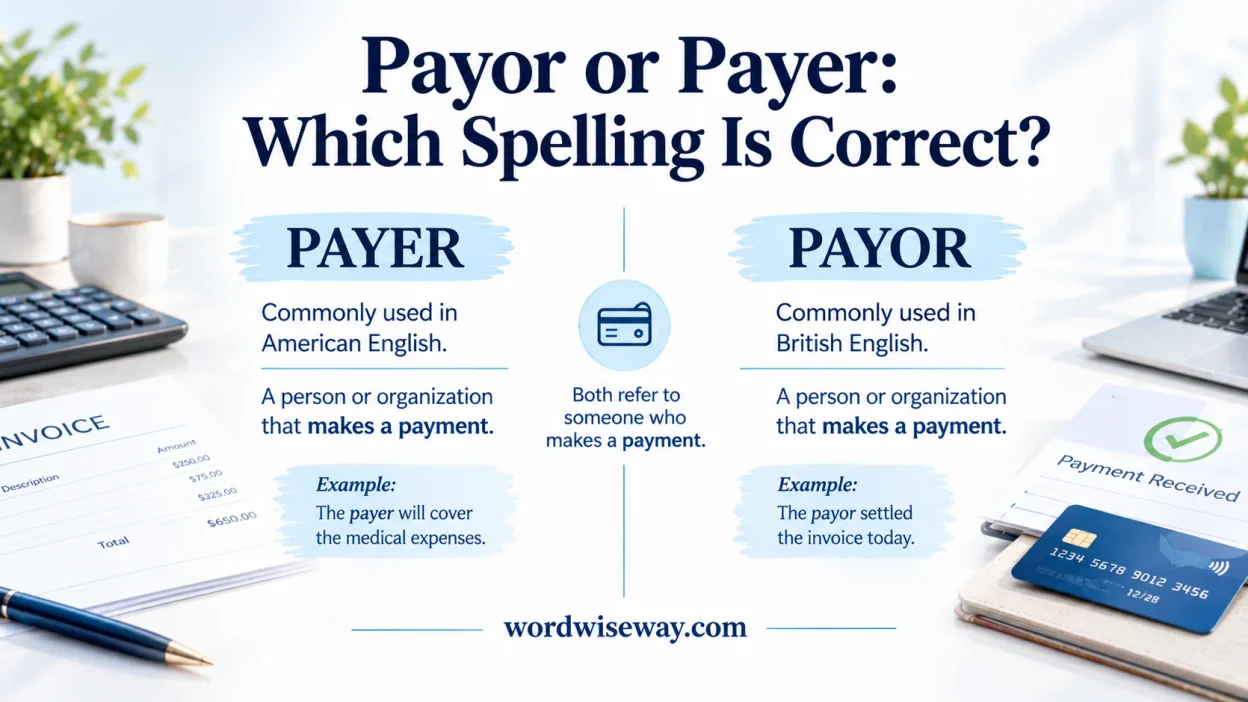
Payor and payer are real words with the same basic meaning: a person, company, or organization that pays money or makes a payment. The spelling difference can be confusing, but their meanings are generally the same. The main difference is usage, industry, and style, depending on where and how the word is used.
In general English, business writing, banking, and insurance, payer is a common spelling. Payor often appears in American legal writing, medical writing, contracts, medical billing, and health insurance document language. Neither form is automatically a spelling mistake, and both can describe the same party.
For professional writing, academic work, or everyday communication, check the relevant style guides and context. This simple guide can help you choose the appropriate form and avoid common mistakes when writing about payments.
Quick Answer:
Payer and payor are both correct words for a person or organization that makes a payment.
In general US English, payer is the more straightforward and widely recognized spelling. It follows the common pattern of adding -er to the verb pay, just as buyer comes from buy and seller comes from sell.
Payor, meanwhile, uses the -or ending found in various formal and professional terms. You may encounter it in healthcare, insurance, contracts, and financial documents.
| Word | Meaning | Typical Use |
| Payer | A person or organization that makes a payment | General, business, financial, and professional writing |
| Payor | A person or organization that makes a payment | Healthcare, insurance, legal, and specialized terminology |
So, if you’re asking “payor or payer?”, neither spelling is automatically wrong. Payer generally works well for broad audiences, while payor often reflects established industry language.
What Does Payer Mean?
A payer is a person, company, organization, or institution that provides money to someone else in exchange for goods, services, debt repayment, or another financial obligation.
The word comes directly from pay. The suffix -er commonly identifies someone who performs an action. Therefore, a payer is literally an entity that pays.
For example, if you purchase a laptop from a store, you’re the payer because you provide the money. The store is the recipient of that payment.
The term also works on a much larger scale. An employer can act as a payer when it issues wages. An insurance company can act as a payer when it reimburses a healthcare provider. A government agency can become a payer when it funds an approved service.
Examples of Payer in a Sentence
- The payer must provide accurate billing information.
- The insurance company is responsible for processing the claim as the payer.
- The customer becomes the payer when the invoice is settled.
- The healthcare provider submitted the claim to the appropriate payer.
- The contract identifies the payer and the recipient of the funds.
Notice that the word doesn’t describe a particular industry. That’s one reason payer works comfortably across many types of writing.
What Does Payor Mean?
Payor has essentially the same basic meaning as payer. It identifies a person or organization responsible for making a payment.
The main distinction isn’t the definition. It’s the spelling and the environments in which people commonly use it.
You’ll often encounter payor in specialized terminology. Healthcare organizations, insurance companies, financial professionals, and legal documents may use this spelling as part of their established vocabulary.
For instance, a healthcare document might refer to a third-party payor. Another organization might use third-party payer for exactly the same concept.
Neither term automatically changes the underlying role.
Examples of Payor in a Sentence
- The payor must approve the requested treatment.
- The provider submitted the claim to the patient’s payor.
- The agreement identifies each party’s responsibilities as a payor.
- The facility works with several healthcare payors.
- The claim was returned because the payor information was incomplete.
This specialized flavor explains why payor can look perfectly natural in one document and slightly unusual in another.
What’s the Difference?
The simplest way to understand payor vs. payer is to separate meaning from usage.
Both words describe an entity that makes a payment. The important difference lies in spelling preference and context.
Payer follows a familiar English formation. The verb pay becomes payer, meaning someone who pays.
Payor uses a different suffix. English has several words ending in -or, particularly in formal, legal, and occupational vocabulary. That pattern helped establish payor as a recognized alternative.
| Feature | Payer | Payor |
| Basic meaning | Entity that pays | Entity that pays |
| Spelling | -er | -or |
| General US English | Very familiar | Less common |
| Healthcare | Common | Very common in some terminology |
| Insurance | Common | Common |
| Legal writing | Used | Used |
| Financial writing | Used | Used |
| Considered valid? | Yes | Yes |
The key point is simple: payor isn’t an incorrect version of payer. It’s an established spelling variant.
Why Does Payor Have an “O”?
The -or ending can make payor look unusual because English speakers often expect payer.
However, English doesn’t always form agent nouns with a single predictable suffix. Words such as actor, operator, administrator, and creditor demonstrate the long-standing use of -or in English vocabulary.
The spelling payor developed alongside payer and survived particularly well in formal and specialized language.
This doesn’t mean every word ending in -or follows the same historical path. English vocabulary contains layers from different linguistic traditions, which is why spelling patterns can feel inconsistent.
Think of the two forms as neighboring roads leading to the same destination. Payer takes the familiar route, while payor follows a more formal-looking route that became especially common in certain industries.
Payer in Healthcare and Insurance
Healthcare provides one of the clearest examples of the payer or payor question.
In healthcare, a payer is generally an entity that pays for covered medical services. Depending on the situation, that entity may be a private insurance company, a government healthcare program, an employer-sponsored arrangement, or another responsible organization.
The healthcare system involves several different parties, so keeping their roles separate matters.
For example:
- Patient: Receives healthcare services.
- Provider: Delivers healthcare services.
- Payer: Provides or processes payment for covered services.
- Employer: May sponsor or contribute to a health plan.
- Insurer: May administer coverage and pay eligible claims.
A healthcare provider might therefore send a claim to a payer after treating a patient.
The word payer is widely understandable in this setting. Yet payor also appears extensively in healthcare terminology.
Payor in Healthcare and Insurance
The spelling payor has a particularly strong presence in healthcare and insurance language.
Terms such as healthcare payor, third-party payor, payor mix, and payor responsibility can appear in professional documents.
A third-party payor generally refers to an entity other than the patient or provider that pays for covered healthcare services. Insurance arrangements provide a common example.
The phrase can appear in administrative documents, financial discussions, contracts, and healthcare operations.
At the same time, third-party payer communicates the same basic concept. The choice often comes down to the terminology preferred by a particular organization, industry publication, document, or style guide.
Payor vs. Payer in Legal and Financial Writing
Legal and financial writing often favors consistency above all else.
A contract may use payer throughout its definitions and clauses. Another agreement may use payor. Neither choice automatically makes the document incorrect.
Once a document establishes one spelling, switching between the two without a reason can create unnecessary inconsistency.
For example, using payer in one section and payor in another could make readers wonder whether the terms describe different parties. If the document intends the same role, using one spelling consistently removes that ambiguity.
A Practical Rule for Professional Documents
When you’re writing a formal document, check these factors:
- Follow the organization’s established terminology.
- Match defined terms used elsewhere in the document.
- Preserve terminology from official forms when appropriate.
- Use one spelling consistently when both forms are acceptable.
- Don’t “correct” payor simply because payer looks more familiar.
Consistency gives professional writing a cleaner structure. It also prevents a harmless spelling variation from becoming a needless terminology problem.
Common Phrases With Payer
The word payer appears in numerous professional expressions.
Third-Party Payer
A third-party payer is an entity that pays for a service or obligation on behalf of another party.
Healthcare provides a familiar example. An insurance company may pay an eligible medical claim instead of the patient paying the entire covered amount directly.
Payer Information
Payer information generally refers to details identifying the party responsible for payment.
Depending on the context, this information may include an organization name, account details, identification numbers, or other relevant billing information.
Payer Responsibility
Payer responsibility describes the financial obligation assigned to the party responsible for making payment.
The exact meaning depends on the contract, insurance arrangement, or financial system involved.
Payer Source
A payer source identifies where the money comes from.
In healthcare finance, organizations may track different payment sources to understand how services are funded.
Common Phrases With Payor
Payor appears in many of the same expressions.
Third-Party Payor
Third-party payor carries essentially the same meaning as third-party payer.
The spelling often reflects established terminology within healthcare or insurance environments.
Payor Mix
Payor mix describes the distribution of payment sources associated with an organization or group of services.
For a healthcare organization, the mix might involve private insurance, government programs, self-pay patients, and other payment arrangements.
Understanding this mix can help organizations analyze revenue patterns and financial exposure.
Payor Responsibility
Payor responsibility identifies the amount or obligation assigned to the party responsible for payment.
Its precise meaning depends on the financial or contractual context.
Payor Information
Payor information refers to information used to identify or communicate with the responsible payment entity.
This phrase commonly appears in administrative and billing environments.
Which One Should You Use?
For most general US English writing, payer is a clear and familiar choice.
If you’re writing an article for a broad audience, preparing ordinary business communication, or explaining who made a payment, payer will usually be easy for readers to understand.
However, payor makes sense when you’re working inside a field that routinely uses that spelling.
Consider the following approach:
- General writing: Use payer.
- Business writing: Either may work, depending on established terminology.
- Healthcare: Check the terminology used by your organization or document.
- Insurance: Follow the established terminology in the relevant material.
- Legal documents: Preserve defined terminology and maintain consistency.
- Existing forms: Match the spelling already used when appropriate.
There isn’t a universal rule that forces every writer to choose one spelling.
Is Payor a Misspelling of Payer?
No. Payor is not simply a misspelling of payer.
Both words are recognized English terms. They can describe the same basic role: an individual or organization that makes a payment.
The confusion usually comes from the fact that payer looks more familiar. English speakers commonly create agent nouns with -er, so payer feels immediately intuitive.
Professional vocabulary tells a different story. Payor has established usage in fields such as healthcare and insurance.
Therefore, seeing payor in a formal document shouldn’t automatically trigger a spelling correction.
Is Payer More Common Than Payor?
In broad everyday US English, payer is generally the more familiar form.
That’s partly because its spelling follows a common pattern. Words such as buyer, seller, borrower, and employer use the -er ending to identify someone who performs an action.
Payor, however, has developed a durable niche in specialized writing.
Frequency also depends heavily on the subject. A general business article may repeatedly use payer, while a healthcare document may use payor throughout.
So, frequency alone doesn’t determine correctness.
Common Mistakes
Several mistakes repeatedly cause confusion around these two spellings.
Assuming Payor Is Always Wrong
This is the biggest misconception. Payor is a valid spelling, especially in specialized professional contexts.
Assuming Payer Is Too Informal
The word payer isn’t inherently informal. It works perfectly well in professional, financial, insurance, and healthcare writing.
Treating Them as Different Roles
In most contexts, payer and payor don’t identify two different types of people.
They’re generally spelling variants for the same basic role.
Switching Between Them Randomly
If you choose payer, continue using payer unless there’s a specific reason to change. The same principle applies to payor.
Replacing Established Terminology
If an organization consistently uses payor, changing every occurrence to payer may create inconsistency with its existing documents.
When terminology has already been defined, consistency usually matters more than personal spelling preference.
Examples Side by Side
The following examples show how the two forms can work in comparable contexts.
| Context | Example |
| General business | The payer must settle the invoice by Friday. |
| Financial transaction | The bank verified the payer information. |
| Healthcare | The provider submitted the claim to the payer. |
| Healthcare terminology | The provider submitted the claim to the payor. |
| Insurance | The payer reviewed the claim. |
| Specialized insurance terminology | The payor reviewed the claim. |
| Legal agreement | The contract identifies the payer. |
| Alternative formal usage | The contract identifies the payor. |
These examples demonstrate an important point: context doesn’t necessarily change the meaning. It often changes the preferred spelling.
Payer vs. Payor vs. Payment
Don’t confuse payer or payor with payment.
A payer/payor is the entity that makes the payment. A payment is the money or financial transfer itself.
For example, imagine a customer buys a service for $500.
- The customer is the payer.
- The $500 is the payment.
- The business receiving the money is the payee.
These terms describe different parts of the same transaction.
Payer vs. Payee
The distinction between payer and payee is especially important in financial writing.
A payer gives the money. A payee receives it.
Imagine sending $100 to a friend to repay a loan. The person sending the $100 is the payer, while the person receiving it is the payee.
| Term | Role |
| Payer | Makes the payment |
| Payor | Makes the payment |
| Payee | Receives the payment |
| Payment | Money transferred |
This simple distinction prevents a common terminology mix-up.
Case Study: Choosing Payer in General Business Writing
Imagine a small company sends an invoice to a customer.
The invoice states that the customer must pay within 30 days. In this situation, the customer acts as the payer because the customer has the obligation to provide the money.
For a general audience, payer offers an immediately recognizable label. There’s little reason to introduce specialized terminology when ordinary language communicates the role clearly.
Now change the scenario.
Suppose a healthcare organization prepares a document using established terminology that consistently refers to insurance companies as payors. In that environment, retaining payor may provide better consistency with the surrounding material.
The underlying role hasn’t changed. The context has.
Read More: Staid or Stayed: Meaning, Differences, and Correct Usage
FAQs
Is payor a correct spelling?
Yes, payor is a correct spelling. It refers to a person, company, or organization that makes a payment. You will often find it in legal, medical, and insurance contexts, particularly in American writing.
Is payer more common than payor?
Payer is generally the more common form in general English and everyday business writing. It is also widely used in banking and other financial contexts. However, payor remains established in specific industries.
Do payor and payer have different meanings?
No, they normally have the same meaning. Both words describe someone or an organization responsible for making a payment. The main distinction is their spelling and typical usage.
Should I use payer in general writing?
Payer is a practical choice for general English, everyday communication, and broad professional writing. It is familiar to many readers and clearly identifies the party that pays money.
When is payor commonly used?
Payor frequently appears in American legal writing, insurance documents, healthcare materials, and medical billing. Industry-specific terminology can make this spelling more common in those settings.
Is payor or payer used in insurance?
Both forms are used in insurance. Payor is especially common in American insurance and healthcare terminology, while payer also appears widely in insurance-related business writing and general materials.
Is payer acceptable in legal writing?
Yes, payer can be used in legal writing when it accurately describes the party making a payment. The preferred form may depend on the terminology already established in a contract, document, or relevant style guide.
Are payor and payer interchangeable?
In most contexts, payor and payer are interchangeable because they describe the same basic role. Still, keeping the terminology consistent throughout a document can make the writing clearer and more professional.
Which spelling should I choose for academic writing?
For academic work, consider your subject, audience, and required style guidelines. Payer works naturally in general academic English, while payor may be appropriate when discussing established legal, medical, or insurance terminology.
How can I avoid mistakes with payor and payer?
Focus on the context rather than treating one spelling as universally correct. Check how the term is used in similar documents, follow applicable style guides, and use one form consistently throughout your writing.
Conclusion
Payor and payer are both valid spellings for someone who makes a payment. Their basic meaning does not usually change, so the choice is mostly shaped by usage, industry, and writing conventions. This is why you may encounter both forms in professional documents.
Payer fits naturally in general English, everyday communication, and broad business writing, while payor appears frequently in American legal, medical, and insurance contexts. Neither form should automatically be treated as a spelling mistake, especially when it follows established industry terminology.
When deciding which form to use, consider your audience, document type, and relevant style guides. Consistency matters, too. Once you understand where each spelling commonly appears, choosing between payor or payer becomes a straightforward writing decision rather than a source of uncertainty.

Emma Smith has dedicated 14 years to Princeton University’s English Department, mentoring students in textual interpretation, literary movements, and critical frameworks. Her research explores Shakespearean drama, Victorian serial fiction, postcolonial narrative theory, and manuscript studies and probing how literary forms evolve across cultures and centuries. Emma has delivered lectures at international humanities congresses and published findings in distinguished academic journals, underscoring her commitment to scholarly depth and vibrant teaching.