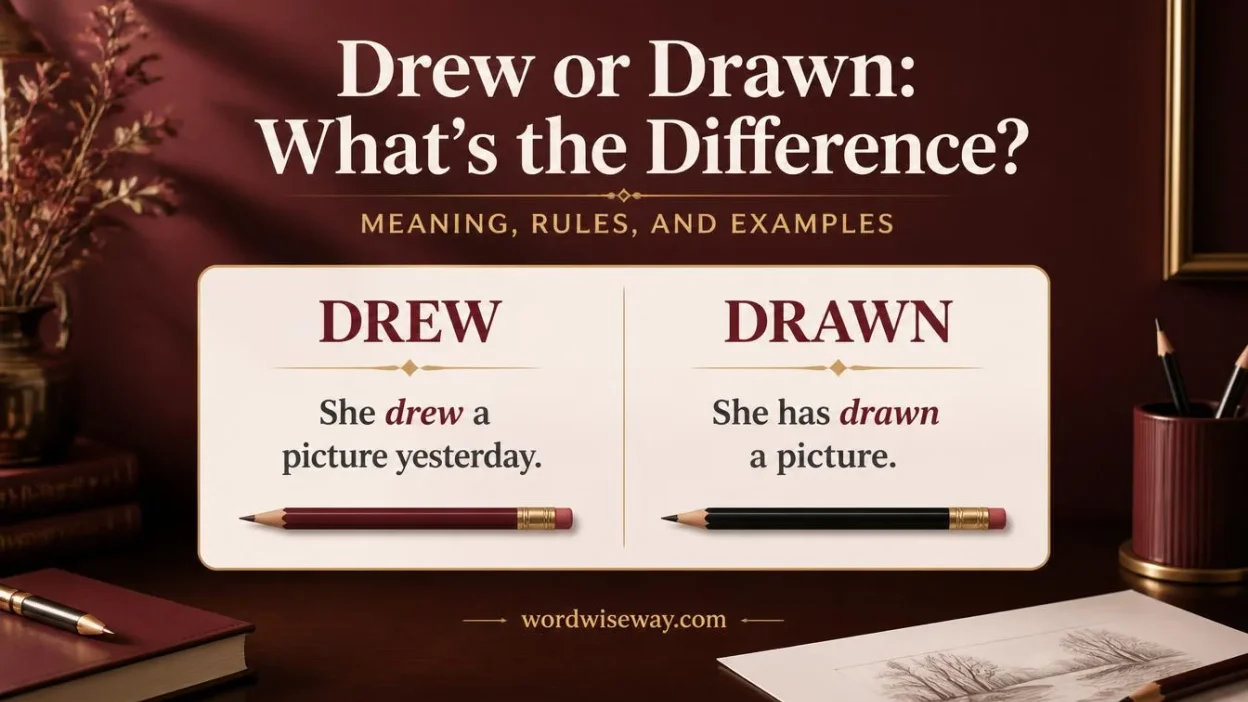
Drew or Drawn: Difference, Meaning, Rules, and Examples explains how the irregular verb draw changes across present, past, and perfect tenses.
The irregular verb draw describes an action in the present, while drew is its simple past tense, referring to past actions or a completed action. For example, “She drew a picture yesterday” shows the correct usage of the verb in the past. In contrast, drawn is the past participle form, which needs an auxiliary verb such as has, have, or had to form perfect tenses.
Understanding the difference in meaning helps you use these words correctly instead of using them interchangeably. When learning grammar, recognizing each verb form makes sentence construction easier and helps you avoid using it incorrectly.The correct past tense forms become easier to remember when you explore their function in different sentences.
Has, have, and had work with drawn in perfect tenses, while is and was can help form the passive voice. Depending on the sentence, drawn can also function as an adjective. This article explores these distinctions through examples, helping you understand their usage without worrying about getting it wrong in the future. In English grammar, natural writing and reviewing reliable language resources make these rules easier to apply while avoiding mistakes.
Quick Answer
Drew is the simple past tense of draw, while drawn is its past participle. Use drew to describe a completed action in the past. Use drawn with auxiliary verbs to form perfect tenses and passive constructions. It can also function as an adjective.
| Word | Grammatical Form | Example |
| Draw | Base form | I draw pictures every weekend. |
| Drew | Simple past tense | I drew a picture yesterday. |
| Drawn | Past participle | I have drawn three pictures today. |
Here is the easiest way to remember the difference:
- Drew: She drew a picture last night.
- Drawn: She has drawn a picture today.
Both forms describe drawing, but their sentence structures differ. The surrounding words tell you which form belongs in your sentence.
What Does Drew Mean?
Drew is the simple past tense of draw. It describes an action that happened in the past, such as creating artwork, pulling something, attracting attention, or reaching a conclusion.
Unlike drawn, drew generally works as the main verb in an ordinary affirmative sentence without an auxiliary verb.
Consider this example:
Marcus drew a detailed map for his classmates.
The sentence tells you that Marcus completed the action of drawing a map in the past. The verb drew carries the past-tense meaning by itself.
However, draw has several meanings beyond making pictures. Its past-tense form, drew, appears in many everyday situations.
Examples of Drew in Sentences
The meaning of drew changes according to how the verb is used. Here are several common examples.
Drawing or creating artwork
- Emma drew a beautiful landscape during art class.
- My younger brother drew a dinosaur on his notebook.
- The architect drew a rough plan of the building.
In each sentence, drew describes creating a picture, illustration, or design.
Pulling something toward a person or position
- He drew the curtains before going to bed.
- The nurse drew a chair closer to the patient’s bed.
- She drew the wagon across the garden.
Here, drew describes pulling or moving something. It doesn’t necessarily involve art or writing.
Attracting attention or interest
- The festival drew thousands of visitors.
- Her speech drew considerable attention from the audience.
- The new restaurant drew customers from nearby towns.
In these examples, drew means attracted or brought something toward a particular place or event.
Reaching a conclusion or decision
- The researchers drew a conclusion from their findings.
- We drew several lessons from the experience.
- The detective drew a connection between the two events.
These sentences demonstrate that draw can describe forming an idea, conclusion, or connection.
When Should You Use Drew?
Use drew when you want to describe a past action in the simple past tense.
For example:
- I drew a portrait yesterday.
- She drew a diagram during the meeting.
- They drew a line across the paper.
- He drew attention to an important problem.
Notice that none of these affirmative sentences needs has, have, or had before drew. The verb already expresses the past action.
Past-time expressions often appear alongside drew. Common examples include:
- Yesterday
- Last night
- Last week
- Two days ago
- In 2024
- When I was younger
These expressions can help establish the time of an action, but they aren’t required.
For example, “She drew a picture” is a complete sentence even without a specific time expression.
Important rule: Don’t use drew directly after has, have, or had when forming a standard perfect-tense construction. Those auxiliary verbs require the past participle drawn.
What Does Drawn Mean?
Drawn is the past participle of draw. It usually appears with auxiliary verbs to create perfect tenses or passive constructions. It can also function as an adjective.
The difference becomes clearer when you compare two sentences:
- She drew a picture.
- She has drawn a picture.
The first sentence uses the simple past tense. The second uses the present perfect tense, formed with has and the past participle drawn.
Although both sentences describe drawing, their grammatical structures differ.
Examples of Drawn in Sentences
The past participle drawn appears in several common grammatical patterns.
Present perfect tense
The present perfect connects a past action to the present in a relevant way. The action may have happened recently, or its result may matter now.
- She has drawn five pictures this week.
- I have drawn a diagram to explain the process.
- They have drawn several conclusions from the experiment.
The structure is:
Subject + has/have + drawn
Use has with third-person singular subjects such as he, she, and it. Use have with I, you, we, and they.
Past perfect tense
The past perfect describes an action completed before another past event or reference point.
- He had drawn the diagram before the teacher arrived.
- They had drawn a map before the road closed.
- I had drawn three sketches before choosing the final design.
The structure is:
Subject + had + drawn
Because had already establishes the past-perfect construction, the main verb takes its past participle form.
Passive voice
Passive constructions emphasize the action or the person or thing receiving it rather than the person performing it.
- The portrait was drawn by a professional artist.
- The curtains were drawn before sunset.
- The diagram had been drawn incorrectly.
The structure commonly uses a form of be followed by the past participle.
In “The portrait was drawn by a professional artist,” the portrait receives the action. The word drawn completes the passive construction.
Adjectival use
Drawn can also describe someone’s appearance, especially when that person looks tired, strained, or unwell.
- His face looked drawn after several sleepless nights.
- She appeared drawn following a stressful week.
- His drawn expression suggested that something was troubling him.
In these examples, drawn describes appearance rather than forming a perfect tense or passive construction.
When Should You Use Drawn?
Use drawn when the sentence requires a past participle.
The most common situations include:
- Present perfect: She has drawn a picture.
- Past perfect: She had drawn a picture.
- Passive voice: The picture was drawn by hand.
- Adjectival use: He had a drawn expression.
However, don’t assume that drawn always needs has, have, or had. Passive constructions use forms of be, while adjectives can appear after linking verbs such as look and seem.
For example, “The curtains were drawn” is a passive-style construction, while “He looked drawn” uses drawn descriptively.
The key is to examine the entire sentence rather than choosing a verb form in isolation.
Key Differences
Although drew and drawn come from the same verb, they aren’t interchangeable in standard English.
Drew is the simple past form. Drawn is the past participle. Their grammatical roles determine where each word belongs.
Drew vs. Drawn Comparison Table
| Feature | Drew | Drawn |
| Verb form | Simple past | Past participle |
| Common sentence pattern | Subject + drew | Subject + auxiliary + drawn |
| Perfect-tense use | Not used as the participle | Used in perfect tenses |
| Passive constructions | Not used as the past participle | Used after forms of be |
| Example | She drew a flower. | She has drawn a flower. |
| Adjectival use | Not the usual form | Can describe a tired or strained appearance |
One useful distinction is that drew can stand alone as the main verb in a simple past-tense statement. By contrast, drawn generally needs a suitable grammatical structure when it functions as a verb form.
For example:
- Correct: The artist drew a portrait.
- Correct: The artist has drawn a portrait.
- Incorrect: The artist has drew a portrait.
The third sentence fails because has requires the past participle drawn, not the simple past form drew.
Drew or Drawn in Different Tenses
Looking at the same action across different grammatical structures makes the distinction easier to understand.
| Tense or Construction | Correct Example | Explanation |
| Simple present | She draws every morning. | Uses the present-tense form draws. |
| Simple past | She drew yesterday. | Uses the simple past form drew. |
| Present perfect | She has drawn today. | Uses has plus the past participle. |
| Past perfect | She had drawn before lunch. | Uses had plus the past participle. |
| Passive voice | The picture was drawn yesterday. | Uses was plus the past participle. |
| Future perfect | She will have drawn the picture by Friday. | Uses will have plus the past participle. |
The future perfect follows the same participle rule as the other perfect tenses. Even though the sentence refers to the future, the verb remains drawn.
Remember: The tense or construction determines the verb form. The time of the action alone doesn’t determine whether you should write drew or drawn.
Is It Drew or Drawn a Picture?
Both forms can appear in correct sentences, but they require different structures.
Use drew a picture when describing a past action.
Correct: She drew a picture during class.
Use has drawn a picture when forming the present perfect.
Correct: She has drawn a picture for the exhibition.
Compare these examples:
| Sentence | Correct or Incorrect? | Reason |
| I drew a picture yesterday. | Correct | Simple past tense |
| I have drawn a picture. | Correct | Present perfect tense |
| I had drawn a picture earlier. | Correct | Past perfect tense |
| I have drew a picture. | Incorrect | Requires the past participle |
| I drawn a picture yesterday. | Incorrect | Missing the required verb structure |
The distinction is straightforward once you identify the sentence pattern.
When you use drew as the main verb in the simple past, you don’t need another auxiliary verb. When you use drawn, make sure the sentence includes the grammatical structure that supports it.
Is It Drew or Drawn From?
The word from doesn’t automatically determine which verb form you need. The surrounding sentence does.
Consider these examples:
- Simple past: She drew a conclusion from the evidence.
- Present perfect: She has drawn a conclusion from the evidence.
- Passive voice: A conclusion was drawn from the available evidence.
All three sentences are correct because each follows a different grammatical structure.
The phrase draw a conclusion from means to reach an interpretation or judgment based on available information.
For example, a researcher might examine survey results and draw a conclusion about customer preferences. If the researcher has completed the analysis and wants to connect it to the present, has drawn a conclusion may be more appropriate.
Similarly, “The conclusion was drawn from the evidence” emphasizes the conclusion and its supporting information rather than the person who reached it.
The takeaway: Choose drew or drawn based on the verb construction, not on the presence of from.
Common Mistakes
Even experienced English speakers occasionally confuse irregular verb forms. Fortunately, the most common mistakes follow predictable patterns.
Using Drew After Has, Have, or Had
One frequent error is using drew after an auxiliary verb that requires a past participle.
Incorrect: She has drew a beautiful picture.
Correct: She has drawn a beautiful picture.
Incorrect: They had drew a map before leaving.
Correct: They had drawn a map before leaving.
Why does this happen? Regular verbs often form their past tense and past participle by adding -ed. For example, walked serves as both forms. Irregular verbs follow different patterns, so draw changes to drew and drawn.
Compare the forms:
- Walk → walked → walked
- Draw → drew → drawn
- Write → wrote → written
- Speak → spoke → spoken
The best approach is to learn all three forms of an irregular verb together.
Using Drawn as the Simple Past
Another mistake is using drawn alone in a simple past-tense statement.
Incorrect: Yesterday, he drawn a picture.
Correct: Yesterday, he drew a picture.
The word yesterday indicates a completed past action, but the main issue is grammatical structure. The sentence needs the simple past form drew.
You could also write:
Yesterday, he had drawn a picture before the class began.
That sentence is correct because had drawn uses the past perfect construction to place one past action before another.
The difference isn’t simply about whether an action happened in the past. It also depends on how the sentence expresses that action.
Confusing Passive Voice With Simple Past
Passive constructions require a past participle, which explains why drawn appears in sentences containing forms of be.
Incorrect: The portrait was drew by the artist.
Correct: The portrait was drawn by the artist.
In the correct sentence, was combines with drawn to form the passive construction.
Compare the active and passive versions:
- Active: The artist drew the portrait.
- Passive: The portrait was drawn by the artist.
Both sentences describe the same basic event. However, the active version emphasizes the artist, while the passive version emphasizes the portrait.
This distinction applies to many irregular verbs:
- The writer wrote the letter.
- The letter was written by the writer.
Learning how passive constructions work can help you avoid mistakes with drew, drawn, and other irregular verbs.
Assuming Drawn Always Refers to Artwork
The word drawn doesn’t exclusively describe pictures or illustrations. Its meaning depends on the expression and context.
For example:
- The curtains were drawn before the meeting.
- She has drawn attention to the problem.
- The team has drawn a difficult opponent.
- He looked drawn after a long week.
In the first example, drawn refers to curtains being pulled closed. In the second, it appears in the expression draw attention to. The third, it describes being assigned or matched with an opponent. In the final example, it describes someone’s tired appearance.
These examples show why learning a word’s grammatical form and its possible meanings is more useful than memorizing only one definition.
How to Remember the Difference
You don’t need a complicated mnemonic to remember these forms. A simple pattern can help you choose correctly in everyday writing.
Use the Simple Past Test
Ask yourself whether you’re describing a past action directly.
For example:
Yesterday, I drew a picture.
The sentence describes a completed past action, so drew is appropriate.
Try these additional examples:
- She drew a picture last weekend.
- We drew a diagram during the lesson.
- He drew the curtains before sleeping.
If the sentence uses the simple past without a perfect-tense or passive construction, drew will usually be the right choice.
Use the Helper-Verb Test
Look for an auxiliary verb that signals a perfect tense or passive construction.
Examples include:
- She has drawn a picture.
- They had drawn a map.
- The portrait was drawn by hand.
- The curtains were drawn at sunset.
In these sentences, the surrounding words establish the grammatical structure that requires drawn.
However, remember that drawn can also function as an adjective. In “His face looked drawn,” the word describes appearance rather than forming a perfect tense.
Compare Draw With a Regular Verb
Replacing draw with a regular verb can help you recognize the grammatical pattern.
Consider this sentence:
She has painted a picture.
The word painted follows has because the present perfect uses a past participle. The same structure applies to draw.
Therefore:
- Correct: She has painted a picture.
- Correct: She has drawn a picture.
- Incorrect: She has drew a picture.
This technique works particularly well when you’re unsure about an irregular verb. Find a familiar verb with a similar sentence pattern, then compare the structures.
Learn All Three Forms Together
Memorizing the complete verb sequence can prevent many common errors.
| Base Form | Simple Past | Past Participle |
| Draw | Drew | Drawn |
| Write | Wrote | Written |
| Speak | Spoke | Spoken |
| Break | Broke | Broken |
| Choose | Chose | Chosen |
| Drive | Drove | Driven |
| Eat | Ate | Eaten |
| Give | Gave | Given |
Practice each verb in three sentences.
For example:
- I draw pictures in my notebook.
- I drew a picture yesterday.
- I have drawn several pictures this month.
This method reinforces the difference between present, simple past, and past participle forms through actual usage.
Read More: 6 Words for the Sound of Throwing Up
FAQs
1. What Is the Main Difference Between Drew and Drawn?
Drew is the simple past tense of draw, while drawn is the past participle. Use drew for a completed past action and drawn with helping verbs such as has, have, or had.
2. Is Drew or Drawn Correct in a Sentence?
Both words are correct, but they serve different grammatical purposes. Use drew in “She drew a flower” and drawn in “She has drawn a flower.”
3. Is Drew the Past Tense of Draw?
Yes, drew is the simple past tense of the irregular verb draw. For example, “I drew a map yesterday” describes an action completed in the past.
4. Is Drawn the Past Tense of Draw?
No, drawn is the past participle of draw. The simple past tense is drew. You usually use drawn with a helping verb, as in “They have drawn a picture.”
5. Should I Use Drew or Drawn With Yesterday?
Use drew when describing an action completed yesterday. For example, “He drew a portrait yesterday” is correct, while “He drawn a portrait yesterday” is grammatically incorrect.
6. Which Helping Verbs Are Used With Drawn?
The helping verbs has, have, and had commonly appear with drawn to form perfect tenses. For example, “She has drawn a diagram” and “They had drawn a map.”
7. Can Drawn Be Used Without a Helping Verb?
Yes, drawn can function as an adjective without a helping verb. For example, “Her face looked drawn after a tiring day.” Here, drawn describes her appearance.
8. How Do I Use Drew and Drawn in Questions?
Use drew in simple past questions with did, as in “Did you draw this picture?” Notice that the main verb returns to draw after did. Use drawn with a helping verb in questions such as “Have you drawn this picture?”
9. Is “I Have Drew” Grammatically Correct?
No, “I have drew” is incorrect in standard English. After have, use the past participle drawn, making the correct sentence “I have drawn a picture.”
10. What Is the Easiest Way to Remember Drew and Drawn?
Remember this simple pattern: draw → drew → drawn. Use draw for the present, drew for the simple past, and drawn with helping verbs in perfect tenses. Practicing short sentences will help you remember the difference naturally.
Conclusion:
Understanding the difference between drew and drawn makes English grammar much easier to handle. Both words come from the verb draw, but they serve different purposes in a sentence. Use drew when describing a completed action in the past, such as “She drew a beautiful picture yesterday.” Use drawn with helping verbs like has, have, and had, as in “She has drawn a beautiful picture.”
The easiest way to remember these forms is to practice the pattern draw, drew, drawn. Pay attention to the words around the verb, especially when choosing between the simple past tense and the past participle. For example, did usually takes the base form draw, while has and have take drawn. These small grammar clues can help you avoid common mistakes and build more natural sentences.
With regular practice, choosing between drew and drawn will become second nature. Try writing a few sentences about things you drew yesterday and things you have drawn recently. Reading your sentences aloud can also help you notice grammatical errors. The more you use these forms in everyday writing, the more confident you’ll become in applying the rules correctly.

Emma Smith has dedicated 14 years to Princeton University’s English Department, mentoring students in textual interpretation, literary movements, and critical frameworks. Her research explores Shakespearean drama, Victorian serial fiction, postcolonial narrative theory, and manuscript studies and probing how literary forms evolve across cultures and centuries. Emma has delivered lectures at international humanities congresses and published findings in distinguished academic journals, underscoring her commitment to scholarly depth and vibrant teaching.