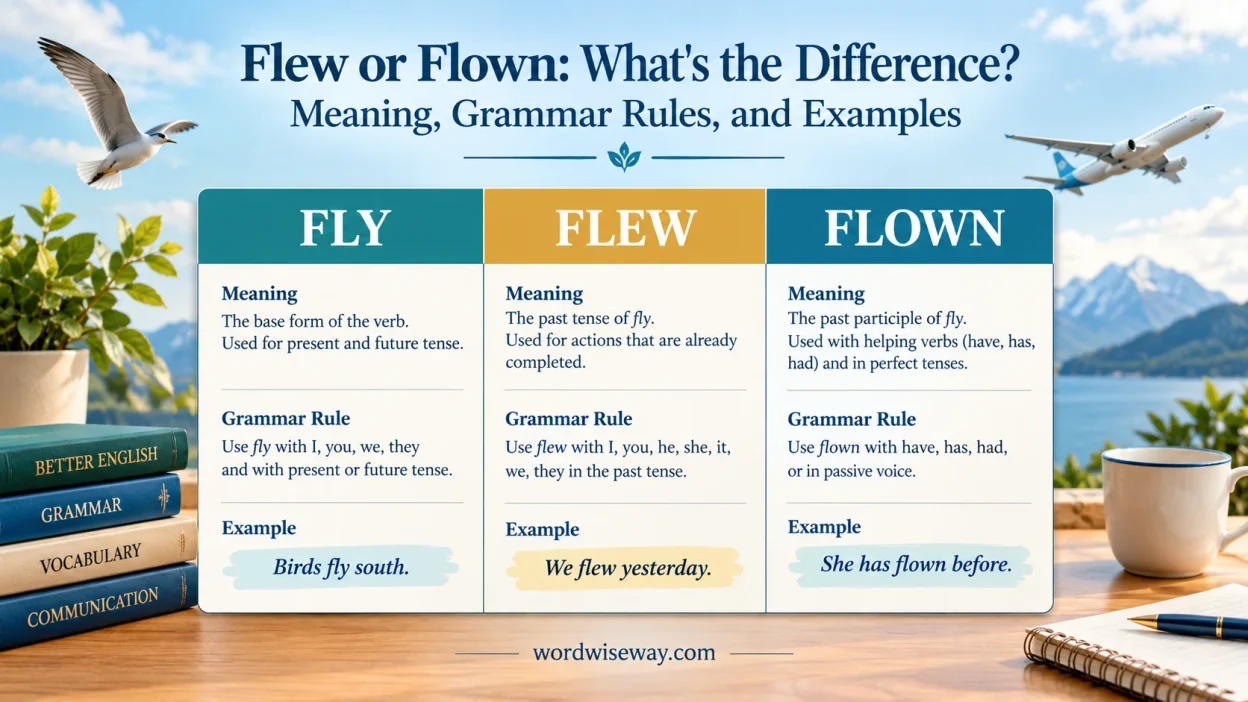
Flew or Flown: Difference Meaning, Rules, and Examples helps English learners understand these confusing verb forms and use them correctly in everyday writing, speaking, and exams.
When discussing air travel, many beginners struggle to understand flew and flown. Both words come from the irregular verb fly, but they serve different grammatical purposes. Flew is the simple past tense used for actions completed at a specific time. For example, “She flew to London last week” describes a past flight. Words such as yesterday, last week, and last year often accompany the simple past tense.
In contrast, flown is the past participle and usually needs a helping verb, such as has, have, or had. For example, “She has flown to London several times” uses the present perfect tense correctly. To choose the right form, check the sentence structure and identify the required verb tense. Understanding these basic grammar rules helps you avoid mistakes and communicate in clear, correct English.
Quick Answer:
Flew is the simple past tense of fly, while flown is the past participle. Use flew to describe an action that happened in the past. Use flown with an appropriate helping verb in perfect tenses and passive constructions.
| Word | Grammatical Form | Common Usage | Example |
| Fly | Base form | Present tense, infinitives, and after modal verbs | Birds fly south in winter. |
| Flew | Simple past tense | An action completed in the past | We flew to Chicago yesterday. |
| Flown | Past participle | Perfect tenses and passive constructions | She has flown to Chicago. |
Easy memory trick: If you’re describing a straightforward past action, use flew. If your sentence needs a past participle, use flown.
For example:
- Correct: He flew to California last week.
- Correct: He has flown to California several times.
- Incorrect: He has flew to California several times.
The difference comes down to grammar, not the type of flight or the meaning of the action.
What Does Flew Mean?
Flew is the simple past tense of the irregular verb fly. You use it when describing an action that happened in the past.
Unlike regular verbs that form the past tense by adding -ed, the verb fly changes its spelling. Its simple past form is flew, not flyed.
For example:
- The airplane flew over the mountains.
- A butterfly flew into the garden.
- She flew home after the conference.
- The hours flew by during the vacation.
In each sentence, flew describes something that happened in the past. The subject might be a person, an animal, an aircraft, or even time in a figurative expression.
When to Use Flew
Use flew when you want to describe a completed past action without forming a perfect tense.
Consider this example:
My family flew to Florida last summer.
The sentence tells you what happened and identifies when it happened. The verb flew expresses the past action directly.
Here are several common situations in which flew is appropriate.
To describe past air travel
Use flew when someone traveled by airplane in the past.
- We flew to New York on Monday.
- My aunt flew home after visiting us.
- The team flew to Seattle for the tournament.
To describe movement through the air
The word also describes birds, insects, objects, and other things moving through the air.
- The eagle flew above the forest.
- A leaf flew across the road.
- The paper airplane flew across the classroom.
To describe rapid movement or the passage of time
English speakers also use flew figuratively to describe something that moved quickly or seemed to pass quickly.
- Time flew during our summer vacation.
- The car flew past the finish line.
- News of the announcement flew through the office.
These examples share one feature: flew presents the action as a past event.
Flew in Negative Sentences and Questions
The verb flew changes when you form negative sentences and questions using did.
After did or didn’t, use the base form fly, not flew. The helping verb already marks the past tense, so the main verb doesn’t need another past-tense form.
| Sentence Type | Correct Example | Incorrect Example |
| Affirmative | She flew to Boston. | She fly to Boston yesterday. |
| Negative | She didn’t fly to Boston. | She didn’t flew to Boston. |
| Question | Did she fly to Boston? | Did she flew to Boston? |
Remember this simple pattern:
- Affirmative: He flew to Denver.
- Negative: He didn’t fly to Denver.
- Question: Did he fly to Denver?
This rule applies to irregular verbs generally. Once did appears, return the main verb to its base form.
What Does Flown Mean?
Flown is the past participle of fly. Unlike flew, it usually appears with a helping verb or within another grammatical construction.
A past participle is a verb form used to build perfect tenses, passive voice, and certain participial phrases. The correct helping verb depends on the sentence’s tense and structure.
For example:
- I have flown on that airline before.
- She had flown abroad before starting college.
- They will have flown home by Friday.
- The injured passenger was flown to a nearby hospital.
Notice that flown appears in different constructions. It works with have, had, will have, and was. The last example uses the passive voice, not a perfect tense.
When to Use Flown
Use flown when your sentence requires the past participle of fly.
The most common uses include perfect tenses and passive constructions.
Present perfect tense
The present perfect connects a past action or experience to the present. Form it with has or have followed by the past participle.
Examples:
- I have flown with that airline twice.
- She has flown to London before.
- They have flown across the country.
- My brother has never flown internationally.
These sentences describe experiences or actions relevant to the present. They don’t necessarily identify an exact finished time.
Past perfect tense
The past perfect describes an action that occurred before another past event. Form it with had followed by the past participle.
Examples:
- We had flown home before the storm arrived.
- She had flown internationally before turning eighteen.
- The pilot had flown that route many times before the schedule changed.
In each example, had flown establishes an earlier action relative to another past event.
Future perfect tense
The future perfect describes an action that will be completed before a particular future time. Form it with will have followed by the past participle.
Examples:
- By Friday, we will have flown to three cities.
- She will have flown for six hours by noon.
- They will have flown home before the weekend ends.
The construction emphasizes completion by a future point, rather than simply describing a future flight.
Passive voice
The past participle also appears in passive constructions. These sentences emphasize the person or thing receiving an action.
Examples:
- The patient was flown to a specialist hospital.
- Supplies were flown to the remote village.
- The equipment had been flown overseas.
Here, flown doesn’t require has, have, or had specifically. Passive voice uses forms of be, sometimes alongside other helping verbs.
Flown in Everyday Sentences
You can use flown to discuss travel experiences, repeated journeys, transportation, and figurative expressions.
For example:
- Have you ever flown across the Atlantic?
- I’ve flown that route several times.
- The supplies have been flown into the region.
- The years have flown by since graduation.
The exact meaning depends on the surrounding words. The grammatical pattern, however, follows the same principle: use the past participle where the sentence structure requires it.
Flew vs. Flown: Key Differences
Although flew and flown share the same base verb, they aren’t interchangeable. Choosing the right form depends on the grammatical construction.
Grammatical Differences Between Flew and Flown
The main distinction is the role each word plays in a sentence.
Flew functions as the simple past tense. It can serve as the main verb in a straightforward statement about a past event.
Flown functions as the past participle. It commonly appears with helping verbs in perfect tenses or passive constructions.
| Feature | Flew | Flown |
| Verb form | Simple past | Past participle |
| Can express a simple past action alone? | Yes | Generally no |
| Used with has or have in perfect tenses? | No | Yes |
| Used with had in the past perfect? | No | Yes |
| Used in passive constructions? | Not as the required participle | Yes |
| Example | The bird flew away. | The bird has flown away. |
Compare these sentences:
Example one: The plane flew over the ocean.
The sentence describes a past event. No helping verb is necessary.
Example two: The plane has flown over the ocean.
The present perfect construction uses has followed by flown. It describes an experience or action connected to the present.
Both sentences are grammatically correct, but they use different verb forms because their structures differ.
Flew vs. Flown in Different Tenses
Understanding the tense helps you choose the correct form without guessing.
| Tense or Construction | Pattern | Example |
| Simple past | Subject + flew | We flew yesterday. |
| Present perfect | Subject + has/have + flown | We have flown before. |
| Past perfect | Subject + had + flown | We had flown earlier. |
| Future perfect | Subject + will have + flown | We will have flown by noon. |
| Simple past passive | Subject + was/were + flown | The patient was flown to safety. |
| Present perfect passive | Subject + has/have been + flown | The supplies have been flown in. |
One important detail: the past participle doesn’t always indicate a specific time by itself. The helping verbs and the wider sentence determine the tense and meaning.
For example, had flown refers to an action before another past event, while will have flown describes completion before a future point.
Flew vs. Flown in Everyday English
Everyday conversations often involve questions about travel experiences. These situations make the distinction especially clear.
Consider the following exchange:
Alex: Did you fly to Miami last weekend?
Jordan: Yes, I flew there on Saturday.
Alex: Have you flown there before?
Jordan: Yes, I’ve flown there twice.
The first question uses fly because did already marks the past tense. Jordan answers with flew because the trip happened at a specific time in the past.
The final sentence uses flown because have forms the present perfect tense.
This pattern works whether you’re talking about a short domestic flight, an international trip, or another kind of movement through the air.
Fly, Flew, and Flown: Understanding All Three Forms
Learning all three principal forms together makes the difference easier to remember.
The verb fly is irregular, so its past forms don’t follow the standard pattern of adding -ed.
| Verb Form | Grammatical Role | Example |
| Fly | Base form | Birds fly south in winter. |
| Flew | Simple past | The bird flew south yesterday. |
| Flown | Past participle | The bird has flown south. |
When to Use Fly Instead of Flew or Flown
The base form fly appears in several common grammatical patterns.
After modal verbs
Use fly after modal verbs such as can, could, may, might, must, should, and will.
Examples:
- We can fly to Dallas tomorrow.
- She will fly home next week.
- They might fly through Chicago.
- You should fly earlier to avoid a delay.
Don’t change fly to flew or flown directly after these modal verbs.
After do, does, and did
The base form also follows do, does, and did in questions and negative sentences.
- Do you fly often?
- She doesn’t fly during thunderstorms.
- Did they fly last night?
Even when the sentence refers to the past, did takes the past-tense marking. Therefore, the main verb remains fly.
In infinitives and commands
Use to fly when the verb appears in an infinitive construction.
- She hopes to fly around the world.
- They decided to fly instead of drive.
Commands also use the base form.
- Fly carefully.
- Fly directly to the airport.
These patterns show why identifying the word immediately before the verb can help you select the correct form.
Common Mistakes
Even experienced English learners sometimes mix up irregular verb forms. Fortunately, most errors become easy to correct once you identify the sentence pattern.
Using Flew With Has, Have, or Had
One of the most common errors is using flew after a helping verb that requires a past participle.
Incorrect: She has flew to Paris.
Correct: She has flown to Paris.
The present perfect tense requires has or have followed by the past participle. Because flown is the past participle of fly, it’s the correct choice.
More examples:
- Incorrect: I have flew on that plane.
- Correct: I have flown on that plane.
- Incorrect: They had flew home early.
- Correct: They had flown home early.
Remember: When has, have, or had forms a perfect tense, use flown, not flew.
Using Flown Without the Required Verb
Another common mistake is treating flown as though it were the simple past tense.
Incorrect: He flown to Chicago yesterday.
Correct: He flew to Chicago yesterday.
The first sentence lacks the grammatical structure needed for a standard simple past statement. The second sentence uses flew correctly.
However, flown doesn’t always need has, have, or had. Consider this example:
The passenger was flown to the hospital.
This sentence is correct because was flown forms the passive voice. The helping verb was supplies the necessary grammatical structure.
Confusing Did Fly With Did Flew
When you form a question or negative sentence with did, use the base form fly.
Incorrect: Did she flew to New York?
Correct: Did she fly to New York?
Incorrect: He didn’t flew home.
Correct: He didn’t fly home.
Why? The word did already expresses the past tense. Adding flew would mark the past twice in the same verb construction.
Use this pattern:
- Past statement: She flew home.
- Past question: Did she fly home?
- Past negative: She didn’t fly home.
Mixing Up Verb Forms in Questions and Negative Sentences
The right verb form depends on the helping verb, not simply on whether a sentence describes the past.
| Incorrect Sentence | Correct Sentence | Reason |
| He has flew abroad. | He has flown abroad. | Perfect tense requires the past participle. |
| They had flew earlier. | They had flown earlier. | Past perfect uses had + past participle. |
| Did you flew yesterday? | Did you fly yesterday? | Did takes the base form. |
| She didn’t flew home. | She didn’t fly home. | Didn’t takes the base form. |
| The supplies were flew overseas. | The supplies were flown overseas. | Passive voice requires the past participle. |
A useful habit is to locate the helping verb before choosing the main verb form. That small check can prevent several common grammar mistakes.
Different Contexts
The meanings of flew and flown don’t change based on what is moving. Their grammatical functions remain the same whether the subject is a bird, a passenger, or an airplane.
Flew or Flown for Air Travel
Air travel provides some of the clearest examples of the distinction.
Use flew when describing a past journey:
- We flew to Denver last Tuesday.
- My cousin flew to Canada last month.
- The passengers flew through heavy clouds.
Use flown when the sentence calls for a past participle:
- We have flown to Denver before.
- My cousin had flown to Canada before starting her new job.
- The passengers have flown with this airline several times.
The key isn’t whether the trip is complete. Both forms can describe completed trips. The difference is the grammatical structure.
Flew or Flown for Birds, Insects, and Other Movement
The same rule applies when describing animals and objects moving through the air.
Examples with flew:
- The robin flew toward the tree.
- A butterfly flew through the open window.
- The kite flew above the beach.
Examples with flown:
- The robin has flown away.
- A butterfly had flown into the garden before we arrived.
- The kite has flown higher than the trees.
These examples show that the verb form depends on tense and sentence structure rather than the subject.
Flew or Flown in Figurative Expressions
The verb fly also appears in figurative language. English speakers often use it to describe speed, time, and the rapid spread of information.
Examples include:
- Time flew during the school holidays.
- The weeks have flown by.
- Rumors flew around the office.
- News of the victory has flown across social media.
In the first and third examples, flew expresses past action. In the second and fourth, flown appears in present perfect constructions.
These expressions sound natural because English regularly uses movement through the air as a way to describe speed or rapid change.
A Quick Comparison Guide
When you’re unsure which word to choose, compare the sentence pattern with the examples below.
| If You Mean… | Use | Example |
| A past action | Flew | We flew to Boston yesterday. |
| A past experience connected to the present | Have/has flown | I have flown internationally. |
| An action before another past event | Had flown | She had flown home before the roads closed. |
| Completion before a future time | Will have flown | They will have flown home by Friday. |
| A passive action in the past | Was/were flown | The supplies were flown to the island. |
| A question about a past flight | Did + fly | Did you fly last night? |
| A negative statement about a past flight | Didn’t + fly | We didn’t fly yesterday. |
The simplest rule is to check the verb construction. Use flew for a simple past statement, flown for the past participle, and fly after did or a modal verb.
How to Remember Flew vs. Flown
Remembering the three forms becomes easier when you learn them as a set: fly, flew, flown.
Each form has a distinct role, so focus on the grammatical pattern instead of memorizing isolated sentences.
Here are three practical ways to remember the difference.
Use the three-form rule
- Fly: the base form.
- Flew: the simple past tense.
- Flown: the past participle.
Say the forms together when practicing irregular verbs. Repeated exposure helps you recognize the correct form more quickly.
Look for helping verbs
If you see has, have, or had forming a perfect tense, choose flown.
- She flew yesterday.
- She has flown before.
- She had flown before the weather changed.
For passive voice, look for a suitable form of be, as in was flown or were flown.
Check for did
If the sentence contains did or didn’t as a helping verb, use fly.
- Did he fly?
- He didn’t fly.
- He flew.
This quick check works especially well when editing questions and negative statements.
Practice Exercises
Now put the rules into practice. Choose the correct verb form for each sentence.
Fill in the Blanks
Complete each sentence with fly, flew, or flown.
- We _____ to Boston last weekend.
- She has _____ on that airline before.
- Did you _____ to Chicago yesterday?
- They had _____ home before the storm started.
- The supplies were _____ to the island.
- My brother will _____ to Seattle tomorrow.
- Time has _____ by since graduation.
- He didn’t _____ to work this morning.
- By next Friday, we will have _____ across three countries.
- The bird _____ away when the door opened.
Correct the Mistakes
Each sentence contains a verb-form error. Rewrite it correctly.
- She has flew to London twice.
- Did they flew home last night?
- He had flew before the weather changed.
- We didn’t flown to New York.
- The patient was flew to a specialist hospital.
Answer Key With Explanations
| Exercise | Correct Answer | Explanation |
| 1 | flew | Simple past tense. |
| 2 | flown | Present perfect with has. |
| 3 | fly | The helping verb did takes the base form. |
| 4 | flown | Past perfect with had. |
| 5 | flown | Passive construction with were. |
| 6 | fly | The modal verb will takes the base form. |
| 7 | flown | Present perfect with has. |
| 8 | fly | The negative helping verb didn’t takes the base form. |
| 9 | flown | Future perfect with will have. |
| 10 | flew | Simple past tense. |
Corrected sentences:
- She has flown to London twice.
- Did they fly home last night?
- He had flown before the weather changed.
- We didn’t fly to New York.
- The patient was flown to a specialist hospital.
If you answered these correctly, you understand the main patterns. If a few were tricky, revisit the helping verbs and identify which form each construction requires.
Read More: What Does LMY Stand For? With Real Conversation Examples
FAQs
What Is the Main Difference Between Flew and Flown?
Flew is the simple past tense of fly, while flown is its past participle. Use flew for a completed past action and flown with helping verbs such as has, have, or had.
Is Flew or Flown Correct for Past Tense?
Both words are correct, but they serve different purposes. Use flew for the simple past, as in “He flew to Karachi yesterday.” Use flown in a sentence such as “He has flown to Karachi before.”
Can You Use Flown Without a Helping Verb?
In standard English, flown usually needs a helping verb when expressing a perfect tense. For example, “She has flown abroad” is correct. However, flown can also appear in other grammatical structures, such as “The plane was flown by an experienced pilot.”
Should You Say I Flew or I Have Flown?
Choose I flew when describing a past action at a specific time. For example, “I flew to Lahore last Monday.” Use I have flown when discussing life experiences without specifying exactly when they happened.
Is Flown the Past Tense of Fly?
No, flown is the past participle of fly. The simple past tense is flew. Remember the three main forms: fly, flew, flown.
How Do You Use Flew in Everyday Sentences?
Use flew to describe an action that happened in the past. For example, “The bird flew over the garden,” or “We flew to Islamabad last summer.” Both sentences describe completed past actions.
How Do You Use Flown With Has, Have, and Had?
Use has flown with he, she, or it; have flown with I, you, we, or they; and had flown when referring to an action completed before another past event. For example, “They had flown home before the storm began.”
Why Do English Learners Confuse Flew and Flown?
These words come from the same irregular verb and both refer to flying in the past. The confusion often occurs because learners apply the same verb form to every sentence. Understanding helping verbs and sentence structure makes the difference easier to remember.
What Is the Easiest Way to Remember Flew and Flown?
Remember this simple pattern: fly, flew, flown. Use flew for a simple past action and flown with a helping verb in perfect tenses. Practicing a few examples every day can help you choose the correct form naturally.
Which Is Correct: The Plane Flew Away or the Plane Flown Away?
“The plane flew away” is correct because flew works as the simple past tense without a helping verb. “The plane has flown away” is also correct because has supports the past participle flown.
Conclusion
Understanding flew or flown becomes much easier when you learn how each word works in a sentence. Both words come from the verb fly, but they have different grammatical roles. Flew describes an action that happened in the past, while flown usually works with helping verbs to form perfect tenses.
The easiest way to remember the difference is to practice the three verb forms: fly, flew, flown. For example, “She flew to London yesterday” describes a specific past event, while “She has flown to London before” talks about her experience. Paying attention to helping verbs and time expressions will help you choose the correct form.
Whether you’re writing an assignment, preparing for an English exam, or improving your everyday conversations, learning this small grammar rule can make a real difference. Read example sentences aloud, write your own examples, and check how each verb fits into the sentence. With regular practice, you’ll use flew and flown more confidently and naturally.