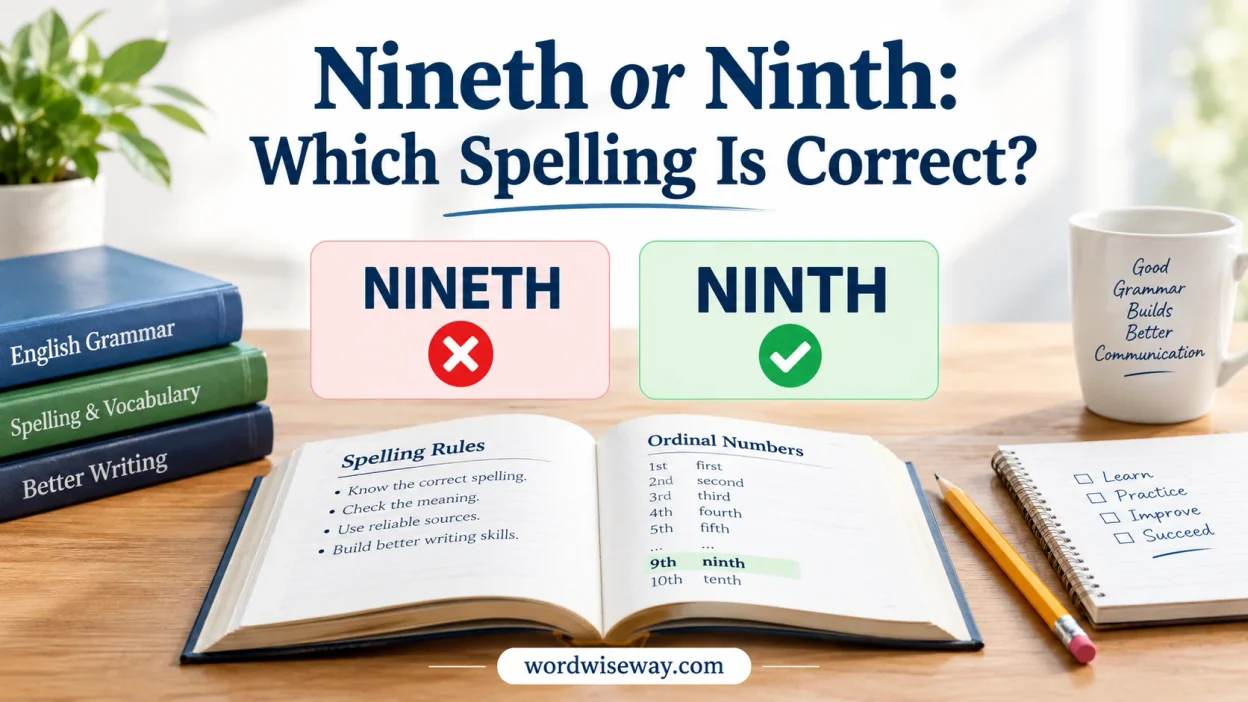
The guide Nineth or Ninth: Correct Spelling, Meaning, and Usage explains why ninth can confuse learners.
The doubt begins with pronunciation, because the soft ending may make you hear an extra e. People notice number words such as nine and fifth. Yet English uses ninth, not nineth, in American English and British English today.
In school assignments, blog posts, exam answers, documents, emails, dates, addresses, and online forms, this tiny letter can cause hesitation. People may pause mid-sentence or search for a quick answer about why ninth and not nineth. Questions about 9th or ninth are common.
Good learning combines grammar rules, English spelling, correct spelling, proper usage and practical advice. Examples build confidence. Spellcheck may miss an error, so remember the pattern, learn the origin, and use ninth correctly.
Quick Answer:
Ninth is the correct spelling.
Nineth is an incorrect spelling in standard English.
The basic relationship is:
| Form | Correct? | Meaning |
| nine | ✓ | The number 9 |
| ninth | ✓ | Coming after eighth |
| nineth | ✗ | Incorrect spelling |
For example:
- She finished ninth in the race. ✓
- She finished nineth in the race. ✗
- The ninth chapter explains the main idea. ✓
- The nineth chapter explains the main idea. ✗
So if you’re choosing between nineth or ninth, choose ninth.
What Does “Ninth” Mean?
Ninth is the ordinal form of the number nine. It describes position, order, sequence, or rank.
To understand it clearly, compare nine with ninth.
Nine is a cardinal number. You use cardinal numbers when you count things.
There are nine books on the shelf.
Ninth is an ordinal number. You use ordinal numbers to show position or sequence.
The blue book is the ninth book on the shelf.
The difference is simple:
- Nine tells you how many.
- Ninth tells you which position.
This distinction appears throughout English.
| Cardinal number | Ordinal number |
| one | first |
| two | second |
| three | third |
| four | fourth |
| five | fifth |
| six | sixth |
| seven | seventh |
| eight | eighth |
| nine | ninth |
| ten | tenth |
The important point is that ninth doesn’t mean “nine things.” It identifies the position occupied by number nine.
Why Is “Ninth” Spelled Without the “E”?
The spelling becomes easier once you look at the actual transformation:
nine → ninth
The final e in nine disappears before the ordinal ending is added.
That’s why the correct form isn’t nineth.
English spelling often changes when a word receives an ending. The base word doesn’t always remain completely unchanged. In this case, retaining the final e would produce the nonstandard form nineth.
Think of it as a spelling adjustment rather than a completely unrelated word.
Nine vs. Ninth
Consider these examples:
- nine people
- the ninth person
- nine questions
- the ninth question
- nine floors
- the ninth floor
- nine chapters
- the ninth chapter
The pattern becomes obvious once you see it repeatedly.
Nine describes quantity.
Ninth describes position.
Why Do People Write “Nineth”?
The spelling nineth is understandable because it follows a pattern that seems logical at first glance.
Someone may reason:
nine + th = nineth
That approach works with some ordinal numbers, such as:
- seven → seventh
- eight → eighth
- ten → tenth
However, English doesn’t always create ordinal numbers by simply attaching -th to the unchanged spelling of the cardinal number.
The word nine is one of the cases where the spelling changes.
This is why nineth can look reasonable while still being incorrect.
Is “Nineth” a Word?
In standard modern English, nineth isn’t the accepted spelling of the ordinal number corresponding to nine.
If you’re writing an essay, article, email, school assignment, report, or other standard English text, use ninth.
For example:
The ninth student answered the question correctly.
Not:
The nineth student answered the question correctly.
The first sentence follows standard English spelling.
What’s the Difference?
The difference between nine and ninth comes down to grammatical function.
Nine
Nine is a cardinal number.
It tells you the quantity of something.
I bought nine notebooks.
Here, nine tells you the number of notebooks.
Ninth
Ninth is an ordinal number.
It tells you the position of something.
I used the ninth notebook first.
Here, ninth identifies a particular position in a sequence.
The distinction becomes especially useful when you’re describing rankings.
The team scored nine points.
The team finished in ninth place.
The first sentence gives a quantity. The second gives a position.
How to Pronounce “Ninth”
Ninth can be slightly difficult for English learners because several consonant sounds occur close together.
The word contains the /n/ sound at the beginning and ends with the /nθ/ sound. The final th represents the unvoiced sound found in words such as think.
ninth
nīnTH
Give feedback
When practicing the word, don’t add an extra vowel sound between the consonants. That can make the word sound different from the standard pronunciation.
A useful approach is to say the beginning naturally and then focus on the final th sound. With practice, the consonant combination becomes much more comfortable.
Examples of “Ninth” in Sentences
Seeing ninth in different contexts helps you understand how the word actually works.
Ninth for Position
When something occupies position number nine, use ninth.
- She finished ninth in the competition.
- He was the ninth person to arrive.
- Our team ranked ninth overall.
- The runner crossed the finish line in ninth place.
Here, ninth identifies a position rather than a quantity.
Ninth for Dates
You can also use ninth when referring to the ninth day of a month.
For example:
The meeting is scheduled for the ninth of May.
You might also see:
The deadline is May 9th.
In standard writing, the exact style for dates can vary according to the publication or style guide. However, ninth remains the correct spelled-out ordinal form.
Ninth for Sequence
Ninth frequently appears when items have a particular order.
- Read the ninth chapter.
- Turn to the ninth page.
- Answer the ninth question.
- Take the ninth exit.
- She lives on the ninth floor.
Each example identifies something occupying position nine.
Ninth for Rankings
Sports, competitions, examinations, and lists often require ordinal numbers.
The player finished ninth.
The school ranked ninth in the regional competition.
She came ninth out of twenty participants.
In these sentences, ninth tells the reader exactly where someone or something stands in a sequence.
Ninth in Fractions
The word ninth also appears when you describe a fraction.
One-ninth means one part of something divided into nine equal parts.
For example:
She ate one-ninth of the cake.
If a whole object is divided into nine equal sections, each section represents one-ninth of the whole.
You can also encounter forms such as:
- one-ninth
- two-ninths
- three-ninths
Notice that the plural form becomes ninths.
For example:
Two-ninths of the class chose the same answer.
The word still comes from the ordinal form ninth.
Common Mistakes
The most obvious mistake is writing nineth instead of ninth.
Mistake: Nineth
She came nineth in the race. ❌
Correct: Ninth
She came ninth in the race. ✓
Another common issue involves ninth and nineteenth.
Ninth vs. Nineteenth
These words refer to different numbers.
- ninth = 9th
- nineteenth = 19th
For example:
The ninth student entered the room.
This means student number 9.
The nineteenth student entered the room.
This means student number 19.
The two words may look related, but they aren’t interchangeable.
| Number | Ordinal | Example |
| 9 | ninth | the ninth chapter |
| 19 | nineteenth | the nineteenth chapter |
Keeping the numbers visible while learning the spellings can prevent confusion.
Ninth in Dates and Formal Writing
Ordinal numbers frequently appear in dates, especially when dates are written out.
For example:
The conference began on the ninth of September.
The ordinal ninth tells you that the date falls on day nine of the month.
In more compact numerical writing, you may see:
September 9
You may also encounter:
September 9th
Which format you choose can depend on the writing style you’re following. The important spelling point remains unchanged: when you spell out 9th, the correct word is ninth, not nineth.
Ninth vs. Nineteenth: A Useful Comparison
Because these forms are often confused, here’s a quick breakdown.
| Word | Number | Meaning |
| ninth | 9th | position after eighth |
| nineteenth | 19th | position after eighteenth |
Consider these examples:
She finished ninth in the first race.
She finished nineteenth in the second race.
The difference is ten positions. A small spelling difference can therefore change the meaning considerably.
A Simple Way to Remember “Ninth”
The easiest memory trick is short:
Nine loses the final “e” before becoming ninth.
Remember:
nine → ninth
Not:
nine → nineth
You can reinforce the pattern by connecting the word to the numeral:
9 → 9th → ninth
That gives you three forms of the same idea.
| Type | Form |
| Number | 9 |
| Ordinal numeral | 9th |
| Ordinal word | ninth |
If you remember 9th = ninth, you’re much less likely to write nineth.
Quick Revision
Here are the key facts to remember:
- Ninth is the correct spelling.
- Nineth is not the standard spelling.
- Ninth is the ordinal form of nine.
- Nine describes quantity.
- Ninth describes position or sequence.
- The spelling changes from nine to ninth.
- The final e disappears.
- Ninth corresponds to 9th.
- Nineteenth corresponds to 19th.
- One-ninth describes one of nine equal parts.
Quick Comparison Table
| Question | Answer |
| Correct spelling? | Ninth |
| Incorrect spelling? | Nineth |
| Cardinal form? | Nine |
| Ordinal form? | Ninth |
| Numeral form? | 9th |
| Position represented? | Number 9 |
| Related ordinal for 19? | Nineteenth |
Real-World Examples of “Ninth”
The word ninth appears in many ordinary situations. It isn’t limited to grammar exercises.
You might use it when talking about:
- school: the ninth grade or ninth question
- buildings: the ninth floor
- competitions: ninth place
- dates: the ninth day of a month
- books: the ninth chapter
- lists: the ninth item
- directions: the ninth exit
- fractions: one-ninth
- rankings: ninth overall
- sequences: the ninth stage
For example:
Please read the ninth paragraph before answering.
The elevator stopped at the ninth floor.
Our team finished ninth overall.
The festival starts on the ninth of July.
Each sentence uses ninth to identify position or order.
Read More: Feet or Foot: Difference and When Should You Use Each?
FAQs
Is “nineth” a correct English spelling?
No. Nineth is an incorrect spelling in standard English. The correct form is ninth, which represents the ordinal number after eighth and refers to position number nine.
Why is “ninth” spelled without the “e”?
The word ninth comes from nine, but the final e is dropped before the -th ending is added. This spelling change makes ninth different from what you might expect from simply combining nine and th.
Is “9th” the same as “ninth”?
Yes. 9th is the numerical form of ninth. You can use either depending on the context. For example, “the ninth grade” and “9th grade” express the same ordinal idea.
Why do people write “nineth” instead of “ninth”?
Many people make this mistake because the pronunciation can suggest an extra vowel sound. The spelling may also seem logical when learners compare nine with other ordinal forms such as five and fifth.
Is “ninth” used in both American and British English?
Yes. Ninth is the standard spelling in both American English and British English. There is no standard regional variation that changes it to nineth.
How do you remember the spelling of ninth?
A simple memory trick is to think of nine without its final e, then add th. Remembering “nine loses e” can help you avoid the common nineth spelling mistake.
Can “nineth” appear online even though it is wrong?
Yes. You may see nineth in social posts, comments, websites, school work, or informal writing. Seeing a misspelling repeatedly does not make it an accepted standard spelling.
Can spellcheck always detect “nineth”?
Not necessarily. Spellcheck tools can miss errors depending on the software, context, device, or dictionary being used. You should still know the correct spelling yourself rather than relying entirely on automatic correction.
How should I use “ninth” in a sentence?
You can use ninth when describing the ninth position, date, item, level, or stage. For example, “She finished ninth in the competition” correctly uses the ordinal form.
What is the easiest way to avoid the “nineth” mistake?
Remember that ninth is the correct spelling and nineth is not. When you hesitate, connect nine with the rule that removes the final e before adding -th.
Conclusion
The difference between ninth and nineth looks tiny, but that single letter can create unnecessary confusion. Ninth is the correct spelling, while nineth is a common mistake that often develops from pronunciation or from applying a spelling pattern too literally. Once you recognize that nine drops its final e before taking -th, the spelling becomes much easier to remember.
You can use ninth confidently in school assignments, formal writing, emails, dates, reports, and everyday conversations. The numerical form 9th carries the same meaning, so the choice between the two usually depends on the style of your writing. Whether you use American English or British English, the standard written form remains the same.
The best way to make the spelling stick is through repeated exposure and practical use. Each time you write ninth correctly, you reinforce the pattern and make the error less likely to return. When doubt creeps in, remember one simple rule: nine loses e before -th.

Emma Smith has dedicated 14 years to Princeton University’s English Department, mentoring students in textual interpretation, literary movements, and critical frameworks. Her research explores Shakespearean drama, Victorian serial fiction, postcolonial narrative theory, and manuscript studies and probing how literary forms evolve across cultures and centuries. Emma has delivered lectures at international humanities congresses and published findings in distinguished academic journals, underscoring her commitment to scholarly depth and vibrant teaching.