Forgot or Forgotten: Difference, Meaning, Rules, and Examples explains how these two irregular verbs work in English grammar and everyday writing.
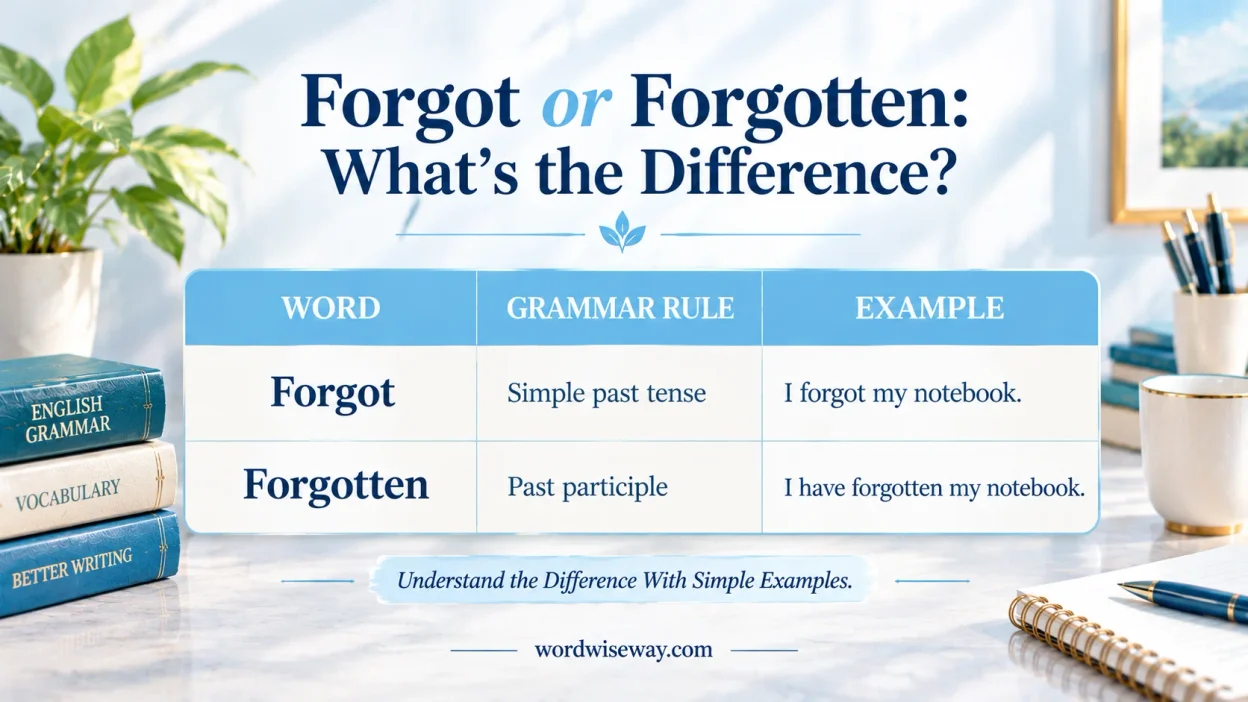
Forgot is the simple past tense of forget. Use it for an action that happened in the past. For example, “I forgot my notebook yesterday.” Forgotten is the past participle, which usually appears with helping verbs such as have, has, or had. For example, “I have forgotten her name.”
Understanding forgot vs. forgotten makes correct verb usage easier. Both words share a similar meaning, but their grammatical roles differ. Learning these verb forms, tense rules, and grammar examples helps you write clearer sentences and follow standard English grammar rules.
Quick Answer:
The main difference between forgot and forgotten is their grammatical form.
- Forgot is the simple past tense of forget. Use it to describe an action that happened in the past.
- Forgotten is the past participle of forget. It commonly appears with auxiliary verbs such as have, has, and had.
| Word | Grammatical form | Example |
| Forget | Base form | I sometimes forget people’s names. |
| Forgot | Simple past tense | I forgot your birthday yesterday. |
| Forgotten | Past participle | I have forgotten your birthday. |
For example, “I forgot my notebook yesterday” describes a past event. In contrast, “I have forgotten my notebook” connects the past event to the present situation.
Easy rule to remember: Use forgot for the simple past and forgotten after have, has, or had when forming perfect tenses.
What Does Forgot Mean?
Forgot is the simple past tense of the verb forget. It describes something a person failed to remember or something that slipped from their mind in the past.
You can use it when talking about missed appointments, misplaced belongings, forgotten responsibilities, or details that escaped your memory. The sentence usually doesn’t need an auxiliary verb in an ordinary affirmative statement.
For example, “I forgot my keys at home” tells you what happened. The verb forgot places the action in the past without requiring another verb to complete the tense.
Examples of Forgot in Sentences
Here are several examples showing how forgot works in everyday English.
- I forgot my homework at home.
- She forgot to call her grandmother.
- We forgot the name of the restaurant.
- He forgot his password again.
- They forgot to bring their tickets.
- My brother forgot about our plans.
- I forgot where I parked the car.
- Sarah forgot to submit her assignment.
Each sentence describes a past action or failure to remember something.
Notice that forgot can appear before a noun, a clause, or an infinitive phrase beginning with to. The structure changes according to the meaning, but the verb remains in its simple past form.
When Should You Use Forgot?
Use forgot when you want to describe an event that occurred in the past.
Use forgot with completed past events.
When you mention a finished time, the simple past is usually appropriate.
Examples:
- I forgot my umbrella yesterday.
- She forgot the appointment last Monday.
- We forgot to buy groceries this morning.
Use forgot in past-tense stories.
When narrating a sequence of events, forgot helps move the story forward.
For example:
“I left the house early, forgot my wallet, and returned to get it.”
Use forgot in questions and negative sentences with did.
When you use did or didn’t, the main verb returns to its base form.
- Did you forget your notebook?
- She didn’t forget the instructions.
- Why did he forget the meeting?
The correct forms are did forget and didn’t forget, not did forgot or didn’t forgot.
What Does Forgotten Mean?
Forgotten is the past participle of forget. Unlike forgot, it generally needs an auxiliary verb when forming a perfect tense.
The most common structures are have forgotten, has forgotten, and had forgotten. These combinations help show how an earlier event relates to the present or to another event in the past.
For example, “I have forgotten her name” suggests that you don’t remember her name now. The forgetting happened earlier, but the result matters in the present.
Examples of Forgotten in Sentences
Here are examples of forgotten in different grammatical constructions.
- I have forgotten his name.
- She has forgotten her password.
- They had forgotten the meeting time.
- We have forgotten how to play that game.
- He had forgotten the address before we arrived.
- The old tradition was forgotten over time.
- It was a long-forgotten family recipe.
These sentences demonstrate that forgotten can appear in perfect-tense constructions, passive constructions, and adjective phrases.
Its exact role depends on the words surrounding it. Understanding that context is more useful than memorizing a rule that says forgotten must always follow have.
When Should You Use Forgotten?
Use forgotten when your sentence requires the past participle of forget.
Use forgotten with have or has.
The present perfect connects a past action with the present.
Examples:
- I have forgotten the instructions.
- She has forgotten where she put her glasses.
- They have forgotten the rules.
Use forgotten with had.
The past perfect describes an action that happened before another past event.
Examples:
- I had forgotten the appointment before you reminded me.
- She had forgotten her keys when she reached the door.
- They had forgotten the instructions before the examination began.
Use forgotten in passive constructions.
A passive sentence can describe something that people no longer remember.
For example, “The old custom was forgotten by later generations.”
Use forgotten as an adjective.
The word can also describe something neglected or no longer remembered.
For example, “We discovered a forgotten photograph in an old drawer.”
Key Differences
Although both words come from forget, they have different grammatical roles. The easiest way to distinguish them is to examine the sentence structure.
| Feature | Forgot | Forgotten |
| Verb form | Simple past | Past participle |
| Main use | Describes a past action | Forms perfect tenses and other constructions |
| Common structure | Subject + forgot | Subject + have/has/had + forgotten |
| Example | I forgot the address. | I have forgotten the address. |
| Use after did | No | No |
| Use in passive voice | Generally not in the same construction | Yes, as in “The address was forgotten.” |
Consider these two sentences:
- “I forgot her birthday.”
- “I have forgotten her birthday.”
The first sentence presents the forgetting as a past event. The second uses the present perfect and emphasizes the situation as it relates to the present.
Neither sentence is automatically better than the other. The appropriate choice depends on what you want to communicate.
Forgot vs. Have Forgotten
The difference between forgot and have forgotten can be confusing because both refer to something that happened earlier.
The important distinction is how the speaker presents that past event. The simple past typically places the event in a finished past time, while the present perfect connects the event to the present.
When to Use Forgot
Use forgot when you describe an event that occurred at a particular time in the past.
Examples:
- I forgot his name yesterday.
- She forgot her appointment last week.
- We forgot to lock the door before leaving.
These sentences identify past events. The expressions yesterday, last week, and before leaving provide context for when the forgetting occurred.
When to Use Have Forgotten
Use have forgotten when you want to connect a past event with the present.
Examples:
- I have forgotten his name.
- She has forgotten her appointment details.
- We have forgotten where we parked.
In the first example, the speaker currently cannot recall the name. The sentence doesn’t specify exactly when the forgetting happened because that detail isn’t the main point.
In standard American English, the present perfect generally doesn’t combine with a finished-time expression such as yesterday.
Therefore:
- Incorrect in standard usage: “I have forgotten it yesterday.”
- Correct: “I forgot it yesterday.”
- Correct: “I have forgotten it.”
Forgot vs. Have Forgotten: A Practical Comparison
Imagine that you meet a former classmate.
If you say, “I forgot your name when we met yesterday,” you describe a past situation. If you say, “I have forgotten your name,” you emphasize that you can’t recall it now.
The difference is subtle but useful. English tenses don’t simply tell us when something happened; they also help us present its relationship to other events.
Forgot vs. Had Forgotten
Both forgot and had forgotten describe past situations, but the past perfect adds a specific relationship between events.
Use had forgotten when you want to make clear that one past event occurred before another past event.
How Had Forgotten Works
The past perfect follows this structure:
Subject + had + past participle
Because forgotten is the past participle, it follows had.
Examples:
- I had forgotten the appointment before she called.
- They had forgotten the meeting time when the manager arrived.
- She realized that she had forgotten her keys.
In the third example, forgetting happened before she realized it. The past perfect makes that sequence clear.
Forgot vs. Had Forgotten in Context
Compare these examples:
Simple past: “When I arrived, I forgot the documents.”
This sentence describes the forgetting as a past event. Depending on the context, it might mean the speaker left the documents behind or failed to remember them at that moment.
Past perfect: “When I arrived, I realized I had forgotten the documents.”
Here, the past perfect shows that the forgetting occurred before the realization.
You don’t need the past perfect every time you mention two past events. When their sequence is already clear, the simple past may be enough. Use had forgotten when the earlier timing matters.
Is It Forgot or Forgotten After Did?
One of the most common mistakes involves using the wrong verb form after did.
In standard English, did already marks the sentence as past tense. Therefore, the main verb must use its base form, forget.
| Incorrect sentence | Correct sentence |
| Did you forgot my birthday? | Did you forget my birthday? |
| Did she forgotten her bag? | Did she forget her bag? |
| I didn’t forgot the address. | I didn’t forget the address. |
| He didn’t forgotten the instructions. | He didn’t forget the instructions. |
The rule applies to both questions and negative statements.
For example, “Did you forget to call me?” is correct. The past tense comes from did, so forget doesn’t need to change into forgot.
Remember this pattern:
- Positive statement: I forgot.
- Question: Did I forget?
- Negative statement: I didn’t forget.
Once you recognize the role of did, these sentence patterns become much easier to use.
Can You Use Forgotten Without Have, Has, or Had?
Yes. Although forgotten commonly appears with have, has, and had, those aren’t its only possible uses.
The word can also appear in passive constructions and adjective phrases. In these sentences, its grammatical role differs from its role in perfect tenses.
Forgotten in Passive Voice
A passive construction uses a form of be followed by a past participle.
Examples:
- The old tradition was forgotten over time.
- The incident was quickly forgotten.
- The names were forgotten by later generations.
In these sentences, was or were helps form the passive construction. The word forgotten supplies the past participle.
Forgotten as an Adjective
Sometimes, forgotten describes a noun rather than forming part of a verb phrase.
Examples:
- We found a forgotten letter in the attic.
- The museum displayed a long-forgotten artifact.
- She wanted to revive a forgotten tradition.
Here, forgotten describes something that people no longer remember or have neglected.
The key point: Don’t assume that forgotten always needs have, has, or had. Check the complete sentence to understand its grammatical function.
Forget, Forgot, and Forgotten: All Three Verb Forms
Learning the three principal forms of forget helps you understand when each word belongs in a sentence.
| Verb form | Grammatical use | Example |
| Forget | Base form and simple present | I sometimes forget names. |
| Forgot | Simple past | I forgot her birthday. |
| Forgotten | Past participle | I have forgotten her birthday. |
| Forgetting | Present participle and gerund | I am forgetting small details. |
When to Use Forget
Use forget for habits, general statements, and constructions that require the base form.
Examples:
- I sometimes forget where I leave my phone.
- Don’t forget to bring your notebook.
- She may forget the appointment.
- Did you forget to send the email?
Notice that forget appears after don’t, may, and did. These words require the base form in the structures shown.
When to Use Forgot
Use forgot to describe a past action.
Examples:
- I forgot my lunch.
- She forgot the appointment.
- They forgot to turn off the lights.
In each example, forgot acts as the main verb in a simple past-tense statement.
When to Use Forgotten
Use forgotten as the past participle in perfect-tense constructions and other structures that require it.
Examples:
- I have forgotten the password.
- She had forgotten the directions.
- The old building was forgotten for decades.
The surrounding words determine how forgotten functions in each sentence.
Common Mistakes
Even experienced English learners sometimes mix up irregular verb forms. The following mistakes are especially common, but each has a straightforward correction.
Using Forgotten Without the Required Auxiliary
Incorrect: “I forgotten my wallet.”
Correct: “I forgot my wallet.”
Correct: “I have forgotten my wallet.”
The first sentence lacks the grammatical structure needed for forgotten. The other two sentences use the correct simple past and present perfect forms.
Using Forgot After Have or Has
Incorrect: “She has forgot her password.”
Correct: “She has forgotten her password.”
In standard American English, the present perfect requires has followed by the past participle forgotten. Although alternative forms occur in some dialects, has forgotten is the standard choice for formal writing.
Using Forgotten After Did
Incorrect: “Did you forgotten your keys?”
Correct: “Did you forget your keys?”
The auxiliary did already establishes the past tense. Use the base form forget afterward.
Confusing Simple Past With Present Perfect
Incorrect in standard American English: “I have forgotten the appointment yesterday.”
Correct: “I forgot the appointment yesterday.”
Correct: “I have forgotten the appointment.”
The word yesterday identifies a finished past time, so the simple past is appropriate. Without that finished-time reference, the present perfect can connect the past event to the present.
Confusing Forgotten With Forgetting
The words forgotten and forgetting have different grammatical functions.
Examples:
- “I have forgotten her name.” This uses the past participle.
- “I am forgetting more names lately.” This uses the -ing form.
- “Forgetting your password can be frustrating.” Here, forgetting functions as a gerund.
Choose the form that matches the sentence structure rather than relying only on the general meaning.
How to Choose Between Forgot and Forgotten
You can usually identify the correct form by examining the words around the verb.
Follow these simple steps.
Step 1: Check whether the sentence uses did.
If it does, use forget.
Example: “Did you forget your notebook?”
Step 2: Look for have, has, or had.
When these auxiliaries form a perfect tense, use forgotten.
Examples:
- I have forgotten the answer.
- She has forgotten the address.
- They had forgotten the instructions.
Step 3: Check whether you’re describing a simple past event.
If the sentence uses a simple past-tense statement, forgot is usually the right choice.
Example: “I forgot the appointment yesterday.”
Step 4: Check for passive voice or an adjective.
If the sentence uses a passive construction or describes a noun, forgotten may be correct.
Examples:
- The incident was forgotten.
- The forgotten book lay on the desk.
Quick Decision Guide
| Sentence structure or purpose | Correct form | Example |
| Simple past statement | Forgot | I forgot the key. |
| Have + past participle | Forgotten | I have forgotten the key. |
| Has + past participle | Forgotten | She has forgotten the key. |
| Had + past participle | Forgotten | They had forgotten the key. |
| Did + base verb | Forget | Did you forget the key? |
| Did not + base verb | Forget | I didn’t forget the key. |
| Passive construction | Forgotten | The key was forgotten. |
| Adjective phrase | Forgotten | A forgotten key |
This approach works for everyday conversation, school assignments, and most formal writing.
Practice Exercises
Now it’s time to put the rules into practice. Complete each sentence with the correct form of forget.
Fill in the Blanks
Choose from forget, forgot, forgotten, or forgetting.
- I _____ my homework last night.
- She has _____ where she parked the car.
- Did you _____ to lock the door?
- They had _____ the meeting time.
- He didn’t _____ his lunch.
- The old custom was _____ over time.
- We have _____ the details.
- She _____ her umbrella yesterday.
- I am _____ more names lately.
- The _____ tradition was revived by the community.
Answers and Explanations
| Sentence | Correct answer | Explanation |
| I _____ my homework last night. | Forgot | The sentence describes a past event at a finished time. |
| She has _____ where she parked the car. | Forgotten | Has requires the past participle in the present perfect. |
| Did you _____ to lock the door? | Forget | Did takes the base form. |
| They had _____ the meeting time. | Forgotten | Had forms the past perfect with the past participle. |
| He didn’t _____ his lunch. | Forget | Didn’t takes the base form. |
| The old custom was _____ over time. | Forgotten | The sentence uses the passive construction. |
| We have _____ the details. | Forgotten | Have combines with the past participle. |
| She _____ her umbrella yesterday. | Forgot | Yesterday identifies a finished past time. |
| I am _____ more names lately. | Forgetting | Am combines with the present participle here. |
| The _____ tradition was revived by the community. | Forgotten | Forgotten describes the noun tradition. |
Review any mistakes by identifying the sentence structure first. Once you know which grammatical form the sentence requires, the correct answer becomes easier to recognize.
Read More: Jess’ or Jess’s? Which Possessive Form Is Correct?
FAQs
1. Is “forgot” or “forgotten” correct?
Both words are correct, but they serve different purposes. Use forgot for the simple past tense and forgotten for the past participle.
2. What is the past tense of “forget”?
The simple past tense of forget is forgot. For example, “I forgot to bring my notebook to class.”
3. Is “forgotten” a past tense word?
Forgotten is the past participle of forget, not its simple past tense. It usually appears with helping verbs, as in “She has forgotten my name.”
4. Can I say “I have forgot”?
In standard English, use “I have forgotten.” The verb have requires the past participle, so forgotten is the correct choice.
5. What is the difference between “forgot” and “forgotten”?
Forgot describes a completed past action, while forgotten works with helping verbs in perfect tenses. For example, “I forgot yesterday” and “I have forgotten.”
6. Is “I forgot about it” grammatically correct?
Yes, “I forgot about it” is grammatically correct. It means you failed to remember something or did not keep it in mind.
7. Can I use “forgotten” without a helping verb?
Yes, forgotten can appear without a helping verb in certain constructions. For example, “The forgotten keys were on the table.” Here, it describes the keys.
8. Is “had forgot” or “had forgotten” correct?
Had forgotten is the correct form in standard English. The past perfect tense uses had followed by the past participle.
9. Why are “forgot” and “forgotten” irregular verbs?
They are forms of the irregular verb forget because they do not follow the usual pattern of adding -ed. Their forms must be learned individually.
10. How can I remember when to use “forgot” and “forgotten”?
Remember this simple rule: use forgot for the simple past and forgotten after have, has, or had. Practice with your own sentences to make the difference easier to remember.
Conclusion:
Understanding the difference between forgot and forgotten becomes simple when you focus on their grammatical roles. Both words come from forget, but each serves a different purpose in English grammar. Forgot expresses an action in the simple past, while forgotten is the past participle used with helping verbs or as a descriptive word.
The easiest way to remember this rule is to look at the sentence around each word. For example, “I forgot my homework” describes a past action, while “I have forgotten my homework” uses the present perfect tense. These small differences help you choose the correct verb form and avoid common writing mistakes.
With regular practice, you can use forgot and forgotten confidently in conversations, schoolwork, and formal writing. Pay attention to helping verbs, review a few examples, and practice creating your own sentences. Soon, choosing the correct form will feel natural rather than confusing.

Emma Smith has dedicated 14 years to Princeton University’s English Department, mentoring students in textual interpretation, literary movements, and critical frameworks. Her research explores Shakespearean drama, Victorian serial fiction, postcolonial narrative theory, and manuscript studies and probing how literary forms evolve across cultures and centuries. Emma has delivered lectures at international humanities congresses and published findings in distinguished academic journals, underscoring her commitment to scholarly depth and vibrant teaching.