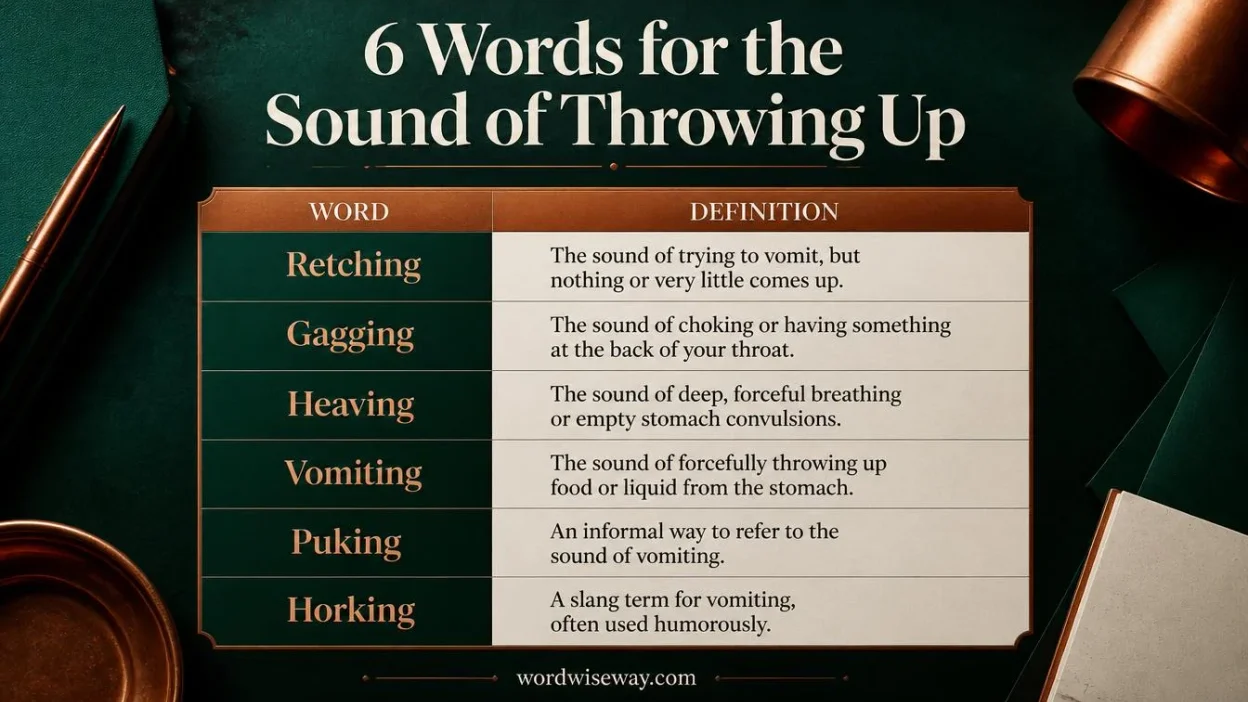
6 Words for the Sound of Throwing Up can help you describe sickness more clearly and make your writing easier for readers to imagine.
Onomatopoeia refers to words that imitate or describe sounds. These words make writing more vivid because they help readers picture a scene as it happens. When talking about someone who is sick, choosing the right sound words can spice up an article without making it difficult to understand.
This guide will explore some of the best words for describing the sound of vomit in simple, clear English. For example, words such as retch, gag, and heave describe different actions or sounds associated with feeling sick. Using them carefully can make the experience easier to picture and help your readers understand exactly what is happening in a story.
Quick Answer:
The following six words describe the sounds, physical actions, or informal expressions associated with throwing up.
| Word | Meaning | Common Usage |
| Retching | Making forceful movements associated with vomiting | Describing strained, repeated efforts to vomit |
| Gagging | Reacting involuntarily when something triggers the gag reflex | Describing a sudden throat reaction |
| Heaving | Making forceful bodily movements associated with vomiting | Describing physical effort before or during vomiting |
| Vomiting | Expelling stomach contents through the mouth | Neutral, direct descriptions |
| Puking | An informal term for vomiting | Casual conversation and informal writing |
| Horking | An informal, context-dependent term for forcefully expelling something | Colloquial dialogue and certain regional expressions |
Quick tip: Use retching or gagging when the sound or bodily reaction matters. Choose vomiting or puking when the actual action is more important than its sound.
What Are the Six Words for the Sound of Throwing Up?
Not every word associated with throwing up represents a sound directly. Some describe a physical reaction, while others name the act itself. Understanding this distinction makes your descriptions more accurate and natural.
Retching
Retching describes the forceful, involuntary movements associated with vomiting. These movements can produce harsh, strained sounds, particularly when someone repeatedly tries to vomit without expelling anything.
The word works well when you want readers to understand the physical effort involved. It can communicate discomfort and urgency without requiring a long explanation.
Example: “He retched over the sink but couldn’t bring anything up.”
In this sentence, the word retched tells readers that the person experienced forceful vomiting-related movements. It doesn’t suggest that vomiting necessarily occurred.
Retching often happens when the body responds to nausea or irritation. However, it can also occur when a person encounters an unpleasant smell or experiences another trigger.
Use this word when the action involves repeated, strained efforts rather than simply describing someone feeling sick.
Gagging
Gagging occurs when something triggers the body’s gag reflex. This protective response helps prevent unwanted material from moving farther into the throat.
The sound can be brief, abrupt, or strained. Unlike retching, gagging doesn’t necessarily involve the repeated muscular movements associated with trying to vomit.
Example: “She gagged when the strong odor reached her nose.”
Here, gagged describes an involuntary reaction rather than actual vomiting. The person might feel nauseated, but the sentence doesn’t establish that anything came up.
Writers often use gagging to describe reactions to unpleasant tastes, smells, or sensations in the throat. It can also describe a character’s response to something disgusting.
Consider the context before choosing this word. If someone makes a sudden throat reaction, gagged may fit. If the person repeatedly struggles to vomit, retched might communicate the action more precisely.
Heaving
Heaving describes a forceful physical movement or effort. In the context of vomiting, it often refers to the strong contractions and bodily movements that accompany the attempt to vomit.
The word can suggest heavy breathing, strained movement, or repeated physical effort. However, it doesn’t represent one specific sound.
Example: “He heaved over the toilet as the nausea intensified.”
This sentence emphasizes the person’s physical effort rather than identifying a particular noise. Readers understand that the person is struggling with the urge to vomit.
Heaving can also describe other actions, including lifting a heavy object or breathing heavily after exertion. Therefore, context matters whenever you use it.
For more precise writing, consider pairing the word with a clear description of the situation. For example, heaved with nausea emphasizes physical discomfort, while heaved a heavy box describes lifting.
Choose heaved when you want to emphasize effort rather than the exact sound produced.
Vomiting
Vomiting is the standard, neutral term for expelling stomach contents through the mouth. It describes the action directly rather than imitating its sound.
This word works in everyday explanations, educational writing, medical discussions, and straightforward storytelling. It also avoids the informal tone associated with expressions such as puking.
Example: “The passenger began vomiting after the boat encountered rough water.”
The sentence communicates what happened without suggesting a particular noise or physical movement.
When describing an event, the direct term is often sufficient. Adding sound effects doesn’t automatically make the sentence more vivid or informative.
For instance, a writer might describe a character as becoming pale, rushing to the bathroom, and vomiting. Those details establish the situation without requiring an exaggerated imitation of the sound.
Use vomiting when accuracy and clarity matter more than tone or sound imitation.
Puking
Puking is an informal, everyday word for vomiting. It appears frequently in casual conversation and informal storytelling.
Although the word communicates the same basic action as vomiting, its tone is more conversational. It can sound blunt, familiar, or deliberately casual depending on the situation.
Example: “He puked after the long, winding car ride.”
This sentence sounds informal and direct. In a formal report, vomited would usually be a more suitable choice.
The word itself doesn’t reproduce the sound of vomiting. Instead, it names the action in language that readers readily understand.
Writers can use puking when a character speaks casually or when the surrounding narration has an informal style. However, it might feel out of place in a formal scientific explanation.
The key is consistency. Match the word to the speaker, audience, and overall tone of your writing.
Horking
Horking is an informal expression whose meaning varies with context and regional usage. It can describe forcefully bringing something up from the throat or expelling something from the mouth.
In some contexts, the word suggests a rough, throaty action. However, it isn’t a standard, universal synonym for vomiting.
Example: “He horked up a mouthful of liquid after coughing.”
This example emphasizes a forceful expulsion, but it doesn’t establish that the person vomited. The surrounding context determines what the expression means.
That distinction matters because hork can be used differently by different speakers. Some may associate it with coughing something up, clearing the throat, or expelling material from the mouth.
Use this term when informal dialogue or a particular character’s vocabulary makes it appropriate. For neutral descriptions, coughed up, spat out, or vomited may communicate the intended action more clearly.
What’s the Difference?
Retching, gagging, and vomiting are related, but they don’t describe the same thing. Choosing between them depends on the bodily action you want to communicate.
Retching involves forceful movements associated with vomiting. Gagging refers to a reflexive response, while vomiting specifically involves expelling stomach contents through the mouth.
These distinctions help writers avoid using related words as interchangeable synonyms.
| Term | Main Meaning | Does It Require Vomiting? | Typical Context |
| Retching | Forceful vomiting-related movements | No | Repeated attempts to vomit |
| Gagging | A reaction involving the gag reflex | No | An unpleasant smell or throat sensation |
| Heaving | Forceful bodily effort | No | Straining before or during vomiting |
| Vomiting | Expelling stomach contents | Yes | Direct descriptions of the act |
For example, someone might gag after smelling spoiled food without vomiting. Another person might retch repeatedly because of nausea but bring nothing up.
Vomiting describes a different outcome because stomach contents actually leave the body.
These distinctions also affect how readers interpret a scene. Gagged communicates a reflexive reaction, whereas retched emphasizes forceful movements. Vomited removes the ambiguity about whether expulsion occurred.
How to Describe the Sound of Throwing Up in Writing
Choosing the right word is only part of creating a clear description. The surrounding sentence should establish what happened and why the sound matters.
A useful description doesn’t need exaggerated sound effects or a long list of unpleasant details. Often, one precise verb and a little context communicate the scene effectively.
Choose a Word That Matches the Action
Start by identifying what the person is actually doing. Are they reacting to an unpleasant smell, struggling with nausea, or expelling stomach contents?
Use the following guide to select an appropriate word:
- Gagged: Use this when someone has a sudden reaction involving the gag reflex.
- Retched: Choose this for forceful, repeated movements associated with vomiting.
- Heaved: Use this when physical effort or straining is the main focus.
- Vomited: Choose this for a clear, neutral description of expelling stomach contents.
- Puked: Use this when an informal, conversational tone suits the writing.
- Horked: Reserve this for contexts where its colloquial meaning is clear.
For example, compare these sentences:
- “She gagged at the smell of the spoiled milk.”
- “He retched repeatedly but couldn’t vomit.”
- “The sick passenger vomited beside the road.”
Each sentence communicates a different action. The verb carries much of the meaning without requiring additional explanation.
Use Onomatopoeia Carefully
Onomatopoeia refers to words that imitate or suggest sounds. Common examples include buzz, clang, and sizzle.
When describing the sound of throwing up, writers sometimes use expressions such as blech or blegh. These forms usually communicate disgust or gagging rather than a precise, universally recognized vomiting sound.
Unlike words such as buzz, which closely imitate a familiar noise, representations of vomiting sounds vary considerably between writers.
Consider this example:
“She made a gagging sound and turned away from the spoiled food.”
This sentence identifies the action without inventing a sound effect.
If a story uses onomatopoeia, make sure it fits the character’s perspective and the scene’s tone. A comic scene may benefit from an exaggerated expression, while a serious scene might sound more natural with a simple verb.
Writing tip: Use sound imitation to serve the scene, not as a substitute for clear description.
Match the Word to the Tone
The same event can sound different depending on the vocabulary you choose.
| Writing Style | Example | Effect |
| Neutral | “He vomited after the ride.” | Direct and factual |
| Conversational | “He puked after the ride.” | Informal and familiar |
| Descriptive | “He retched over the sink.” | Emphasizes the physical reaction |
| Action-focused | “He heaved over the toilet.” | Highlights physical effort |
| Colloquial | “He horked up the liquid.” | Informal and context-dependent |
The best choice depends on your audience and purpose. A school report generally benefits from neutral wording, while dialogue may call for casual expressions.
A mystery story, for example, might use retched to convey a character’s physical distress without explaining every detail. A conversation between friends might use puked because the informal wording sounds more natural.
Avoid Confusing Sounds With Actions
One common writing mistake is treating every vomiting-related word as a direct description of a noise.
Words such as retch, gag, and heave describe physical actions that may produce sounds. By contrast, vomit and puke identify the act of expelling stomach contents.
The difference is subtle but important.
Consider these examples:
- “He gagged.” This identifies a reflexive reaction.
- “He retched.” This describes forceful movements associated with vomiting.
- “He vomited.” This confirms that he expelled stomach contents.
- “He made a loud noise.” This describes a sound without identifying its cause.
When precision matters, choose the word that describes the actual event. Don’t assume that a person who gags or retches has necessarily vomited.
Common Mistakes
Even familiar words can become confusing when writers use them without considering their meanings.
Avoiding a few common mistakes will make your descriptions more accurate.
Treating Retching and Vomiting as Identical
Retching can happen without vomiting. Someone may experience repeated forceful movements without expelling stomach contents.
Use retching when the effort or bodily reaction is important. Use vomiting when the actual expulsion is the event you’re describing.
Using Gagging for Every Vomiting-Related Action
Gagging refers to a reflexive response, not every movement associated with vomiting.
A person might gag because of an unpleasant taste or sensation. That reaction doesn’t automatically mean the person is about to vomit.
Choose gagged when the reflex itself matters.
Assuming Heaving Names a Specific Sound
Heaving describes physical effort rather than one defined noise. The word can suggest straining or forceful movement, but the exact sound depends on the situation.
If you need to describe the noise itself, add a brief, accurate detail instead of assuming the verb explains everything.
Using Informal Terms in Every Context
Words such as puke and hork may suit casual conversation, but they don’t always fit formal writing.
For example, a health-related explanation generally benefits from vomiting. A character speaking to a friend might naturally choose puking.
Register matters because word choice affects how readers perceive both the speaker and the situation.
Read More: 4 Ways to Spell the Sound of Spitting
FAQs
What Is the Sound of Throwing Up Called?
The sound of throwing up can be described as retching, gagging, or vomiting. The best word depends on the sound and action you want to describe.
What Is an Onomatopoeia for Throwing Up?
Onomatopoeia uses words that imitate sounds. Words such as “blech” and “urp” can represent the unpleasant sounds associated with vomiting in informal writing.
What Word Describes the Sound Before Vomiting?
“Retch” describes the action of trying to vomit, often producing a harsh, strained sound. It works well when describing a character who feels very sick.
Is Gagging the Same as Throwing Up?
No, gagging and throwing up are different. Gagging is a reflex that can happen when something irritates the throat, while vomiting involves bringing stomach contents up through the mouth.
How Can You Describe Vomiting in a Story?
Use clear verbs and sound words to help readers imagine the scene. For example, you might describe someone gagging, retching, or making a short “urp” sound.
What Is a Funny Word for the Sound of Throwing Up?
“Blech” is a playful expression that can communicate disgust or nausea. It suits humorous dialogue, comic scenes, and informal storytelling.
What Is the Difference Between Retching and Heaving?
Retching describes the action of trying to vomit, sometimes without bringing anything up. Heaving refers to forceful body movements that often accompany vomiting or an attempt to vomit.
Can Sound Words Make Writing More Realistic?
Yes, sound words can make a scene feel more immediate. However, use them sparingly so they support the description rather than distract readers from the story.
What Sound Word Should You Use for a Character Who Feels Nauseated?
Words such as “ugh,” “blech,” and “urp” can suggest nausea or disgust. Choose one that matches the character’s reaction and the tone of your writing.
Why Do Writers Use Vomiting Sound Words?
Writers use these words to communicate physical reactions, emotions, and atmosphere. The right word can help readers understand a scene without relying on lengthy descriptions.
Conclusion
Choosing the right words for the sound of throwing up can make your writing clearer, more expressive, and easier to imagine. Words such as retch, gag, and heave describe different actions, while playful expressions like blech can add personality to informal writing.
The key is to match each word to the situation. If you’re writing a story, describing a character’s reaction, or explaining an unpleasant experience, think about the sound and action you want readers to picture. A carefully chosen word often communicates more than a long explanation.
Onomatopoeia also helps you vary your vocabulary and create more natural descriptions. Experiment with different sound words, consider your audience, and avoid repeating the same expression too often. With the right choices, you can describe even an uncomfortable moment in simple, memorable English.

Amelia Sanders has spent 14 years in Harvard University’s English Department, helping students navigate literary analysis, interpretive theory, and narrative techniques. Her academic pursuits center on 18th-century British prose, romantic poetry, diasporic writing, and digital editing exploring how textual choices influence cultural perspectives. Amelia has spoken at major international meetings and contributed essays to respected academic volumes, demonstrating her dedication to thoughtful scholarship and effective teaching.