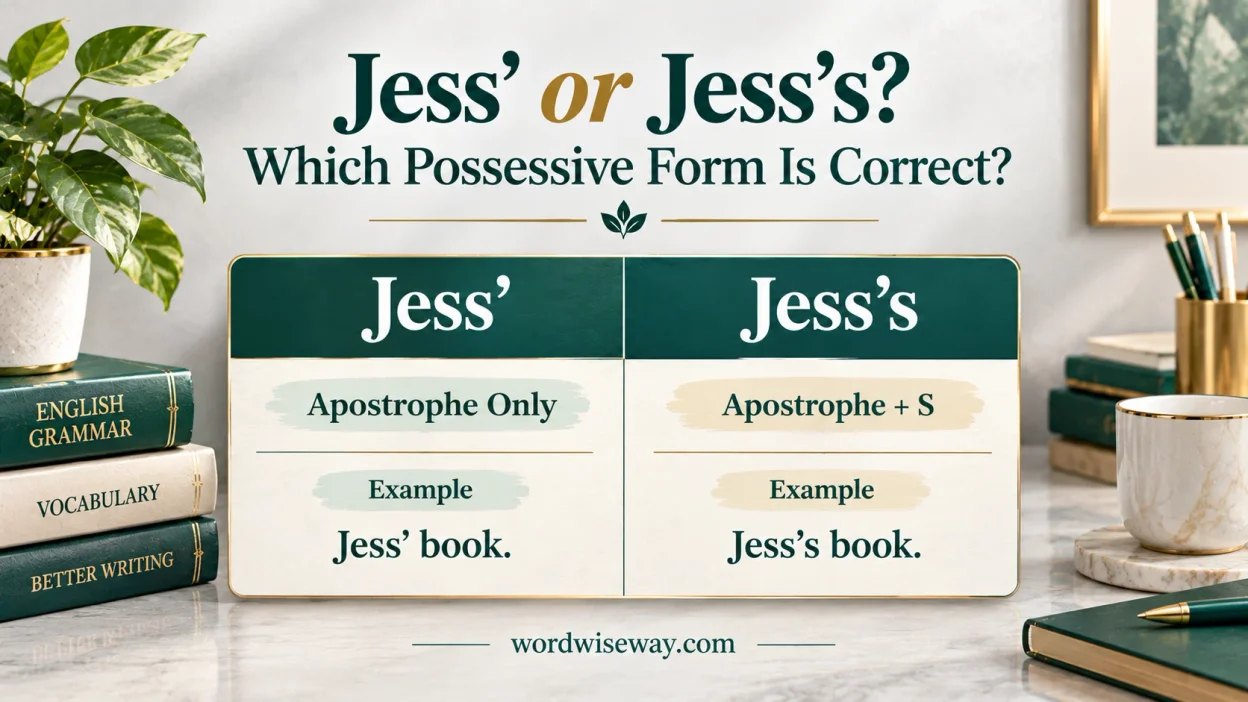
When choosing Jess’ or Jess’s? Which Possessive Form Is Correct?, remember that both forms can show ownership. The right choice depends on your style guide and writing conventions.
In American English, many style guides prefer Jess’s because they add an apostrophe and another S. For example, Jess’s bag, Jess’s car, and Jess’s new job show possession. However, some guides accept Jess’, placing the apostrophe after the final S. These options follow different spelling and punctuation rules. Understanding apostrophe placement helps you avoid common grammatical mistakes.
British English and American English may follow different style preferences. Always check your preferred style guide for schoolwork, emails, websites, articles, and professional documents. Consistent usage makes your writing clearer and helps readers understand ownership without confusion. When in doubt, choose one accepted form and use it consistently throughout your work.
Quick Answer:
Both Jess’ and Jess’s can show possession. However, different style guides recommend different forms for singular names that end in s.
- Jess’s: Adds an apostrophe and s. Many general writing conventions use this form for singular names, including names that already end in s.
- Jess’: Adds only an apostrophe. Some editorial styles use this form for certain singular names ending in s.
Here are two examples:
- Jess’s notebook is on the desk.
- Jess’ notebook is on the desk.
Both sentences express the same idea. The spelling changes according to the chosen style convention, not the meaning.
If your teacher, editor, or employer requires a particular style guide, follow its rules. Otherwise, choose a consistent convention throughout your writing.
Why Do Jess’ and Jess’s Both Exist?
English uses apostrophes to show possession, but it doesn’t apply exactly the same spelling convention to every name. When a singular name ends in s, writers encounter two established approaches.
The first approach adds an apostrophe and another s. The second adds only an apostrophe. Both can communicate ownership, a relationship, or an association with Jess.
For example, consider these sentences:
- Jess’s favorite song played on the radio.
- Jess’ favorite song played on the radio.
Neither sentence changes the basic meaning. The difference reflects an editorial choice about how to form singular possessives ending in s.
Grammar Rules Versus Style Preferences
Grammar explains how words work together to communicate meaning. A style guide provides consistent choices for spelling, punctuation, capitalization, and other writing details.
The distinction matters because writers sometimes mistake a preferred style for the only grammatically acceptable option. In this case, both possessive forms have established uses.
Here’s how the main approaches differ:
- The apostrophe-and-s approach: Adds ’s to a singular name, even when the name already ends in s.
- The apostrophe-only approach: Adds ’ to certain singular proper names ending in s.
- The consistency rule: Requires writers to follow the same convention throughout a document.
Understanding these differences helps you make a clear choice instead of guessing whenever a name ends in s.
When to Use Jess’s
Use Jess’s when your chosen style follows the convention of adding an apostrophe and s to singular proper names. This approach treats Jess like other singular names, regardless of the final letter.
The same pattern appears in names such as James, Chris, and Alexis.
Consider these examples:
- Jess’s phone is ringing.
- James’s bicycle needs repairs.
- Chris’s presentation starts at noon.
- Alexis’s notebook contains all the answers.
In each sentence, the name refers to one person. Adding ’s indicates that the following item belongs to or relates to that person.
Why Jess’s Follows the Singular Possessive Rule
Most singular nouns form their possessives by adding ’s. For example, you would write the teacher’s desk, the student’s book, and the author’s latest novel.
The same principle applies to Jess under this convention. The final s doesn’t prevent you from adding another s after the apostrophe.
Compare the following examples:
| Singular name or noun | Possessive form | Example |
| Jess | Jess’s | Jess’s laptop is new. |
| James | James’s | James’s room looks tidy. |
| Chris | Chris’s | Chris’s idea worked well. |
| The boss | The boss’s | The boss’s office is upstairs. |
| The class | The class’s | The class’s project won an award. |
Notice that each possessive refers to one person, group, or thing. The final s in the original word doesn’t automatically require an apostrophe alone.
How to Use Jess’s in Everyday Writing
The form Jess’s works naturally in many kinds of writing when the selected style calls for it.
In school assignments: Jess’s answer explains the problem clearly.
In emails: I’ve attached Jess’s updated schedule.
Stories: Jess’s footsteps echoed through the empty hallway.
In blog posts: Jess’s writing improved after several rounds of revision.
In conversations written as dialogue: “Jess’s turn comes next,” Maria said.
These examples show possession, association, or a relationship with Jess. The apostrophe doesn’t change the meaning of the sentence; it clarifies how the words connect.
When to Use Jess’
Use Jess’ when your chosen editorial style calls for an apostrophe alone after a singular proper name ending in s. This convention appears in some American English publications and journalism.
For example:
- Jess’ phone is ringing.
- Jess’ bicycle needs repairs.
- Jess’ presentation starts at noon.
- Jess’ notebook contains all the answers.
Each sentence expresses the same basic meaning as its Jess’s counterpart. The difference lies in the punctuation convention.
Why Some Writers Prefer Jess’
Some editorial styles favor the shorter form for singular proper names ending in s. It creates a consistent visual pattern for names such as Jess, James, and Chris.
However, the shorter spelling doesn’t represent a universal rule. Writers shouldn’t assume that every word ending in s must take an apostrophe alone.
For example, some styles distinguish between singular common nouns and singular proper names:
| Word type | Example | Possessive form under the convention |
| Singular common noun | Boss | The boss’s office |
| Singular proper name | Jess | Jess’ office |
| Plural noun ending in s | Teachers | The teachers’ office |
| Singular noun not ending in s | Student | The student’s office |
This table illustrates one convention, not a rule shared by every style guide. Always check the requirements for your particular writing task.
Where Jess’ May Be Appropriate
The shorter form can be appropriate when a publication or organization requires the apostrophe-only convention for singular proper names ending in s.
You might encounter it in:
- Newspaper articles that follow a particular editorial style.
- Publications with established house rules.
- Editing assignments that specify a particular style guide.
- Documents that consistently use the same convention for similar names.
For instance, if an editor requests Jess’ account rather than Jess’s account, follow that instruction throughout the document.
The key is consistency, not personal preference alone.
Key Differences
Although the two spellings look different, they can express the same possessive relationship. Neither form automatically changes who owns the item or how the sentence should be interpreted.
The table below summarizes their main differences.
| Feature | Jess’ | Jess’s |
| Meaning | Shows possession or association | Shows possession or association |
| Punctuation | One apostrophe after the final s | Apostrophe followed by another s |
| Use with a singular name | Accepted in some styles | Accepted in many styles |
| Editorial preference | Common in some journalism conventions | Common in many book and general-writing conventions |
| Example | Jess’ notebook | Jess’s notebook |
| Main deciding factor | The selected style guide | The selected style guide |
Which Form Should You Choose?
Start with the requirements of your writing task. If your teacher, editor, or employer specifies a style guide, follow it.
If nobody specifies a style, either form may work. However, choosing one convention and using it consistently will make your writing easier to edit and read.
For general writing, Jess’s is a practical choice because it follows the widely used convention of adding ’s to singular names. The apostrophe-only form remains appropriate when your chosen style requires it.
What Do Major Style Guides Say About Jess’ and Jess’s?
The disagreement becomes easier to understand when you look at the conventions used by major American English style guides.
Two influential guides take different approaches to singular proper names ending in s. Their rules explain why both spellings appear in professionally edited writing.
The AP Style Convention: Jess’
The Associated Press style convention traditionally uses an apostrophe alone for singular proper names ending in s. Under this approach, the possessive form of Jess is Jess’.
Examples include:
- Jess’ notebook
- James’ jacket
- Chris’ presentation
- Agnes’ garden
This convention is associated with newspaper and journalistic writing. Publications that follow it generally apply the rule consistently to comparable names.
However, the rule for singular proper names differs from the treatment of ordinary singular nouns in this style. For example, the convention generally uses the boss’s office, not the boss’ office.
That distinction is important. The spelling rule depends on the type of noun, not simply its last letter.
The Chicago Style Convention: Jess’s
The Chicago Manual of Style generally adds an apostrophe and s to singular proper names ending in s. Under this convention, the correct form is Jess’s.
Examples include:
- Jess’s notebook
- James’s jacket
- Chris’s presentation
- Agnes’s garden
This approach applies the singular possessive rule consistently, even when a name already ends in s. It also distinguishes singular names from plural names that require an apostrophe alone.
For example, James’s jacket refers to one person named James. A possessive referring to a family named James would follow a different pattern because the family name becomes plural first.
Why the Two Conventions Differ
The disagreement reflects different editorial preferences rather than a disagreement about the sentence’s meaning.
One convention uses a shorter form for certain singular proper names. The other applies the apostrophe-and-s pattern more broadly.
Neither approach changes the basic purpose of the possessive. Both tell readers that something belongs to or is associated with Jess.
If you’re editing an article, don’t mix the two approaches without a reason. A consistent style gives readers fewer distractions and helps your writing look professionally edited.
How Do You Pronounce Jess’ and Jess’s?
Pronunciation can help explain why the spelling looks different, although it doesn’t determine which written form you should choose.
When speakers say Jess’s, they may pronounce an additional syllable or sound the possessive ending as a separate syllabic unit, depending on their accent and speaking style. In everyday speech, the sound may be less distinct.
The written form Jess’ doesn’t automatically require a different pronunciation. Some writers use it to follow an editorial convention rather than to represent a different spoken form.
Consider these examples:
- Jess’s bag: The possessive ending may be pronounced with an additional syllabic sound.
- Jess’ bag: The written convention may use an apostrophe alone, while the intended possessive relationship remains the same.
The important distinction is between spelling and speech. You shouldn’t assume that an apostrophe-only spelling always means the possessive ending disappears when spoken.
Jess’ or Jess’s in Sentences
Seeing both forms in complete sentences makes the rule easier to apply. The following examples demonstrate how each spelling works in everyday contexts.
Examples Using Jess’s
Jess’s car is parked outside. The possessive identifies the person associated with the car.
I borrowed Jess’s notebook yesterday. The notebook belongs to Jess.
Jess’s presentation impressed the entire class. The possessive connects Jess with the presentation.
We celebrated Jess’s birthday on Saturday. The name identifies whose birthday the sentence describes.
The decision was Jess’s responsibility. The possessive identifies who was responsible for the decision.
Jess’s favorite book sits beside her bed. The spelling indicates a relationship between Jess and the book.
Examples Using Jess’
Jess’ car is parked outside. This follows the apostrophe-only convention.
I borrowed Jess’ notebook yesterday. The sentence communicates the same ownership relationship.
Jess’ presentation impressed the entire class. The shorter form follows a style that permits it.
We celebrated Jess’ birthday on Saturday. The possessive identifies the person whose birthday the group celebrated.
The decision was Jess’ responsibility. The spelling reflects an editorial choice rather than a different meaning.
Jess’ favorite book sits beside her bed. The apostrophe-only form is acceptable under the relevant convention.
These examples illustrate why context alone usually cannot tell you which spelling a writer intended to follow. Both forms can fit the same sentence.
Common Mistakes
Apostrophe mistakes often happen when writers apply one rule to every word ending in s. Fortunately, a few simple distinctions can prevent most problems.
Assuming Jess’ Is Always Correct
The idea that names ending in s must take only an apostrophe is too broad. Some style guides use Jess’, while others prefer Jess’s.
Incorrect assumption: Every singular name ending in s must use an apostrophe alone.
Better approach: Check your chosen style convention before deciding which spelling to use.
Assuming Jess’s Is Always Incorrect
Adding another s after the apostrophe may look unusual at first. However, Jess’s follows an established singular possessive convention.
For example, James’s book and Chris’s desk are acceptable under styles that add ’s to singular proper names ending in s.
The extra letter doesn’t make the possessive incorrect.
Switching Between Jess’ and Jess’s
Imagine an article that begins with Jess’s project but later refers to Jess’ presentation. If both phrases follow the same convention and refer to the same person, the inconsistency can distract readers.
Choose one form according to your style guide and apply it throughout the document.
Confusing Possessives With Plurals
Apostrophes show possession or mark certain contractions. They don’t ordinarily create plural nouns.
Compare these examples:
- Jess: One person named Jess.
- Jesses: More than one person named Jess.
- Jess’s bag: A bag belonging to Jess.
- Jess’ bag: The same possessive meaning under an alternative convention.
The distinction matters because adding an apostrophe to a plural noun can change the grammatical relationship between words.
What’s the Difference?
These three forms may look similar, but they serve different purposes. Understanding the difference helps you avoid errors in both formal and casual writing.
| Form | Meaning | Example |
| Jess | One person | Jess joined the meeting. |
| Jess’ | Possessive form under some styles | Jess’ notebook is missing. |
| Jess’s | Possessive form under other styles | Jess’s notebook is missing. |
| Jesses | Plural of the name Jess | Two Jesses joined the meeting. |
When Should You Write Jesses?
Use Jesses when referring to multiple people named Jess. You don’t need an apostrophe because you’re forming an ordinary plural.
For example:
- Two Jesses attend the same school.
- The Jesses in our class share a first name.
- Three Jesses entered the competition.
These sentences refer to multiple people, not to something owned by one person.
If you want to show that several people named Jess own something together, you may need a plural possessive. Under the usual rule for plural nouns ending in s, that form is Jesses’.
For example: The Jesses’ project received first prize.
Here, the project belongs to the group of people named Jess. The apostrophe follows the plural form rather than the original singular name.
How to Choose the Correct Form in Your Writing
You don’t need to memorize every punctuation rule to choose between Jess’ and Jess’s. A simple decision process will usually solve the problem.
- Check the required style. If your assignment or publication specifies a style guide, use its possessive rules.
- Identify the noun. Determine whether Jess refers to one person or multiple people.
- Apply the appropriate convention. Use Jess’s under the apostrophe-and-s rule or Jess’ under the apostrophe-only convention for singular proper names.
- Check similar examples. Look at how your document handles names such as James and Chris.
- Stay consistent. Apply the same convention throughout your article, essay, or email.
What If No Style Guide Is Required?
When no particular convention applies, Jess’s is a sensible default for general writing. It follows the common practice of adding ’s to singular names, including names ending in s.
However, you don’t need to change Jess’ if you’re following a style that accepts or requires it. The goal is to use a recognized convention consistently.
Read More: Flew or Flown: Difference Meaning, Rules, and Examples
FAQs
1. Is Jess’s or Jess’ grammatically correct?
Both Jess’s and Jess’ can be grammatically correct. The preferred form depends on the style guide you follow. Many American English guides recommend Jess’s.
2. Why do some writers use Jess’ instead of Jess’s?
Some writers use Jess’ because certain style guides allow an apostrophe alone after names ending in S. This approach keeps the spelling shorter while still showing possession.
3. Should I write Jess’s name or Jess’ name?
Both forms may be accepted, depending on your style guide. However, if you mean the name itself rather than something Jess owns, simply write Jess’s name or Jess’ name according to your chosen convention.
4. How do I show that something belongs to Jess?
You can write Jess’s book or Jess’ book to show ownership. Choose the version that matches your writing style, and use it consistently throughout your text.
5. Does Jess’s have an extra S?
Yes. Jess’s includes an additional S after the apostrophe. This form is widely recommended in American English, although some style guides prefer Jess’.
6. Is Jess’ acceptable in formal writing?
Yes, Jess’ can be acceptable in formal writing when the relevant style guide supports it. For school assignments or professional documents, check the required guidelines before choosing a form.
7. Do British and American English use different possessive rules?
They can differ in their style preferences. American English commonly favors adding apostrophe S, while some British English style guides allow an apostrophe alone after names ending in S. The specific guide matters more than the country’s general preference.
8. What is the difference between Jess’ and Jess’s?
The difference is spelling, not meaning. Both forms can express possession. Jess’s adds another S after the apostrophe, while Jess’ places the apostrophe after the existing S.
9. Should I use Jess’s in emails and social media posts?
Jess’s is a practical choice for emails, articles, and social media posts because many modern style guides recommend it. If your organization follows a particular style guide, use its preferred form instead.
10. How can I avoid mistakes when writing Jess’s or Jess’?
First, check your style guide. Next, choose the accepted possessive form and apply it consistently. For example, if you choose Jess’s bag, use the same apostrophe convention for similar names throughout your writing.
Conclusion:
Choosing between Jess’ and Jess’s doesn’t have to be confusing. Both forms can show ownership, but the preferred spelling depends on the style guide you follow. In American English, Jess’s is commonly recommended because it adds an apostrophe and another S. Meanwhile, some style guides accept Jess’ as an alternative.
The easiest way to remember the difference is to look at examples. You can write Jess’s bag, Jess’s car, or Jess’s new job to show that something belongs to Jess. The shorter form, Jess’, can express the same meaning when your chosen style guide permits it. Neither option changes the basic meaning of the sentence.
Before you choose, check the writing rules for your school, workplace, or publication. Once you’ve selected a style, stick with it throughout your work. Consistent punctuation makes your writing easier to read and helps you avoid unnecessary grammar mistakes.

Evelyn Shaw has spent 14 years at Yale University’s English Department, leading students through close readings, genre studies, and interpretive methodologies. Her scholarly interests include Renaissance drama, gothic fiction, feminist literary criticism, and archival research and examining how texts generate meaning across historical periods. Evelyn has presented at major academic conferences and published essays in peer-reviewed journals, reflecting her passion for rigorous analysis and student-centered learning.