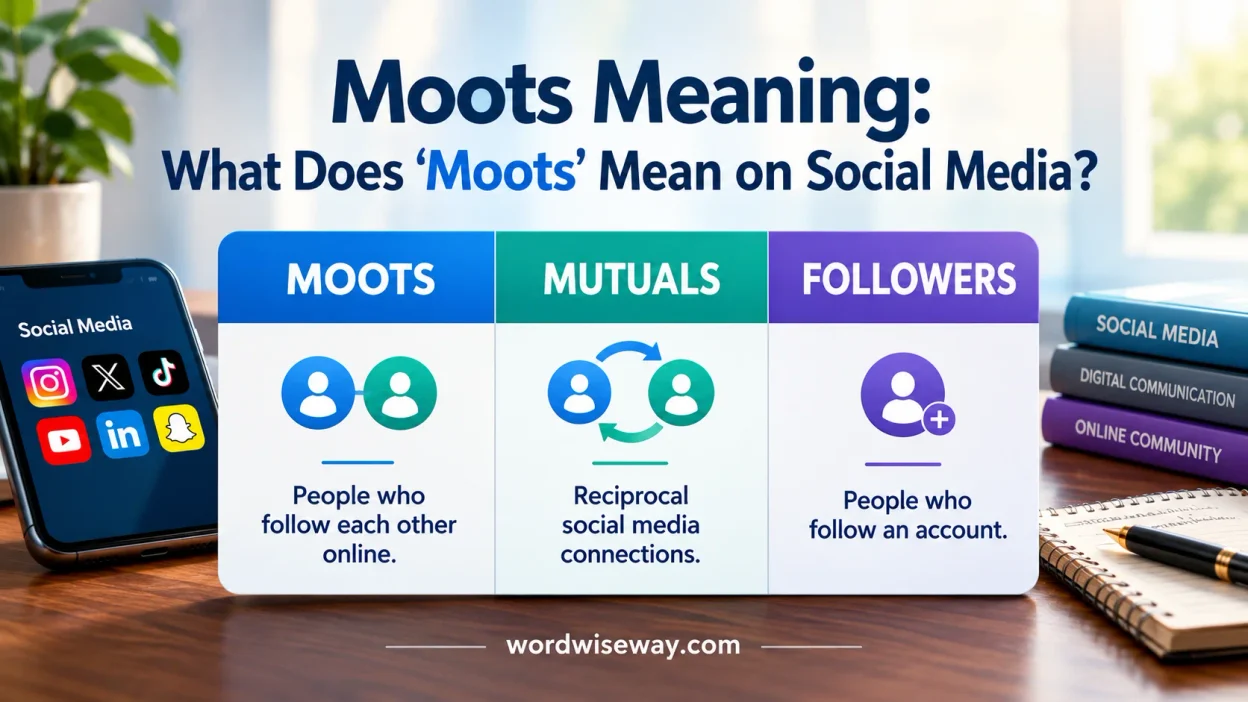
Scroll through the replies under a viral video or a fan account’s latest post and you’ll likely spot a word that looks like a typo: “moots.” One person thanks theirs for the support, another begs for more of them, and a third says theirs always have the best show recommendations.
In online slang, moots are simply mutuals, meaning accounts that follow you while you follow them back. People on TikTok, Instagram, and X use the label as a quick, casual way to talk about the circle of people they interact with, without explaining the whole relationship every time.
The confusion comes from the fact that “moot” is also an established English word, one you’re more likely to hear in a courtroom or a debate than in a comment section. This article breaks down what moots mean on social media, how people use it, and how to tell it apart from the traditional word.
Quick Answer: What Does Moots Mean?
Moots is informal internet slang for mutuals, or people who follow each other on social media.
For example, if you follow someone on Instagram and that person follows you back, you can describe each other as mutuals or moots.
Here are the key facts:
- Meaning: Mutual followers or people who follow each other online.
- Origin of the slang: A shortened form of mutuals.
- Common platforms: TikTok, X (formerly Twitter), Instagram, and fandom communities.
- Typical usage: Casual conversations, comments, captions, and posts seeking new connections.
- Formality: Informal internet slang rather than standard formal English.
- Important distinction: Being moots doesn’t automatically mean two people are close friends.
For instance, someone might post, “I need more book-loving moots!” This means they want to connect with people who share their interest in reading and potentially follow each other.
What Does Moots Mean on Social Media?
On social media, moots describes a particular kind of online connection. It usually refers to two or more users who follow each other rather than a person who follows an account without receiving a follow-back.
The term is especially useful in online communities where people regularly interact with others who share their interests. These communities might revolve around music, gaming, books, television shows, sports, or popular creators.
Imagine that you follow someone because you both enjoy the same television series. They discover your account, follow you back, and occasionally comment on your posts. You might eventually call each other moots.
However, the term doesn’t require a deep personal relationship. Some mutual followers chat every day, while others simply enjoy each other’s posts.
Moots Meaning on TikTok
TikTok users may use moots in captions, comments, and videos when talking about mutual followers or seeking new online connections.
For example, a TikTok creator might write:
Looking for new moots who love mystery novels!
This caption invites people with similar interests to connect. If the creator and another user follow each other, they can describe themselves as moots.
You may also encounter expressions such as:
- “Hey, moots!” A casual greeting to mutual followers.
- “Any new moots?” A question about making new mutual connections.
- “My moots understand.” A statement referring to people in the user’s mutual-following circle.
- “Follow for follow?” An invitation to exchange follows, although this doesn’t guarantee that either person will follow back.
TikTok’s social features allow people to discover creators and interact through comments and other forms of engagement. The slang describes the relationship between users, not a special TikTok feature or official account category.
Moots Meaning on X (Twitter)
On X, formerly known as Twitter, moots is commonly associated with mutual followers and online communities.
The term is particularly familiar in fandom spaces, where people connect through shared interests in artists, fictional characters, television series, and other topics.
For example:
My moots have the best recommendations for new music.
This sentence refers to people who follow the user and whom the user follows in return. The writer may interact with these people regularly, but the term itself doesn’t guarantee friendship.
Users might also write “looking for moots” when they want to expand their social circle. They may include hashtags or mention their interests to attract people with similar tastes.
One important detail: Following someone on X doesn’t automatically make that person your mutual. The relationship becomes mutual when both users follow each other.
Moots Meaning on Instagram
On Instagram, moots usually refer to people who follow one another.
You might encounter the term in comments, direct messages, Stories, or posts about building an online community.
Consider this example:
We both love photography, so let’s be moots!
The person is suggesting that they follow each other and potentially interact through their content.
The distinction between followers and moots matters on Instagram. Someone may follow your public account without you following them back. That person is your follower, but the relationship isn’t mutual.
Account privacy and following settings can affect how these connections work. For private accounts, users generally need approval before they can follow the account and access its private content.
Read More: FR Meaning in Text: What Does FR Mean in a Text Message?
What Does Moots Mean in Texting?
In texting, moots usually carries the same meaning as it does on social media. People use it when discussing mutual followers, online acquaintances, or connections formed through shared interests.
The word can appear in direct messages between people who have already connected online.
For example:
Person A: “Are you moots with that artist’s fan account?”
Person B: “Yes! We follow each other.”
Here, the first person wants to know whether both users have a mutual-following relationship.
Another example:
Person A: “I want more moots who read fantasy books.”
Person B: “Same! I love fantasy novels.”
In this case, the conversation is about finding people with similar interests who may become mutual followers.
A few things are worth remembering:
- Moots is casual, so it’s more common in informal digital conversations than professional messages.
- The word doesn’t necessarily imply that two people have met in real life.
- Mutual followers may be friends, acquaintances, or people who rarely communicate.
- Someone unfamiliar with internet slang may not immediately understand the term.
If you’re texting someone who doesn’t spend much time in online communities, saying “mutual followers” may communicate your meaning more clearly.
Where Did the Word Moots Come From?
The social media slang moots is commonly understood as a shortened form of mutuals. The word developed within informal online communication, where users often shorten expressions to make conversations quicker and more natural.
The underlying word mutual describes something shared by two or more people. In social media contexts, it can describe a relationship in which two users follow each other.
Over time, online communities adopted mutuals as a noun for people who share that following relationship. Users then shortened the term to moots.
The exact date when this slang first appeared isn’t firmly established. It’s better to understand it as a community-driven internet expression rather than assign it an unsupported invention date.
How Did Moots Become Popular in Online Communities?
Online communities thrive on shared interests and repeated interactions. A short term like moots gives members an easy way to refer to people in their social circles.
Fandom communities are one place where this usage is particularly recognizable. Fans often follow one another to share reactions, discuss fictional characters, recommend music, and participate in conversations about their favorite subjects.
For example, a person who enjoys a particular music group might connect with other fans through posts and comments. After following one another, they may refer to their online connections as moots.
The word is also convenient because it describes a relationship without requiring a lengthy explanation. Instead of saying “people who follow me and whom I follow back,” a user can simply say “my moots.”
Is Moots Related to the Traditional Word Moot?
The slang term is commonly linked to mutuals, but the traditional English word moot has its own history and meaning.
In standard English, moot can describe a subject that is open to debate. In American English, it also commonly describes an issue that no longer has practical relevance to the matter being discussed.
For example:
- Social media slang: “My moots recommended this book.” This refers to mutual followers.
- Traditional English: “Whether the old rule applies is now a moot point.” This suggests that the issue no longer affects the outcome.
The spelling may look similar, but the meanings depend on context. When someone mentions moots in a post about followers, they’re almost certainly using the internet slang meaning.
What Is the Difference Between Moots, Mutuals, and Followers?
The terms moots, mutuals, and followers describe related but distinct concepts. Understanding the difference helps you interpret social media conversations correctly.
| Term | Meaning | Example |
| Moots | Informal slang for mutual followers | “My moots recommended this movie.” |
| Mutuals | People who follow each other | “We became mutuals yesterday.” |
| Followers | People who follow a particular account | “I gained 50 followers.” |
| Following | Accounts a user has chosen to follow | “I’m following several book reviewers.” |
| Friends | People who share a personal relationship | “We’re friends outside social media, too.” |
The most important distinction is that every mutual-following relationship involves two-way following, but not every follower relationship is mutual.
Imagine you have 100 followers on a public account. You follow 40 accounts, and 15 of those accounts follow you back. You have 100 followers, follow 40 accounts, and have 15 mutual connections within that group.
These numbers are only an illustration, not a claim about typical account statistics. They show how the terms describe different relationships.
Moots vs. Mutuals: Are They the Same?
In social media slang, moots and mutuals usually mean the same thing. Both refer to people who follow each other.
The main difference is tone. Mutuals is more directly connected to the word mutual, while moots has a distinctly informal, internet-oriented feel.
Consider these examples:
- “My mutuals helped me find a new podcast.”
- “My moots helped me find a new podcast.”
Both sentences communicate essentially the same idea. The second sounds more like casual internet slang.
Neither term guarantees that the people involved are close friends. The words describe the following relationship, not the emotional closeness between users.
Moots vs. Followers: What’s the Difference?
A follower is someone who follows an account. That relationship can exist in one direction only.
Moots, by contrast, usually refers to a two-way following relationship.
For example, suppose Alex follows Jordan on Instagram. Jordan doesn’t follow Alex back. Alex is one of Jordan’s followers, but they aren’t mutuals under the usual meaning of the term.
If Jordan follows Alex back, their following relationship becomes mutual. They can now describe each other as moots.
This distinction is useful when interpreting posts such as “Thank you to all my followers” versus “Love my moots.” The first refers broadly to an audience, while the second generally refers to reciprocal connections.
How Do People Use Moots in Conversations?
People use moots in several ways, depending on their goals and the online community they’re part of. Sometimes the word is a simple greeting. In other cases, it helps users find people who share their interests.
Here are the most common uses, along with examples of how the term works in context.
Using Moots to Address Mutual Followers
One common use is addressing a group of mutual followers.
For example:
Good morning, moots! What are you reading today?
The writer is greeting people who follow each other and inviting them to join a conversation. The word creates a sense of familiarity without necessarily suggesting a close personal relationship.
Other examples include:
- “How are my moots doing today?”
- “Good night, moots!”
- “Moots, recommend a good mystery series.”
- “I hope my moots have a wonderful weekend.”
In each example, the term works as a casual form of address. It can make an online message feel more personal than a general announcement to all followers.
Using Moots to Find New Connections
People also use the term when looking for new mutual followers.
A post might say:
Looking for new moots who enjoy photography, travel, and nature.
This message tells readers what the user enjoys and what kind of connections they’re seeking. People with similar interests may follow the account and hope for a follow-back.
Common expressions include:
- “Looking for new moots!”
- “Let’s be moots.”
- “Any book-loving moots here?”
- “I need more gaming moots.”
However, seeing one of these phrases doesn’t guarantee that the person will follow everyone who responds. It’s an invitation to connect, not an automatic agreement or platform rule.
Using Moots in Fandom Communities
Fandoms provide a natural setting for mutual connections because members often share niche interests.
Fans may discuss new episodes, favorite characters, concert experiences, music releases, or theories about fictional worlds. They follow users whose posts they enjoy and sometimes develop ongoing conversations.
For example:
Any moots here who love science fiction and space exploration?
The user is inviting people with similar interests to connect. If they begin following each other, they may become moots.
This usage is especially useful in large online communities, where shared interests can help strangers find one another. Still, being part of the same fandom doesn’t automatically make two people mutuals. The following relationship must exist.
What Does “Looking for Moots” Mean?
The phrase “looking for moots” means that someone wants to find new mutual followers on social media.
Usually, the person hopes to connect with users who share similar interests. They may want more people to talk to, more accounts to interact with, or a stronger sense of community around their content.
For example:
Looking for new moots! I love fantasy books, cozy games, and science fiction.
This post communicates three things:
- The user wants to make new online connections.
- They are interested in specific subjects.
- They hope to find people who enjoy those subjects and may follow them back.
Someone who sees the post might respond by following the account or starting a conversation. If both users follow each other, they can describe themselves as moots.
Does Looking for Moots Mean Follow for Follow?
Not always.
Some users who seek moots are interested in reciprocal following. Others primarily want to find people with similar interests and build genuine online connections.
A request for moots doesn’t necessarily mean the user will follow every person who follows them. The wording, context, and behavior of the account can help clarify their intentions.
It’s also worth distinguishing mutual following from engagement. Two users might follow each other without liking, commenting on, or sharing each other’s content regularly.
A mutual follow is a connection, not a promise of constant interaction.
Does Moots Mean Friends?
Not necessarily. Moots usually describes a social media relationship rather than a personal friendship.
Two people can follow each other without ever having a conversation. They might enjoy each other’s posts, share a common interest, or simply recognize one another within an online community.
Other mutual followers eventually become genuine friends. They may chat regularly, exchange advice, collaborate on projects, or continue their relationship outside social media.
Consider these examples:
| Situation | Are They Moots? | Are They Friends? |
| Two users follow each other but never interact | Yes, under the usual meaning | Not necessarily |
| Two users follow each other and chat daily | Yes | They may be |
| Two people are close friends, but only one follows the other | Not mutuals under the usual meaning | Yes |
| Two users enjoy the same creator but don’t follow each other | Not yet | Not necessarily |
The table shows why the terms shouldn’t be treated as interchangeable.
If someone calls you their moot, it generally means that you share a mutual-following relationship. It doesn’t automatically imply romantic interest, a close friendship, or a commitment to communicate regularly.
Likewise, calling someone a moot doesn’t diminish the relationship. It simply describes the connection in a way that makes sense within online communities.
What Does Moot Mean in Standard English?
Although moots has a familiar meaning on social media, the word moot also has a traditional meaning in English. This distinction matters because a sentence about a debate may use the word differently from a post about online followers.
In American English, moot often describes a question or issue that no longer matters practically. It can also describe something that remains open to debate.
For example:
- “Whether we should change the schedule is a moot point because the event has already ended.”
- “The students discussed a moot question during their debate.”
- “The disagreement became moot after both sides reached an agreement.”
In the first and third examples, the issue no longer affects the outcome. In the second, the wording relates to a question being considered or debated.
What Does “Moot Point” Mean?
A moot point is an issue that is no longer practically relevant or, in some contexts, remains open to argument.
For example, imagine that a store has already closed permanently. Debating whether it should extend its opening hours may be a moot point because the decision no longer has practical consequences.
The expression can also carry a different emphasis in legal or academic contexts, where a moot question may be discussed for practice or debate rather than to resolve an immediate real-world dispute.
This traditional expression is separate from social media slang. If someone says, “My moots love this series,” they’re talking about mutual followers, not a debate.
Is Moots Slang or a Real Word?
Moots is an established informal expression in internet slang. Its common social media meaning comes from mutuals, but it doesn’t function as a standard formal term for social relationships.
That doesn’t make the expression meaningless. Slang develops naturally as people communicate within particular communities. Words can gain widely understood meanings in those communities even when their use remains informal.
You might encounter moots in:
- Social media captions and comments
- Informal text messages
- Fandom discussions
- Posts seeking mutual followers
- Casual conversations about online relationships
However, in a professional report, academic essay, or formal business email, “mutual followers” is usually clearer than “moots.”
For example, a formal statement might say, “The two accounts follow each other.” A casual social media post could communicate the same idea with “We’re moots.”
The best choice depends on your audience. Use slang when it fits the conversation, but choose clearer wording when precision matters.
Is Moots Still Used on Social Media?
Moots remains a recognizable expression in online slang, particularly in communities where users discuss mutual followers and shared interests. However, its popularity can vary between platforms, age groups, and online communities.
Some users regularly refer to their moots when posting about music, gaming, books, or other interests. Others prefer expressions such as mutuals, online friends, or followers.
It’s important to distinguish a term’s continued use from a claim that it is currently trending everywhere. Without reliable, up-to-date usage data, it’s not possible to assign a trustworthy popularity ranking or percentage.
If you encounter moots in a social media post, the surrounding conversation usually provides enough context to understand it.
For example, a caption asking people to “become moots” most likely invites reciprocal following. A sentence discussing a “moot point,” however, may be using the traditional English expression.
Read More: WYM Meaning in Text: Definition, Real Examples and Best Reply
FAQs
What Does Moots Mean in Simple Words?
Moots means mutual followers on social media. It usually describes people who follow each other, whether or not they know each other personally.
What Does Moots Mean on TikTok?
On TikTok, moots commonly refers to users who follow each other. People may use the term when greeting mutual followers, finding new connections, or discussing shared interests.
What Does Moots Mean on X?
On X, formerly Twitter, moots refers to mutual followers. The term is common in informal online conversations, including fandom communities.
What Does Moots Mean in Texting?
In texting, moots usually means mutual followers or online connections who follow each other. Its exact meaning depends on the conversation.
Does Moots Mean Mutual Followers?
Yes. In common internet slang, moots is a shortened form of mutuals, which refers to people who follow each other online.
What Is the Difference Between Moots and Mutuals?
Both terms generally mean the same thing on social media. Moots is the more informal slang expression, while mutuals is a more recognizable form of the underlying word.
How Do You Become Moots With Someone?
You generally become moots when you follow someone and they follow you back. You can start by connecting with people who share your interests, although following someone doesn’t guarantee a follow-back.
Does Moots Mean Best Friends?
No. Moots are mutual followers, not necessarily best friends. Some mutuals become close friends, while others simply follow each other’s accounts.
Is Moots Short for Mutuals?
Yes. The social media slang moots is commonly understood as a shortened form of mutuals. It refers to reciprocal following relationships.
What Does Moot Mean Outside Social Media?
In standard English, moot can describe a question open to debate or an issue that no longer has practical relevance. The phrase moot point is a common example.
Can You Call Someone a Moot Without Talking to Them?
Yes. If you follow each other, you can generally call each other moots even if you’ve never exchanged messages. The term describes your mutual-following relationship rather than how often you communicate.
Is Moots Used Only on TikTok?
No. The term appears across different online communities and social platforms, including X and Instagram. Its use depends on the community and the way people communicate there.
Conclusion:
The simplest way to understand moots meaning is to remember that it usually refers to mutual followers on social media. When two users follow each other, they can describe themselves as moots.
The term is especially useful in casual online conversations, where people use it to greet mutual followers, find new connections, and discuss shared interests. However, it doesn’t automatically mean that two people are close friends.
It’s also important to distinguish internet slang from the traditional English word moot, which can describe a debatable question or an issue that no longer matters practically.
Once you understand these differences, you’ll be able to recognize the word in social media posts, comments, and messages without confusing its meanings.

Amelia Sanders has spent 14 years in Harvard University’s English Department, helping students navigate literary analysis, interpretive theory, and narrative techniques. Her academic pursuits center on 18th-century British prose, romantic poetry, diasporic writing, and digital editing exploring how textual choices influence cultural perspectives. Amelia has spoken at major international meetings and contributed essays to respected academic volumes, demonstrating her dedication to thoughtful scholarship and effective teaching.