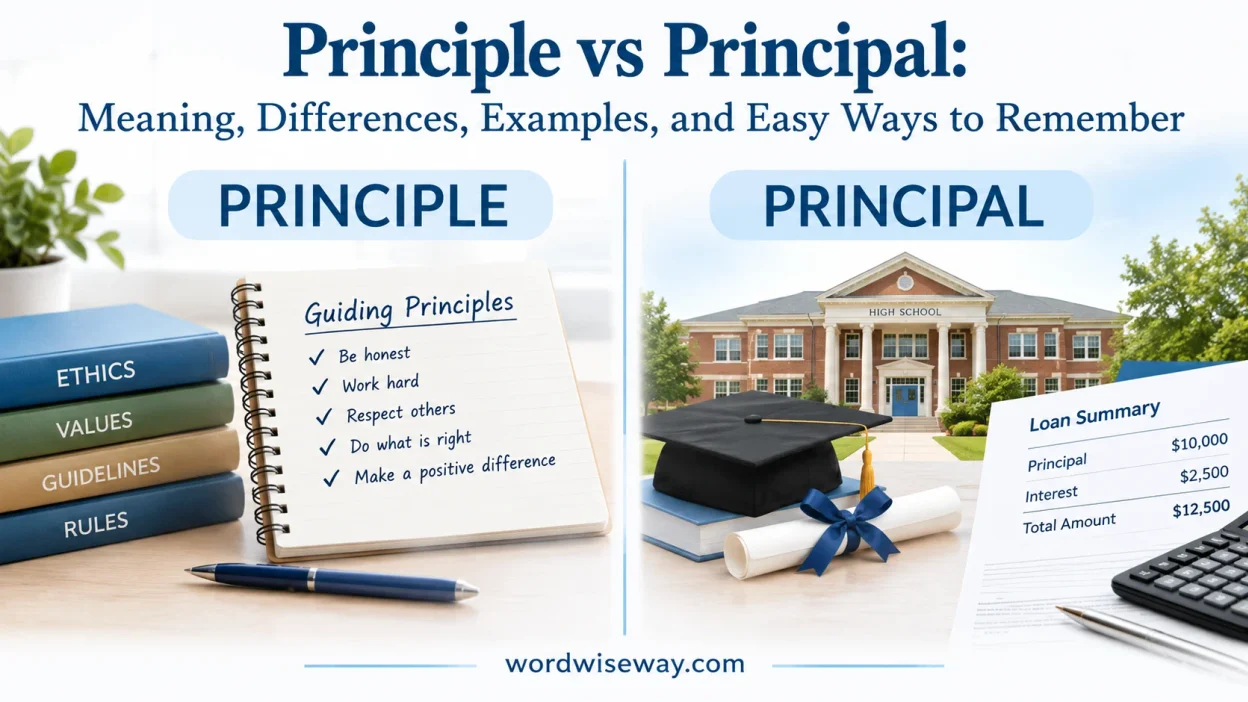
The Principle vs. Principal: Meaning, Differences, and Examples guide helps clear up a common confusion between two words that sound the same but have different meanings and grammatical uses. Principal can mean a school leader, headmaster, or a person in charge of a company.
Principal can also be an adjective meaning main, most important, original, or first. It can describe an amount of money or invested amount. A principle is a moral rule, rule, law, guideline, fact, belief, or fundamental idea that can shape a decision or explain the main reason behind it.
The terms have shared roots and entered English through Old French, with Latin roots including principium, meaning source, and principalis, meaning first. Both trace further to princeps, princip, meaning chief. Although they’re pronounced the same way, PRIN-suh-pul, their modern use remains different.
Quick Answer:
Principle is a noun that means a basic rule, belief, value, or fundamental idea. For example, Honesty is an important principle in her life.
Principal can be a noun or an adjective. As a noun, it commonly means the person who leads a school or the original amount of money borrowed or invested. As an adjective, it means main, primary, or most important.
| Word | Main Meaning | Example |
| Principle | A rule, belief, value, or fundamental idea | Honesty is one of his core principles. |
| Principal | A school leader | The principal welcomed the new students. |
| Principal | The main or most important thing | Her principal concern was safety. |
| Principal | Original money borrowed or invested | She paid part of the loan principal. |
A simple rule makes the distinction easier:
Principle = a rule or belief. Principal = a person, primary thing, or original sum of money.
What Does Principle Mean?
Principle refers to a fundamental rule, belief, standard, or idea. It usually describes something that guides decisions, behavior, judgment, or understanding.
The word often appears when people discuss values. Someone might have a principle of honesty, fairness, responsibility, or respect. In these cases, a principle acts like an internal guide. It helps a person decide what they consider right, appropriate, or important.
For example:
- She refused to lie because honesty was one of her principles.
- The company operates according to several ethical principles.
- Fairness is a basic principle of the policy.
- The experiment demonstrates a basic scientific principle.
- He wouldn’t compromise his principles for money.
Notice something important in these examples. Principle describes an idea or rule rather than a person.
Principle as a Rule or Belief
A principle can guide someone’s actions without being a formal law. It might be a personal value or a widely accepted standard.
For instance, you might believe that people should keep promises. That belief can become a personal principle. It influences what you do when keeping a promise becomes difficult.
Principles can also exist outside personal ethics. Businesses may establish operating principles. Scientists may study fundamental principles. Engineers rely on physical principles when designing systems.
Consider this sentence:
The design follows the principle of simplicity.
Here, principle means a fundamental idea that influences the design.
The same concept appears in everyday life:
She lives by the principle that everyone deserves respect.
The principle doesn’t refer to a person or object. It refers to a belief that guides behavior.
Principle Examples
Here are several common contexts where principle fits naturally:
Personal values
- He follows his principles even when nobody is watching.
- She has strong principles about treating people fairly.
Ethics
- Transparency is an important ethical principle.
- The organization based its decision on moral principles.
Science
- The machine works according to a simple physical principle.
- The lesson explains the principle behind the process.
Business
- The company built its policies around customer-service principles.
- Several management principles shaped the new strategy.
Everyday decisions
- He wouldn’t break his principles for a quick reward.
- The decision challenged one of her strongest principles.
In each case, principle represents an idea, rule, value, or underlying concept.
What Does Principal Mean?
Principal has several meanings, which explains why it can seem more confusing than principle.
As a noun, principal can refer to a person who holds a leading position, especially the head of a school. It can also refer to the original amount of money involved in a loan or investment.
As an adjective, principal means main, primary, or most important.
So, unlike principle, principal has more than one common use.
Principal as a Person
In education, a principal is the person who leads a school. The principal typically oversees school operations, staff, students, policies, and administrative matters.
For example:
- The principal announced the new school policy.
- Students met with the principal after the assembly.
- The principal spoke to parents during the meeting.
- The new principal joined the school in August.
The spelling matters here.
Correct: The school principal called a meeting.
Incorrect: The school principle called a meeting.
The person is a principal, not a principle.
This is one of the most common spelling mistakes because the two words sound alike.
Principal as the Most Important Thing
Principal can also function as an adjective meaning main, primary, or most important.
For example:
- Safety is the principal concern.
- Cost was the principal reason for the change.
- The principal goal is to improve access.
- Her principal responsibility is managing the project.
- The building’s principal entrance faces the street.
Here, principal doesn’t describe a school administrator. It describes something that ranks first in importance.
A useful replacement test can help.
If you can replace principal with main or primary, the word is probably correct.
The principal reason was cost.
Becomes:
The main reason was cost.
The meaning remains essentially the same. Therefore, principal works.
Principal in Finance
In finance, principal has a specific meaning.
The principal is the original amount of money borrowed or invested, excluding interest or earnings added later.
Suppose you borrow $10,000. The original $10,000 is the loan principal. If the lender charges interest, that interest represents a separate cost.
For example:
- She borrowed $10,000 in principal.
- The monthly payment covers both interest and principal.
- Making extra payments can reduce the loan principal faster.
- The investor received the original principal at the end of the term.
The distinction becomes especially important when discussing loans.
| Term | Meaning |
| Principal | Original amount borrowed or invested |
| Interest | Cost of borrowing or earnings generated from money |
| Principal payment | A payment that reduces the amount originally borrowed |
For example, if you owe $8,000 on a loan, paying $500 toward the principal reduces the amount you still owe. An interest charge doesn’t reduce the original balance in the same way.
Key Differences
The clearest way to understand principle vs principal is to compare their roles side by side.
| Feature | Principle | Principal |
| Word type | Noun | Noun and adjective |
| Refers to a rule or belief | ✓ | ✗ |
| Refers to a school leader | ✗ | ✓ |
| Means main or primary | ✗ | ✓ |
| Used in finance | Rarely in this sense | ✓ |
| Refers to an original loan amount | ✗ | ✓ |
| Example | Honesty is a principle. | The principal addressed the class. |
| Memory clue | Rule or belief | Person, primary, or money |
The difference isn’t about pronunciation. It’s about meaning and context.
If the sentence discusses values, rules, or fundamental ideas, choose principle.
If it discusses a school leader, something primary, or the original amount of money, choose principal.
Examples
Seeing the words in pairs makes the distinction even clearer.
Principle:
Honesty is an important principle in her life.
Principal:
The school principal spoke during the ceremony.
Now consider another pair:
Principle:
The engineer explained the scientific principle behind the device.
Principal:
The project’s principal objective is to improve efficiency.
And one more:
Principle:
He wouldn’t abandon his principles to gain approval.
Principal:
The borrower made an extra payment toward the loan principal.
The spelling changes because the meaning changes.
Principle vs Principal in Sentences
Sentences With Principle
Here are practical examples showing how principle works in different situations:
- Respect is a core principle in their family.
- The policy reflects the principle of equal treatment.
- She refused the offer on principle.
- The teacher explained the basic principle behind the formula.
- Good leaders often rely on clear ethical principles.
- The system operates according to a simple principle.
- His actions didn’t match his stated principles.
The phrase “on principle” deserves special attention. It means someone refuses to do something because doing it would conflict with a belief or standard.
For example:
She wouldn’t accept unfair treatment on principle.
Here, principle refers to a personal or moral standard.
Sentences With Principal
Now look at the different uses of principal:
- The principal greeted students at the entrance.
- The principal announced the schedule change.
- Safety remained the principal concern.
- The principal reason for the delay was bad weather.
- The bank explained how the payment would reduce the loan principal.
- The project’s principal objective is to reduce costs.
- The investor received the original principal after the term ended.
These examples cover the three major meanings: school leader, main or primary, and original financial amount.
Common Mistakes
Because these words sound alike, spelling errors often happen when writers rely on pronunciation alone.
Using Principle for a School Leader
Incorrect:
The school principle addressed the students.
Correct:
The school principal addressed the students.
A school leader is a principal.
Using Principal for a Moral Rule
Incorrect:
Honesty is an important principal.
Correct:
Honesty is an important principle.
A moral rule or belief is a principle.
Confusing Principal With Interest
In financial writing, some people use principle when they mean the original amount of a loan.
Incorrect:
The bank reduced the loan principle.
Correct:
The bank reduced the loan principal.
The financial term is principal.
Using Principal When You Mean a Fundamental Idea
Incorrect:
The principle of conservation of energy is important in physics.
Correct:
The principle of conservation of energy is important in physics.
A scientific fundamental rule is a principle.
This distinction matters because principal and principle aren’t interchangeable simply because they sound alike.
How to Remember
A strong memory trick can save you from repeatedly checking the spelling.
Principle = Rule
Think of principle as a rule or belief.
If the word refers to something that guides behavior or explains a fundamental idea, choose principle.
For example:
- moral principle
- ethical principle
- scientific principle
- guiding principle
- personal principle
The common thread is an idea or rule.
Principal = Person
A classic memory aid is:
The principal is your pal.
The word principal contains the letters associated with pal, making it a popular way to remember the school leader.
For example:
The principal is my pal.
You don’t need to use this trick forever. Once the spelling becomes familiar, context usually does the work.
Principal = Primary
Remember another useful connection:
Principal = primary.
Both words begin with pri and relate to something that comes first in importance.
So:
1.principal reason = primary reason
2.principal goal = primary goal
3.principal concern = primary concern
This makes the adjective easier to identify.
Principal = Money
When discussing loans or investments, principal refers to the original amount.
Think:
principal = the base amount
Interest gets calculated in relation to the principal. As the principal falls, the amount of interest charged on many loans can also change.
Which One Should You Use?
Start by asking what the word means in your sentence.
If you’re talking about a rule, belief, value, or fundamental idea, use principle.
If you’re talking about a school leader, use principal.
Or if you’re describing something as main or primary, use principal.
If you’re discussing the original amount of a loan or investment, use principal.
Here’s a quick decision guide:
| Ask yourself… | Use |
| Does it mean a rule or belief? | Principle |
| Does it mean a moral or ethical standard? | Principle |
| Does it describe a scientific fundamental idea? | Principle |
| Is it the head of a school? | Principal |
| Does it mean main or primary? | Principal |
| Does it refer to original borrowed or invested money? | Principal |
When you’re unsure, replace the word with a simpler one.
If rule, belief, or idea fits, use principle.
If main, primary, school leader, or original amount fits, use principal.
Principle vs Principal in Different Contexts
Education
Education creates one of the most recognizable uses of principal.
The principal met with the teachers.
Here, principal means the person who leads the school.
However, schools can also discuss principles.
The school teaches principles of honesty and responsibility.
Both words can appear in the same setting while carrying completely different meanings.
Ethics
Ethical discussions commonly use principle.
Examples include:
- principle of fairness
- principle of honesty
- ethical principles
- moral principles
- guiding principles
These expressions describe standards or ideas that influence behavior.
Business
Businesses use both words, too.
A company might establish several principles that guide its decisions.
At the same time, a report might identify its principal objective.
For example:
Transparency is one of the company’s guiding principles.
Customer retention is the principal objective of the campaign.
The first sentence describes a guiding value. The second identifies the main goal.
Finance
Finance commonly uses principal.
For example:
The borrower still owes $25,000 in principal.
The word refers to the amount of debt itself rather than the interest charged on it.
This meaning appears in discussions about mortgages, personal loans, bonds, investments, and other financial arrangements.
Science
Scientific writing frequently uses principle when describing a fundamental rule or concept.
For example:
The device works according to a basic physical principle.
In this context, principle means an underlying idea that helps explain how something works.
A Practical Case Study: One Context, Two Different Words
Imagine a school preparing for a major safety project.
The principal meets with teachers to discuss the plan. During the meeting, the staff agrees that student safety should remain a guiding principle.
Later, the principal explains the project’s principal objective: improving emergency communication.
Notice how all three uses fit naturally into the same scenario:
- Principal = school leader
- Principle = guiding belief or standard
- Principal = main objective
The spelling depends entirely on the meaning.
This is why memorizing isolated definitions isn’t always enough. Context gives you the final clue.
Comparison Chart
| Meaning | Correct Word | Example Phrase |
| Rule | Principle | a basic principle |
| Belief | Principle | personal principles |
| Moral standard | Principle | moral principle |
| Scientific idea | Principle | scientific principle |
| School leader | Principal | school principal |
| Main | Principal | principal reason |
| Primary | Principal | principal objective |
| Original loan amount | Principal | loan principal |
| Original investment amount | Principal | investment principal |
The table reveals the central pattern: principle deals with ideas and standards, while principal covers leadership, priority, and money.
Read More: Bougie or Boujee: Correct Spelling, Meaning, and Usage
FAQs
What is the main difference between principle and principal?
Principle usually means a rule, belief, or guiding idea, while principal can mean a school leader, something most important, or an original amount of money.
How can I remember principal vs. principle?
A useful trick is to remember that a school principal is a person. You can also connect principal with money, while principle relates to rules and beliefs.
Is principal a noun or an adjective?
Principal can be both. As a noun, it can refer to a school leader or an original sum of money. As an adjective, it means main or most important.
Is principle always related to morality?
No. A principle can describe a moral belief, but it can also mean a general rule, scientific idea, guideline, or basic truth.
Can principal refer to money?
Yes. In finance, the principal is the original amount of money borrowed or invested, separate from interest or other earnings.
Does principle have anything to do with schools?
Not usually. A school principal is the person who leads a school. A principle is a rule, belief, or basic idea.
Why do principle and principal sound the same?
They are homophones, meaning they have the same pronunciation but different meanings and spellings. This shared pronunciation often causes confusion in writing.
What does principal mean as an adjective?
As an adjective, principal means the main, most important, or primary part of something. For example, you might describe something as the principal reason for an event.
What does principle mean in simple English?
A principle is a basic rule, belief, or idea that guides how someone thinks or acts. It can also describe a fundamental rule in a particular subject.
Are principle and principal related words?
Yes. Both words have historical connections to Old French and Latin roots. Their related origins help explain their similar forms, but their meanings developed differently.
Conclusion
Knowing the difference between principle and principal makes your writing clearer and helps you avoid a common spelling mistake. Although both words sound alike, their meanings are easy to separate once you focus on context. Principal can refer to a school leader, an important person, the main part of something, or an original amount of money.
A principle, on the other hand, describes a rule, belief, standard, or basic idea that guides an action or decision. Think of a principal as a person or something primary, while a principle is something you believe, follow, or use as a foundation. This simple distinction works in everyday writing, schoolwork, business, and financial discussions.
Their shared history explains why the two words look and sound so similar, but their modern meanings remain distinct. When you’re unsure, check whether you’re talking about a person, importance, or money. If you’re referring to a rule, belief, or guiding idea, principle is the word you need.

Emma Smith has dedicated 14 years to Princeton University’s English Department, mentoring students in textual interpretation, literary movements, and critical frameworks. Her research explores Shakespearean drama, Victorian serial fiction, postcolonial narrative theory, and manuscript studies and probing how literary forms evolve across cultures and centuries. Emma has delivered lectures at international humanities congresses and published findings in distinguished academic journals, underscoring her commitment to scholarly depth and vibrant teaching.