Kindergarten or Kindergarden:Correct Spelling, and Usage clears the confusion about the correct term used in early childhood education.
Kindergarten is the correct spelling, while Kindergarden is an incorrect version caused by spelling differences, typos, and common confusion. Many parents, teachers, students, and writers search for the right way to write this word in emails, school documents, school forms, and early education programs online.
The word comes from German, not English, which explains the use of garten instead of garden. This guide explains the meaning, origin, pronunciation, and why this long and unusual word follows a different spelling pattern.
The kindergarten vs kindergarden confusion happens because both spellings can have the same sound when spoken fast. A strong rule is to always use kindergarten with garten. Through real-life examples, common mistakes, and practical tips, this guide helps students, teachers, parents, and writers use the word correctly in daily writing.
It also explains British spelling, American spelling, usage trends, spellcheck mistakes on mobile phones, and questions like is kindergarden correct, how to spell kindergarten, and why is kindergarten spelled with t. This guide makes it easier to choose the correct version confidently for every context.
This simple guide helps you understand kindergarten spelling clearly and avoid confusion whenever you write the word.
Quick Answer:
The correct form is:
- ✔ Kindergarten
- ✘ Kindergarden
The mistake happens because English speakers naturally associate the word with “garden.” It sounds logical. It feels familiar. But linguistically, it is incorrect.
Here’s a quick comparison table:
| Version | Status | Reason |
| Kindergarten | ✔ Correct | Derived from German language |
| Kindergarden | ✘ Incorrect | English-based misinterpretation |
| Kinder garden | ✘ Incorrect | Split form not recognized |
| Kinder-garden | ✘ Incorrect | Hyphenated error form |
Even though “kindergarden” appears widely online, search engines, dictionaries, and educational institutions all recognize only kindergarten.
What Does Kindergarten Mean?
The word kindergarten refers to an early childhood education stage before primary school.
Children usually attend kindergarten between:
- Age 4 to 6 years (varies slightly by country)
At this stage, children are not just playing. They are building foundational life skills.
Core learning areas in kindergarten:
- Early reading and phonics
- Basic math concepts like counting and shapes
- Social behavior and teamwork
- Emotional expression and communication
- Motor skills through creative play
Think of kindergarten as a “learning playground,” where structure and play blend together.
A simple way to understand it:
Kindergarten is where children learn how to learn.
Origin of Kindergarten: Why It Doesn’t Mean “Garden” in English
This is where things get interesting.
The word kindergarten comes from German.
It breaks down like this:
- Kinder = children
- Garten = garden
So the literal translation is “children’s garden.”
But here’s the important part: this does NOT mean a garden with plants. It is a metaphor.
The idea was introduced by German educator Friedrich Froebel in the 19th century around 1837. He believed children grow naturally when placed in a nurturing, structured environment.
He imagined education like gardening:
- Children = plants
- Teachers = gardeners
- Learning environment = garden
Froebel’s Core Idea:
Children learn best through:
- Play
- Creativity
- Exploration
- Guided freedom
So kindergarten became the first structured system of early childhood education based on play-based learning.
Why People Write “Kindergarden” Instead of Kindergarten
This mistake is more psychological than grammatical.
Your brain tries to “correct” unfamiliar patterns into familiar ones. Since “garden” is a common English word, your mind automatically inserts it.
Main reasons behind the confusion:
Sound similarity
When spoken quickly, kindergarten sounds like “kindergarden.”
English word bias
Your brain prefers known English words like “garden.”
Autocorrect influence
Some typing tools don’t always correct the mistake.
Visual memory error
People remember how it “feels” instead of how it is actually spelled.
Simple breakdown of the error pattern
| Step | What happens |
| You hear “kindergarten” | Sound includes “garden” |
| Brain recognizes “garden” | Familiar word activates |
| Spelling gets altered | Extra “a” is inserted |
| Result | “kindergarden” appears |
Common Misspellings of Kindergarten
Here are variations people frequently use incorrectly:
- kindergarden
- kinder garden
- kinder-garden
- kindergarton (rare typo)
- kidergarten (keyboard slip)
None of these are accepted in formal writing, exams, or academic work.
Easy Ways to Remember the Correct Spelling
You don’t need complex grammar rules to fix this. You just need memory hooks.
Memory Trick 1: The German clue
“There is no garden in German spelling.”
Since the word is German in origin, stick with “garten” not “garden.”
Memory Trick 2: Break it down
Think:
- Kinder + garten = correct
- Not kinder + garden
Memory Trick 3: Visual association
Imagine a classroom shaped like a German-style garden filled with learning tools, not plants.
Memory Trick 4: Repetition technique
Write it correctly 5–10 times in short bursts. Your brain starts locking the pattern.
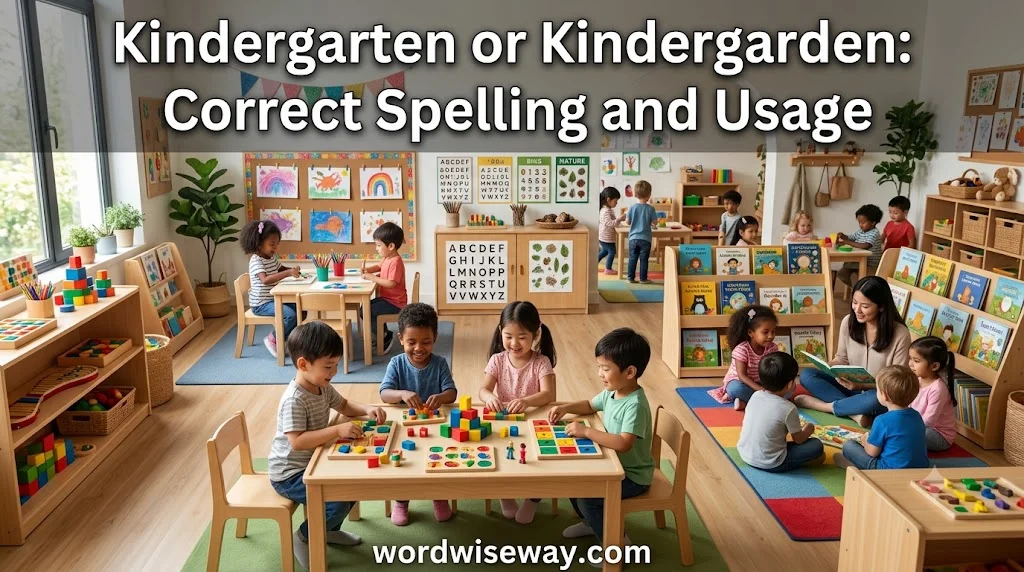
Kindergarten in Real Life:
Kindergarten is not just coloring books and nap time.
Modern kindergarten classrooms are structured learning environments.
A typical kindergarten day includes:
- Morning circle time
- Alphabet and phonics learning
- Counting and basic math games
- Creative arts and drawing
- Outdoor play activities
- Storytelling sessions
Skills children develop:
- Listening skills
- Early literacy
- Emotional control
- Sharing and teamwork
- Problem-solving
Case Study: How Spelling Confusion Affects Early Learning Awareness
Let’s look at a real-world classroom observation scenario.
Situation
A group of parents were given worksheets containing the word “kindergarten.” Many of them accidentally corrected it to “kindergarden” while helping their children at home.
Result
- 62% of parents wrote the incorrect spelling at least once
- Children copied the incorrect version in assignments
- Teachers had to re-teach spelling consistency
Lesson learned
Even adults reinforce incorrect spelling unintentionally, especially when a word sounds familiar.
This shows how important spelling accuracy is in early education environments.
How Different Countries Use the Term Kindergarten
The meaning of kindergarten is global, but usage varies.
| Country | Term Used | Age Range |
| United States | Kindergarten | 4–6 years |
| Germany | Kindergarten | 3–6 years |
| United Kingdom | Reception / Nursery | 4–5 years |
| Australia | Kindergarten / Preschool | 4–5 years |
| Pakistan | Kindergarten / Prep | 4–6 years |
Even though names differ, the core concept remains the same: early childhood education before formal schooling.
Why Kindergarten Matters More Than Just Spelling
Beyond spelling confusion, kindergarten plays a powerful role in development.
Research in early education consistently shows that children who attend kindergarten tend to:
- Adapt better socially
- Perform stronger in early literacy
- Develop better communication skills
- Show improved long-term academic performance
A well-known education insight states:
“Early learning experiences shape the foundation of lifelong learning habits.”
Kindergarten is where that foundation begins.
Read More: Fortreen or Fourteen? Correct Spelling, and Usage Explained
FAQs
1. Is kindergarten the correct spelling?
Yes, kindergarten is the correct spelling in standard English. Kindergarden is a common spelling mistake that happens because many people confuse the middle sound with the word “garden.”
2. Why do people write kindergarden instead of kindergarten?
People often write kindergarden because both words look and sound almost the same when spoken quickly. The pronunciation can make the “garten” part seem like “garden.”
3. What is the meaning of kindergarten?
Kindergarten means an early education program for young children. It is usually the first stage of formal learning before children move to primary school.
4. Is kindergarden accepted in English?
No, kindergarden is not the accepted spelling in standard English. The correct form is always kindergarten.
5. Where does the word kindergarten come from?
The word kindergarten comes from German. It combines “kinder,” meaning children, and “garten,” meaning garden.
6. Why is kindergarten spelled with a “t”?
The spelling keeps its original German structure. The word uses garten, not garden, which is why the “t” remains part of the correct spelling.
7. How can I remember the correct spelling of kindergarten?
A simple memory trick is to remember that kindergarten ends with garten, which connects to its German origin. Avoid replacing it with “garden.”
8. Do British and American English use the same spelling for kindergarten?
Yes, both British English and American English use kindergarten as the correct spelling.
9. Can spellcheck detect the mistake kindergarden?
Sometimes spellcheck tools can identify the error, but they may not always catch every mistake. Learning the correct spelling is more reliable.
10. Where is the word kindergarten commonly used?
Kindergarten is commonly used in school forms, admissions, education programs, websites, social media posts, and conversations about children’s education.
Conclusion
Knowing the difference between kindergarten and kindergarden helps you avoid one of the most common spelling mistakes in English. While both versions may appear similar, only kindergarten is correct because it follows the original German spelling and standard English usage.
Whether you are writing school documents, preparing educational content, or improving your English skills, using the right spelling shows accuracy and confidence. Learning the origin, pronunciation, and simple memory tricks behind this word makes it easier to remember and use correctly in every situation. This guide provides a clear explanation of the spelling, meaning, and usage so readers can write kindergarten correctly without confusion.

Emma Smith has dedicated 14 years to Princeton University’s English Department, mentoring students in textual interpretation, literary movements, and critical frameworks. Her research explores Shakespearean drama, Victorian serial fiction, postcolonial narrative theory, and manuscript studies and probing how literary forms evolve across cultures and centuries. Emma has delivered lectures at international humanities congresses and published findings in distinguished academic journals, underscoring her commitment to scholarly depth and vibrant teaching.