Understanding Set vs Sit: Differences, and Correct Usage is essential for polished professional communication.
Confusing these irregular verbs remains one of the most common mistakes in formal academic reports, everyday emails, and casual social media platforms. In my years of analyzing linguistics and reviewing corporate text, I have seen how an awkward phrase—like telling someone to “sit the files on the desk instantly damages your credibility. The core semantics rely on a strict transitive versus intransitive grammatical distinction.
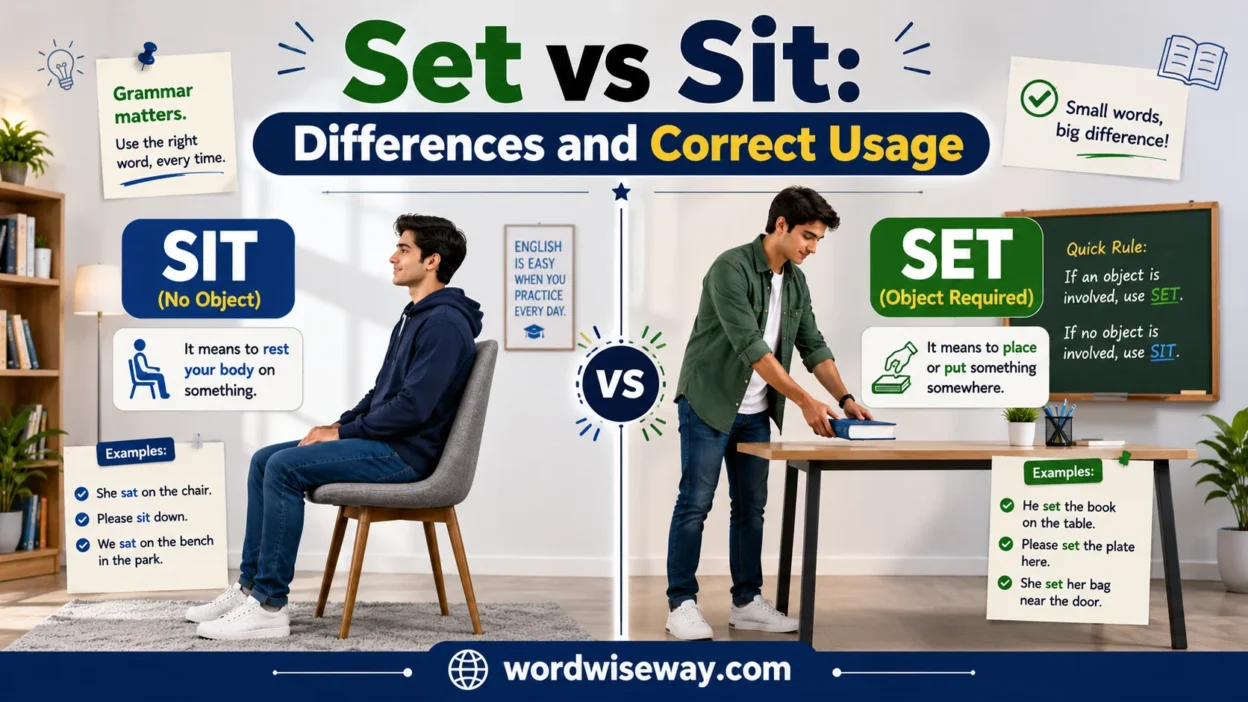
To set is an active action that always requires a direct object; you must physically place a book or an item onto a table. Conversely, to sit means to adopt a seated posture on a chair or rest yourself, a function that never takes an object and perfectly suffices in spoken language without needing any external target.
When you fail to spot these foundational patterns in your daily speech, your sentences sound confusing, breeding ambiguity and miscommunication in critical instructions. For anyone building their skills, learning this fundamental grammar rule acts as an instructional roadmap to eliminate errors across all writing contexts.
By practicing with clear examples, you can easily look past the confusing forms and idioms of the English language to ensure your content remains highly accurate, clearer, and completely natural. This comprehensive guide is engineered to help you master the exact context of each word with absolute precision, providing the definitive clarity needed to navigate both intricate writing assignments and casual conversations without a single doubt.
Set vs Sit: Why This Confuses So Many Learners
If you’ve ever mixed up “set” and “sit,” you’re not alone. Even fluent speakers slip sometimes when speaking quickly.
The confusion comes from three things:
- They sound similar in casual speech
- Both relate to physical positions in real life
- English verbs don’t always follow obvious patterns
But here’s the real issue. English uses verb structure logic, not just meaning. Once you see that logic, everything becomes simpler.
Think of it like this:
- “Sit” is what your body does
- “Set” is what your hands do to objects
That tiny mental split solves most of the confusion instantly.
Core Difference in Set vs Sit
Let’s lock the foundation first. No shortcuts here.
“Sit” means to lower your body into a seated position
You use sit when the subject performs the action on themselves.
It is an intransitive verb, which means:
- No object is needed
- The action stays with the subject
Examples of correct usage:
- I sit on the chair every morning.
- She sits near the window during class.
- They sit quietly during the meeting.
Notice something important? Nothing is being “placed” or “moved.” The person is just changing position.
“Set” means to place or position something
Now switch gears.
Set is a transitive verb, which means:
- It needs an object
- Something is being moved, placed, or arranged
Examples of correct usage:
- I set the book on the table.
- She sets her phone beside the bed.
- They set the plates before dinner.
If nothing follows “set,” the sentence feels incomplete. That’s because the action is waiting for an object.
Grammar Breakdown of Set vs Sit Correct Usage
To really understand this, we need to zoom into grammar structure.
Intransitive vs Transitive Verbs Explained Simply
Here’s the clean difference:
| Verb Type | Meaning | Needs Object? | Example |
| Intransitive | Action stays with subject | No | I sit |
| Transitive | Action moves to something else | Yes | I set the cup |
Now let’s make it real.
- When you say “I sit”, you don’t need anything else.
- When you say “I set”, people immediately ask what did you set?
That’s the grammar trigger.
Why “Set” Always Feels Incomplete Alone
Try saying:
- I set…
It sounds unfinished because your brain expects an object.
Now compare:
- I sit…
It feels complete because no object is required.
This is why learners often pause mid-sentence when using “set.” Their brain is searching for what comes next.
Read More: Addition vs Edition: Difference and Correct Usage
Everyday Uses of Sit in Set vs Sit
Let’s explore how sit actually works in real life.
Physical sitting actions
This is the most common use.
- Sit on a chair
- Sit on the floor
- Sit by the door
Simple and direct.
Idiomatic and natural expressions with sit
English also uses “sit” in phrases that don’t always mean physical sitting.
- Sit tight → wait patiently
- Sit still → remain motionless
- Sit with something → deal with or reflect on something
Example:
- You need to sit with your decision before acting.
Here, “sit” is mental, not physical.
Common mistake with sit
A frequent error is trying to attach objects:
- ❌ I sit the book on the table
This is incorrect because “sit” cannot transfer action to objects.
Everyday Uses of Set in Set vs Sit
Now let’s flip to “set,” where things get more dynamic.
Physical placement uses
- Set the cup on the table
- Set your bag down
- Set the keys beside the door
This is the most literal usage.
Abstract uses of set
“Set” becomes powerful when used abstractly.
- Set goals
- Set rules
- Set boundaries
- Set expectations
Example:
- The teacher sets clear rules for the class.
Here, nothing physical is being placed, but something is still being “established.”
Common phrasal verbs with set
English loves combining “set” with prepositions:
- Set up → arrange or establish
- Set out → begin a journey or explain
- Set aside → reserve something
Example:
- She set aside time for reading every evening.
Biggest Mistake in Set vs Sit
Here’s where most learners stumble.
They treat both words like interchangeable action verbs.
The real mistake:
- Thinking both can take objects
- Assuming “sit” can behave like “set”
Example of confusion
- ❌ I sit the book on the table
- ✔ I set the book on the table
The logic breaks because:
- “Sit” cannot transfer action
- “Set” is built for transfer
Set vs Sit: Comparison Table
Let’s simplify everything visually.
| Feature | Sit | Set |
| Verb type | Intransitive | Transitive |
| Object required | No | Yes |
| Meaning | To be seated | To place something |
| Physical action | Body movement | Hand/object movement |
| Example | I sit here | I set it there |
This table alone solves most confusion in exams and writing.
Real-Life Scenarios for Set vs Sit
Let’s see how this works outside grammar books.
At home
- You sit on the sofa after work
- You set your phone on the table
Simple daily distinction.
At school
- Students sit during lessons
- Teachers set homework
Notice how roles matter here:
- Students receive positions
- Teachers assign tasks
At work
- You sit in meetings
- Managers set deadlines
Again:
- Sit = presence
- Set = action on tasks or objects
Quick Memory Tricks
Here are simple ways to remember without overthinking.
“Sit = Self” rule
If the subject is doing something to themselves, use sit.
“Set = Something else” rule
If an object is involved, use set.
Visualization trick
- Sit → imagine sitting down in a chair
- Set → imagine placing a cup on a table
Your brain stores images faster than grammar rules.
Advanced Edge Cases in Set vs Sit
Let’s go a bit deeper.
“Set” as a noun
“Set” can also become a noun.
- A chess set
- A film set
- A set of tools
Here, “set” means a group or collection.
“Sit” in idiomatic English
“Sit” also changes meaning in expressions:
- Sit on it → delay action or ignore
- Sit through → endure something long or boring
Example:
- I had to sit through a long lecture.
Here, the meaning is emotional rather than physical.
Mini Practice:
Try these:
Fill in the blanks:
- I ___ on the bench.
- She ___ the book on the shelf.
- They ___ quietly during the speech.
- He ___ the alarm for 7 AM.
Answers:
- sit
- set
- sit
- set
If you got them right, you’ve already mastered the core rule.
Case Study:
Let’s look at a real learning pattern.
Student Profile:
A beginner English learner from South Asia.
Problem:
They say:
- “I sit my bag here”
- “She set on the chair”
Root cause:
- Overgeneralizing verb behavior
- Ignoring object requirement rules
Fix applied:
After learning:
- “Sit = no object”
- “Set = always needs object”
Result:
Accuracy improved significantly in speaking tests within two weeks.
This shows grammar clarity matters more than memorizing long rules.
Read More: Since vs Sense: Meaning, Difference, and Correct Usage
FAQs
1. What is the main difference between set and sit?
The primary distinction between these two irregular verbs comes down to whether the action requires a target. To sit means to rest yourself or adopt a seated posture on a chair, which is completely intransitive and needs no recipient. On the other hand, to set is transitive, meaning you must actively place a direct object—such as a book or a glass—down onto a table or desk.
2. Why do people frequently confuse these two terms?
Many learners make mistakes with these words because they sound very similar and share overlapping themes of placement and rest. In both casual conversation and formal academic reports, this phonetic similarity causes structural ambiguity. Over time, these habits creep into everyday speech, making it easy to swap them accidentally without realizing the grammatical errors being made.
3. Can you give an example of set used correctly in a sentence?
An accurate example would be: “Please set the final financial reports on my desk before you leave.” In this context, the verb directly acts upon the physical documents, which serve as the necessary object. This demonstrates the clear precision required when utilizing this verb in professional writing and corporate communication.
4. Can you give an example of sit used correctly in a sentence?
A perfectly natural example is: “You may sit anywhere you like while waiting for the instructions.” Here, the action is entirely self-contained, meaning the subject is simply resting themselves without transferring the energy to an external item. This intransitive behavior is a core rule of English grammar that ensures your sentences remain clear.
5. What happens if I use sit instead of set in professional emails?
Using the wrong word in corporate emails creates an awkward phrasing that instantly damages your credibility. Writing a sentence like “Please sit the package by the door” introduces grammatical miscommunication that can distract your reader. Maintaining an accurate distinction ensures that your professional content looks polished, authoritative, and completely clearer.
6. Are there any irregular forms of these verbs I should know?
Yes, tracking their conjugated forms is a vital part of mastering the language. The verb sit changes to “sat” in both the past tense and past participle forms, making it highly dynamic. Conversely, set remains unchanged as “set” across the present, past, and past participle tenses, which is one of its most unique patterns.
7. How does understanding this help my linguistics and grammar skills?
Focusing on these details refines your overall linguistics baseline and sharpens your syntax skills. It acts as an instructional roadmap for recognizing how verbs interact with nouns in various contexts. By mastering this subtle grammar boundary, you build a stronger foundation for writing highly sophisticated text.
8. Are there common idioms that use these words?
Absolutely, the English language features several idioms that rely on these specific verbs. For instance, you “set a date” or “set the table,” both of which require a clear direct object. Conversely, you might tell someone to “sit tight,” which relies on the self-contained, objectless nature of the word.
9. How can I easily remember the rule while writing?
A simple trick to guide your writing is to associate the “a” in “place” with set (as in, placing an object). Similarly, match the “i” in “sit” with the “i” in “incline” or “inside” a chair, focusing on your own body. This structural guide helps you select the correct word with absolute precision every time.
10. Does this rule apply to social media and casual writing?
Yes, keeping these rules straight matters just as much on social media as it does in an academic thesis. Even in a casual post, using the wrong word can make your text sound clunky or unpolished to native speakers. Prioritizing clarity across all communication platforms reflects high-level language mastery and attention to detail.
Conclusion
Mastering Set vs Sit Correct Usage: Differences, and Correct Usage Explained provides a reliable roadmap for elevating your personal communication skills. By recognizing the structural distinction between a transitive action and an intransitive state of rest, you permanently eliminate common errors from your speech and writing. This foundational grammar awareness ensures that whether you are drafting formal academic reports or sending rapid corporate emails, your message remains profoundly accurate and highly professional.
Ultimately, keeping these patterns clear prevents ambiguity and protects your professional credibility from accidental mistakes. Armed with this comprehensive guide, you can now confidently navigate the context of both verbs across all social and structural contexts. Looking past the confusing forms and idioms allows your written content to flow in a way that is completely natural, clearer, and balanced with absolute precision.

Emma Smith has dedicated 14 years to Princeton University’s English Department, mentoring students in textual interpretation, literary movements, and critical frameworks. Her research explores Shakespearean drama, Victorian serial fiction, postcolonial narrative theory, and manuscript studies and probing how literary forms evolve across cultures and centuries. Emma has delivered lectures at international humanities congresses and published findings in distinguished academic journals, underscoring her commitment to scholarly depth and vibrant teaching.