In English grammar, Given vs. Gave: Difference, and Correct Usage explains how the irregular verb give changes in the past tense. Unlike regular verbs, it does not follow standard rules by adding -ed. Instead, it changes to gave or given, depending on the sentence.
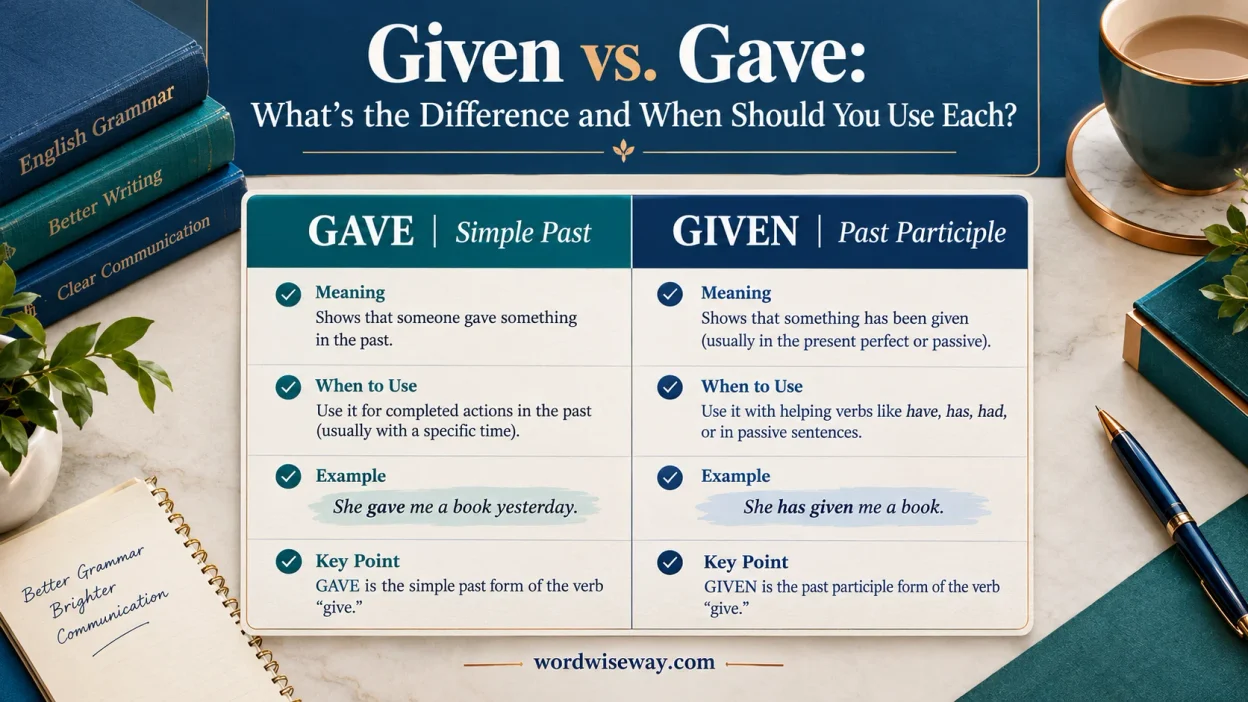
The main difference between gave and given is their grammatical usage. Gave describes a completed action, such as “She gave me a book yesterday.” Given is a past participle that works with helping verbs like has, have, and had. These verb forms follow specific irregular verb patterns.
Understanding these key past tense forms improves your writing and speaking. Rather than memorizing grammar rules, focus on sentence patterns and verb conjugation. This approach helps you recognize the correct tense and use each form naturally in everyday English.
Quick Answer:
Gave is the simple past tense of give. Use it when someone performed an action in the past. Given is the past participle of give. It typically appears with helping verbs such as have, has, had, or forms of be.
| Word | Verb Form | Common Use | Example |
| Gave | Simple past | A completed past action | She gave me a book yesterday. |
| Given | Past participle | Perfect tenses | She has given me a book. |
| Given | Past participle | Passive voice | The students were given extra time. |
| Given | Adjective | Something specified or established | Under the given conditions, the plan works. |
Remember this simple rule: Use gave for the simple past and given for past participle constructions.
For example, “He gave me advice yesterday” is correct. So is “He has given me advice.” However, “He has gave me advice” is grammatically incorrect.
What Does Gave Mean?
Gave is the simple past tense of the irregular verb give. It describes an action that happened in the past. Unlike regular verbs that form the past tense by adding -ed, the verb give changes to gave.
You don’t need a helping verb to use gave in a standard affirmative statement. The word itself indicates that the action occurred in the past.
Consider these examples:
- My brother gave me his old laptop.
- The teacher gave us extra homework last Friday.
- Sarah gave her friend a birthday card.
- The company gave its employees a holiday bonus.
- They gave the children permission to play outside.
Each sentence describes an action that took place in the past.
How to Use Gave in a Sentence
The word gave commonly appears in affirmative sentences, especially when the writer wants to describe a completed event.
For example, “The manager gave me clear instructions before the meeting.” The action happened before the meeting, so the simple past tense fits naturally.
You can also use gave with expressions that identify a finished period, such as yesterday, last month, two days ago, or in 2023.
Examples include:
- I gave him the documents yesterday.
- She gave her presentation last week.
- We gave our neighbors a housewarming gift two days ago.
- The school gave every student a new notebook in September.
These time expressions often help you recognize when the simple past is appropriate.
Using Gave in Negative Sentences and Questions
When you form a negative sentence or question with did, the main verb returns to its base form, give. It doesn’t remain in the past form.
Correct examples:
- She didn’t give me the answer.
- They didn’t give us enough time.
- Did you give him the message?
- Why did the teacher give extra homework?
Incorrect examples:
- She didn’t gave me the answer.
- Did you gave him the message?
The reason is straightforward. The auxiliary verb did already marks the past tense. Adding gave would mark the past twice in the same verb construction.
The correct pattern is:
Subject + did/didn’t + give + object
For questions, place did before the subject: “Did she give you the book?”
What Does Given Mean?
Given is the past participle of give. It is not the simple past tense. In most standard verb constructions, it works with a helping verb rather than appearing alone as the main verb in an ordinary past-tense statement.
You’ll often see given in perfect tenses, passive constructions, and adjective phrases.
Examples include:
- I have given her the information.
- He has given three presentations this month.
- They had given us permission before the event.
- The students were given additional time.
- The instructions given yesterday were clear.
Although these examples use the same word, their grammatical structures differ.
Given With Have, Has, and Had
The words have, has, and had combine with given to form perfect tenses. These constructions connect an action with a particular time or another event.
Present perfect: have or has given
Use the present perfect when a past action connects to the present or falls within a relevant period that continues into the present.
- I have given you all the details.
- She has given me useful advice.
- They have given several interviews this week.
Past perfect: had given
Use the past perfect when one action happened before another past event.
- I had given him the keys before he left.
- She had given her presentation before the manager arrived.
- They had given us the schedule before the meeting started.
Notice the difference between these sentences:
“I gave him the keys before he left.”
“I had given him the keys before he left.”
Both are grammatical. The first reports a past event. The second explicitly presents the key handover as completed before another past event.
Given in Passive Voice
Passive sentences use given with a form of be. In these constructions, the person or thing receiving something becomes the subject.
Compare these sentences:
- Active: The teacher gave the students extra time.
- Passive: The students were given extra time.
The meaning remains similar, but the emphasis changes. The active sentence highlights what the teacher did. The passive sentence focuses on the students and what they received.
More examples include:
- The winner was given a trophy.
- New employees are given safety instructions.
- The applicants were given another opportunity.
- She has been given responsibility for the project.
In the last example, has been given combines the present perfect with the passive voice.
Given as an Adjective
Not every use of given forms part of a perfect tense or a passive verb phrase. Sometimes, given functions as an adjective meaning specified, established, or assumed.
For example:
- Under the given circumstances, we should wait.
- The task must be completed within a given period.
- For a given value of (x), the equation has one solution.
In these sentences, given describes a condition, period, or value. It doesn’t describe someone performing the act of giving.
This distinction matters because grammar depends on how a word functions in context, not simply on its spelling.
Key Differences
The easiest way to understand given vs. gave is to compare their grammatical roles.
| Feature | Gave | Given |
| Verb form | Simple past | Past participle |
| Main function | Reports a past action | Forms perfect tenses and passive constructions |
| Typical structure | Subject + gave + object | Subject + helping verb + given |
| Perfect tense | Not used directly after have | Used after have, has, or had |
| Passive voice | Not used as the participle | Used with forms of be |
| Example | He gave me a pen. | He has given me a pen. |
Both words describe the same underlying action, but they fit different sentence patterns.
Gave vs. Given in Past and Perfect Tenses
Compare the following sentences:
Simple past: “Maria gave me the report yesterday.”
Present perfect: “Maria has given me the report.”
Past perfect: “Maria had given me the report before the meeting.”
The first sentence identifies a completed past action. The second connects the action to the present or a relevant current period. The third establishes that the action happened before another past event.
The choice depends on what you want to communicate, not merely on whether the action has finished.
Gave vs. Given in Active and Passive Sentences
Active and passive constructions provide another clear contrast.
| Active Sentence | Passive Sentence |
| The principal gave the students certificates. | The students were given certificates. |
| The company gave him a promotion. | He was given a promotion. |
| The coach has given the team new instructions. | The team has been given new instructions. |
The active voice identifies the person or organization performing the action. The passive voice emphasizes the recipient or result.
Neither structure is automatically better. Choose the one that communicates your intended emphasis clearly.
When to Use Gave
Use gave when you want to report an action that occurred in the past without forming a perfect tense or passive construction.
For Completed Past Actions
When an event happened and finished in the past, the simple past often provides the clearest expression.
- My aunt gave me a watch for my birthday.
- The librarian gave us new membership cards.
- Our instructor gave a helpful explanation during class.
Each sentence reports a completed event.
With Specific Past-Time Expressions
Expressions such as yesterday, last night, last year, and three hours ago commonly appear with the simple past.
- He gave me the news yesterday.
- They gave their final presentation last Friday.
- The organization gave scholarships to ten students last year.
These expressions identify a finished past period, making the simple past a natural choice.
In Simple Past Questions and Negatives
Use gave in affirmative statements, but use give after did or didn’t.
Correct:
- I gave her the book.
- I didn’t give her the book.
- Did you give her the book?
Incorrect:
- I didn’t gave her the book.
- Did you gave her the book?
This pattern applies to irregular verbs generally. The auxiliary did carries the past-tense marking, so the main verb stays in its base form.
When to Use Given
Use given when the sentence requires a past participle. The most common situations involve perfect tenses, passive voice, and certain adjective or participial phrases.
In Present Perfect Sentences
Use have given or has given to connect a past action with the present or a relevant time period.
Examples:
- I have given you my final answer.
- She has given several interviews this month.
- We have given the proposal careful consideration.
Remember the subject agreement: use has with he, she, and it in standard present-perfect constructions. Use have with I, you, we, and they.
In Past Perfect Sentences
Use had given to establish that an action preceded another past event.
- He had given me the address before I called.
- They had given their approval before the deadline.
- We had given the instructions before the workshop began.
The past perfect can clarify the order of events when the sequence matters.
In Passive Constructions
Use given after the appropriate form of be when the sentence uses the passive voice.
- I was given a second chance.
- The workers were given protective equipment.
- She has been given a new assignment.
- The documents will be given to the director tomorrow.
These examples show that the helping verb changes according to tense and subject, while given remains the past participle.
With Modal Perfect Constructions
Modal verbs can also appear in structures such as should have given, could have given, and might have given.
Examples:
- You should have given her more time.
- He could have given a clearer explanation.
- They might have given us the wrong address.
These constructions often express advice about a past action, a possible alternative, or uncertainty about what happened.
The pattern is:
Subject + modal verb + have + given
Do not write “should have gave” or “could have gave.” After have in this construction, use the past participle given.
Given vs. Gave in Different Tenses
Understanding the common sentence patterns makes it easier to select the correct form without memorizing isolated examples.
| Tense or Construction | Correct Pattern | Example |
| Simple past | gave | She gave me a notebook. |
| Present perfect | has/have given | She has given me a notebook. |
| Past perfect | had given | She had given me a notebook. |
| Simple past passive | was/were given | We were given notebooks. |
| Present perfect passive | has/have been given | We have been given notebooks. |
| Past perfect passive | had been given | We had been given notebooks. |
| Modal perfect | should/could have given | She should have given me a notebook. |
| Future passive | will be given | We will be given notebooks. |
A useful way to learn these patterns is to keep the object and meaning similar while changing the grammatical structure.
For example:
- Past: The manager gave me the file.
- Present perfect: The manager has given me the file.
- Past perfect: The manager had given me the file before lunch.
- Passive: I was given the file by the manager.
The original action stays recognizable. The sentence structure determines which form of give belongs in the blank.
Common Mistakes
Even experienced English learners sometimes mix up irregular verb forms. Fortunately, a few simple corrections cover most mistakes.
Using Given Instead of Gave in the Simple Past
Incorrect: “She given me a gift yesterday.”
Correct: “She gave me a gift yesterday.”
The sentence uses the simple past, so it needs gave. The word given normally requires a suitable grammatical construction or must function as an adjective or participle.
Using Gave After Have, Has, or Had
Incorrect: “I have gave him the documents.”
Correct: “I have given him the documents.”
The present perfect requires the past participle, not the simple past form.
The same rule applies to other perfect constructions:
- Incorrect: He has gave me permission.
- Correct: He has given me permission.
- Incorrect: They had gave us the details.
- Correct: They had given us the details.
Writing Did Gave Instead of Did Give
Incorrect: “Did you gave her the message?”
Correct: “Did you give her the message?”
Because did already marks the past tense, the main verb takes its base form.
This rule also applies to negative statements:
- Incorrect: He didn’t gave me a receipt.
- Correct: He didn’t give me a receipt.
Confusing Active and Passive Voice
Incorrect: “The students was given extra time.”
Correct: “The students were given extra time.”
The passive construction requires a form of be that agrees with the subject. Because students is plural, were is correct.
Compare:
- The teacher gave the students extra time.
- The students were given extra time.
Both sentences are grammatical, but they emphasize different parts of the event.
Treating Given as Only a Verb Form
Consider this sentence: “The given information was incomplete.”
Here, given describes the information. It doesn’t form a perfect tense.
Similarly, “Given enough time, we can finish the project” uses a participial construction with the meaning if we are given enough time.
Context determines how the word functions.
Examples in Everyday English
Everyday situations offer practical ways to see the distinction.
Gifts and Personal Favors
- Past action: My cousin gave me a birthday card.
- Present perfect: My cousin has given me several birthday cards.
- Passive: I was given a birthday card by my cousin.
The first sentence reports a past event. The second connects past actions with the present context. The third emphasizes the recipient.
School and Assignments
- Past action: The teacher gave us a difficult assignment.
- Present perfect: The teacher has given us three assignments this week.
- Passive: We were given a difficult assignment.
These examples show how the same basic meaning fits different grammatical structures.
Advice and Information
- Past action: My friend gave me useful advice.
- Present perfect: My friend has given me useful advice before.
- Past perfect: My friend had given me the address before I left.
The time relationship determines which form works best.
Money, Permission, and Opportunities
- Past action: The organization gave the students financial assistance.
- Present perfect: The organization has given several students financial assistance.
- Passive: Several students were given financial assistance.
The recipient can appear as the direct object in an active sentence or as the subject in a passive sentence.
A Short Case Study: Choosing the Correct Verb
Imagine that a student is writing about a teacher who provided extra study materials.
The student drafts three sentences:
- “The teacher gave us extra notes yesterday.”
- “The teacher has given us extra notes this week.”
- “We were given extra notes before the examination.”
All three sentences are correct.
The first uses gave because it reports a past event with a specific time expression. The second uses has given to describe an action within the current week. The third uses were given to emphasize the students who received the notes.
The lesson is simple: choose the form that matches the sentence structure and the time relationship you want to express.
Given vs. Gave in Questions and Negative Sentences
Questions and negatives follow predictable patterns. The main distinction is whether the sentence uses the simple past or a perfect construction.
Simple Past Questions
Use did followed by the base form give.
- Did she give you the keys?
- Did they give you enough time?
- When did he give you the results?
Avoid placing gave immediately after did.
Simple Past Negative Sentences
Use didn’t give to express an action that didn’t happen.
- She didn’t give me the receipt.
- We didn’t give them the final schedule.
- He didn’t give an explanation.
These sentences refer to the past, but the main verb remains give.
Perfect-Tense Questions
Use have, has, or had before the subject in a question, followed by the past participle given.
- Have you given her the information?
- Has he given you permission?
- Had they given their approval before the meeting?
Perfect-Tense Negative Sentences
Place not after the helping verb.
- I haven’t given my final answer.
- She hasn’t given us the details.
- They hadn’t given permission before the event.
Compare “Did she give you the answer?” with “Has she given you the answer?” The first asks about a past action. The second asks whether the action has occurred within a context relevant to the present.
Given vs. Gave vs. Give vs. Giving
The verb give has several forms, each with a distinct grammatical role. Learning all four makes it easier to understand why gave and given aren’t interchangeable.
| Verb Form | Grammatical Role | Example |
| Give | Base form | Please give me the book. |
| Gave | Simple past | She gave me the book. |
| Given | Past participle | She has given me the book. |
| Giving | Present participle or gerund | She is giving me the book. |
Give: The Base Form
Use give after modal verbs such as can, will, and should. It also follows do, does, and did in questions and negatives.
Examples:
- I can give you an answer.
- Please give him a copy.
- Did you give her the invitation?
- They don’t give refunds after the deadline.
Gave: The Simple Past
Use gave to report an action in the past.
Example: “The librarian gave me a new library card.”
Given: The Past Participle
Use given in perfect tenses, passive constructions, and other participial structures.
Examples:
- I have given my permission.
- He was given another chance.
- The advice given during the session was helpful.
Giving: The -ing Form
Use giving in continuous tenses and in gerund constructions.
Examples:
- She is giving a presentation.
- They were giving instructions when the power went out.
- Giving useful feedback takes practice.
The form giving can function as part of a verb phrase or as a noun-like gerund. Its role depends on the sentence.
Is Given Ever Used Without a Helping Verb?
Yes. Although given commonly appears with helping verbs, it can also occur without one in several grammatical structures.
Given in Reduced Passive Clauses
A reduced passive clause contains a past participle without the full passive verb phrase.
For example:
“The information given yesterday was accurate.”
The phrase given yesterday means that was given yesterday. It describes the information rather than serving as the main verb of an independent simple past sentence.
Other examples include:
- The instructions given during class were helpful.
- The documents given to the manager contained errors.
- The award given to the winner recognized outstanding achievement.
These constructions are common in formal and concise writing.
Given as an Adjective
The word can also describe something specified or established.
Examples:
- At a given temperature, the material expands.
- We must finish the work within a given period.
- The solution works under the given conditions.
In each sentence, given describes a particular value, period, or set of conditions.
Given at the Beginning of a Sentence
You may encounter sentences such as:
“Given enough time, the team can complete the project.”
Here, given enough time means if the team is given enough time. The phrase introduces a condition.
This use is grammatical and doesn’t require have, has, or had immediately before given.
However, in a standard independent simple past sentence, write “The team gave us enough time,” not “The team given us enough time.”
Read More: Williams’ or Williams’s: Meaning, Difference and Usage
FAQs
What Is the Difference Between Given and Gave?
Gave is the simple past tense of give, while given is its past participle. Both words describe the act of giving, but they work differently in sentences.
Is Gave the Past Tense of Give?
Yes, gave is the simple past tense of give. For example, “He gave me a pen yesterday” describes an action that happened in the past.
Is Given a Past Tense Verb?
Given is the past participle of give. It usually appears with helping verbs, such as has, have, or had, to form perfect tenses.
When Should I Use Gave in a Sentence?
Use gave when describing a completed action in the past. For example, “Sarah gave her friend a birthday card last week.”
When Should I Use Given in a Sentence?
Use given with helping verbs in perfect tenses. For example, “I have given him the correct answer” shows that the action has been completed.
Is It Correct to Say I Have Gave?
No, “I have gave” is grammatically incorrect in standard English. The correct sentence is “I have given” because have requires the past participle.
Should I Write She Gave Me or She Given Me?
Write “She gave me” when describing a simple past action. If you use given, include a suitable helping verb, as in “She has given me a gift.”
What Are the Three Forms of the Verb Give?
The three main forms are give, gave, and given. Give is the base form, gave is the simple past tense, and given is the past participle.
Why Is Give Considered an Irregular Verb?
Give is an irregular verb because it does not form its past tense by simply adding -ed. Instead, its forms change to gave and given.
How Can I Remember the Difference Between Given and Gave?
Remember this simple pattern: use gave for a completed past action and given with helping verbs such as has, have, and had. Practicing short sentences can help you remember the correct forms.
Conclusion
Understanding given vs. gave becomes easier when you learn how each word works in a sentence. Both words come from the verb give, but they serve different grammatical purposes. Gave is the simple past tense, while given is the past participle. Recognizing this difference helps you avoid common mistakes in everyday English writing and speaking.
The easiest way to remember their correct usage is to look at the helping verbs and sentence structure. For example, “She gave me a gift yesterday” describes a past action, while “She has given me a gift” uses the present perfect tense. These examples show why choosing the correct verb form matters. Instead of memorizing complicated grammar rules, practice using both words in simple, meaningful sentences.
With regular practice, you can recognize these irregular verb forms without second-guessing yourself. Pay attention to how gave and given appear in books, conversations, and written examples. The more you use them correctly, the more natural your English will sound. A clear understanding of verb forms also builds a strong foundation for learning other irregular verbs.

Amelia Sanders has spent 14 years in Harvard University’s English Department, helping students navigate literary analysis, interpretive theory, and narrative techniques. Her academic pursuits center on 18th-century British prose, romantic poetry, diasporic writing, and digital editing exploring how textual choices influence cultural perspectives. Amelia has spoken at major international meetings and contributed essays to respected academic volumes, demonstrating her dedication to thoughtful scholarship and effective teaching.