Spit onomatopoeia turns real-life sounds into written words, helping readers imagine the action. 4 Ways to Spell the Sound of Spitting explores how different spellings represent these sounds naturally.
These expressive words make writing more interesting by showing how a sound might appear in a story, conversation, or comic scene. Choosing the right spelling helps your readers understand the action without needing a detailed explanation.
Three useful spit sounds are ptoo, pfft, and splut. Each can suggest a different sound depending on the situation. For example, “ptoo” can represent someone spitting something out, while “pfft” may suggest a quick burst of air
. “Splut” can describe a wet sound in a fictional scene. These sound words create simple sound effects that bring written scenes to life.When choosing the best spit onomatopoeia options, consider your audience and purpose
Using onomatopoeia correctly means matching each sound to the intended action. This improves onomatopoeia usage and makes your writing clearer. Try reading each word aloud to check whether it communicates the intended sound.
Whether you’re writing for friends, colleagues, or readers, the right sound imitation can make your language more expressive and engaging.
Quick Answer
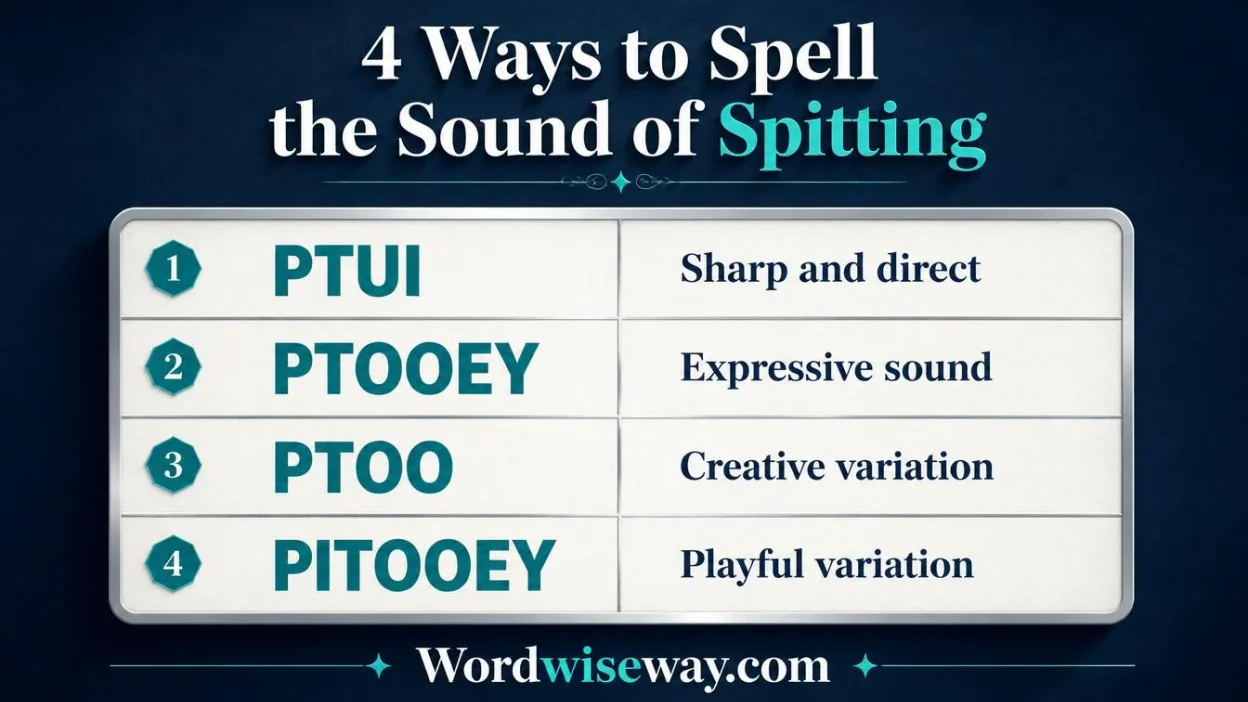
Four ways to spell the sound of spitting are ptui, ptooey, ptoo, and spitooey. These spellings differ in familiarity, length, and expressive tone. Some are recognizable interjections, while others work better as creative sound effects.
| Spelling | Typical effect | Best use |
| Ptui | Short, sharp expression | Disgust, contempt, or rejection |
| Ptooey | More exaggerated spitting sound | Informal dialogue and humorous scenes |
| Ptoo | Brief, abrupt sound effect | Comics and creative writing |
| Spitooey | Playful, extended expression | Exaggerated fictional scenes |
The spelling you choose should fit the scene rather than follow a rigid formula. For everyday writing, ptui and ptooey are recognizable options. Forms such as ptoo and spitooey are more dependent on creative context.
What Is the Sound of Spitting Called?
The written sound of spitting is commonly represented by an onomatopoeic expression such as ptui or ptooey. These expressions imitate the sharp burst of sound associated with spitting. They can also communicate disgust or contempt without describing a physical action.
Onomatopoeia is the use of words that imitate or suggest sounds. Think of buzz for an insect, clang for metal, or splash for water. Spitting sounds belong to the same broad category because their spellings attempt to recreate an audible event.
However, written sound effects don’t always have one fixed spelling. Different writers may hear or interpret the same sound differently. That’s why ptui, ptooey, and related expressions can appear in English writing.
Consider these examples:
- Ptui! He rejected the bitter taste.
- Ptooey! She spat out the unpleasant mouthful.
- He made a sharp spitting sound and turned away.
The first two examples use interjections, which express a reaction or imitate a sound. The third describes the action directly. Each approach serves a different purpose.
A useful distinction matters here: the sound of spitting and the act of spitting aren’t exactly the same thing in writing. A sound effect emphasizes what readers might hear, while a descriptive verb explains what someone does.
Four Ways to Spell the Sound of Spitting
English offers several ways to represent this sound, but not every spelling has the same level of recognition. ptooey and Ptui have established dictionary support, while related forms can serve as creative variations.
Ptui
Ptui is a recognized spelling used to suggest the sound or act of spitting. It often appears as a short interjection, particularly when a character expresses disgust, contempt, or rejection.
The spelling looks unusual because English rarely begins ordinary words with the letter combination pt. In this expression, however, the unusual opening helps suggest the abrupt beginning of the sound.
When should you use ptui?
Choose ptui when you want a brief, sharp expression that feels direct rather than playful. It can work in literary dialogue, traditional storytelling, or a scene where a character reacts with strong disapproval.
Examples:
- Ptui! The bitter medicine tasted terrible.
- “Ptui! I’d never eat that again,” Martin said.
- She muttered, “Ptui,” and dismissed the unpleasant suggestion.
Notice how the punctuation changes the effect. An exclamation point makes the reaction stronger, while a comma or period creates a quieter tone.
Writers can also repeat the expression to suggest repeated sounds or emphasize a character’s reaction.
For example:
Ptui! Ptui! The old man showed his contempt for the bad luck he feared.
Use repetition carefully, though. One well-placed sound effect often communicates more than a long string of repeated expressions.
Ptooey
Ptooey is another established spelling for an imitation of the sound of spitting. It has a longer, more expressive appearance than ptui, which can make it useful in humorous dialogue or exaggerated scenes.
The extra letters give the expression a drawn-out quality. Depending on the context, readers may imagine a more theatrical sound rather than a quick, clipped one.
When should you use ptooey?
Use ptooey when you want the written sound to feel expressive, conversational, or slightly comic. It can work well in fiction, cartoons, informal storytelling, and dialogue that emphasizes a character’s reaction.
Examples:
- Ptooey! He spat out the sour candy.
- “Ptooey! This soup needs a lot less salt.”
- She took one bite, grimaced, and exclaimed, “Ptooey!”
The surrounding sentence helps readers understand what the sound represents. In the first example, the physical action makes the meaning clear. In the second, the expression also communicates dissatisfaction with the food.
It’s important not to confuse ptooey with phooey. The two expressions look similar, but they aren’t interchangeable in every context. Ptooey imitates spitting, while phooey commonly expresses contempt, disbelief, or dismissal.
For instance:
- Ptooey! He spat out the unpleasant taste.
- “Phooey on that ridiculous idea!” she exclaimed.
The second sentence expresses rejection without necessarily describing a spitting sound.
Ptoo
Ptoo is a shorter, more experimental-looking way to represent a spitting sound. It may work in creative writing when the writer wants a compact sound effect without the extended ending of ptooey.
However, there’s an important distinction: ptoo isn’t as firmly established as a standard spelling of the spitting sound in major dictionary entries. Treat it as a creative choice rather than a universally accepted form.
When should you use ptoo?
Use ptoo when the context makes the intended sound obvious and you want a short, abrupt effect. It’s particularly suited to stylized dialogue, comic panels, or informal fiction where writers can establish their own sound conventions.
Examples:
- Ptoo! The character rejected the bitter flavor.
- “Ptoo! That was a dreadful idea,” Ben muttered.
- The character turned away with a quick ptoo.
These examples demonstrate how a writer might use the spelling. They don’t mean that every reader will interpret it identically.
If clarity matters more than experimentation, ptui or ptooey may be safer choices. Readers are more likely to recognize a spelling that already appears in established usage references.
Pitooey
Pitooey is a documented alternative form of ptooey. It represents the same general kind of sound, although readers may find it less familiar than the more recognizable spelling.
The additional initial vowel gives the expression a slightly different visual rhythm. Since these words imitate sounds rather than follow strict spelling rules, such variations can develop in dialogue, informal writing, and expressive language.
When should you use pitooey?
Choose pitooey when you want a playful variation and the surrounding context clearly establishes its meaning. It can suit exaggerated fictional reactions or dialogue in which a character’s voice matters more than conventional spelling.
Examples:
- Pitooey! The character rejected the unpleasant taste.
- “Pitooey! I can’t believe I agreed to that,” she complained.
- He made a face and muttered, “Pitooey.”
Because the form is less familiar to some readers, avoid introducing it without context in formal or highly concise writing. A short descriptive phrase can make its meaning clear.
For example, “Pitooey!” she exclaimed, spitting out the sour drink, immediately connects the expression with the action.
Which Spelling of the Spitting Sound Should You Use?
The right spelling depends on what you want readers to hear or understand. A short expression can communicate disgust, while a longer one may create a more exaggerated effect.
Use the following comparison to choose a suitable form.
| Spelling | Recognition and tone | Suggested context |
| Ptui | Established, sharp, direct | Disgust, contempt, rejection |
| Ptooey | Established, expressive | Humorous dialogue and sound effects |
| Ptoo | Creative, brief | Stylized fiction and comics |
| Pitooey | Documented variant, playful | Informal or exaggerated dialogue |
The distinction isn’t a strict rule about sound length. People don’t all make identical sounds when they spit, and writers don’t reproduce those sounds in precisely the same way.
Instead, think about your audience. If readers need to understand the expression immediately, a recognizable spelling helps. If you’re writing a comic or a highly stylized scene, a creative variation may work just as well.
For most general-purpose writing, start with ptui or ptooey. Choose a less familiar form only when it adds something meaningful to the scene.
How to Use Spitting Sounds in Sentences
A sound effect works best when it fits naturally into the action. The goal isn’t simply to insert an unusual word. You want readers to understand what happens and why the sound matters.
Place the sound before the reaction
Putting a sound effect first can create an immediate response.
Example:
“Ptooey! That tastes awful,” Nina said.
The sound captures the moment of disgust before the dialogue explains it. This structure works well in fiction, informal storytelling, and comic-style writing.
Put the sound inside dialogue
A sound effect can also interrupt or shape a character’s speech.
Example:
“I tried that new drink, and… ptui! Never again.”
Here, the sound becomes part of the character’s reaction. The pause creates anticipation, while the interjection delivers the response.
Use the sound in narration
You don’t always need quotation marks or spoken dialogue. A narrator can use an interjection to describe a moment directly.
Example:
Ptui! The character spat out the mouthful and reached for a glass of water.
This approach gives the scene a lively, immediate quality. It’s especially useful when the narrator has a playful or expressive voice.
Choose punctuation that matches the scene
Punctuation affects how readers interpret a sound effect.
- Exclamation point: Creates a strong or dramatic reaction.
- Comma: Integrates the expression into a longer sentence.
- Period: Gives the sound effect a more restrained ending.
- Quotation marks: Help distinguish a spoken expression from surrounding narration when needed.
For example:
- Ptooey! The candy was far too sour.
- “Ptooey,” he muttered under his breath.
- She made a face and said, “Ptui. That’s unpleasant.”
There isn’t one punctuation pattern that works in every situation. Follow the conventions of your publication or the style of your story, and keep the meaning clear.
Spitting Sound vs. the Word “Spit”
A sound effect and an ordinary verb perform different jobs. Knowing the difference helps you choose between imitating a sound and describing an action.
Spit is a verb that describes the physical action. Ptui and ptooey are interjections that can represent the sound or express a reaction associated with spitting.
Consider these examples:
| Word or expression | Function | Example |
| Spit | Present-tense verb | He spits out the seed. |
| Spat | Past-tense verb | She spat out the bitter drink. |
| Spitting | Verb form or gerund | The child was spitting watermelon seeds. |
| Ptui | Sound-imitation interjection | “Ptui! That tastes awful.” |
| Ptooey | Sound-imitation interjection | “Ptooey!” He rejected the flavor. |
These words aren’t interchangeable in every sentence. A verb describes an action, while an interjection can recreate a sound or communicate an immediate feeling.
When a descriptive verb works better
Sound effects aren’t always necessary. Sometimes a direct description makes the action easier to understand.
Compare these examples:
- With a sound effect: “Ptooey!” He spat out the medicine.
- Without a sound effect: He spat out the medicine because it tasted bitter.
The first version emphasizes the immediate reaction. The second explains the action and its cause.
Neither version is automatically better. Choose the one that fits the scene and gives readers the information they need.
Common Mistakes
Even a short sound effect can feel awkward when it doesn’t match the surrounding text. A few simple checks can help you avoid common problems.
Assuming there’s only one correct spelling
Unlike many ordinary English words, sound effects often have several accepted or creative forms. Ptui and ptooey are recognized spellings, while other variations may depend on the writer’s style.
Don’t assume every variation has equal recognition. If conventional usage matters, choose a form with established dictionary support.
Choosing a sound effect that doesn’t fit the tone
A playful expression may weaken a serious scene. Likewise, a short, sharp interjection may feel too restrained for an exaggerated cartoon.
For example, ptooey may suit a humorous reaction to an unpleasant meal. A straightforward description may work better in a serious narrative.
Repeating sound effects too often
Repetition can emphasize disgust or create a comic rhythm. However, repeating the same expression after every action can make the writing feel artificial.
Instead, combine sound effects with gestures, dialogue, and descriptive verbs.
For example:
Ptooey! Marcus spat out the candy, wiped his mouth, and pushed the packet away.
One sound effect establishes the reaction. The remaining details carry the scene forward.
Using unfamiliar spellings without context
Readers may not immediately understand a creative form such as ptoo. Give them enough surrounding information to identify the intended sound.
For example:
“Ptoo!” The character spat out the sour drink and reached for water.
The action clarifies the sound effect without requiring a separate explanation.
Confusing spitting with an expression of disgust
Some expressions communicate disgust without literally imitating a spitting sound. Phooey, for instance, often expresses dismissal or contempt.
If your sentence describes an actual sound, choose an expression that suits that purpose. If it communicates an opinion, an ordinary interjection may be enough.
Read More: “My Wife and I” vs. “My Wife and Me” vs. “Me and My Wife”:
FAQs
What Is Spit Onomatopoeia?
Spit onomatopoeia uses written words to imitate the sound of spitting. Examples include “ptoo” and “splut.”
How Do You Spell the Sound of Spitting?
You can spell the sound of spitting as “ptoo,” “ptuh,” or “splut,” depending on the sound you want to describe.
Is “Ptoo” a Real Word?
“Ptoo” is an informal sound word that represents spitting. Writers often use it in dialogue and fictional scenes.
What Does “Pfft” Mean?
“Pfft” represents a short burst of air or a dismissive reaction. Its meaning depends on the context.
What Is the Difference Between “Ptoo” and “Splut”?
“Ptoo” often imitates the sound of spitting, while “splut” can suggest a wet, messy sound.
Why Do Writers Use Spit Sound Words?
Writers use spit sound words to make actions easier to imagine. These words also add personality and detail to stories.
Can You Use Spit Onomatopoeia in Comics?
Yes, comic writers can use words such as “ptoo” and “pfft” to show sounds without lengthy descriptions.
How Do You Choose the Right Spitting Sound Word?
Choose a word that matches the action, mood, and setting. Reading it aloud can help you decide whether it sounds appropriate.
Is Spit Onomatopoeia Suitable for Creative Writing?
Yes, spit onomatopoeia can make dialogue, humorous scenes, and fictional actions more vivid when used naturally.
How Can Beginners Practice Spit Onomatopoeia?
Beginners can list different sound words, say them aloud, and use them in short sentences. This helps them understand how each spelling communicates a sound.
Conclusion
Spit onomatopoeia adds a lively touch to writing by turning real sounds into simple, expressive words. Spellings such as “ptoo,” “pfft,” and “splut” can describe different sounds depending on the scene. Each option helps readers picture an action without relying on long explanations.
Choosing the right sound word depends on the meaning, tone, and audience. A playful comic may need a different expression than a realistic story or casual conversation. Reading each word aloud can help you decide whether it fits the action you want to describe.
With a little practice, you can use spit sound words naturally in creative writing, dialogue, and storytelling. Experiment with different spellings, consider the effect each one creates, and choose the clearest option for your readers. The goal is to make your writing more expressive while keeping every sound easy to understand.

Emma Smith has dedicated 14 years to Princeton University’s English Department, mentoring students in textual interpretation, literary movements, and critical frameworks. Her research explores Shakespearean drama, Victorian serial fiction, postcolonial narrative theory, and manuscript studies and probing how literary forms evolve across cultures and centuries. Emma has delivered lectures at international humanities congresses and published findings in distinguished academic journals, underscoring her commitment to scholarly depth and vibrant teaching.