
When a person accuses you of wrongdoing while hiding their own guilt, the situation can feel confusing and unfair. Words for When Someone Accuses You of What They Are Guilty Of explores projection, psychological projection, and blame shifting, where someone redirects attention toward someone else’s actions to distract from their own behavior.
A hypocrite may use false accusation, denial, deflection, dishonesty, or deception to avoid responsibility. Fault shifting, shifting blame, and blame reversal describe attempts to make an accused person appear guilty. These accusation tactics may involve manipulation, misconduct, and unfair blame instead of admitting fault.
Recognizing manipulative behavior, self-projection, and projecting guilt helps you describe these situations accurately. Suitable synonyms include false blame, wrongdoing accusation, and accountability avoidance. When someone is accusing others of what they are guilty of, understanding the pattern can help you deal with the situation calmly.
Quick Answer:
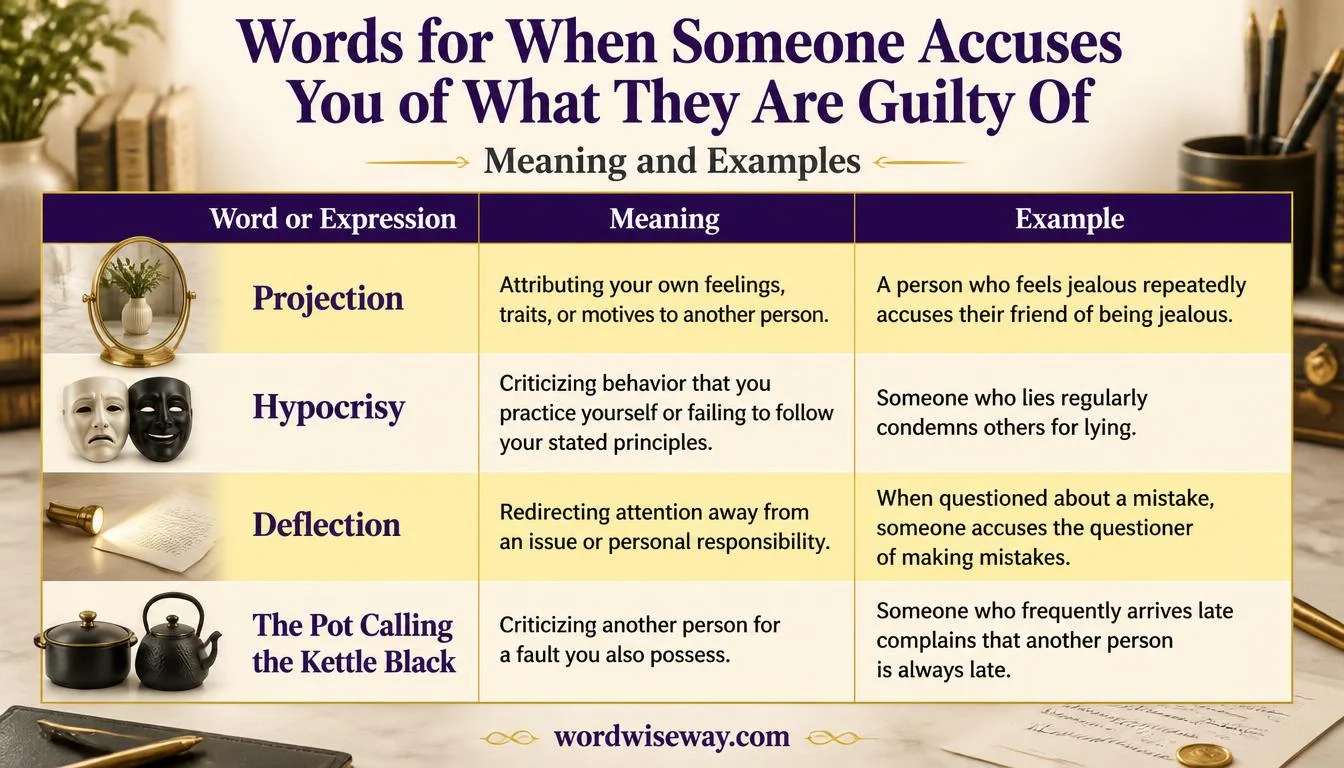
The four most useful expressions are projection, hypocrisy, deflection, and the pot calling the kettle black. Each describes a slightly different aspect of accusing someone of behavior the accuser also displays.
| Word or Expression | Meaning | Example |
| Projection | Attributing your own feelings, traits, or motives to another person. | A person who feels jealous repeatedly accuses their friend of being jealous. |
| Hypocrisy | Criticizing behavior that you practice yourself or failing to follow your stated principles. | Someone who lies regularly condemns others for lying. |
| Deflection | Redirecting attention away from an issue or personal responsibility. | When questioned about a mistake, someone accuses the questioner of making mistakes. |
| The Pot Calling the Kettle Black | Criticizing another person for a fault you also possess. | Someone who frequently arrives late complains that another person is always late. |
The simplest answer: Use projection when someone attributes their own traits or feelings to you. Use hypocrisy for double standards, deflection for redirecting blame, and the pot calling the kettle black when someone criticizes a fault they share.
What Is It Called When Someone Accuses You of What They Do?
Several terms can describe this behavior, but they aren’t interchangeable. The distinction matters because accusing someone of hypocrisy isn’t quite the same as saying they are projecting their feelings onto you.
Consider this example: Two coworkers disagree about honesty. One regularly gives misleading information but accuses the other of being dishonest. Depending on the circumstances, the accusation might involve hypocrisy, projection, or deflection. The details determine which term fits best.
Here is a simple way to distinguish them:
- Projection focuses on attributing one’s own traits, feelings, or motives to someone else.
- Hypocrisy focuses on the gap between someone’s behavior and the standards they expect others to follow.
- Deflection focuses on shifting attention away from the original concern.
- The pot calling the kettle black highlights the irony of criticizing someone for a fault you also have.
A person might display more than one of these behaviors during the same argument. However, one term may describe the situation more precisely than the others.
Projection: When Someone Accuses You of Their Own Traits or Feelings
What Does Projection Mean?
Projection is a psychological defense mechanism in which someone attributes their own feelings, motives, or unwanted characteristics to another person. Instead of recognizing a feeling or trait in themselves, they perceive it in someone else.
For instance, someone who struggles with jealousy might repeatedly accuse their partner or friend of being jealous. A person who feels insecure about their honesty might become unusually suspicious of other people’s intentions.
Projection can happen without deliberate deception. The person may genuinely believe their accusation because they have difficulty recognizing their own feelings or behavior.
However, an accusation alone doesn’t establish that projection is taking place. People sometimes make accusations because they misunderstand a situation, have incomplete information, or notice genuine problems.
Signs of Projection in Accusations
Projection may be a reasonable possibility when someone’s accusations repeatedly reflect feelings or traits they struggle with themselves. Look for patterns rather than relying on one disagreement.
Possible examples include:
- Jealousy: A person who feels jealous frequently accuses others of being jealous.
- Dishonesty: Someone who regularly hides information becomes excessively suspicious of everyone else’s honesty.
- Insecurity: A person who doubts their own abilities repeatedly claims that others feel threatened by them.
- Hostility: Someone who feels resentful interprets ordinary comments as deliberate attacks.
These examples illustrate possible patterns, not proof of another person’s psychological state. Context matters, and similar behavior can have different explanations.
Examples of Projection in Everyday Life
Example one: A friendship
Maya feels jealous when her friend spends time with other people. Instead of acknowledging her feelings, Maya repeatedly accuses her friend of being jealous whenever the friend expresses disappointment.
This situation could involve projection if Maya attributes her own jealousy to her friend. However, the accusation alone doesn’t establish what Maya is experiencing internally.
Example two: A workplace
Daniel frequently doubts his own performance. During meetings, he repeatedly claims that his coworkers feel threatened by his abilities, even when they offer ordinary feedback.
His accusations might reflect his own insecurities. Still, more context would be needed to determine whether projection explains his behavior.
Projection vs. Hypocrisy
Projection and hypocrisy can overlap, but they describe different things.
Projection concerns the attribution of personal feelings, motives, or traits to another person. Hypocrisy concerns a mismatch between someone’s actions and the standards they expect others to follow.
For example, a person who feels jealous and accuses everyone else of jealousy may be projecting. A person who openly practices a behavior while condemning others for the same behavior may be acting hypocritically.
The key distinction is simple: projection concerns attribution, while hypocrisy concerns inconsistency.
Hypocrisy: When Someone Criticizes You for Something They Do Themselves
What Does Hypocrisy Mean?
Hypocrisy occurs when someone’s behavior conflicts with the principles, standards, or moral expectations they claim to uphold.
A hypocritical person may demand honesty while lying, criticize others for breaking rules they routinely ignore, or insist on fairness while applying different standards to themselves.
The central issue is inconsistency. Someone expects other people to behave one way but doesn’t hold themselves to the same standard.
For example, imagine a manager who repeatedly arrives late but reprimands employees whenever they arrive a few minutes behind schedule. The manager’s behavior demonstrates a double standard because the same expectation doesn’t appear to apply equally.
When to Use the Word Hypocrisy
Use hypocrisy when someone criticizes you for behavior they regularly practice themselves, especially when they claim to follow a different standard.
Common situations include:
- Dishonesty: A person lies but demands complete honesty from everyone else.
- Lateness: Someone frequently arrives late but complains whenever another person does the same.
- Rule-breaking: A person ignores household rules but punishes others for breaking them.
- Judgment: Someone condemns others for making mistakes they repeatedly make themselves.
- Responsibility: A person expects everyone else to admit their mistakes but refuses to acknowledge their own.
Hypocrisy doesn’t necessarily mean someone has accused you of their exact wrongdoing. It can also describe a broader pattern of inconsistent standards.
Examples of Hypocrisy in Everyday Life
Example one: Family relationships
A family member frequently interrupts others during conversations. However, whenever someone interrupts them, they complain about disrespect.
Their behavior reveals a double standard. They expect others to follow a rule that they don’t consistently follow themselves.
Example two: Friendships
A friend regularly cancels plans at the last minute but becomes upset when you need to cancel once.
The issue isn’t simply the canceled plans. It’s the unequal expectation that one person should receive more understanding than the other.
Example three: School or work
A colleague copies other people’s ideas but accuses a teammate of taking credit for someone else’s work.
If the colleague engages in the same conduct they condemn, their behavior may be hypocritical.
Hypocrisy vs. Hypocrite
These related words serve different grammatical purposes.
| Word | Part of Speech | Meaning | Example |
| Hypocrisy | Noun | Behavior that contradicts stated principles. | Her hypocrisy became apparent during the discussion. |
| Hypocrite | Noun | A person who behaves hypocritically. | He called his coworker a hypocrite after noticing the double standard. |
| Hypocritical | Adjective | Describing behavior that demonstrates hypocrisy. | His hypocritical accusation upset the team. |
Use hypocrisy when discussing the behavior itself. Use hypocrite when referring to the person, and hypocritical when describing an action or statement.
Deflection: When Someone Turns the Blame Back on You
What Does Deflection Mean?
Deflection means redirecting attention away from an issue, question, or responsibility. During an argument, someone may use deflection to avoid addressing concerns about their own behavior.
For example, suppose you ask a friend why they broke a promise. Instead of explaining what happened, your friend responds, “You broke a promise last month, too!”
Your friend’s response shifts the discussion toward your behavior. That may be deflection, particularly if they use the counteraccusation to avoid discussing the original concern.
However, a counteraccusation isn’t automatically deflection. Your friend might raise a relevant concern that deserves attention. The important question is whether the original issue receives a fair response.
How Deflection Works During Arguments
Deflection can take several forms. Recognizing these patterns helps you distinguish a productive disagreement from a conversation that continually avoids its original subject.
Common examples include:
- Counteraccusations: Responding to criticism by accusing the other person of similar behavior.
- Changing the subject: Introducing an unrelated complaint when asked to explain a specific action.
- Shifting responsibility: Blaming circumstances or other people without acknowledging one’s own contribution.
- Minimizing the concern: Treating a legitimate question as unimportant to avoid discussing it.
- Reversing the focus: Making the person raising a concern defend themselves instead of addressing the original issue.
These behaviors can occur intentionally or unintentionally. Their presence doesn’t establish someone’s motives, but repeated redirection can make resolving a disagreement difficult.
Examples of Deflection in Everyday Life
Example one: A disagreement between friends
Ava asks Noah why he shared something private. Noah responds, “You told someone my secret last year!”
Noah’s response may be deflection if he uses Ava’s past mistake to avoid discussing his own actions. Ava’s previous behavior might deserve a separate conversation, but it doesn’t automatically resolve her current concern.
Example two: A workplace disagreement
A supervisor asks an employee why a report contains errors. The employee immediately criticizes another team member’s mistakes without explaining the errors in their own report.
The employee has redirected the discussion. Unless the other team’s work directly explains the problem, the response may be an attempt to deflect responsibility.
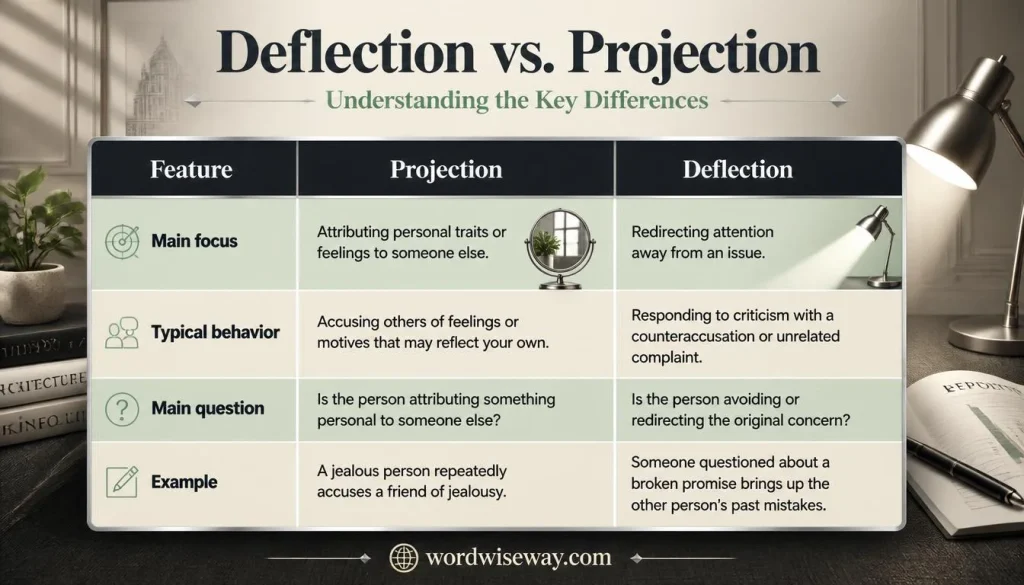
Deflection vs. Projection
Although projection and deflection can occur together, they describe different processes.
| Feature | Projection | Deflection |
| Main focus | Attributing personal traits or feelings to someone else. | Redirecting attention away from an issue. |
| Typical behavior | Accusing others of feelings or motives that may reflect your own. | Responding to criticism with a counteraccusation or unrelated complaint. |
| Main question | Is the person attributing something personal to someone else? | Is the person avoiding or redirecting the original concern? |
| Example | A jealous person repeatedly accuses a friend of jealousy. | Someone questioned about a broken promise brings up the other person’s past mistakes. |
A person might accuse someone else of dishonesty while also redirecting attention away from their own actions. In that case, projection and deflection might both be relevant, but neither should be assumed without sufficient context.
The Pot Calling the Kettle Black: An Idiom for Shared Faults
What Does the Pot Calling the Kettle Black Mean?
The pot calling the kettle black is an English idiom used when someone criticizes another person for a fault they also possess.
The expression highlights the irony of the accusation. The person criticizing someone else has a similar flaw, making the criticism seem inconsistent or hypocritical.
Imagine someone who frequently interrupts conversations complaining that another person never lets anyone speak. The complaint may be justified in a particular situation, but the speaker’s own behavior makes the criticism ironic.
Unlike projection, this idiom doesn’t require a psychological explanation. Unlike deflection, it doesn’t necessarily suggest that someone is avoiding responsibility. It simply highlights a shared fault.
When to Use the Pot Calling the Kettle Black
This expression works especially well in casual conversations, everyday disagreements, and situations where someone’s criticism exposes their own inconsistency.
Use it when:
- Someone who regularly lies accuses another person of dishonesty.
- A person who constantly arrives late complains about someone else’s punctuality.
- Someone who interrupts others criticizes another person for interrupting.
- A person who ignores shared responsibilities accuses someone else of being irresponsible.
- Someone who frequently judges others complains about being judged.
The idiom often communicates the point more naturally than a formal psychological term.
Examples of the Pot Calling the Kettle Black
Example one: Punctuality
“You’re always late!” says a friend who frequently arrives after everyone else.
You might describe the situation by saying, “That’s the pot calling the kettle black.”
Example two: Honesty
A person who routinely exaggerates their achievements accuses a colleague of exaggerating one accomplishment.
Their criticism resembles the pot calling the kettle black because they share the fault they’re condemning.
Example three: Personal habits
Someone who leaves shared spaces untidy complains that another person never cleans up.
The expression fits because the critic’s own behavior conflicts with their complaint.
Pot Calling the Kettle Black vs. Hypocrisy
These expressions overlap, but their emphasis differs slightly.
Hypocrisy describes inconsistent behavior or principles. The idiom the pot calling the kettle black specifically emphasizes the irony of criticizing someone for a fault the critic also possesses.
For instance, a person who demands honesty but regularly lies demonstrates hypocrisy. When that person accuses another habitual liar of dishonesty, the situation also resembles the pot calling the kettle black.
Both expressions may fit the same situation. Choose the idiom for a conversational observation and hypocrisy when discussing the broader pattern of inconsistent standards.
Which Word Best Describes Someone Who Accuses You of Their Own Wrongdoing?
The most accurate word depends on what the person actually does. Instead of automatically labeling the accusation, consider the behavior and the context surrounding it.
Use Projection When Someone Attributes Their Own Traits or Feelings to You
Choose projection when someone’s accusation appears to reflect their own feelings, motives, or characteristics.
For example, a person who struggles with jealousy might repeatedly accuse their friend of being jealous. The term becomes more relevant when a broader pattern supports that interpretation.
Remember that you can’t reliably determine someone’s internal motives from one accusation alone.
Use Hypocrisy When Someone Applies a Double Standard
Choose hypocrisy when someone condemns behavior they practice themselves or expects others to follow standards they ignore.
For example, a person who regularly breaks promises but harshly criticizes others for doing so demonstrates a clear inconsistency.
You don’t need to establish the person’s hidden motives to describe the observable double standard.
Use Deflection When Someone Shifts the Blame
Choose deflection when someone redirects attention away from the original concern instead of addressing it.
For example, you ask why someone missed an important deadline, and they immediately criticize your work on an unrelated project.
The criticism may or may not be valid. What matters is whether it addresses the question you originally raised.
Use the Pot Calling the Kettle Black for Shared Faults
Choose this idiom when someone criticizes another person for a flaw they also have.
For example, a person who constantly interrupts others complains that you interrupted them once. The idiom captures the contradiction in a direct, conversational way.
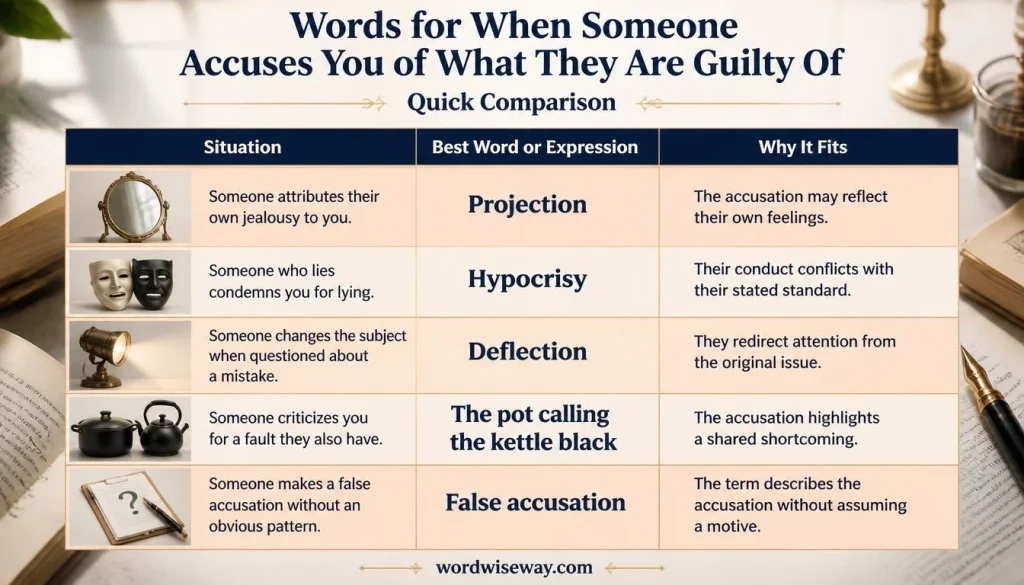
Quick Comparison: Which Expression Should You Choose?
| Situation | Best Word or Expression | Why It Fits |
| Someone attributes their own jealousy to you. | Projection | The accusation may reflect their own feelings. |
| Someone who lies condemns you for lying. | Hypocrisy | Their conduct conflicts with their stated standard. |
| Someone changes the subject when questioned about a mistake. | Deflection | They redirect attention from the original issue. |
| Someone criticizes you for a fault they also have. | The pot calling the kettle black | The accusation highlights a shared shortcoming. |
| Someone makes a false accusation without an obvious pattern. | False accusation | The term describes the accusation without assuming a motive. |
The final example matters because not every incorrect accusation involves projection, hypocrisy, or deflection. Sometimes someone simply misunderstands what happened or lacks accurate information.
Common Mistakes
Using the right term makes your explanation clearer. However, confusing these expressions can lead to inaccurate assumptions about another person’s behavior.
Confusing Projection With Hypocrisy
Projection and hypocrisy can look similar from the outside, but they emphasize different things.
A person who accuses others of jealousy might be projecting their own feelings. A person who criticizes others for gossiping while regularly gossiping themselves demonstrates hypocrisy.
The first example concerns possible attribution of feelings. The second concerns a mismatch between behavior and standards.
Treating Every Counteraccusation as Deflection
A counteraccusation doesn’t always mean someone is avoiding responsibility.
Suppose two friends disagree about interrupting each other. One raises a concern, and the other points out that interruptions have happened on both sides.
That response might introduce a legitimate issue rather than deflecting blame. To determine whether deflection is occurring, consider whether the person addresses the original concern fairly.
Using Psychological Terms Without Enough Evidence
Words such as projection can sound authoritative, but they shouldn’t replace careful observation.
You might notice that someone repeatedly accuses you of behavior they display themselves. That pattern is worth discussing, but it doesn’t prove why they make those accusations.
When you lack evidence about someone’s motives, describe the observable behavior instead. Saying “You criticized me for something you do, too” makes a clearer claim than declaring that someone has a particular psychological mechanism.
Confusing an Incorrect Accusation With Projection
An incorrect accusation isn’t automatically projection.
Someone may accuse you of dishonesty because they misunderstood a message or received incomplete information. Another person may make an accusation based on their own fears or experiences.
Both situations involve an accusation, but only the second might involve projection. The distinction depends on the broader circumstances rather than the accusation alone.
Assuming Hypocrisy Makes Every Criticism Invalid
A person can behave inconsistently and still raise a legitimate concern.
For example, someone who struggles with punctuality might correctly point out that you missed an important appointment. Their own lateness doesn’t automatically make your missed appointment irrelevant.
This distinction matters because identifying a double standard doesn’t settle every question about the original behavior. Both issues may deserve separate consideration.
Read More: Countries or Country’s or Countries’? Difference and Usage
FAQs
What do you call someone who accuses others of what they do themselves?
You can call such a person a hypocrite. Depending on the situation, their behavior may also involve projection, especially when they attribute their own faults or actions to someone else.
What is psychological projection in simple words?
Psychological projection happens when someone attributes their own feelings, faults, or behaviors to another person. For example, someone who often lies might repeatedly accuse others of being dishonest.
What is the difference between hypocrisy and projection?
Hypocrisy means criticizing or opposing behavior that you practice yourself. Projection involves attributing your own thoughts, feelings, or faults to someone else. Although they can overlap, they describe different patterns.
What is blame shifting?
Blame shifting occurs when someone tries to make another person responsible for their own mistake or behavior. Instead of accepting accountability, they redirect attention toward someone else’s actions.
What is another word for falsely accusing someone?
Depending on the context, you can use terms such as falsely blaming, making an unfounded accusation, or scapegoating. Each expression describes a slightly different way of placing blame unfairly.
Why do people accuse others of their own mistakes?
People may do this to protect their reputation, avoid embarrassment, or escape consequences. Sometimes, they may genuinely fail to recognize that they display the same behavior they criticize.
How can you respond when someone blames you for their actions?
Stay calm, explain your perspective clearly, and focus on specific facts. You can set boundaries without getting pulled into an endless argument about who is at fault.
Is accusing someone of projection always accurate?
No. An accusation alone doesn’t prove that someone is projecting. Consider the available evidence, the person’s behavior, and the wider context before drawing conclusions.
What is the difference between blame shifting and gaslighting?
Blame shifting means transferring responsibility for an action or mistake to someone else. Gaslighting involves manipulating someone into questioning their own memory, perception, or understanding of events. The two behaviors can sometimes occur together.
What is a short phrase for someone who blames others for their own faults?
You could say, “They’re projecting their own faults onto others.” Another option is, “They’re shifting the blame.” The best phrase depends on whether the person is projecting their behavior or avoiding responsibility.
Conclusion:
Knowing the 4 Words for When Someone Accuses You of What They Are Guilty Of can help you describe difficult situations more clearly. Terms such as projection, hypocrisy, blame shifting, and deflection explain different ways people may redirect attention away from their own actions. Although these expressions have related meanings, each describes a slightly different behavior, so choosing the right word makes your message more accurate.
When someone blames you for something they have done themselves, take a moment to consider the facts before responding. Their accusation doesn’t automatically make you responsible, just as your disagreement doesn’t automatically make them guilty. Focus on what actually happened rather than getting caught in repeated arguments about blame.
Ultimately, understanding these words helps you communicate with greater confidence and set healthy boundaries. You don’t need to prove your point through endless arguments. Explain your perspective calmly, recognize patterns when there is evidence, and remember that accountability means taking responsibility for your own actions instead of placing it unfairly on others.