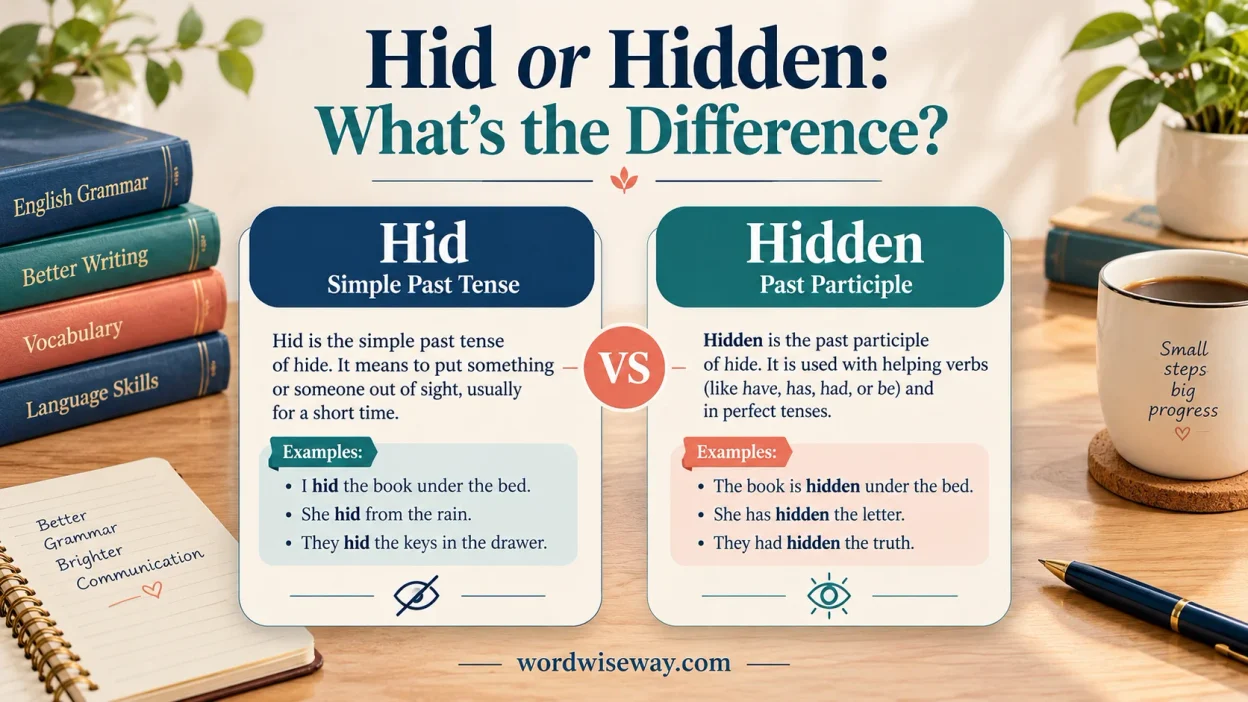
Hid or Hidden: Difference, Meaning, and Correct Forms Explained helps you understand these verb forms in English grammar and choose the right one. Both forms come from the verb hide, but they serve different grammatical purposes.
Hid is the simple past tense of hide, while hidden is its past participle. Both are correct forms, but their usage depends on the sentence context. For example, “She hid the letter yesterday” describes a completed action in the past.
Hidden usually follows an auxiliary verb such as have or had. “She has hidden the letter” uses the present perfect tense, while “They had hidden the keys before we arrived” uses the past perfect tense. Understanding these patterns helps you distinguish between the forms and use them confidently in everyday writing.
Quick Answer:
Hid is the simple past tense of hide. Hidden is the past participle of hide, which commonly appears with helping verbs such as has, have, and had. It can also function as an adjective.
| Word | Grammatical form | Example |
| Hide | Base form | I hide my spare key under the mat. |
| Hid | Simple past tense | I hid my spare key yesterday. |
| Hidden | Past participle | I have hidden my spare key. |
| Hidden | Adjective | The key is hidden under the mat. |
| Hiding | Present participle | I am hiding the spare key. |
Remember this simple rule: use hid for a straightforward past action and hidden when your sentence requires a past participle or an adjective.
For example, “She hid the letter yesterday” is correct because hid expresses a completed past action. However, “She has hidden the letter” is correct because has requires the past participle hidden.
What Is the Difference Between Hid and Hidden?
The main difference between hid and hidden is their grammatical function. Although both describe concealing something, each form fits a different sentence structure.
Hid Is the Simple Past Tense of Hide
Use hid when describing an action that happened in the past. It works as the main verb without requiring an auxiliary verb in an ordinary affirmative sentence.
Examples:
- She hid the birthday present in her closet.
- The children hid behind the curtains.
- He hid the truth from his friends.
- I hid my notebook before the meeting.
- They hid the spare key near the entrance.
Each sentence describes an action that occurred in the past. The verb hid tells readers what happened without needing another verb to complete the tense.
Hidden Is the Past Participle of Hide
Use hidden when the sentence requires the past participle. This form commonly follows have, has, or had in perfect tenses. It also appears in passive constructions and can describe a concealed condition.
Examples:
- She has hidden the birthday present.
- The children had hidden behind the curtains.
- He has hidden the truth from his friends.
- The notebook was hidden inside a drawer.
- A hidden message appeared beneath the picture.
Notice that hidden doesn’t always need a helping verb when it functions as an adjective. In the last example, it describes the message rather than expressing a complete verb tense.
Side by Side Comparison
| Sentence | Correct form | Why it works |
| She ___ the gift yesterday. | Hid | Simple past tense |
| She has ___ the gift. | Hidden | Present perfect tense |
| She had ___ the gift before we arrived. | Hidden | Past perfect tense |
| The gift was ___ in a drawer. | Hidden | Passive construction |
| Did she ___ the gift? | Hide | Base form after did |
| The ___ gift surprised everyone. | Hidden | Adjective describing the gift |
The helping verb often provides the clearest clue. However, you should also consider whether the word functions as a main verb, a participle, or an adjective.
What Are the Verb Forms of Hide?
Hide is an irregular verb, meaning it doesn’t form its past tense by simply adding -ed. Instead, its principal forms change to hid and hidden.
Learning the complete sequence makes it easier to choose the right word in everyday writing.
| Verb form | Correct word | Example |
| Base form | Hide | I hide my diary in a drawer. |
| Third-person singular | Hides | She hides her diary in a drawer. |
| Present participle | Hiding | She is hiding her diary. |
| Simple past | Hid | She hid her diary yesterday. |
| Past participle | Hidden | She has hidden her diary. |
These forms serve different purposes. Once you recognize the sentence pattern, the correct choice becomes much easier.
Hide: The Base Form
Hide is the basic form of the verb. You use it in the present tense with subjects such as I, you, we, and they. You also use it after modal verbs and in infinitive constructions.
Examples:
- I hide my important documents in a safe place.
- They hide their presents before the celebration.
- She wants to hide the surprise.
- You can hide the file in another folder.
- Did he hide the key?
The last two examples illustrate an important rule: modal verbs such as can and auxiliary verbs such as did take the base form of the main verb.
You wouldn’t write “You can hid the file” or “Did he hid the key?” Both sentences use the wrong verb form.
Hid: The Simple Past Tense
Hid describes an action that happened in the past. It doesn’t need have, has, or had in a standard affirmative simple past sentence.
For example:
- The cat hid beneath the sofa.
- I hid the documents last night.
- She hid her disappointment during the conversation.
- They hid the evidence of their mistake.
- He hid his phone before the game began.
Past-time expressions often accompany hid, although they aren’t required. Words such as yesterday, earlier, last week, and a few minutes ago can help establish when the action occurred.
Consider this example:
“Maria hid the invitation before her brother entered the room.”
The verb hid describes Maria’s completed action. The sentence doesn’t need an additional helping verb because the simple past form already expresses the tense.
Hidden: The Past Participle
Hidden is the past participle of hide. It appears in perfect tenses and passive constructions, and it can also describe a state or quality.
Examples:
- I have hidden the spare key.
- She had hidden the letter before anyone noticed.
- The documents were hidden in a locked cabinet.
- The hidden entrance led to another room.
The first two examples use perfect tenses. The third uses passive voice, and the fourth uses hidden as an adjective.
This distinction matters because hidden doesn’t automatically require the same sentence structure every time. Its grammatical role determines how you should use it.
Hiding and Hides
Two other forms of hide deserve attention because they frequently appear in everyday English.
Hides is the simple present form used with he, she, and it.
- He hides his keys in the same drawer.
- The dog hides whenever it hears thunder.
Hiding is the present participle. It appears in continuous tenses and certain other constructions.
- She is hiding behind the door.
- They were hiding when the lights went out.
- Hiding the mistake won’t solve the problem.
Knowing all five forms gives you a complete foundation for using hide correctly.
When Should You Use Hid?
Use hid when you want to describe a past action directly. It is the simple past form, so it works naturally in sentences about completed events.
For example, “The children hid their toys before bedtime” communicates what happened. You don’t need another verb to establish the past tense.
Hid in Positive Sentences
Affirmative sentences use hid as the main verb.
Examples:
- The gardener hid the spare tools in the shed.
- My sister hid a note inside my book.
- The magician hid the coin in his hand.
- The company hid important details from its customers.
- We hid the decorations until the guests arrived.
Each example describes an action that took place in the past. The subject performs the action, and hid tells readers what that action was.
You can also use hid without a specific past-time expression.
For example, “The rabbit hid behind the fence” is grammatically complete. The surrounding context can establish when the event occurred.
Hid After Did or Didn’t: Is It Correct?
No. In standard English, you should use the base form hide after did or didn’t.
When did carries the past-tense meaning, the main verb stays in its base form.
| Incorrect sentence | Correct sentence |
| Did you hid the letter? | Did you hide the letter? |
| She didn’t hid the money. | She didn’t hide the money. |
| Why did he hid the key? | Why did he hide the key? |
| They didn’t hid behind the wall. | They didn’t hide behind the wall. |
The same rule applies to other irregular verbs.
You say “Did you go?” rather than “Did you went?” You also say “Did she write?” rather than “Did she wrote?”
Once did establishes the past tense, the main verb returns to its base form. This rule applies whether you’re asking a question or making a negative statement.
When Should You Use Hidden?
Use hidden when the sentence calls for the past participle of hide or when you need an adjective describing something concealed.
Unlike hid, which commonly stands alone as the main verb in a simple past sentence, hidden usually needs a suitable grammatical structure when it functions as a verb participle.
Hidden With Have, Has, and Had
The words have, has, and had help form perfect tenses. When these auxiliaries work with hide, the correct participle is hidden.
Present perfect tense
Use has hidden or have hidden to connect a past action with the present or another relevant period.
- She has hidden the documents.
- I have hidden the gift in the cupboard.
- They have hidden their plans from the public.
Past perfect tense
Use had hidden to describe an action completed before another past event or reference point.
- He had hidden the key before the guests arrived.
- They had hidden the photographs by the time we returned.
- She had hidden the surprise before anyone discovered it.
Compare these two sentences:
- “He hid the key before dinner.”
- “He had hidden the key before dinner started.”
Both are grammatical. The first uses the simple past, while the second emphasizes that the hiding happened before another past event.
Hidden in Passive Voice
Passive voice shifts attention toward the person or thing affected by an action. In these constructions, hidden commonly follows a form of be, such as is, was, or were.
Examples:
- The documents were hidden in a cabinet.
- The entrance is hidden behind a curtain.
- The letters were hidden beneath the floorboards.
- The treasure had been hidden for decades.
Compare active and passive versions:
| Active voice | Passive voice |
| Someone hid the documents. | The documents were hidden. |
| The gardener hid the tools. | The tools were hidden by the gardener. |
| Someone had hidden the letter. | The letter had been hidden. |
The active versions emphasize who performed the action. The passive versions emphasize what happened to the object.
Remember that passive voice requires an appropriate form of be followed by the past participle. In a typical passive construction, hid doesn’t replace hidden.
Hidden as an Adjective
Hidden can also describe something concealed, unnoticed, or difficult to discover. In this role, it functions as an adjective rather than a simple past-tense verb.
Examples include:
- Hidden costs increased the total price.
- The map revealed a hidden entrance.
- She discovered a hidden talent for painting.
- We found a hidden message inside the book.
- The report exposed hidden risks in the proposal.
Adjectival hidden often appears before a noun, but it can also follow a linking verb.
For example:
- The entrance remained hidden.
- The answer was hidden from view.
The second sentence can be analyzed as a passive construction or as a description of the entrance’s state, depending on context. Either way, hidden is the correct form.
Example Sentences
The easiest way to understand the distinction is to compare both words in realistic situations. Each sentence below demonstrates a different grammatical pattern.
| Sentence | Correct form | Explanation |
| Emma ___ the present yesterday. | Hid | Simple past action |
| Emma has ___ the present. | Hidden | Present perfect |
| Emma had ___ the present before lunch. | Hidden | Past perfect |
| The present was ___ in a cupboard. | Hidden | Passive voice |
| Did Emma ___ the present? | Hide | Base form after did |
| Emma didn’t ___ the present. | Hide | Base form after didn’t |
| The ___ present surprised everyone. | Hidden | Adjective |
| Emma is ___ the present now. | Hiding | Present continuous |
| Emma usually ___ presents in the closet. | Hides | Simple present |
| Emma wants to ___ the present. | Hide | Infinitive after to |
These examples show why you can’t choose a word based on meaning alone. The sentence’s grammatical structure determines which form belongs there.
A Short Real-World Example
Imagine that Daniel is planning a surprise party for his friend.
First, Daniel hid the decorations in a spare room. He then told his friend that the house looked ordinary. By the time the guests arrived, he had hidden every present and prepared the room.
Later, his friend discovered the hidden decorations. Daniel explained that he had hidden them because he wanted the celebration to remain a surprise.
This short scenario uses hid for a completed past action and hidden in perfect-tense and descriptive constructions. The meaning stays connected, but the grammar changes with each sentence.
Common Mistakes
Even confident English speakers sometimes confuse irregular verb forms. Most mistakes happen when writers overlook a helping verb or apply the wrong tense pattern.
Using Hid Instead of Hidden
A common mistake occurs when someone uses hid after have, has, or had.
Incorrect: I have hid the documents.
Correct: I have hidden the documents.
The auxiliary have requires the past participle in the present perfect tense. Since hidden is the past participle of hide, it completes the construction correctly.
More examples:
- Incorrect: She has hid the letter.
- Correct: She has hidden the letter.
- Incorrect: They had hid the key.
- Correct: They had hidden the key.
In standard modern English, use hidden in these perfect-tense constructions.
Using Hidden Instead of Hid
Another mistake occurs when writers use hidden as a standalone simple past verb.
Incorrect: She hidden the letter yesterday.
Correct: She hid the letter yesterday.
The sentence needs the simple past tense, not a past participle without the required grammatical structure.
Compare these examples:
- Incorrect: He hidden the gift last night.
- Correct: He hid the gift last night.
- Incorrect: They hidden the documents before lunch.
- Correct: They hid the documents before lunch.
However, don’t assume that hidden always needs a helping verb in every possible sentence. It can function independently as an adjective, as in “The entrance remained hidden.”
Using Hid After Did or Didn’t
Writers sometimes use two past-marked forms in the same clause.
Incorrect: Did you hid the key?
Correct: Did you hide the key?
The auxiliary did already carries the past tense. Therefore, the main verb must use its base form.
The same principle applies to negative sentences.
Incorrect: I didn’t hid the file.
Correct: I didn’t hide the file.
This isn’t a special rule for hide. It applies broadly to English verbs after did and didn’t.
Writing Hided Instead of Hid
The word hided isn’t the standard simple past form of hide in modern English.
The correct sequence is:
Hide → Hid → Hidden
Examples:
- Incorrect: She hided the present.
- Correct: She hid the present.
- Incorrect: He has hided the documents.
- Correct: He has hidden the documents.
Irregular verbs don’t all follow the same pattern. For example, walk becomes walked, while write becomes wrote and written. Memorizing common verb forms helps you avoid these errors.
How to Choose the Correct Word
You don’t need to memorize complicated grammar terminology every time you write. Instead, follow a short decision-making process.
Step one: Check whether the sentence describes a simple past action.
If it does, hid may be the correct form.
Example: “She hid the letter yesterday.”
Step two: Look for a perfect-tense helping verb.
If the sentence uses has, have, or had to form a perfect tense, use hidden.
Example: “She has hidden the letter.”
Step three: Check for passive voice.
If a form of be combines with the past participle to describe an action performed on the subject, use hidden.
Example: “The letter was hidden in a drawer.”
Step four: Check whether the word describes a noun or condition.
If hidden describes something concealed, it may be functioning as an adjective.
Example: “The hidden letter contained a clue.”
Step five: Look for did or didn’t.
When either word introduces a question or negative statement, use hide.
Example: “Did she hide the letter?”
Quick Reference Table
| Sentence pattern | Form to use | Example |
| Subject + past verb | Hid | He hid the key. |
| Subject + has/have + participle | Hidden | He has hidden the key. |
| Subject + had + participle | Hidden | He had hidden the key. |
| Subject + be + passive participle | Hidden | The key was hidden. |
| Did + subject + base verb | Hide | Did he hide the key? |
| Didn’t + base verb | Hide | He didn’t hide the key. |
| Adjective + noun | Hidden | The hidden key was discovered. |
One final caution: context matters. The word hidden can appear in several grammatical roles, so don’t rely on a single nearby word without checking the whole sentence.
Practice Questions:
Test your understanding with these sentences. Choose the correct form of the verb hide for each blank.
- Yesterday, Mia ___ her notebook beneath the bed.
- Mia has ___ her notebook in a safe place.
- The notebook was ___ inside a drawer.
- Had Mia ___ the notebook before the guests arrived?
- Why did Mia ___ the notebook?
- Mia hadn’t ___ the notebook before school started.
- The ___ notebook contained several notes.
- They ___ the presents last weekend.
- The children didn’t ___ behind the sofa.
- The dog had ___ its favorite toy.
Answers and Explanations
| Question | Answer | Explanation |
| Yesterday, Mia ___ her notebook beneath the bed. | Hid | Simple past tense |
| Mia has ___ her notebook in a safe place. | Hidden | Present perfect |
| The notebook was ___ inside a drawer. | Hidden | Passive construction |
| Had Mia ___ the notebook before the guests arrived? | Hidden | Past perfect |
| Why did Mia ___ the notebook? | Hide | Base form after did |
| Mia hadn’t ___ the notebook before school started. | Hidden | Past perfect negative |
| The ___ notebook contained several notes. | Hidden | Adjective |
| They ___ the presents last weekend. | Hid | Simple past tense |
| The children didn’t ___ behind the sofa. | Hide | Base form after didn’t |
| The dog had ___ its favorite toy. | Hidden | Past perfect |
If you answered most of these correctly, you’ve grasped the central distinction. If a few caused trouble, revisit the helping-verb rules and try the exercise again.
Read More: Grew or Grown: Difference, Meaning, Rules, and Examples
FAQs
1. Is It Hid or Hidden?
Both hid and hidden are correct forms of the verb hide. Use hid for the simple past tense and hidden as a past participle.
2. What Is the Past Tense of Hide?
The simple past tense of hide is hid. For example, “She hid her notebook before class started.”
3. Is Hidden the Past Tense of Hide?
No, hidden is the past participle of hide. It usually appears with auxiliary verbs such as have, has, or had.
4. Can I Say “I Have Hid”?
In standard English, the correct phrase is “I have hidden.” The present perfect tense requires the past participle, not the simple past form.
5. How Do You Use Hid in a Sentence?
Use hid when describing an action completed in the past. For example, “Tom hid the spare key under the flowerpot.”
6. How Do You Use Hidden in a Sentence?
Use hidden with an appropriate auxiliary verb. For example, “The children have hidden their toys in the closet.”
7. Is “Had Hid” Grammatically Correct?
No, standard English uses had hidden for the past perfect tense. For example, “She had hidden the documents before the meeting began.”
8. What Is the Difference Between Hid and Hidden in Grammar?
Hid is the simple past tense, while hidden is the past participle. The correct choice depends on the tense and structure of your sentence.
9. Is “The Door Was Hid” Correct?
In standard English, “The door was hidden” is the natural choice when describing a door concealed from view. Here, hidden works as a past participle.
10. How Can I Remember the Difference Between Hid and Hidden?
Remember this simple pattern: hide, hid, hidden. Use hid for a completed past action and hidden with forms such as has, have, and had. Practicing a few example sentences can help you remember the difference.
Conclusion:
Choosing between hid and hidden becomes easier when you understand how each form works. Although both come from the verb hide, they cannot always replace each other in a sentence. The key is knowing which tense you want to express.
Use hid when describing a completed action in the past, such as “He hid the gift.” Choose hidden when the sentence requires a past participle, usually with an auxiliary verb. For example, “He has hidden the gift” is grammatically correct.
The next time you hesitate between these forms, check the words around the verb. Look for have, has, or had, and consider the sentence’s meaning. With regular practice, you’ll recognize the correct form naturally and write clearer, more accurate English.