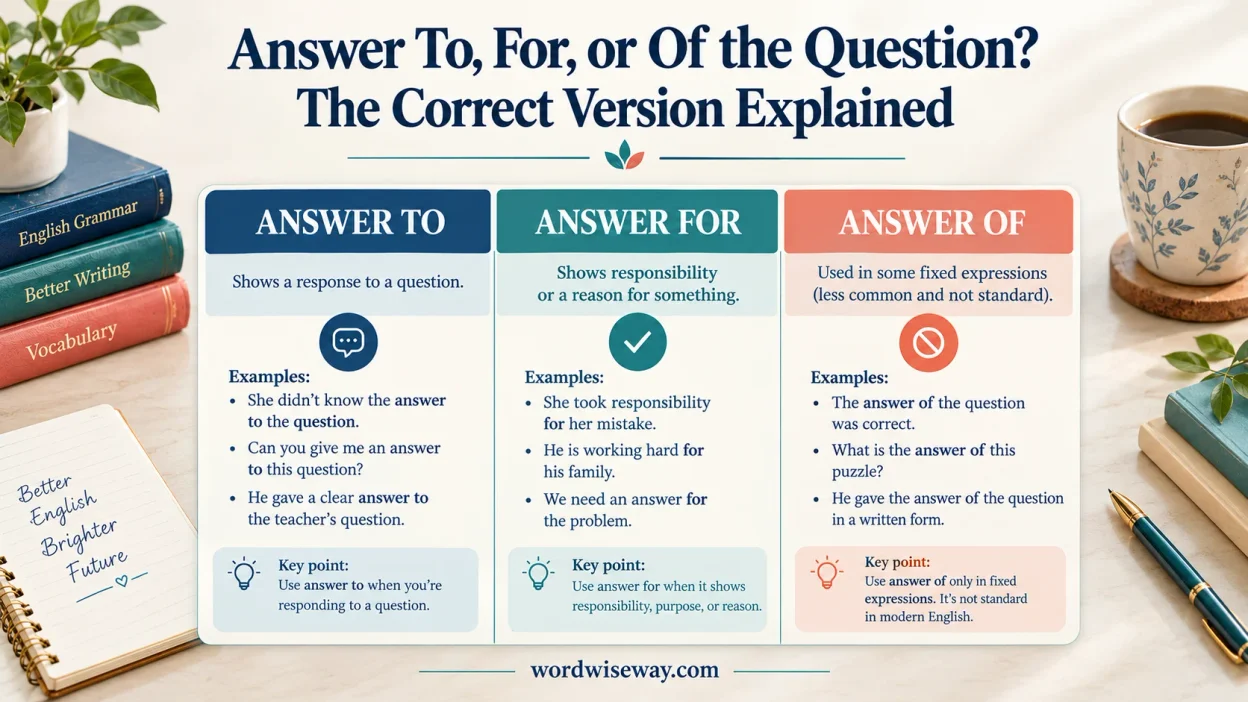
Answer To, For, or Of the Question? The Correct Version Explained explores how context and grammar help you choose the correct preposition in English.
In English grammar, choosing between answer to, answer for, and answer of depends on context and common usage. The phrase “the answer to the question” is the standard expression. Prepositions influence sentence meaning, sentence structure, and natural phrasing. Understanding grammatical rules and language conventions helps you improve word choice, writing clarity, and grammatical correctness.
When comparing these phrases, consider their meaning and context. Answer to the question refers to a response to a question. Answer for can describe responsibility, while answer of is less common in this context. Learning preposition usage, phrase structure, and language patterns helps you recognize correct wording and write clearer English sentences.
Quick Answer:
“Answer to the question” is the standard expression when referring to a response to a question. However, “answer for” has a different meaning, and “answer of” usually doesn’t work when you want to identify a response to a question.
Here’s a quick comparison:
| Expression | Correct Usage | Example |
| Answer to the question | Identifies a response to a question | Her answer to the question was correct. |
| Answer for something | Expresses responsibility or accountability | He must answer for his actions. |
| Answer of the question | Usually incorrect for this intended meaning | Use “answer to the question” instead. |
| Answer the question | Uses answer as a verb with a direct object | Please answer the question honestly. |
| Answer to someone | Can express accountability or a reporting relationship | She answers to the department manager. |
Remember the central distinction: You give an answer to a question, but you answer the question directly. When responsibility enters the picture, “answer for” may be the better choice.
Why Is “Answer To the Question” Correct?
The phrase “answer to the question” follows a standard English grammatical pattern. Here, answer functions as a noun, and the preposition to connects that noun with the question it addresses.
Consider this sentence:
“Her answer to the question surprised everyone.”
The noun answer identifies the response. The phrase to the question explains which question that response addresses.
This construction appears naturally in academic writing, professional communication, examinations, and everyday conversations. You can also use it when discussing solutions to problems, puzzles, and difficult situations.
For example:
- The answer to the question appears in the final paragraph.
- We finally discovered an answer to the problem.
- His answer to the teacher’s question was thoughtful.
- Nobody knew the answer to the riddle.
In each sentence, to establishes a relationship between the answer and the question, problem, or riddle.
Answer To a Question as a Noun Phrase
When answer functions as a noun, you generally use to to identify the question being addressed.
The basic pattern is:
Answer + to + question, problem, or issue
You can place this construction in different parts of a sentence without changing its meaning.
As the subject:
“The answer to the question remains unclear.”
Here, the entire noun phrase acts as the subject of the sentence.
As the object:
“The teacher explained the answer to the question.”
In this example, answer is the object of the verb explained. The prepositional phrase identifies the response being discussed.
After a linking verb:
“Her explanation was the answer to our problem.”
This sentence connects the answer with the problem that needed a solution.
Notice that the same construction works in formal and informal settings. Whether you’re writing a school assignment or discussing a puzzle with a friend, “answer to the question” remains a natural choice.
Answer a Question as a Verb Phrase
The rules change slightly when answer functions as a verb.
In standard English, answer can take a direct object without an additional preposition. You can therefore write “answer the question,” “answer the email,” or “answer the phone.”
For example:
- Correct: She answered the question correctly.
- Correct: Please answer my email today.
- Correct: The student answered every question.
- Incorrect for the intended meaning: She answered to the question correctly.
The difference comes from grammatical function rather than a change in the basic idea.
Compare these two sentences:
“His answer to the question was correct.”
“He answered the question correctly.”
The first sentence uses answer as a noun. The second uses it as a verb.
Adding to after the verb answer is unnecessary when you simply mean that someone responded to a question. However, “answer to” is correct in other contexts, particularly when it expresses accountability or a relationship with someone.
Key Differences
The three expressions differ because each preposition establishes a different relationship. Understanding that relationship helps you choose the right phrase without relying on guesswork.
| Phrase | Main Meaning | Example | Explanation |
| Answer to | A response to a question or solution to a problem | The answer to the question is five. | Identifies the question being addressed. |
| Answer for | Responsibility or accountability | She must answer for the mistake. | Indicates responsibility for an action or outcome. |
| Answer of | Not the usual construction for identifying a response to a question | The answer of the question is five. | Replace it with “the answer to the question.” |
| Answer to someone | Being accountable to someone | Employees answer to their supervisor. | Describes a reporting or authority relationship. |
These differences matter because the preposition affects the sentence’s meaning. Substituting one preposition for another can produce an unnatural expression or communicate the wrong idea.
When to Use “Answer To”
Use “answer to” when answer is a noun referring to a response, explanation, or solution connected to a question or problem.
Common examples include:
- The answer to this question is straightforward.
- Scientists are still searching for an answer to the mystery.
- Her answer to the interviewer was honest.
- We need an answer to this technical problem.
- The book provides an answer to several common questions.
The phrase also appears in expressions involving solutions and explanations. For example, “an answer to poverty” refers to a proposed solution, while “an answer to the criticism” refers to a response addressing that criticism.
The preposition to doesn’t always refer to a literal question. It can connect an answer with a broader issue that requires a response or solution.
Grammar tip: When you can replace the phrase with “a response to,” the noun construction will often be appropriate.
For example, “Her answer to the complaint was professional” can also be expressed as “Her response to the complaint was professional.”
When to Use “Answer For”
Use “answer for” when you mean that someone must accept responsibility, explain their conduct, or face consequences for something.
For example:
- You must answer for your actions.
- The manager will answer for the team’s decision.
- Who will answer for the damage?
- Every employee should answer for their own mistakes.
- The company may have to answer for its misleading claims.
These sentences don’t simply ask someone to provide information. They suggest accountability or responsibility.
Imagine that an employee makes a costly mistake at work. A colleague might ask, “Who will answer for this decision?” The question concerns responsibility, not the correct response to a quiz question.
The phrase can also appear in everyday conversations when someone must explain their behavior.
For instance, a parent might say, “You’ll have to answer for your actions.” This means the person will need to explain what they did and accept the consequences.
Important distinction: “Answer for the mistake” and “answer to the question” serve different purposes. The first concerns accountability, while the second identifies a response.
When to Use “Answer Of”
When you’re referring to a response to a question, “answer of the question” is generally not the standard English construction.
For example:
- Nonstandard: The answer of the question is correct.
- Standard: The answer to the question is correct.
However, this doesn’t mean the word of cannot appear near answer. It works naturally in other grammatical relationships.
Consider these examples:
- The meaning of the answer was unclear.
- The wording of the answer confused the students.
- The accuracy of the answer matters.
- The length of the answer depends on the question.
In these sentences, of connects a noun with another noun that explains its meaning, wording, accuracy, or length. It doesn’t directly connect answer to the question it addresses.
This distinction helps you avoid a common mistake: assuming that because “of” works in “the meaning of the answer,” it must also work in “the answer of the question.”
English prepositions don’t follow a universal substitution rule. Each construction has its own established pattern.
Common Mistakes
Even experienced English learners sometimes choose the wrong preposition because these expressions look so similar. The easiest way to correct such errors is to examine the intended meaning and the grammatical role of answer.
| Incorrect or Misleading Sentence | Better Version | Why |
| The answer of the question is simple. | The answer to the question is simple. | Use to to connect the noun answer with the question. |
| She answered to the question correctly. | She answered the question correctly. | The verb answer takes a direct object here. |
| He gave an answer for the question. | He gave an answer to the question. | To is the standard choice for the response being provided. |
| Who will answer to the mistake? | Who will answer for the mistake? | For expresses responsibility in this context. |
| The meaning to the answer is unclear. | The meaning of the answer is unclear. | Of connects meaning with answer. |
Context matters, so not every sentence containing “answer to” or “answer for” is automatically wrong.
For example, “She answers to the director” is grammatically correct when it means that she reports to or is accountable to the director. Likewise, “He answered for his actions” is correct when it expresses responsibility.
Mistake: Confusing Nouns With Verbs
One of the most frequent errors involves using a noun construction where a verb construction would be more natural.
Compare:
- Noun: “I don’t know the answer to the question.”
- Verb: “I don’t know how to answer the question.”
Both sentences are correct, but they have different grammatical structures.
In the first sentence, answer identifies a response. In the second, answer describes the action of responding.
Writers sometimes transfer the noun’s preposition into the verb phrase. That leads to sentences such as “I don’t know how to answer to the question,” even though the intended meaning requires no to.
A useful editing technique is to identify the main verb before checking the preposition. If answer already acts as the verb and takes question as its direct object, you usually don’t need to.
Mistake: Assuming “Answer For” Always Means the Same Thing
The expression “answer for” often signals responsibility, but context can influence its precise meaning.
For example, “I’ll answer for him” might mean that someone will respond on another person’s behalf. In another situation, it could mean accepting responsibility for that person or their conduct.
Likewise, “answer for a decision” commonly suggests accountability, while “answer a question for a colleague” may mean responding on that colleague’s behalf.
Don’t judge a phrase by the preposition alone. Read the entire sentence and determine what relationship the writer intends to express.
Is “Answer To the Question” Always Correct?
“Answer to the question” is correct when answer functions as a noun and identifies a response to a question. However, that doesn’t mean you should insert to every time the word answer appears.
The correct construction depends on how the word functions in the sentence.
Consider these examples:
- “The answer to the question is correct.” Correct noun construction.
- “She answered the question correctly.” Correct verb construction.
- “She answers to the principal.” Correct when expressing accountability or reporting.
- “He must answer for his behavior.” Correct when expressing responsibility.
Each sentence uses a different grammatical pattern because each communicates a different relationship.
“Answer To” in Formal and Academic Writing
Academic writing frequently uses “answer to the question” when discussing a response, explanation, or conclusion.
For example:
“The answer to the research question depends on the evidence collected.”
This sentence clearly identifies the relationship between the response and the research question.
In an examination, you might write:
“The answer to question three is supported by the passage.”
In a research report, you might write:
“The study offers a possible answer to the central research question.”
These examples work because answer functions as a noun. The preposition to introduces the question being addressed.
For concise academic writing, however, you can often use the verb form instead.
Compare:
“The answer to the question demonstrates the relationship between the variables.”
“The findings answer the research question by demonstrating the relationship between the variables.”
Both sentences are grammatical. The second places the action directly in the verb, which can make the sentence more concise.
“Answer For” in Everyday and Professional English
In professional and everyday communication, “answer for” often appears when discussing responsibility, decisions, and consequences.
For example:
“The department head must answer for the team’s decision.”
This sentence suggests that the department head is accountable for the decision.
Similarly, “The company must answer for its claims” suggests that the company may need to justify or defend those claims.
In ordinary conversation, you might hear:
“You’ll have to answer for that later.”
The speaker means that the person will need to explain their actions or accept the consequences.
These uses differ from asking someone to respond to a question. If a teacher asks, “Who can answer this question?” the teacher wants a response, not an admission of responsibility.
Answer To the Question vs. Response To the Question
“Answer to the question” and “response to the question” are both standard English expressions. They share a similar grammatical structure, but their meanings can differ slightly depending on context.
An answer generally provides information that addresses a question. A response can be broader and may include a reaction, explanation, comment, or other form of communication.
Consider these examples:
- “Her answer to the question was 42.”
- “Her response to the question was a detailed explanation.”
- “The answer to the question appears in the textbook.”
- “The company’s response to the complaint addressed three concerns.”
The word answer often suggests that a question has a specific solution. Response allows more flexibility, especially when the issue requires discussion rather than a single correct answer.
The verb forms also follow different patterns:
| Noun Phrase | Verb Phrase | Correct Example |
| Answer to the question | Answer the question | She answered the question. |
| Response to the question | Respond to the question | She responded to the question. |
| Answer to the email | Answer the email | He answered the email. |
| Response to the complaint | Respond to the complaint | They responded to the complaint. |
Notice the important difference: You answer a question, but you respond to a question.
The verb respond typically requires to when identifying the thing receiving the response. The verb answer generally takes the question directly.
Therefore, “respond the question” is usually incorrect in standard English when you mean “respond to the question.”
Examples of Correct Usage in Real Sentences
Practical examples make the distinction easier to recognize. The following sentences show how each expression works in different situations.
Examples Using “Answer To”
Use these sentences as models when writing about questions, problems, and solutions.
- The answer to this question is straightforward.
- We finally found an answer to the technical problem.
- Her answer to the interviewer’s question was thoughtful.
- The textbook contains the answer to the final exercise.
- Researchers are looking for an answer to the mystery.
- There isn’t a simple answer to this complicated issue.
In each example, answer is a noun, and to identifies the question or issue being addressed.
Examples Using “Answer For”
These examples demonstrate responsibility, accountability, and related meanings.
- You must answer for your actions.
- The manager will answer for the team’s decision.
- Who will answer for the damage?
- The organization must answer for its public statements.
- He agreed to answer for his colleague during the meeting.
The final example can mean that he agreed to respond on his colleague’s behalf. This illustrates why the surrounding context matters.
Examples Clarifying “Answer Of”
The following examples show where of works naturally and where it doesn’t.
| Sentence | Correct? | Explanation |
| The answer of the question is five. | No, for the intended meaning | Use “the answer to the question.” |
| The meaning of the answer is unclear. | Yes | Of connects meaning with answer. |
| The wording of the answer needs improvement. | Yes | Of identifies the wording being discussed. |
| The accuracy of the answer matters. | Yes | Of connects accuracy with answer. |
| The answer to the question is five. | Yes | This is the standard noun construction. |
A quick reminder: of can describe a relationship involving an answer, but it doesn’t normally replace to in the phrase “answer to the question.”
A Practical Case Study: Choosing the Right Preposition
Imagine a student writing a short report about a science experiment. The student wants to describe a question, explain the result, and discuss responsibility for an error.
The first draft reads:
“The answer of the question was unclear, so Maya answered to the question with a guess. Later, she had to answer to the mistake.”
Although the reader can understand the general idea, the sentences contain problems.
Here’s a more natural revision:
“The answer to the question was unclear, so Maya answered the question with a guess. Later, she had to answer for the mistake.”
Why does the revision work?
- “Answer to the question” uses the standard noun construction.
- “Answered the question” uses answer as a verb with a direct object.
- “Answer for the mistake” expresses responsibility for an error.
The example demonstrates a simple principle: choosing the right preposition requires understanding the relationship between the words, not merely memorizing a phrase.
How to Remember the Correct Phrase
You don’t need a complicated grammar chart every time you write a sentence. Instead, ask yourself what you want answer to mean.
Use this simple decision guide:
- Are you talking about a response to a question? Use “answer to the question” when answer is a noun.
- Are you describing the act of responding? Use “answer the question” when answer is a verb.
- Are you talking about responsibility? Use “answer for the action” or “answer for the mistake.”
- Are you describing a reporting relationship? Use “answer to someone,” as in “She answers to the director.”
- Are you connecting another noun with an answer? Use of when the complete construction calls for it, as in “the meaning of the answer.”
You can also use a quick substitution test.
If “response to” fits naturally, the noun construction “answer to” may work too. If “take responsibility for” captures your meaning, “answer for” may be appropriate.
For example:
“The answer to the question was incomplete.”
“The response to the question was incomplete.”
Both work because the sentence identifies a response.
However:
“The employee must answer for the mistake.”
Replacing this with “the employee must answer to the mistake” changes the established construction and sounds unnatural for the intended meaning.
Read More: Hid or Hidden: Difference, Meaning, and correct Forms Explained
FAQs
1. Is It “Answer To” or “Answer For the Question”?
“Answer to the question” is the standard expression when referring to a response. “Answer for” can be correct when discussing responsibility or accountability.
2. Is “Answer Of the Question” Grammatically Correct?
“Answer of the question” is generally unnatural in standard English. Use “answer to the question” when referring to a response someone gives.
3. Why Do We Say “The Answer to the Question”?
The preposition “to” connects the answer with the question it addresses. This construction follows common English usage and sounds natural in everyday conversations and formal writing.
4. Can I Use “Answer For” in a Sentence?
Yes. For example, “She must answer for her actions.” Here, “answer for” expresses responsibility rather than a response to a question.
5. What Is the Difference Between “Answer To” and “Answer For”?
“Answer to” usually introduces the question being addressed. “Answer for” often relates to responsibility, accountability, or something a person must explain.
6. Which Preposition Should I Use in Formal Writing?
Use “to” when referring to a response to a question. For example, “Please provide an answer to the question” is appropriate for academic assignments and professional communication.
7. Is “The Answer of This Question” Correct English?
This phrase sounds unnatural in standard English. A more natural version is “the answer to this question,” which clearly expresses the relationship between the question and its response.
8. How Can I Remember the Correct Preposition?
Remember the common expression “answer to a question.” Read examples, practice writing sentences, and notice how reliable English dictionaries and grammar resources use the phrase.
9. Does Context Change the Meaning of “Answer To” and “Answer For”?
Yes. Context helps determine the intended meaning. “Answer to” can identify a question or person receiving an explanation, while “answer for” can express responsibility for an action.
10. What Is the Easiest Way to Avoid Preposition Mistakes?
Learn common phrases instead of memorizing isolated prepositions. Practice expressions such as “answer to a question,” “responsible for an action,” and “depend on something” to develop more natural English usage.
Conclusion
Choosing between answer to, answer for, and answer of becomes easier when you understand the meaning behind each phrase. In everyday English grammar, context, common usage, and grammatical rules help you identify the correct preposition. For example, answer to the question is the natural and widely accepted expression when referring to a response to a question.
Remember that preposition usage depends on how words connect within a sentence. While answer for can relate to responsibility, answer of rarely serves as a natural alternative when discussing a question’s response. Paying attention to sentence structure, word choice, language conventions, and contextual meaning helps you avoid awkward expressions and improve writing clarity.
With regular practice, recognizing prepositional phrases, usage patterns, and grammatical context becomes much easier. Read sentences carefully, notice how native speakers use prepositions, and choose expressions that sound natural. These simple habits strengthen your English writing, improve grammatical correctness, and help you communicate your ideas clearly and confidently.

Evelyn Shaw has spent 14 years at Yale University’s English Department, leading students through close readings, genre studies, and interpretive methodologies. Her scholarly interests include Renaissance drama, gothic fiction, feminist literary criticism, and archival research and examining how texts generate meaning across historical periods. Evelyn has presented at major academic conferences and published essays in peer-reviewed journals, reflecting her passion for rigorous analysis and student-centered learning.