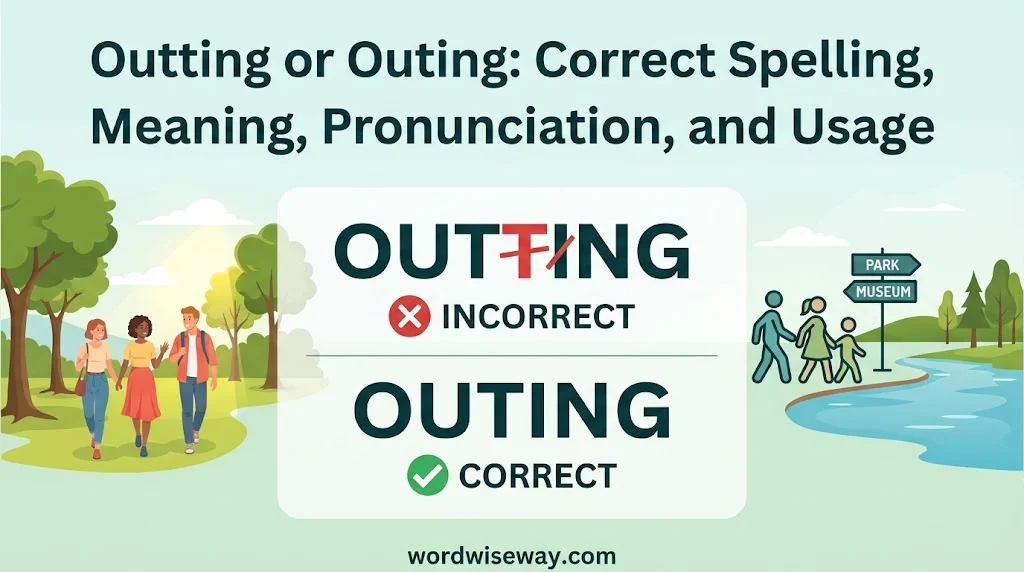
Outting or Outing: Correct Spelling, Meaning, and Usage can confuse English learners, writers, and English speakers. The correct spelling is outing, while outting and outtings are spelling mistakes. The grammar pattern in words like putting, sitting, and running may cause this common mistake, but outing uses only one “t”.
The meaning of outing is a trip or excursion for leisure or entertainment. Examples include going to the movies, visiting a museum, or attending a sporting event. This proper word is the standard form in the English language.
In casual writing, professional writing, emails, assignments, and social media posts, use outing to avoid confusion. It is correct in British English and American English and works naturally in everyday sentence usage.
Quick Answer:
Outing is the correct spelling.
Outting is a misspelling when you mean the standard noun outing.
The correct form is:
OUT + ING = OUTING
Here are a few examples:
- We planned a family outing for Saturday.
- The students went on a school outing.
- Our team enjoyed a weekend outing.
- The pitcher had a strong outing.
Oxford traces the word to out + -ing, which explains why the standard form contains only one t.
So, if you’re deciding between outting or outing, the answer is straightforward:
Correct: outing
Incorrect: outting
What Does “Outing” Mean?
The most common meaning of outing is a short trip or activity taken for pleasure, entertainment, or education.
Oxford describes it as a trip usually taken with a group and generally lasting no more than one day. Cambridge similarly defines it as a short trip made by a group, usually for pleasure or education.
For example:
The children went on a school outing to the museum.
In this sentence, outing means a short educational trip.
You can also use the word for a relaxed recreational activity:
We had a family outing at the park.
An outing doesn’t have to involve a long journey. In many cases, it simply means getting away from your normal routine and doing something enjoyable with other people.
Outing as a Short Trip
An outing usually focuses on the experience rather than the distance traveled.
You might go on an outing to:
- A park
- A museum
- A zoo
- A beach
- A historical site
- A restaurant
- A recreational center
- A local attraction
- A sporting event
For example:
The family planned an outing to the wildlife park.
The sentence emphasizes the shared activity rather than the transportation involved.
That’s one reason outing feels slightly different from the broader word trip. A trip can describe almost any kind of travel, while an outing usually carries a more social, recreational, or educational feeling.
Family Outing
A family outing is an activity or short trip that family members enjoy together.
For example:
We went on a family outing to the beach.
Sunday’s family outing was a wonderful way to spend the afternoon.
The children were excited about the weekend family outing.
The phrase is common because outing naturally suggests a shared activity outside the home.
A family doesn’t necessarily need to travel far for something to qualify as an outing. A few hours at a nearby park can be a family outing just as easily as a visit to a local attraction.
School Outing
Schools often use outing for short trips involving students.
For example:
The class went on an outing to the science museum.
Our teacher organized an educational outing for the students.
The school outing gave the children a chance to learn outside the classroom.
Oxford and Cambridge both recognize school and educational outings as standard uses.
A school outing can combine education with recreation. Students might visit a museum to study history, explore a science center, or visit a nature reserve to observe wildlife.
Team or Company Outing
You can also use outing for a recreational activity involving coworkers or a group.
For example:
The company organized a team outing after the project ended.
Everyone enjoyed the annual office outing.
Our department planned an afternoon outing at the park.
The word works particularly well here because it highlights the social side of the event.
A company outing might involve lunch, a sporting activity, sightseeing, or another group experience. The specific activity doesn’t determine whether you can call it an outing. The context does.
Outing in Sports
Sports writers use outing in another established way.
In sports, an outing can mean an occasion when an athlete takes part in a competition. Oxford labels this use as informal.
For example:
The pitcher had an impressive outing against the Tigers.
Nobody is talking about a day trip in this sentence. Instead, outing refers to the pitcher’s appearance and performance during the game.
You might also see:
The rookie had a difficult outing in his first game of the season.
This meaning is especially common in sports reporting because it provides a compact way to describe a particular appearance.
What Does “Outing” Mean in a Sensitive Context?
Outing has another established meaning that is completely different from the recreational sense.
It can refer to publicly revealing someone’s sexual orientation when that person wanted the information to remain private. Both Oxford and Cambridge record this meaning.
For example, a news report or discussion about privacy might use outing to describe the unwanted public disclosure of someone’s identity.
Context makes the meaning clear.
| Phrase | Meaning |
| family outing | A recreational trip or activity |
| school outing | A short educational or recreational trip |
| team outing | A group recreational activity |
| athletic outing | An athlete’s appearance in a competition |
| public outing | Public disclosure of private information in the relevant context |
The spelling remains outing regardless of which meaning applies.
Why Is “Outting” Incorrect?
The confusion usually comes from English consonant-doubling patterns.
When certain English words take -ing, their final consonant doubles:
- run → running
- sit → sitting
- stop → stopping
- swim → swimming
Because of these familiar examples, someone might reason:
out + ing = outting
Unfortunately, English spelling doesn’t work that way.
The standard form is:
out + -ing = outing
Oxford gives the word origin as out + -ing.
That means the extra t isn’t part of the standard spelling.
Why “Running” Has Two Ns but “Outing” Has One T
Compare these words:
| Base word | Correct form |
| run | running |
| sit | sitting |
| stop | stopping |
| swim | swimming |
| out | outing |
The important lesson is that you shouldn’t apply the consonant-doubling pattern automatically to every word.
English has spelling patterns, but those patterns have conditions and exceptions. Sometimes the safest approach is simply to learn the established form of a frequently used word.
For outing, remember one simple formula:
OUT + ING = OUTING
Outting vs. Outing: Side-by-Side Comparison
| Feature | Outing | Outting |
| Standard spelling | Correct | Incorrect |
| Letters | O-U-T-I-N-G | O-U-T-T-I-N-G |
| Standard dictionary form | Yes | No, for the intended noun |
| Common meaning | Short trip or recreational activity | Usually a spelling mistake |
| Recommended in writing | Yes | No |
| Example | We planned an outing. | We planned an outting. |
The difference is only one letter, but that extra t makes the spelling incorrect.
If you’re writing a school assignment, blog post, email, report, or social media caption, use outing.
How to Spell “Outing” Correctly
The simplest way to remember the spelling is to separate the base word from the ending:
OUT + ING
Now put them together:
OUTING
There is no second t.
You can reinforce the spelling by remembering common phrases:
- family outing
- school outing
- weekend outing
- team outing
- afternoon outing
- day outing
- outing with friends
- outing to the beach
Seeing the correct spelling repeatedly makes the pattern easier to recognize.
Here’s another useful trick. If you aren’t sure whether outting looks right, remove the -ing ending mentally.
You get:
out
Now add -ing:
outing
That gives you the standard form without inserting an unnecessary letter.
How to Pronounce “Outing”
The word outing has two syllables:
OUT-ing
Cambridge gives the US pronunciation as /ˈaʊ.t̬ɪŋ/ and the UK pronunciation as /ˈaʊ.tɪŋ/.
For an easy pronunciation guide, think:
OUT-ing
The first syllable sounds like out.
The second sounds like ing.
The pronunciation doesn’t contain an extra syllable just because someone writes the incorrect form outting.
When speaking naturally, the word flows as two syllables.
How to Use “Outing” in a Sentence
Once the spelling is clear, using outing is simple.
Family Outing Examples
We enjoyed a family outing at the park.
Our family planned an outing to the beach.
The weekend outing gave everyone time to relax.
These examples use outing in its most familiar recreational sense.
School Outing Examples
The students went on a school outing to the museum.
Our teacher organized an educational outing for the class.
The school outing helped students learn about local history.
These examples show how outing can describe an organized educational activity.
Workplace Outing Examples
The company arranged a team outing after the annual meeting.
Everyone enjoyed the office outing.
Our department planned an afternoon outing.
In each case, outing describes a shared activity rather than a formal business trip.
Sports Examples
The pitcher had a strong outing.
The goalkeeper’s latest outing was difficult.
The rookie delivered an impressive outing in his first game.
Here, outing refers to the athlete’s appearance or participation in competition.
Common Mistakes With “Outing”
Several mistakes can appear alongside the outting or outing confusion.
Mistake: Writing “Outting”
Incorrect:
We had a great family outting.
Correct:
We had a great family outing.
The solution is simple: remove the second t.
Mistake: Applying the Wrong Doubling Rule
English contains many words with doubled consonants before -ing, but that doesn’t mean every word follows the same pattern.
For example:
run → running
but:
out → outing
Learning the actual spelling of common words is more reliable than applying a broad rule without checking how the word behaves.
Mistake: Writing “A Outing”
Because outing starts with a vowel sound, the correct article is an.
Incorrect:
We planned a outing.
Correct:
We planned an outing.
Other examples include:
- an outing
- an educational outing
- an afternoon outing
- an enjoyable outing
The choice between a and an depends on pronunciation rather than simply looking at the first written letter.
Mistake: Confusing an Outing With a Trip
An outing and a trip can overlap in meaning, but they’re not interchangeable in every sentence.
A trip is a broad term for travel. It can describe a business journey, vacation, weekend visit, or many other forms of travel.
An outing usually suggests something shorter and more recreational or educational.
For example:
We took a trip to New York.
This could mean several days of travel.
Compare it with:
We went on an outing to the park.
The second sentence suggests a shorter recreational activity.
Outing vs. Excursion vs. Trip
Several English words describe travel or short journeys, but each has a slightly different emphasis.
| Word | Typical meaning | Example |
| Outing | A short trip for pleasure or education, usually with a group | We went on a family outing. |
| Excursion | A short organized trip, often for pleasure | The class took an excursion to the museum. |
| Trip | A general term for traveling somewhere | We took a trip to Chicago. |
| Journey | Travel from one place to another, often emphasizing the travel itself | The journey took six hours. |
| Jaunt | A short, usually enjoyable trip | We took a quick jaunt into town. |
Oxford distinguishes outing from related words such as trip, journey, tour, expedition, and excursion. It describes an outing as a short trip for pleasure or education, generally involving a group and lasting no more than one day.
When Should You Use “Outing”?
Use outing when the activity is short and the recreational or educational experience matters.
The children enjoyed their outing to the zoo.
When Should You Use “Trip”?
Use trip when you want a broad word for travel.
We took a business trip to Chicago.
When Should You Use “Excursion”?
Use excursion when the journey sounds organized or purposeful.
The students went on an excursion to the historical site.
The boundaries aren’t rigid. A single event might reasonably be called a trip or an outing, depending on what you want to emphasize.
Is “Outing” the Same in American and British English?
Yes. Outing is standard in both American and British English.
The pronunciation differs slightly, but the spelling stays the same. Cambridge lists both US and UK pronunciations for outing, while Oxford provides the same standard written form in its American English dictionary.
So there is no standard spelling difference such as:
American: outing
British: outting
That distinction doesn’t exist.
Whether you’re writing for an American audience or a British audience, use outing.
Is “Outing” a Noun or a Verb?
When outing means a trip, excursion, or athletic appearance, it functions as a noun.
For example:
The outing was canceled because of rain.
Here, outing names an activity.
The plural is:
outings
For example:
The students enjoyed several outings during the school year.
Oxford lists outing as a countable noun for the trip sense.
The word also has a connection with the verb out, but that grammatical use is separate from the everyday noun meaning discussed here.
A Practical Case Study: Choosing Between Outting and Outing
Imagine you’re preparing a school newsletter.
Your first sentence reads:
Our annual school outting will take place next Friday.
The sentence sounds natural when read quickly. Yet the spelling contains an unnecessary t.
The corrected version is:
Our annual school outing will take place next Friday.
Now consider a sports article:
The pitcher had an excellent outing.
The spelling remains exactly the same, but the meaning changes. In the first sentence, outing means a school trip. In the second, it means an athlete’s appearance in competition.
That’s an important point about English vocabulary: meaning can change with context without changing the spelling.
Key Facts About “Outing”
Here are the main facts worth remembering:
- Outing is the correct standard spelling.
- Outting is a misspelling when referring to the standard noun.
- Outing has one t.
- The word is commonly used as a noun.
- The plural form is outings.
- Its most common meaning is a short trip for pleasure or education.
- An outing often involves a group.
- Oxford describes the common trip sense as generally lasting no more than one day.
- The word can describe family, school, workplace, and recreational activities.
- In sports, outing can describe an athlete’s appearance in a competition.
- Outing also has a separate meaning involving the public disclosure of someone’s private sexual orientation.
- The US pronunciation is approximately OUT-ing.
- American and British English use the same spelling.
- The word comes from out + -ing.
Read More: Couch or Coach: Correct Spelling, Meaning, and Usage
FAQs
1. Is “outting” or “outing” correct?
Outing is the correct spelling. Outting is a common spelling mistake. The word outing refers to a trip, excursion, or activity done for enjoyment.
2. Is “outtings” a correct English word?
No, outtings isn’t the standard English spelling. The correct plural form is outings. For example, you can say, “Our family enjoys weekend outings.”
3. Why do people spell outing as outting?
People often confuse outing with words such as putting, sitting, and running. Those words double their final consonants before adding -ing, but outing doesn’t follow that pattern.
4. What does outing mean?
An outing is a short trip or visit made for leisure, entertainment, or a particular activity. A visit to a museum, movie theater, park, or sporting event can all be described as an outing.
5. What is the plural of outing?
The plural of outing is outings. You simply add -s to the singular form. For example, “The students enjoyed several outings during the school year.”
6. Can I use outing in formal writing?
Yes. Outing works in both casual and formal contexts when its meaning fits the sentence. You can use it in emails, school assignments, articles, reports, and other forms of writing.
7. Is outing a noun or a verb?
Outing is generally used as a noun when it means a trip or recreational activity. It can also appear as the -ing form of the verb out in certain contexts, although the noun is the common use discussed here.
8. Is outing spelled the same in British and American English?
Yes. Outing has the same spelling in both British English and American English. There is no standard regional spelling that changes it to outting.
9. How can I remember the spelling of outing?
A simple way to remember it is to focus on the word out. Add -ing without doubling the t: out + ing = outing. This can help you avoid the tempting but incorrect form outting.
10. What is an example of outing in a sentence?
You could write, “Our class went on an outing to the museum.” Here, outing describes a planned trip that students took together for an educational and enjoyable experience.
Conclusion
The difference between outing and outting is small in appearance but important in correct English spelling. Outing is the standard form, while outting should be avoided in normal writing. Once you connect the word with out + ing, the spelling becomes much easier to remember.
Whether you’re writing a school assignment, email, article, or social media post, choosing outing keeps your sentence clear and polished. Its plural form is outings, so there is no need to add an extra t in either form.