Choosing between My Wife and I, My Wife and Me, and Me and My Wife can confuse English learners. The correct choice depends on whether the pronoun acts as a subject or an object. Although many people believe “and I” is always right, that generalization is incorrect. Understanding basic English grammar helps you avoid common mistakes in everyday writing and speaking.
A simple trick is to remove the other person and test the remaining “My wife and I went shopping” is correct because “I” performs the actionpronoun. For example,. However, “They invited my wife and me” is correct because “me” receives the action. This method makes pronoun choice easier and improves sentence clarity.
Remember, subject pronouns perform actions, while object pronouns receive them. Learning this distinction strengthens your grammar skills and helps you write clear, natural English sentences.
Quick Answer:
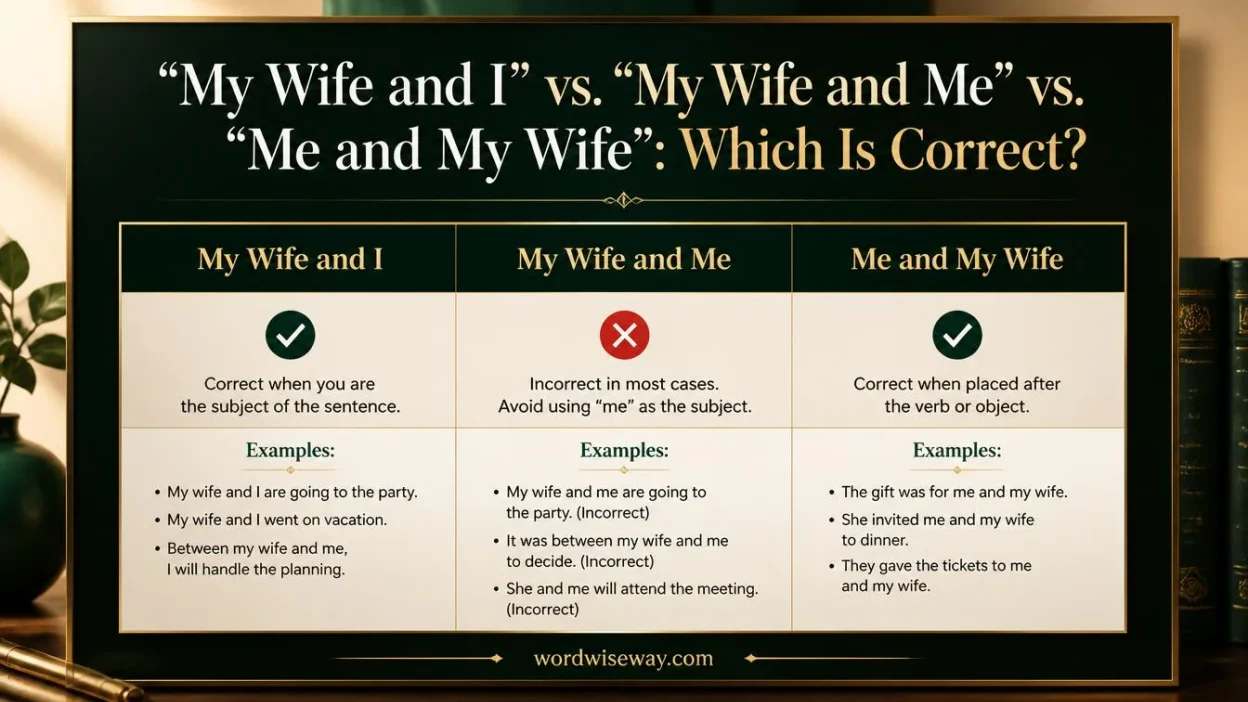
The correct expression depends on the grammatical role the phrase plays in your sentence. Each option has a different use in standard written English.
| Expression | Grammatical use | Example |
| My wife and I | Subject performing an action | My wife and I visited the museum. |
| My wife and me | Object of a verb or preposition | They invited my wife and me. |
| Me and my wife | Common informal subject construction; also possible as an object phrase | Me and my wife went shopping. (Informal) |
Remember these three basic rules:
- Use “my wife and I” when the phrase acts as the subject: “My wife and I own a small business.”
- Use “my wife and me” when the phrase acts as an object: “The manager congratulated my wife and me.”
- In formal writing, prefer “my wife and I” over “me and my wife” when the phrase serves as the subject.
A useful shortcut is to remove “my wife and” temporarily. If “I” fits the remaining sentence, use “my wife and I.” If “me” fits, use “my wife and me.” This test works for many common constructions, although complex sentences sometimes require a closer look.
What Does “My Wife and I” Mean?
“My wife and I” refers to two people, with the speaker included as one of them. The phrase combines a noun phrase, “my wife,” with the first-person singular subject pronoun “I.”
The important point is that “I” functions as a subject pronoun. It identifies the person performing an action or participating as the subject of a sentence. When you and your wife perform an action together, this expression usually fits standard English grammar.
For example:
- My wife and I started a garden last spring.
- My wife and I discussed the proposal.
- My wife and I are planning a family vacation.
- My wife and I attended the conference yesterday.
In each example, the phrase tells readers who performed the action or took part in the situation. The pronoun “I” works because the entire phrase occupies the subject position.
When to Use “My Wife and I”
Use “my wife and I” when you and your wife jointly perform the action described by the sentence. The phrase often appears at the beginning, although grammatical function matters more than position.
Use it as the subject of a sentence.
For example, “My wife and I prepared dinner for our guests” is correct because both people prepared the meal. The phrase functions as the subject of the verb “prepared.”
Use it when describing shared experiences or decisions.
“My wife and I decided to renovate the kitchen” clearly identifies both decision-makers. Similarly, “My wife and I learned Spanish together” describes an activity both people participated in.
Use it in formal and professional writing.
When writing business correspondence, reports, applications, or academic assignments, “my wife and I” is the standard choice when the phrase acts as a subject.
Consider these additional examples:
- My wife and I appreciate your generous offer.
- My wife and I will attend the ceremony.
- My wife and I believe this plan will work.
- My wife and I have lived here for five years.
Each sentence uses the subject pronoun “I” correctly. The phrase doesn’t become correct simply because it sounds formal; it works because its grammatical role requires a subject.
Is “My Wife and I” Ever Incorrect?
Yes. “My wife and I” becomes incorrect in standard English when the entire phrase functions as an object and the pronoun “I” is used where “me” is required.
For example:
❌ The organizer invited my wife and I to dinner.
✅ The organizer invited my wife and me to dinner.
The organizer performed the action, while the two guests received the invitation. Therefore, the phrase acts as the object of the verb “invited.”
Here’s another example:
❌ This gift is for my wife and I.
✅ This gift is for my wife and me.
The preposition “for” requires an object pronoun in this construction. Because “me” is the appropriate object form, the second sentence follows standard grammar.
The lesson is simple: “I” isn’t automatically more correct or more formal than “me.” Each pronoun has its own grammatical job.
What Does “My Wife and Me” Mean?
“My wife and me” refers to the speaker and their wife as the people receiving an action or appearing after a preposition. The pronoun “me” is the object form of the first-person singular pronoun “I.”
Although many people associate “me” with casual conversation, it isn’t less correct than “I.” In fact, “my wife and me” is the grammatically correct choice whenever the phrase requires an object pronoun in standard English.
For example:
- Our friends invited my wife and me to dinner.
- The teacher congratulated my wife and me.
- The travel agent booked a hotel for my wife and me.
- The decision surprised my wife and me.
In these sentences, the phrase doesn’t perform the main action. Instead, it receives the action or follows a preposition.
When to Use “My Wife and Me”
Two common grammatical patterns call for “my wife and me”: the direct or indirect object of a verb and the object of a preposition.
When the phrase receives an action
A verb can describe an action directed toward another person. When you and your wife receive that action, “my wife and me” often fits.
| Example | Why it’s correct |
| The host welcomed my wife and me. | The phrase receives the action of “welcomed.” |
| Our neighbors helped my wife and me. | The phrase receives the help. |
| The committee selected my wife and me. | The phrase receives the action of “selected.” |
| The company thanked my wife and me. | The phrase receives the thanks. |
When the phrase follows a preposition
Prepositions establish relationships involving people, places, objects, or ideas. Their objects normally take objective pronouns, so “me” is appropriate in these constructions.
| Example | Preposition |
| The tickets are for my wife and me. | For |
| The invitation was addressed to my wife and me. | To |
| The disagreement remained between my wife and me. | Between |
| Our friends traveled with my wife and me. | With |
| The children sat beside my wife and me. | Beside |
Notice that the phrase doesn’t have to appear at the end of a sentence. Its grammatical function determines which pronoun you should use.
Examples of “My Wife and Me” in Everyday Sentences
Context makes the distinction easier to recognize. Compare these examples, which show how the same people can appear in different grammatical roles.
- At work: The manager asked my wife and me to review the proposal.
- During travel: The airline offered my wife and me alternative flights.
- At home: The children made breakfast for my wife and me.
- At a celebration: The guests congratulated my wife and me on our anniversary.
- In a conversation: Our friends told my wife and me about their new house.
In every case, the phrase functions as an object. Replacing “me” with “I” would create a pronoun-case error in standard English.
One useful habit is to identify the main verb or preposition before choosing a pronoun. That small step prevents many common mistakes.
What Does “Me and My Wife” Mean?
“Me and my wife” refers to the same two people as the other expressions, but it places “me” first. The phrase appears frequently in everyday conversation, informal storytelling, dialogue, and some varieties of English.
However, putting “me” first doesn’t change its grammatical case. “Me” remains an object pronoun, even when speakers use it informally as part of a subject phrase.
For example, someone might casually say, “Me and my wife went to the beach.” Listeners will generally understand the meaning immediately. In standard edited English, however, “My wife and I went to the beach” is the preferred version.
This distinction matters because everyday speech and formal writing don’t always follow the same conventions. A phrase can be widely understood without being the best choice for a professional document.
Is “Me and My Wife” Grammatically Correct?
The answer depends on how the phrase is used and which standard you’re following.
In standard edited English, “me and my wife” is generally not recommended as the subject of a sentence. The subject requires a subject pronoun, so “my wife and I” is the conventional choice.
Compare these examples:
| Informal or nonstandard for formal writing | Preferred standard English |
| Me and my wife went shopping. | My wife and I went shopping. |
| Me and my wife are moving next month. | My wife and I are moving next month. |
| Me and my wife own this house. | My wife and I own this house. |
| Me and my wife attended the event. | My wife and I attended the event. |
The left-hand versions occur in real speech, but the right-hand versions are safer in school assignments, professional correspondence, and edited articles.
There is also an important distinction between informal subject use and object use. The sequence “me and my wife” can occur as an object phrase in casual speech, although standard writing generally favors “my wife and me.”
For example:
- Informal: They invited me and my wife.
- Preferred in formal writing: They invited my wife and me.
Both convey the same meaning, but the second follows the conventional order for referring to yourself and another person.
Should You Say “Me and My Wife” or “My Wife and Me”?
When the phrase acts as an object, “my wife and me” is generally the better choice in standard English. It follows the conventional practice of mentioning the other person before yourself.
For example:
- Preferred: The photographer took a picture of my wife and me.
- Less formal: The photographer took a picture of me and my wife.
When the phrase acts as a subject, use “my wife and I” instead.
- Preferred: My wife and I took a picture together.
- Informal: Me and my wife took a picture together.
The difference isn’t merely the order of the words. It involves two separate considerations: pronoun case and conventional word order.
Pronoun case determines whether you need “I” or “me.” Conventional word order explains why standard English generally places the other person first. Keeping these rules separate makes the choice much easier.
Key Differences
The central distinction between these phrases is grammatical function. “I” is a subject pronoun, while “me” is an object pronoun.
Both expressions refer to the speaker and their wife. However, each fits a different role in a sentence.
| Feature | My wife and I | My wife and me |
| Pronoun type | Subject pronoun | Object pronoun |
| Main grammatical role | Subject | Object |
| Typical example | My wife and I cooked dinner. | They thanked my wife and me. |
| After a preposition | Generally incorrect in standard usage | Usually correct |
| In professional writing | Correct when used as a subject | Correct when used as an object |
Consider the following paired examples:
Example one
- My wife and I called the doctor.
- The doctor called my wife and me.
In the first sentence, the two people make the call. In the second, the doctor makes the call and contacts them.
Example two
- My wife and I received the invitation.
- The invitation was addressed to my wife and me.
The first phrase serves as the subject. The second follows the preposition “to,” so the objective form “me” is appropriate.
Example three
- My wife and I discussed the budget.
- The accountant discussed the budget with my wife and me.
The same people appear in both sentences, but their grammatical roles change.
The easiest way to remember the difference is to focus on the sentence’s structure. Don’t choose a pronoun simply because it sounds more sophisticated.
How to Choose Between “I” and “Me” in a Sentence
You can resolve most “my wife and I” versus “my wife and me” questions with a simple grammatical check. First, identify what the phrase does in the sentence. Then test the pronoun without the other person.
This method works because English pronouns change form depending on their grammatical role. The same distinction appears in phrases such as “my husband and I,” “my friend and me,” and “my brother and I.”
The Simple Removal Test
The removal test involves temporarily taking the other person out of the sentence. Then read the sentence using only “I” or “me.”
For example:
Sentence one
“My wife and I went to the market.”
Remove “my wife and.”
“I went to the market.”
The sentence remains grammatical, so “my wife and I” is the correct choice.
Sentence two
“The organizer invited my wife and me.”
Remove “my wife and.”
“The organizer invited me.”
This sentence also remains grammatical. Therefore, “my wife and me” is correct.
Sentence three
“The tickets were reserved for my wife and me.”
Remove “my wife and.”
“The tickets were reserved for me.”
The pronoun “me” works because it follows the preposition “for.”
Here is a quick reference table:
| Original sentence | Test sentence | Correct phrase |
| My wife and I arrived early. | I arrived early. | My wife and I |
| They invited my wife and me. | They invited me. | My wife and me |
| The gift is for my wife and me. | The gift is for me. | My wife and me |
| My wife and I prepared lunch. | I prepared lunch. | My wife and I |
Important limitation: The removal test is a practical shortcut, not a complete substitute for grammatical analysis. Some complex sentences contain additional clauses or unusual constructions that require more careful examination.
Check the Pronoun’s Role, Not Just Its Position
A common mistake is assuming that “I” belongs at the beginning of a sentence and “me” belongs near the end. Although subjects often appear before verbs, English word order varies.
For example, consider this sentence:
“After the meeting ended, my wife and I went home.”
The subject appears after an introductory clause. Even so, “my wife and I” remains correct because it performs the action of going home.
Now consider this sentence:
“The invitation was sent to my wife and me after the meeting ended.”
The phrase follows the preposition “to.” Therefore, “me” is the correct object form.
To choose accurately, ask yourself two questions:
- Who performs or experiences the action as the sentence’s subject?
- Is the phrase receiving an action or following a preposition?
These questions reveal the grammatical role more reliably than sentence position alone.
Common Mistakes
Even confident English speakers sometimes mix up these expressions. The confusion often comes from trying to sound formal rather than checking how the sentence works.
Here are the mistakes worth avoiding.
Using “My Wife and I” as an Object
This error often occurs because people assume “I” always sounds more educated or professional.
Incorrect: The receptionist called my wife and I.
Correct: The receptionist called my wife and me.
The receptionist performed the action, and the two people received the call. Therefore, the object pronoun “me” is necessary.
Replacing Every “Me” With “I”
The opposite mistake is just as common. Some writers replace “me” with “I” whenever another person appears in the same phrase.
Incorrect: Please send the documents to my wife and I.
Correct: Please send the documents to my wife and me.
The preposition “to” takes an object in this construction. Using “I” doesn’t make the sentence more formal; it makes the pronoun choice incorrect in standard English.
Assuming “Me and My Wife” Is Always Unacceptable
Informal speech often differs from formal writing. People may use “me and my wife” naturally in casual conversation without causing any confusion.
However, when writing a business email, academic assignment, or polished article, choose the standard form that matches the grammatical role.
Choosing a Pronoun Based Only on Word Order
A phrase doesn’t require “I” simply because it appears near the beginning of a sentence. Likewise, “me” isn’t correct just because the phrase appears later.
Compare these examples:
- Correct: My wife and I were surprised by the announcement.
- Correct: The announcement surprised my wife and me.
- Incorrect in standard English: My wife and I were invited to dinner?
The last example is actually grammatically correct as written because “my wife and I” is the subject of the passive verb phrase “were invited.” This illustrates why you must examine the sentence’s structure rather than rely on a simplistic active-versus-passive rule.
Different Contexts
The subject-object distinction remains the same across different writing situations. However, the level of formality can affect which wording is most appropriate.
| Context | Recommended expression | Example |
| Academic writing | My wife and I / my wife and me, depending on function | My wife and I completed the assignment. |
| Professional email | My wife and I / my wife and me, depending on function | Please send the information to my wife and me. |
| Everyday conversation | Any commonly understood form, depending on dialect and register | My wife and I went out for dinner. |
| Informal dialogue | Me and my wife may appear naturally | Me and my wife had a great time. |
| Published articles | Standard subject-object forms | The editor interviewed my wife and me. |
In Professional Emails
Professional writing benefits from clear, conventional grammar. Use “my wife and I” as the subject and “my wife and me” as the object.
For example:
“ My wife and I appreciate your assistance. Please forward the final documents to my wife and me.”
This wording keeps both pronouns consistent with their grammatical roles.
In Academic Assignments
Teachers generally expect standard edited English in formal assignments. Using “my wife and I” as an object may be marked as a pronoun-case error.
For example:
- Correct: My wife and I researched the topic.
- Correct: The instructor praised my wife and me.
Understanding the grammatical distinction helps you avoid errors in essays, examinations, and reports.
In Everyday Conversation
Casual speech allows more variation in phrasing. You may hear “me and my wife” in conversations, interviews, or informal storytelling.
That doesn’t mean every expression works equally well in every setting. If you’re unsure, the standard forms are reliable choices in both speech and writing.
Read More: Rung or Rang: Correct Spelling, Meaning, Rules, and Examples
FAQs
What Is the Difference Between “My Wife and I” and “My Wife and Me”?
“My wife and I” is used when you are part of the subject, while “my wife and me” is used when you are part of the object. The correct choice depends on how the phrase functions in the sentence.
Is “My Wife and I” Always Grammatically Correct?
No, “my wife and I” is not always correct. Use it when the phrase acts as the subject, such as “My wife and I enjoy reading.” Use “my wife and me” when the phrase acts as an object.
Is It Correct to Say “Me and My Wife”?
Yes, people use “me and my wife” in casual conversations. However, in standard formal English, “my wife and I” is preferred when the phrase is the subject. For an object, “my wife and me” is generally preferred.
Should I Say “My Wife and I Went Shopping” or “Me and My Wife Went Shopping”?
“My wife and I went shopping” is the standard grammatical choice. The phrase is the subject because it performs the action of going shopping. “Me and my wife went shopping” is common in informal speech but is not preferred in formal writing.
When Should I Use “My Wife and Me” in a Sentence?
Use “my wife and me” when the phrase acts as an object. For example, “Our friends invited my wife and me to dinner.” You can check the sentence by removing “my wife and” and seeing whether “me” fits.
Is “My Wife and Me” Correct After a Preposition?
Yes, “my wife and me” is correct after prepositions such as for, with, to, and between. For example, “This gift is for my wife and me.” The pronoun “me” works because prepositions take object pronouns in these constructions.
How Can I Remember Whether to Use “I” or “Me”?
Try removing the other person from the sentence. If “I” makes the remaining sentence correct, use “my wife and I.” If “me” fits, use “my wife and me.” This simple trick helps you identify the correct pronoun without memorizing complicated grammar rules.
Should I Put “My Wife” Before “I” or “Me”?
In standard English, placing the other person first is generally considered polite. Therefore, “my wife and I” and “my wife and me” are usually preferred over “I and my wife” or “me and my wife.” However, the grammatical role still determines which pronoun is correct.
Can I Use “My Wife and I” in Emails and Professional Writing?
Yes, when the phrase acts as the subject. For example, “My wife and I appreciate your invitation.” If the phrase acts as an object, write “Please contact my wife and me.” Choosing the correct pronoun makes professional writing clearer and more polished.
What Is the Easiest Way to Check These Phrases?
Identify the action and determine who performs or receives it. Then remove the reference to your wife and test the pronoun. Use “I” for a subject and “me” for an object. This quick check helps you choose the right phrase in most everyday situations.
Conclusion
Choosing between “My Wife and I,” “My Wife and Me,” and “Me and My Wife” becomes much easier when you understand the role of each pronoun. The main rule is simple: use “I” when the phrase acts as the subject and “me” when it acts as the object. Don’t assume that “and I” is always correct.
When you’re unsure, remove the other person from the sentence and read it again. For example, “My wife and I went shopping” becomes “I went shopping,” while “They invited my wife and me” becomes “They invited me.” Both sentences sound natural because the pronouns fit their grammatical roles.
With a little practice, you’ll recognize the correct phrase without second-guessing yourself. Pay attention to how pronouns work in everyday conversations, emails, and professional writing. Once you understand this simple distinction, you can write clearer sentences and avoid one of the most common mistakes in English grammar.

Evelyn Shaw has spent 14 years at Yale University’s English Department, leading students through close readings, genre studies, and interpretive methodologies. Her scholarly interests include Renaissance drama, gothic fiction, feminist literary criticism, and archival research and examining how texts generate meaning across historical periods. Evelyn has presented at major academic conferences and published essays in peer-reviewed journals, reflecting her passion for rigorous analysis and student-centered learning.