Have you ever wondered whether you should write catalogue or catalog? Many English learners, writers, and even professionals hesitate because both spellings appear correct. The confusion becomes even greater when reading international websites, academic publications, or online stores that use different versions.
As an English teacher and language specialist, I’ve seen students repeatedly ask which spelling is actually correct. The answer is simple: both are correct, but the right choice depends on whether you’re writing in British or American English. In this guide, you’ll learn the meaning of catalogue vs catalog, their regional differences, usage rules, real-world examples, and practical tips to help you choose the appropriate spelling with confidence.
Quick Answer:
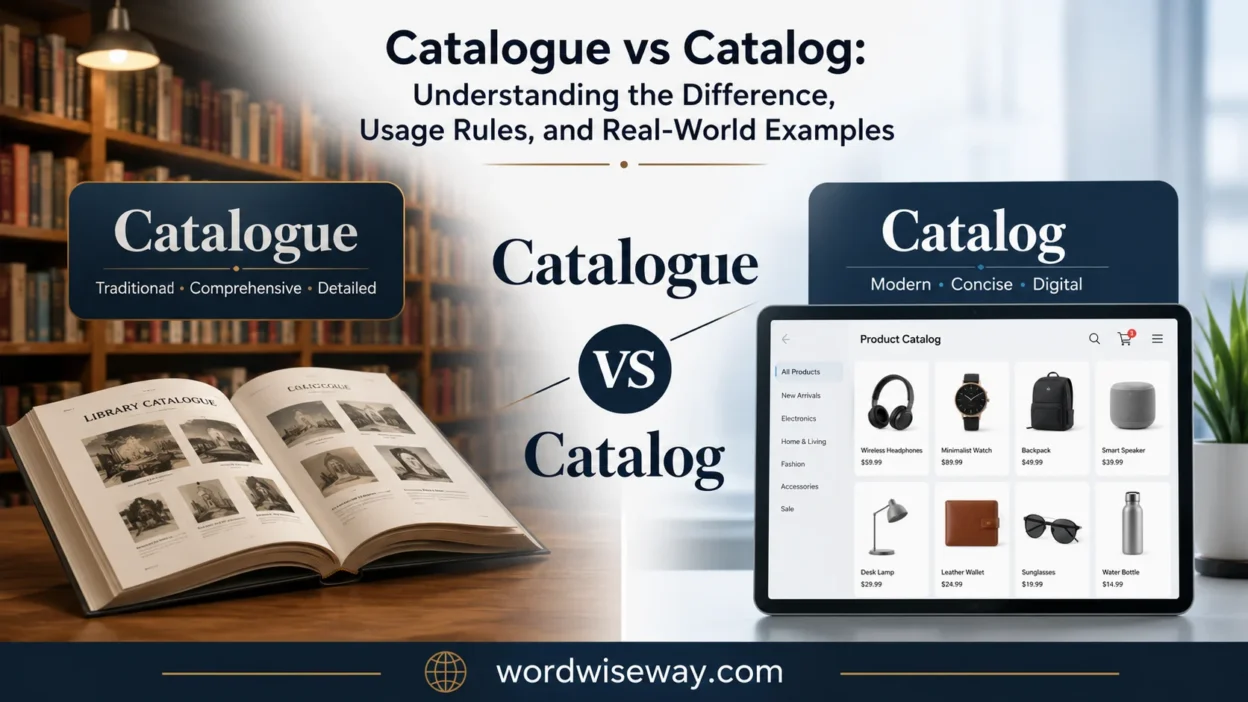
Both catalogue and catalog are correct and have the same meaning. Catalogue is the preferred spelling in British English, while catalog is the standard spelling in American English. Choose the version that matches your audience and use it consistently throughout your writing.
Catalogue vs Catalog Meaning
Before comparing spelling, it helps to understand what both words actually mean.
Both catalogue and catalog refer to:
- A structured list of items
- A systematic collection of products or data
- An organized record used for browsing, searching, or reference
Think of it like a well-labeled warehouse shelf. Every item has a place. Every item is easy to find.
Simple examples you already know
- A library catalog of books
- A fashion catalog showing clothing collections
- A digital product catalog on an e-commerce website
- A museum catalogue listing artifacts
The core idea never changes. Only the spelling shifts depending on region and style.
Catalogue vs Catalog Difference
Here’s the clean breakdown that removes confusion instantly.
- Catalogue → British English spelling
- Catalog → American English spelling
That’s it. No difference in meaning. No hidden grammar rule. No functional distinction.
Why both exist
English evolved differently across regions. British English kept older French-influenced spellings like “catalogue,” while American English simplified many words for efficiency.
You see this pattern elsewhere too:
- Colour vs Color
- Centre vs Center
- Organise vs Organize
“Catalogue” simply follows the British pattern, while “catalog” follows American simplification.
Regional Usage Explained
Spelling depends heavily on audience location. Writers who ignore this often confuse readers or hurt SEO performance.
British English regions
You will typically see catalogue in:
- United Kingdom
- Australia
- New Zealand
- South Africa
- Pakistan and India (formal academic and publishing contexts)
Example:
- University research catalogue
- Museum artifact catalogue
American English regions
You will almost always see catalog in:
- United States
- Most US-based companies
- Tech platforms and SaaS tools
Example:
- Amazon product catalog
- Software data catalog
Global digital reality
Online usage complicates things. Many global companies default to catalog because:
- It is shorter
- It performs better in SEO targeting US traffic
- It aligns with tech industry naming conventions
So even outside the US, “catalog” often wins online.
Read More: “Authorization” or “Authorisation” Meaning, and Correct Usage!
Usage Rules That Actually Work
Instead of memorizing grammar rules, use these practical decision filters.
Use “catalogue” when:
- Writing for British audiences
- Following UK academic standards
- Publishing in Commonwealth-focused media
- Maintaining British English consistency in documents
Example:
The museum published a detailed catalogue of Roman artifacts.
Use “catalog” when:
- Targeting American readers
- Writing for global SaaS or tech platforms
- Creating SEO-driven content for international traffic
- Naming digital products or software features
Example:
The company launched a new product catalog for online shoppers.
The golden rule
Pick one spelling and stay consistent throughout your entire document. Mixing both creates confusion and looks unprofessional.
Catalogue vs Catalog in Real Industries
This difference becomes clearer when you see how industries actually use both terms.
Retail and E-commerce
Retail uses both forms, but with regional intent.
- UK brands: product catalogue
- US brands: product catalog
Example:
- A British fashion brand may publish a seasonal catalogue
- Amazon uses “product catalog” in backend systems
Libraries and archives
Libraries lean toward traditional language structures.
- UK libraries often use catalogue
- US libraries use catalog
Both refer to structured book databases.
Example:
- Library catalogue system
- Digital library catalog search
Technology and data systems
Tech almost always uses catalog.
Why?
- Simplicity matters in software naming
- American English dominates tech documentation
- Shorter terms improve interface clarity
Examples:
- Data catalog in cloud platforms
- API catalog systems
- Metadata catalog tools
Even global companies like AWS and Google Cloud use “catalog.”
Education and academic publishing
Academic writing depends on region.
- UK universities → catalogue
- US universities → catalog
Example:
- Course catalogue (UK university handbook)
- Course catalog (US university portal)
Common Mistakes in Catalogue vs Catalog Usage
Even experienced writers slip up. These are the most common errors.
Mixing both spellings in one document
This usually happens when multiple writers contribute.
Bad example:
The product catalogue includes digital catalog features.
This instantly breaks consistency.
Assuming they are different concepts
Some people think “catalogue” is physical and “catalog” is digital. That’s incorrect.
Both can be physical or digital.
Overcorrecting based on personal preference
Writers sometimes switch spelling mid-article based on what “feels right.” That leads to inconsistency and weak readability.
Industry Case Studies: How Companies Use Catalogue vs Catalog
Case study: E-commerce platform naming
A global e-commerce company faced a choice:
- Use “product catalogue” for UK users
- Use “product catalog” for US users
They chose catalog globally.
Why?
- Simplified backend architecture
- Better SEO consistency
- Reduced duplication of content
Result: clearer indexing and improved search performance in US markets.
Case study: University course systems
A UK-based university maintained “course catalogue” across its entire system.
When expanding internationally, it faced confusion.
Solution:
- Kept “catalogue” for UK-facing content
- Used localized “catalog” pages for US students
Result: better regional clarity without rewriting entire systems.
Case study: SaaS data platforms
Cloud companies standardize on “data catalog.”
Why?
- Tech terminology favors American English
- Developers expect consistency
- Documentation becomes easier to scale
Even non-US companies adopt this standard in technical environments.
Quick Comparison Table
| Feature | Catalogue | Catalog |
| Meaning | Same | Same |
| English variant | British | American |
| Common regions | UK, Commonwealth | US, global tech |
| Usage in tech | Rare | Standard |
| SEO strength | Regional | Global |
| Tone | Traditional | Modern |
Real-Life Examples for Better Understanding
Let’s make this practical.
Example in retail
- UK: “Browse our summer fashion catalogue”
- US: “Browse our summer fashion catalog”
Example in libraries
- UK: “Search the digital book catalogue”
- US: “Search the digital book catalog”
Example in software
- “Data catalog helps organize cloud resources”
- Rarely: “Data catalogue” in modern tech writing
Simple Rule to Never Get Confused Again
Here’s a memory trick that actually works:
- If your audience uses American English → choose catalog
- If your audience uses British English → choose catalogue
- If your audience is global → choose catalog for simplicity and SEO strength
Consistency beats complexity every time.
My Personal Experience
From my classroom experience, I’ve noticed that students often believe catalogue and catalog have different meanings. I explain that the meaning stays the same and only the spelling changes based on British or American English. Once they understand this simple rule, they become much more confident in choosing the correct form for their writing.
FAQs
1. What is the difference between catalog and catalogue?
Both mean the same thing, but catalog is used in American English while catalogue is used in British English.
2. Is catalog correct English?
Yes, catalog is correct in American English and is widely used in modern writing and digital content.
3. Is catalogue British or American?
Catalogue is British English and is commonly used in the UK and other Commonwealth countries.
4. Why do two spellings exist?
The two forms exist because of regional spelling conventions shaped by language evolution and usage habits.
5. Which spelling should I use?
Use catalog for American audiences and catalogue for British audiences.
6. Do catalog and catalogue mean the same thing?
Yes, both catalog and catalogue refer to a list or collection of items.
7. Is catalog more modern?
Yes, catalog is seen as a more simplified and modern American English spelling.
8. Is catalogue still correct today?
Yes, catalogue is still correct and widely used in British English.
9. Where is catalog commonly used?
Catalog is mainly used in the United States and some other regions influenced by American English.
10. Can I mix catalog and catalogue?
It is better not to mix them; choose one spelling style and stay consistent throughout your writing.
Conclusion
The difference between catalog and catalogue mainly depends on regional English usage, not meaning. Both spellings are correct and understood globally, but choosing the right form improves clarity and professionalism. Understanding these spelling conventions helps writers adapt their language to different audiences and maintain consistency in communication.
In everyday writing, especially in English language learning, small spelling differences like this can create confusion, but once understood, they actually make communication more flexible. Whether you use catalog or catalogue, the key is to stay consistent within your document. This awareness also helps readers quickly identify whether the text follows American English or British English standards, making your writing more precise, natural, and audience-friendly.