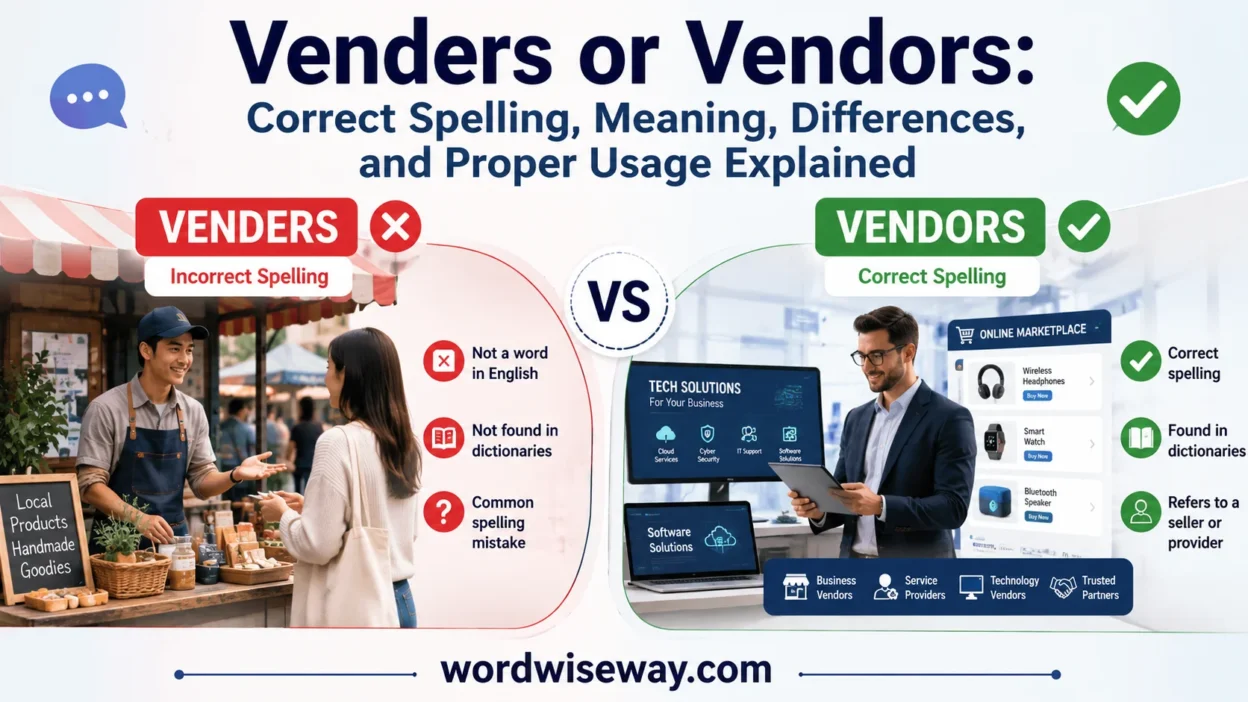
Our unique guide helps you learn practical meanings and pronunciation tips to avoid common mistakes in everyday business communication. The source material spans multiple lines, establishing a solid foundation for mastering American vs British English usage. By reading Venders or Vendors: Correct Spelling, and Meaning, you will quickly discover which term to use in formal documents.
This detailed explanation highlights why vendor is the standard spelling for a person, business, or company that sells goods or services in modern professional settings. In contrast, vender is a rare variant form found almost exclusively in historical or archaic legal contexts. Knowing this distinction ensures your communication remains accurate.
Understanding this one small difference in a single letter matters immensely when choosing the right word for your projects. It impacts how you write an online website page, product description, job document, school paper, email, invoice, or contract. Confusion often arises because English grammar patterns and noun ending rules are not always consistent.
Venders or Vendors: Which Spelling Is Correct?
The correct and preferred spelling in modern English is:
Vendor
The word vender is not considered completely incorrect, but it is an uncommon variation. Most modern dictionaries recognize both forms, yet professional and business writing strongly favors vendor.
Both words have the same meaning:
A person, company, or organization that sells goods or services.
Here is a quick comparison:
| Word | Meaning | Usage Level | Best Choice |
| Vendor | A person or company that sells products or services | Very common | Recommended spelling |
| Vender | A person or company that sells products or services | Less common | Rarely used |
Examples:
✅ The vendor supplied new computers to the company.
✅ The street vendor sells fresh fruit every morning.
⚠️ The street vender sells fresh fruit every morning.
The last sentence still makes sense, but most readers expect vendor.
If you are writing for a professional audience, choose vendor.
What Does Vendor Mean?
Vendor Definition and Meaning
A vendor is a person, business, or organization that sells something to customers or other businesses.
The item being sold can be almost anything, including:
- Physical products
- Digital products
- Software
- Services
- Equipment
- Business solutions
A vendor can operate in many different environments. Some vendors sell directly to individual customers, while others provide products and services to large companies.
For example:
- A food seller at a market is a food vendor.
- A company providing cybersecurity software is a security vendor.
- A business selling products online is an online vendor.
The word has become especially common in business because companies frequently work with outside providers.
Vendor Meaning in Everyday Life
You interact with vendors more often than you might realize.
A few everyday examples include:
| Type of Vendor | What They Provide |
| Food vendor | Meals, drinks, snacks |
| Clothing vendor | Clothes and accessories |
| Online vendor | Products through digital platforms |
| Software vendor | Applications and technology solutions |
| Service vendor | Professional services |
For example:
A local food vendor prepares meals for customers near the office area.
The vendor provides the product, while customers purchase and use it.
Vendor Meaning in Business
In the business world, a vendor is usually a company that provides products or services to another organization.
Businesses depend on vendors for many important operations.
Examples include:
- Office equipment vendors
- Internet service vendors
- Software vendors
- Marketing vendors
- Manufacturing vendors
A company may work with dozens or even hundreds of vendors to operate successfully.
For example:
A company might use:
- A cloud storage vendor for online data storage.
- A payment vendor for processing transactions.
- A technology vendor for software tools.
This is why terms like vendor management and vendor relationship management are common in modern business.
What Does Vender Mean?
Vender Definition
A vender means the same thing as a vendor.
It refers to someone who sells products or services.
However, the spelling appears much less frequently today.
Example:
The vender sold handmade items at the market.
This sentence is understandable, but most modern writers would use:
The vendor sold handmade items at the market.
The meaning does not change. Only the spelling preference changes.
Why Is Vender Less Common?
The English language contains many words ending with -er, so some people naturally assume that vender should be the correct form.
Examples:
- Teacher
- Worker
- Seller
- Farmer
However, many professional roles use the ending -or:
- Doctor
- Director
- Operator
- Investor
The spelling vendor became the dominant form because businesses, organizations, and industries adopted it widely.
Over time, repeated usage made vendor the expected spelling.
Vendor vs Vender: Key Differences Explained
Meaning Difference Between Vendor and Vender
There is almost no difference in meaning.
Both words describe someone who sells goods or services.
Examples:
Vendor:
The vendor provides software solutions to small businesses.
Vender:
The vender provides software solutions to small businesses.
Both sentences communicate the same idea.
Spelling Difference Between Vendor and Vender
The difference is mainly spelling preference.
| Feature | Vendor | Vender |
| Meaning | Seller of goods or services | Seller of goods or services |
| Popularity | Extremely common | Less common |
| Business usage | Widely used | Rare |
| Professional acceptance | Preferred | Accepted but uncommon |
Which One Should You Use?
In almost every modern situation, use:
Vendor
This spelling works best for:
- Business writing
- Academic writing
- Website content
- Professional emails
- Contracts
- Reports
Using vendor helps your writing match current language standards.
Vendor vs Seller vs Supplier: Understanding Related Terms
Vendor vs Seller
The word seller has a broader meaning.
Anyone who sells something can be called a seller.
Examples:
- Someone selling an old laptop.
- A person selling handmade crafts.
- A company selling products online.
A vendor usually sounds more professional and business-focused.
For example:
A person selling homemade food at a festival can be called a seller or vendor.
A company providing enterprise software is usually called a vendor.
Vendor vs Supplier
Many people use vendor and supplier interchangeably, but there is a small difference.
A supplier usually provides materials, products, or resources to another business.
A vendor often sells finished products or services.
| Term | Main Role | Example |
| Vendor | Sells products or services | Software provider |
| Supplier | Provides materials or resources | Raw material provider |
Example:
A furniture company needs wood to make tables.
- The company providing wood is the supplier.
- The company selling finished tables is the vendor.
However, in some industries, a company can be both.
Vendor vs Merchant
A merchant is someone who buys and sells goods for profit.
The word often relates to traditional trade.
A vendor is a broader modern term.
Examples:
- A shop owner selling goods may be called a merchant.
- A technology company providing software may be called a vendor.
The choice depends on the industry and situation.
Why People Confuse Venders and Vendors
Similar Pronunciation Creates Confusion
One of the biggest reasons people confuse venders and vendors is their pronunciation. Both words sound almost identical when spoken, so the difference becomes invisible when people only hear the word.
When someone says “vendor,” you cannot determine the spelling just from the sound. The writer must know which form is commonly accepted in modern English.
This confusion appears often among:
- English learners
- Students
- New writers
- People translating from other languages
- Anyone unfamiliar with business terminology
For example:
The company hired a vendor to manage its software services.
Most readers expect vendor because it is the standard spelling used in professional environments.
Read More: Wellbeing vs Well-being: Correct Spelling, Meaning, and Usage
English Spelling Patterns Create Uncertainty
English spelling does not always follow a simple formula. Many words that describe people or professions use different endings.
Some words use -er:
- Teacher
- Worker
- Farmer
- Writer
- Seller
Other words use -or:
- Doctor
- Director
- Creator
- Operator
- Investor
- Vendor
Because both patterns exist, people may naturally wonder whether vender should be correct.
However, English words often become standard through common usage rather than strict rules. Over time, businesses and organizations consistently used vendor, which helped it become the dominant spelling.
Common Mistakes When Using Vendor and Vender
Using Vender in Formal Writing
One common mistake is choosing vender in professional communication.
Although readers can understand it, the spelling may look unusual in modern business writing.
This includes:
- Business reports
- Contracts
- Marketing content
- Company websites
- Professional emails
- Academic documents
Compare these examples:
Less common:
The company selected a trusted vender for its software requirements.
Preferred:
The company selected a trusted vendor for its software requirements.
The second sentence feels more natural because vendor is the spelling most readers expect.
Treating Vendor and Vender as Equally Common
Another mistake is assuming both words have the same level of popularity.
Technically, both forms exist. However, real-world usage shows a clear difference.
The word vendor appears much more frequently in:
- Business articles
- Technology documentation
- Industry reports
- Legal agreements
- Online marketplaces
The word vender appears much less often and may seem outdated to many readers.
Confusing Vendor With Similar Business Terms
People sometimes use vendor incorrectly because they confuse it with words such as seller, supplier, or merchant.
These words overlap, but they are not always interchangeable.
For example:
- A person selling a used bicycle online is a seller.
- A company providing cloud software to businesses is a vendor.
- A company providing raw materials to manufacturers is often a supplier.
Understanding the context helps you select the right word.
Vendor in Modern Business and Digital Platforms
The Rise of Online Vendors
The internet has transformed the meaning and reach of vendors.
In the past, many people imagined vendors as individuals selling goods in markets, shops, or public areas. Today, vendors operate across digital platforms and global marketplaces.
Modern online vendors sell through:
- E-commerce websites
- Online marketplaces
- Mobile shopping applications
- Social media stores
- Subscription platforms
Examples include:
- A clothing business selling products online
- A designer offering digital templates
- A company selling software subscriptions
- A creator offering online courses
A small business owner can now become a global vendor without opening a physical store.
Software Vendors and Technology Vendors
The technology industry uses the word vendor more than many other fields.
A technology vendor provides digital products or technical services to individuals or businesses.
Common examples include:
- Software vendors
- Cloud service vendors
- Cybersecurity vendors
- Hardware vendors
- Database vendors
Companies often depend on technology vendors because developing every solution internally can require significant time and resources.
For example:
A business may purchase accounting software from a software vendor instead of building its own accounting system.
The vendor provides:
- Software updates
- Technical support
- Security improvements
- Product maintenance
Vendor Management in Organizations
Large companies usually work with many vendors at the same time.
Managing these relationships is known as vendor management.
Vendor management involves several activities:
- Selecting reliable vendors
- Reviewing service quality
- Negotiating contracts
- Monitoring performance
- Managing payments
- Maintaining long-term partnerships
A company must carefully evaluate vendors because they can directly affect business operations.
For example:
A hospital depends on medical equipment vendors to provide reliable products. A failure in quality or delivery can create serious operational problems.
History and Origin of the Word Vendor
The Latin Root Behind Vendor
The word vendor comes from the Latin word vendere, which means “to sell.”
This root connects the modern word vendor with the basic idea of selling goods or services.
The word developed through different languages before becoming part of English vocabulary.
The original concept remained the same:
Someone who sells something.
How Vendor Became the Preferred Spelling
English has always changed through usage. Different spellings sometimes exist, but one usually becomes more popular over time.
Both vendor and vender appeared in English. However, professional industries increasingly adopted vendor.
Businesses used terms such as:
- Vendor agreement
- Vendor contract
- Vendor management
- Vendor relationship
Because these terms became common worldwide, vendor became the expected spelling.
Today, it is the form used most often in professional settings.
How to Remember the Correct Spelling of Vendor
Use the Business Connection Method
A simple way to remember the spelling is to connect vendor with business.
Think of common phrases:
- Vendor management
- Vendor contract
- Vendor agreement
- Vendor evaluation
All of these use vendor.
This mental connection makes it easier to remember the correct spelling.
Remember Technology Terms
Technology provides another useful reminder.
You frequently see:
- Software vendor
- Cloud vendor
- Security vendor
- Hardware vendor
The technology industry almost always uses vendor, making it the safer choice.
Follow the Modern Writing Rule
When you are unsure, use this simple rule:
Choose vendor in almost every modern writing situation.
This spelling works best for:
- Websites
- Articles
- Emails
- Reports
- Business documents
- Academic writing
Frequently Asked Questions
1. Which spelling is correct: vender or vendor?
The standard and correct spelling in modern English is vendor. While vender exists as a rare variant form, it is widely considered outdated or mistaken in everyday business communication.
2. What is the meaning of vendor?
A vendor refers to a person, business, or company that sells goods or services. This applies to both physical retail stores and digital online platforms.
3. Is vender ever acceptable in legal contexts?
Yes, vender occasionally appears in historical or archaic legal contexts and older land deeds. However, for modern contracts and professional settings, vendor is preferred.
4. Why is there confusion between er and or endings?
Confusion arises because English grammar patterns for agent nouns (words for people who perform an action) are not always consistent. This leads to common spelling mistakes between words ending in er and or.
5. Which form should I use for an email or invoice?
You should always use vendor when drafting a professional email, invoice, job document, or product description to protect your credibility with readers.
6. Is vendor used in both American and British English?
Yes, vendor is the standard spelling in both American (US) and British English. The spelling vender is rarely used in either region today.
7. How can I remember the difference between the two?
A simple trick to remember is that a vendor sells, and the word ends in -or, just like other corporate terms like creditor or contractor, making it the proper text for business.
8. Does using the wrong spelling affect my writing?
Yes, using the unusual er spelling can make your writing look outdated or mistaken, which may reduce your professional credibility in commercial situations.
9. Are there practical exercises to master this?
Reviewing clear examples in a detailed explanation or completing quick proofreading exercises on a website page can help you lock in the correct form and pronunciation tips.
10. Can a company be a vendor, or only a person?
Both. A vendor can represent a single individual selling goods or a massive global company providing specialized services.
Conclusion
Mastering the one small difference between a single letter is essential for clear and effective everyday business communication. While historical dictionaries might still record vender, choosing the standard spelling vendor ensures your content remains professional and completely accurate. By understanding these linguistic patterns and applying them to every contract, school paper, or online product description, any writer can communicate with total confidence.

Evelyn Shaw has spent 14 years at Yale University’s English Department, leading students through close readings, genre studies, and interpretive methodologies. Her scholarly interests include Renaissance drama, gothic fiction, feminist literary criticism, and archival research and examining how texts generate meaning across historical periods. Evelyn has presented at major academic conferences and published essays in peer-reviewed journals, reflecting her passion for rigorous analysis and student-centered learning.