The possessive form of United States can seem tricky to figure out because it differs from what people expect from standard grammatical rules. United States’ or United States’s? The Correct Possessive Form explains this common question in English grammar. Understanding nouns, singular nouns, plural nouns, and proper nouns helps explain noun ownership and grammatical structure.
The United States is a country name and a collective entity made up of multiple states. The USA, also called the United States of America, has a plural form that affects its possessive structure. When learning United States grammar, consider established writing conventions and noun endings.
The correct possessive form is United States’, the traditional plural possessive form. Although United States’s may appear in discussions of possessive nouns and possessive endings, United States’ is the conventional choice in standard American English.To use this possessive construction correctly, understand apostrophe placement, the apostrophe, and apostrophe s.
These possessive rules clarify word usage, punctuation, and the possessive apostrophe while distinguishing plural possessive from singular possessive forms. A reliable grammar guide explains how grammatical exceptions, language rules, and grammar usage support writing correctly.
Following accepted plural possessive rules improves grammatical correctness and correct usage in the English language, strengthening English writing and clarifying the grammatical form used in formal writing.
Quick Answer:
United States’ is the preferred possessive form in standard American English. Writers commonly use it to show that something belongs to or relates to the country.
For example:
- Correct: The United States’ economy influences global markets.
- Correct: The United States’ history spans centuries.
- Generally avoided: The United States’s economy influences global markets.
The distinction becomes clearer when you compare the possessive form with the country’s ordinary name.
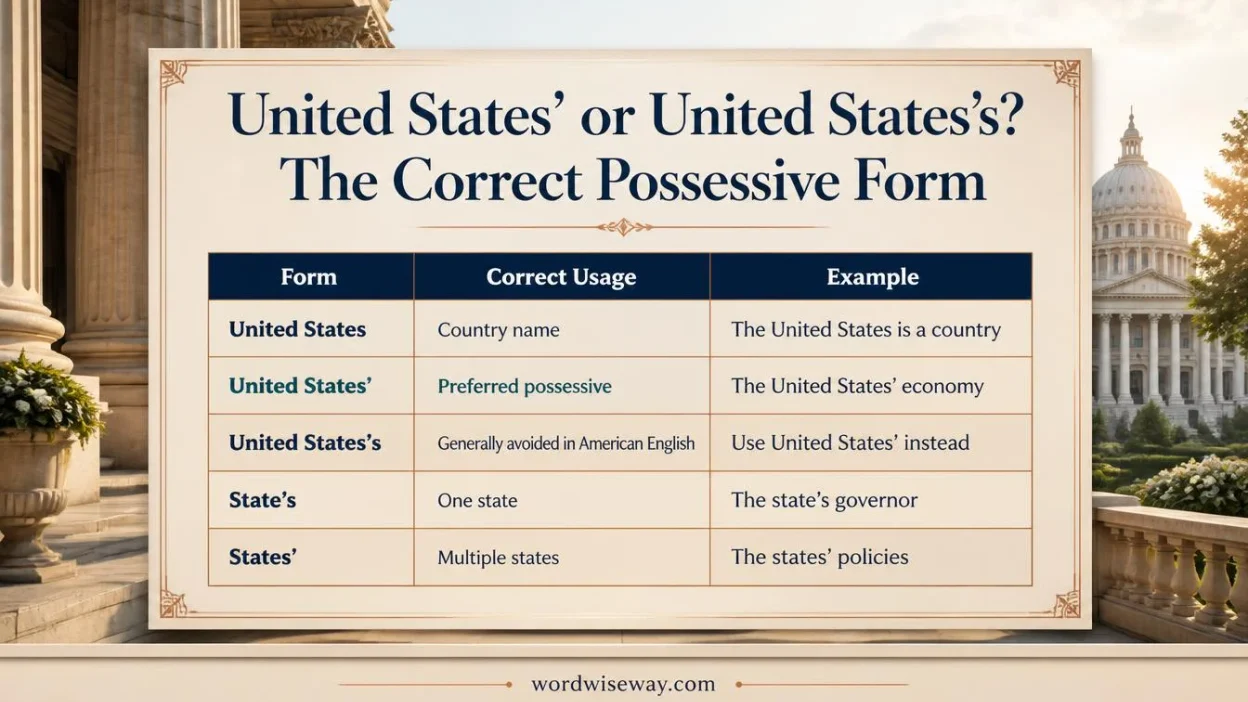
| Form | Meaning or use | Example |
| United States | The country’s name | The United States has a federal government. |
| United States’ | Possessive form of the country’s name | The United States’ economy continues to evolve. |
| State’s | Possessive form of a singular noun | The state’s governor announced a new policy. |
| States’ | Possessive form of a plural noun | The states’ governors attended the meeting. |
| United States’s | Generally avoided in standard American usage | Use United States’ instead. |
Remember that United States’ is the usual choice when you need the country’s possessive form. However, possessive rules can vary across style guides, so follow the required editorial standard when writing for a particular publication.
Why Is United States’ the Preferred Possessive Form?
To understand this spelling, start with the word States. The word ends in s, which affects how writers form its possessive.
In English, plural nouns that already end in s generally form the possessive by adding an apostrophe after the final letter. For example, teachers’ lounge refers to a lounge used by multiple teachers, while students’ books refers to books belonging to multiple students.
The same pattern helps explain why writers commonly choose United States’.
Consider these examples:
- The United States’ foreign policy affects international relations.
- The United States’ national parks attract millions of visitors.
- The United States’ Constitution establishes the framework of the federal government.
- The United States’ educational system includes public and private institutions.
In each example, the apostrophe signals a relationship between the country and the noun that follows.
However, United States is the proper name of a country, not simply a reference to several unrelated states. Its established usage matters alongside the general grammatical rule.
How the Apostrophe Changes the Meaning
An apostrophe can tell readers whether a noun is possessive or simply plural. Its position makes a difference.
Compare these sentences:
- The states approved the agreement.
- The states’ agreement received widespread attention.
- The state’s agreement covered a separate issue.
The first sentence uses states as a plural noun. The second uses states’ to indicate a relationship between multiple states and an agreement. The third uses state’s because the possessive refers to one state.
The same principle helps you understand the country’s possessive form. When you write United States’ policies, you’re describing policies associated with the United States.
Is United States’ Grammatically Correct?
Yes. United States’ is a standard and widely accepted possessive form in American English.
The expression follows an established writing convention for the country’s name. Writers use it in discussions of government, history, economics, geography, and international affairs.
For example:
- The United States’ economy is connected to international trade.
- The United States’ founding documents shaped its political institutions.
- The United States’ national parks protect a wide range of landscapes.
- The United States’ legal system includes federal and state courts.
These sentences use the possessive form to connect the country with a related subject.
It’s also important to understand that a possessive relationship doesn’t always mean literal ownership. In the United States’ history, the apostrophe connects the country with its historical experience. In the United States’ foreign policy, it connects the country with its approach to international relations.
Possessive Grammar and Editorial Style
Grammar and style are related, but they aren’t identical. Grammar explains how words function in sentences, while style guides establish consistent editorial preferences.
A publication may specify how writers should handle proper names that end in s. Another publication may follow a different convention for certain names.
For that reason, use United States’ as your default in standard American writing. If a teacher, editor, or publication provides a specific style rule, follow it consistently.
Is United States’s Ever Correct?
The form United States’s can look reasonable because English often forms singular possessives by adding ’s, even when a name ends in s. However, that general pattern doesn’t automatically determine the preferred spelling of every proper name.
For example, writers commonly use James’s book when following a style convention that adds ’s to singular names ending in s. Some style guides instead permit or prefer a final apostrophe in particular cases.
The name United States presents a different editorial situation because States is plural in form and the complete expression is an established country name. In standard American writing, United States’ is the familiar and preferred possessive form.
Consider these examples:
- Preferred: The United States’ economic policies affect international markets.
- Preferred: The United States’ history includes major political and social changes.
- Generally avoided: The United States’s economic policies affect international markets.
The last example isn’t the form most American readers expect in ordinary formal writing. Choosing United States’ keeps your wording consistent with conventional usage.
Why Doesn’t the General Singular Possessive Rule Settle the Question?
English has more than one convention for possessives ending in s. Some rules focus on whether the underlying noun is singular or plural. Others account for pronunciation, proper names, or a publication’s established style.
For example, the boss’s office is common because boss is singular. By contrast, the bosses’ offices refers to multiple bosses.
The country’s name doesn’t fit neatly into every simplified classroom rule. That’s why it’s useful to learn the conventional spelling of United States’ rather than mechanically applying one rule to every word ending in s.
United States’ vs. States’ vs. State’s
These three forms look similar, but they communicate different meanings. The easiest way to choose correctly is to identify exactly what your sentence refers to.
| Form | Grammatical function | Example |
| United States’ | Possessive form of the country’s name | The United States’ population is spread across many regions. |
| States’ | Plural possessive referring to multiple states | The states’ education policies differ. |
| State’s | Singular possessive referring to one state | The state’s education policy changed. |
| States | Ordinary plural noun | Several states introduced new regulations. |
| State | Singular noun | The state introduced a new regulation. |
When Should You Use United States’?
Use United States’ when the sentence refers to something associated with the country as a whole.
Examples include:
- The United States’ diplomatic relationships
- The United States’ federal government
- The United States’ cultural diversity
- The United States’ transportation infrastructure
In each phrase, the country is the main point of reference.
When Should You Use States’?
Use states’ when you’re referring to multiple states rather than the country as a single entity.
For example, consider this sentence:
The states’ tax policies vary across the country.
Here, states’ refers to policies associated with multiple individual states. It doesn’t replace the possessive form of the country’s name.
Another example is The states’ representatives met to discuss regional concerns. The apostrophe belongs after the final s because the possessive noun is plural.
When Should You Use State’s?
Use state’s when one state possesses, controls, or relates to something.
For example:
- The state’s governor signed the bill.
- The state’s constitution establishes its governmental structure.
- The state’s transportation department repaired the highway.
The singular possessive uses ’s because state refers to one state.
A quick memory trick helps: one state takes state’s, multiple states take states’, and the country takes United States’ in conventional American usage.
United States’ vs. U.S.’: Which Possessive Form Should You Use?
The abbreviation U.S. creates another punctuation question. Writers often use it as a shortened form of United States, particularly in American prose.
When you need the possessive form, you may encounter constructions such as the U.S.’ role in international trade. This form places an apostrophe after the abbreviation’s final period.
However, that punctuation can look crowded. In many sentences, rewriting the phrase produces a cleaner result.
Compare these examples:
- The United States’ role in international trade remains significant.
- The U.S. government’s trade policy affects international businesses.
- The country’s role in international trade remains significant.
The second sentence avoids placing a possessive apostrophe after U.S. because the possessive attaches to government instead.
Practical tip: When an abbreviation makes a possessive construction awkward, consider rewriting the sentence instead of forcing the punctuation.
If you must use U.S.’, check the style guide required for your assignment or publication. Abbreviation and possessive conventions can differ across editorial standards.
United States’ vs. United States of America’s
Both United States and United States of America refer to the same country. However, their possessive forms differ because the full name ends with a different word.
The shorter name ends with States, so conventional American usage generally favors United States’. The full name ends with America, making United States of America’s the natural possessive construction.
For example:
- The United States’ political system has a federal structure.
- The United States of America’s political system has a federal structure.
Both sentences communicate the same basic idea. The first is shorter and generally sounds more natural in everyday writing.
Which Form Sounds More Natural?
Choose United States’ when you want concise, direct wording. It works well in blog posts, essays, news-style writing, and general informational articles.
Use United States of America’s when the full formal name serves a clear purpose. For example, a document discussing the country’s official name may need the complete expression.
Avoid using the longer form repeatedly when the shorter version communicates the same meaning. Unnecessary words can make an otherwise clear sentence feel heavy.
When Should You Use United States’ in a Sentence?
Use the possessive form when you want to connect the country with a policy, institution, historical event, resource, or other related subject.
The following examples show how the construction works across several common topics.
Government and Public Policy
Government writing often uses the possessive to connect the country with its institutions or decisions.
Examples:
- The United States’ federal government has three branches.
- The United States’ foreign policy influences its diplomatic relationships.
- The United States’ immigration policies have changed over time.
In these examples, the possessive phrase identifies the country associated with the government, policy, or decision.
Economy and International Trade
Economic writing frequently uses the possessive form to discuss national markets, financial conditions, or trade relationships.
Examples:
- The United States’ economy includes a wide range of industries.
- The United States’ trade relationships connect it with markets worldwide.
- The United States’ labor market reflects changes in employment and demand.
Notice that the apostrophe doesn’t change the meaning of the noun itself. It simply shows the relationship between the country and the subject being discussed.
History and National Identity
Historical writing uses the possessive to connect events, documents, and cultural developments with the country.
Examples:
- The United States’ history includes periods of significant political change.
- The United States’ founding documents continue to shape constitutional discussions.
- The United States’ cultural traditions reflect influences from many communities.
The construction can also help reduce repetition. Instead of repeatedly writing the history of the United States, you can often write the United States’ history.
Geography and Natural Resources
Geographical writing frequently refers to the country’s landscapes, parks, rivers, and natural resources.
Examples:
- The United States’ national parks protect important natural habitats.
- The United States’ geographic diversity includes mountains, plains, deserts, and coastlines.
- The United States’ natural resources support numerous industries.
These phrases are concise and easy to understand. They also demonstrate why possessive constructions are useful beyond literal ownership.
When You Don’t Need an Apostrophe
Not every reference to the country requires a possessive form. If United States functions as the subject or object of a sentence without indicating possession, leave out the apostrophe.
Compare these examples:
- Correct: The United States has a federal system of government.
- Correct: The United States participates in international organizations.
- Correct: The United States’ federal system divides authority between national and state governments.
The first two sentences simply name the country. The third connects the country’s name with its federal system.
Apostrophes should serve a grammatical purpose. Adding one whenever you see a word ending in s creates errors rather than improving clarity.
Common Mistakes
Even experienced writers can stumble over possessive punctuation. Most errors happen when writers apply a rule without checking the noun’s meaning or grammatical function.
Here are the most common mistakes and how to correct them.
| Common mistake | Correct form | Why it matters |
| The United States’s economy | The United States’ economy | The shorter possessive is conventional in American English. |
| The United States’ has a large economy. | The United States has a large economy. | The sentence doesn’t require a possessive. |
| The state’ governor | The state’s governor | A singular noun generally takes ’s. |
| The states’s governors | The states’ governors | A plural noun ending in s generally takes an apostrophe alone. |
| The United States policies | The United States’ policies | The apostrophe clarifies the intended possessive relationship. |
| The states’ government, when referring to one state | The state’s government | The singular and plural forms have different meanings. |
Mistake: Confusing Possessives With Plurals
A plural noun identifies more than one person, place, or thing. A possessive noun indicates a relationship such as ownership, association, or responsibility.
For example, states is plural, while states’ is plural possessive.
Similarly, state is singular, while state’s is singular possessive.
Remember that an apostrophe doesn’t make a noun plural. It marks a possessive relationship or, in certain cases, a contraction.
Mistake: Applying One Possessive Rule to Every Word
English possessives have several conventions, particularly for proper names ending in s. Assuming every noun follows exactly the same pattern can lead to inconsistent punctuation.
For example, the teacher’s desk and the teachers’ desks follow different patterns because one noun is singular and the other is plural.
With United States’, use the established conventional form rather than automatically adding ’s.
Mistake: Switching Styles Midway Through an Article
Consistency makes writing easier to read. If you use United States’ throughout an article, don’t randomly switch to United States’s without a clear reason.
When editing a long article, search for both spellings. Check each instance against your chosen style and make the wording consistent.
How to Choose the Correct Form: A Simple Rule
You don’t need to memorize every possessive rule to get this particular expression right. Start by identifying what your sentence means.
- Are you referring to the country itself? Use United States without an apostrophe when no possessive relationship is intended.
- Are you referring to something associated with the country? Use United States’ in conventional American writing.
- Are you referring to one individual state? Use state’s, as in the state’s constitution.
- Are you referring to several individual states? Use states’, as in the states’ constitutions.
- Are you following a required publication style? Check its guidance and apply it consistently.
For a final comparison, consider these sentences:
- The United States has fifty states.
- The United States’ government operates under a federal constitutional system.
- The state’s government manages matters within its jurisdiction.
- The states’ governments have different responsibilities and policies.
Each sentence uses a different form because each noun plays a different grammatical role.
Read More: Agencies, Agency’s, or Agencies’? What’s the Difference?
FAQs
1. Is United States’ or United States’s correct?
United States’ is the conventional possessive form in standard American English. It follows the plural possessive pattern used for names that end in s.
2. Why does United States’ use only an apostrophe?
The name United States ends in s and refers to multiple states. Standard American English commonly adds only an apostrophe to form its possessive.
3. Is United States’s grammatically incorrect?
Not necessarily in every style system, but United States’ is the established choice in standard American English. Some style guides allow an apostrophe followed by s in certain proper names.
4. How do you use United States’ in a sentence?
Use United States’ before a noun to show possession or association. For example, “The United States’ economy influences global markets.”
5. Is United States a singular or plural noun?
United States has a plural-looking name because it refers to multiple states. However, the country is treated as a singular entity in most sentences, so we say, “The United States is a country.”
6. Does the United States’ need the word “the”?
Yes, in ordinary English usage, the country’s name usually takes the definite article the. For example, “The United States’ laws vary across different areas of government.”
7. What is the difference between United States’ and United States?
United States names the country, while United States’ indicates possession or association. For example, “The United States has a large economy” names the country, whereas “The United States’ economy is diverse” shows a relationship.
8. Can I write United States’s in academic writing?
For academic writing in American English, United States’ is generally the safer choice. Always check your institution’s preferred style guide to ensure consistent punctuation.
9. Does the same possessive rule apply to all country names?
No. Possessive forms depend on the name’s spelling, grammatical structure, and the applicable style guide. For example, “Canada’s” takes apostrophe s, while “the United States’” traditionally takes only an apostrophe.
10. What is the easiest way to remember the correct form?
Remember the conventional American English form: United States’. When writing about the country’s history, government, economy, or policies, use this form consistently and follow your chosen style guide.
Conclusion:
Choosing between United States’ and United States’s becomes easier when you understand how possessive forms work. In standard American English, United States’ is the conventional choice because the country’s name already ends in s. Although the country functions as a singular entity in most sentences, its name refers to multiple states, which explains the traditional possessive spelling.
When writing about the country’s history, economy, government, or achievements, use United States’ to show possession or association. For example, “The United States’ education system continues to evolve.” This simple approach keeps your writing clear and helps you avoid unnecessary punctuation mistakes. Remember that some style guides differ, so check the relevant guidelines when writing academic or professional documents.
Ultimately, correct grammar is about understanding patterns rather than memorizing every phrase individually. Once you recognize the conventional United States’ possessive form, you can use it confidently in essays, articles, and everyday writing. Keep your punctuation consistent, follow standard American English conventions, and let clarity guide your word choices.

Emma Smith has dedicated 14 years to Princeton University’s English Department, mentoring students in textual interpretation, literary movements, and critical frameworks. Her research explores Shakespearean drama, Victorian serial fiction, postcolonial narrative theory, and manuscript studies and probing how literary forms evolve across cultures and centuries. Emma has delivered lectures at international humanities congresses and published findings in distinguished academic journals, underscoring her commitment to scholarly depth and vibrant teaching.