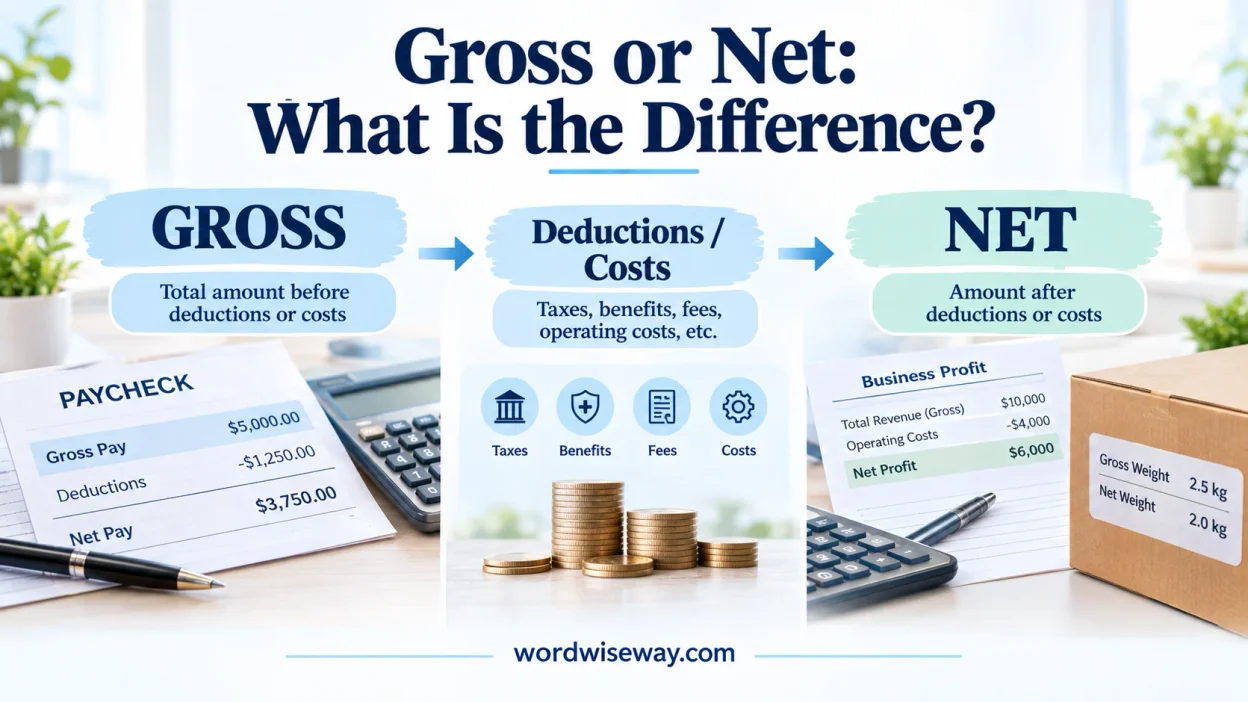
Gross or Net: What Is the Difference? Knowing this difference makes payroll, paychecks, and salary details less confusing.
Gross pay represents the whole amount earned before any deduction, while net pay is the amount you receive afterward. Your gross salary may appear on a salary slip, while net income shows the money reaching your pocket. Taxes, expenses, overheads, and interest payments can reduce your final amount.
For employees, understanding the meaning of gross and net can help you negotiate salaries, create budgets, and manage deductions according to your needs. Employers also need these terms when running payroll effectively. Knowing the difference makes salary discussions clearer and helps prevent misunderstandings about income and amounts.
The same idea appears in business, finance, and pricing. A business report may show income or profit, while a bill can contain different amounts. Gross weight includes goods and packaging, whereas net weight covers the goods alone. Understanding how they differ helps you use these terms correctly in daily life and professional settings.
Quick Answer:
Gross generally means the total amount before relevant deductions, costs, or adjustments. Net generally means the amount remaining after those deductions, costs, or adjustments.
| Term | General meaning | Simple example |
| Gross | Amount before applicable deductions or costs | $60,000 gross salary |
| Net | Amount remaining after applicable deductions or adjustments | $48,000 net pay |
| Gross profit | Revenue minus direct costs | $100,000 revenue − $60,000 COGS = $40,000 |
| Net profit | Profit remaining after broader expenses | $40,000 gross profit − $25,000 expenses = $15,000 |
| Gross weight | Product plus packaging | 11 lb total |
| Net weight | Product contents after packaging is excluded | 10 lb contents |
The key isn’t simply to ask which number is bigger. Instead, ask what has been included or removed from the figure.
For example, the IRS explains that gross pay represents what an employee earns, while net pay represents take-home pay after deductions.
What Does Gross Mean?
Gross describes a total before specific deductions or costs are removed. The word doesn’t automatically mean income, profit, salary, or weight. Its meaning depends on the noun attached to it.
A gross amount often provides a starting point for another calculation. You might begin with gross revenue before accounting for returns and allowances. A payroll calculation can begin with gross pay before taxes and other withholdings. A weighing process can record gross weight before subtracting the container.
In other words, gross gives you the broader figure before a particular adjustment takes place.
Gross Income
Gross income generally refers to income before certain deductions are taken into account. In U.S. federal tax terminology, gross income can include compensation, business income, interest, rents, royalties, dividends, and other forms of income.
For employees, gross income can include more than basic wages. Compensation may include salaries, commissions, fees, tips, and certain benefits depending on the circumstances.
That’s why gross income shouldn’t automatically be treated as the money available for spending.
Gross Pay
Gross pay is the amount you earn before payroll deductions. It can include regular wages plus applicable overtime, bonuses, commissions, or other earnings.
Suppose an employee earns $25 per hour and works 40 hours in one week:
- Regular earnings: $25 × 40 = $1,000
- Gross pay: $1,000
- Taxes and other deductions: $180
- Net pay: $820
The employee earned $1,000, but the bank deposit may show only $820. The $1,000 is the gross pay, while $820 represents the net pay in this simplified example.
Gross Profit
Gross profit measures what remains after a business subtracts the direct cost of producing or acquiring what it sold.
The basic formula is:
Gross Profit = Revenue − Cost of Goods Sold
The IRS uses a similar structure for businesses that sell products. It explains that businesses first account for gross receipts, adjust for returns and allowances, and then subtract the cost of goods sold to determine gross profit.
For example, imagine a store generates $100,000 in sales and spends $60,000 on inventory sold during the period.
$100,000 − $60,000 = $40,000 gross profit
That $40,000 isn’t necessarily the business’s final profit. Rent, advertising, administrative costs, interest, taxes, and other expenses may still need to be accounted for.
What Does Net Mean?
Net refers to the amount left after the relevant deductions, costs, or adjustments have been applied.
That’s why net figures often give you a more specific picture of what remains. Yet “net” doesn’t always mean that every possible cost has been removed. You must identify which adjustments the calculation includes.
For example, net pay usually reflects payroll deductions. Net weight excludes packaging. Accounts of net profit for business expenses.
Net Income
It is the amount remaining after the applicable expenses have been deducted from income.
For a business, net income is commonly described as the final profit after accounting for expenses such as operating costs, interest, taxes, depreciation, and amortization.
This figure often appears near the bottom of an income statement. That’s why people frequently call it the bottom line.
However, personal net income can have a different calculation depending on the tax system and the specific financial context. Always check what deductions or adjustments the source includes.
Net Pay
Net pay is the amount an employee actually receives after applicable payroll deductions.
Common deductions can include:
- Federal or state income tax withholding where applicable
- Social Security and Medicare taxes in the United States
- Retirement contributions
- Health insurance premiums
- Other authorized deductions
The IRS specifically describes net pay as take-home pay after deductions.
This distinction becomes important when comparing job offers. A salary advertisement may show an annual gross salary, but your actual paycheck will normally be lower after applicable deductions.
Net Profit
Net profit shows what a business has left after accounting for its relevant expenses.
Imagine a business earns $100,000 in revenue. After subtracting $60,000 in direct costs, it has $40,000 in gross profit.
Now suppose it spends another $25,000 on operating expenses, interest, and other applicable costs.
$40,000 − $25,000 = $15,000 net profit
The business therefore has:
- Revenue: $100,000
- Gross profit: $40,000
- Net profit: $15,000
The two profit figures answer different questions. Gross profit helps show how effectively sales cover direct costs. Net profit shows what remains after broader expenses.
Key Differences
The clearest way to understand gross or net is to compare what each figure includes.
| Feature | Gross | Net |
| Basic idea | Before specified deductions or costs | After specified deductions or adjustments |
| Position in a calculation | Often an earlier figure | Often a later figure |
| Salary | Earnings before payroll deductions | Take-home amount |
| Business profit | After direct costs but before many other expenses | After applicable business expenses |
| Product weight | Includes packaging in relevant weighing contexts | Excludes packaging |
| Price | May refer to an amount before certain adjustments | May reflect specified discounts or adjustments |
| Main purpose | Shows the broader starting amount | Shows the resulting amount after adjustments |
One important detail stands out: gross and net aren’t universal mathematical labels. Their precise definitions depend on the calculation being discussed.
Gross vs. Net in Salary and Paychecks
Salary is one of the most common places people encounter the gross-versus-net distinction.
Suppose a company offers an annual salary of $60,000. That figure normally describes the employee’s gross salary.
The employee won’t necessarily receive $60,000 in their bank account. Payroll deductions reduce the amount actually paid.
For a simplified example:
| Paycheck item | Amount |
| Gross annual salary | $60,000 |
| Applicable deductions | $12,000 |
| Net annual pay | $48,000 |
The example doesn’t represent a universal tax calculation. Actual deductions depend on factors such as location, tax status, benefits, retirement contributions, and other circumstances.
The practical lesson is simple: gross salary tells you the stated earnings, while net pay tells you what remains after applicable payroll deductions.
Gross vs. Net Income
Income becomes confusing because people sometimes use “income,” “earnings,” and “pay” interchangeably.
They aren’t always interchangeable.
Gross income generally represents income before certain deductions or adjustments. Net income represents what remains after the relevant deductions or expenses in the particular context.
For a business, the distinction can be even more important. Revenue isn’t the same thing as profit, and gross profit isn’t the same thing as net profit.
A business could generate $1 million in revenue while earning far less in final profit. Revenue measures money generated from business activities, while profit reflects what remains after relevant costs.
Gross vs. Net Profit
Gross profit and net profit sit at different stages of the profitability calculation.
Consider a fictional online retailer:
| Calculation | Amount |
| Sales revenue | $250,000 |
| Cost of goods sold | −$150,000 |
| Gross profit | $100,000 |
| Operating expenses | −$55,000 |
| Interest and other costs | −$10,000 |
| Net profit | $35,000 |
The company generated $250,000 in sales, but its final profit was $35,000 in this simplified example.
The $100,000 gross profit shows how much remained after direct product costs. The $35,000 net profit reflects what remained after additional expenses.
The IRS similarly distinguishes gross profit from net profit by treating gross profit as an earlier calculation and net profit as the amount remaining after business income and expenses are considered.
Gross vs. Net Weight
Money isn’t the only place where gross or net matters.
On product packaging, gross weight can include both the product and its packaging. Net weight focuses on the contents after the packaging weight is excluded.
The USDA defines gross weight for packaged food as the weight of the food plus the primary container. It defines tare weight as the empty container’s weight and net weight as the difference between gross and tare weight.
The relationship is straightforward:
Gross Weight = Net Weight + Tare Weight
For example:
- Product contents: 10 lb
- Packaging: 1 lb
- Gross weight: 11 lb
- Net weight: 10 lb
So, if a package says Net Wt. 10 oz, the number refers to the product contents rather than the entire package.
Gross vs. Net Price
Prices can also involve gross and net figures, although the exact terminology varies by industry and transaction.
A gross price may represent an initial price before specified discounts or adjustments. A net price may represent the amount remaining after those adjustments.
Suppose a product has a listed price of $500 and receives a $50 discount:
$500 − $50 = $450
If the context defines the $500 as the gross amount and the $450 as the amount after the discount, the latter is the net amount.
Taxes can complicate the picture. In some transactions, the quoted price may exclude tax, while in others the displayed price already includes it. That’s why you should always check the pricing terms rather than assuming that “net” automatically means “after tax.”
Gross vs. Net Revenue
Gross revenue and net revenue aren’t the same as gross profit and net profit.
Revenue describes money generated from sales or services. Profit is what remains after relevant costs are deducted.
For example:
Gross receipts → Adjustments → Net receipts → Cost of goods sold → Gross profit
The IRS explains that returns and allowances can reduce gross receipts to arrive at net receipts before the cost of goods sold is deducted.
That distinction prevents a common accounting mistake: treating every “net” figure as a profit figure.
Gross vs. Net in Accounting
Accounting uses several related measurements because one number rarely tells the whole financial story.
A simplified income statement can look like this:
Revenue
↓
Cost of goods sold
↓
Gross profit
↓
Operating expenses
↓
Operating income
↓
Interest and taxes
↓
Net income
Each stage answers a different question.
- Revenue: How much did the business generate from sales?
- Gross profit: How much remained after direct costs?
- Operating income: How much remained after operating expenses?
- Net income: What remained after the applicable expenses and other items?
This layered approach gives owners, investors, lenders, and managers a clearer view of business performance.
Gross Margin vs. Net Margin
Margins turn profit figures into percentages, making comparisons easier.
Gross Margin = Gross Profit ÷ Revenue × 100
Net Margin = Net Profit ÷ Revenue × 100
Suppose a company has:
- Revenue: $500,000
- Gross profit: $200,000
- Net profit: $50,000
Its gross margin is:
$200,000 ÷ $500,000 × 100 = 40%
Its net margin is:
$50,000 ÷ $500,000 × 100 = 10%
The 40% gross margin shows that the company retained $0.40 of gross profit for every $1 of revenue after the relevant direct costs. The 10% net margin shows that $0.10 remained as net profit after the broader expenses included in the calculation.
Common Examples
Example: Salary
An employee earns $5,000 before payroll deductions.
- Gross pay: $5,000
- Deductions: $1,200
- Net pay: $3,800
Example: Small Business
A business earns $80,000 from sales.
- Revenue: $80,000
- COGS: $45,000
- Gross profit: $35,000
- Other expenses: $25,000
- Net profit: $10,000
Example: Product Weight
A packaged product weighs 6 pounds in total.
- Gross weight: 6 lb
- Packaging: 0.5 lb
- Net weight: 5.5 lb
Example: Discounted Price
A product starts at $200 and receives a $30 discount.
- Original amount: $200
- Discount: $30
- Adjusted amount: $170
The exact use of “gross” and “net” depends on the transaction’s terminology.
Which One Should You Use?
Neither gross nor net is automatically the correct choice. The right term depends on what the number represents and what has already been deducted.
Use gross when you need to describe the broader amount before the relevant deductions, costs, or adjustments.
Use net when you need to describe the amount remaining after those specified adjustments.
A useful decision process is:
- Identify the original amount.
- Check which costs or deductions have been removed.
- Look at the definition used by the document or industry.
- Decide whether the resulting figure is gross or net.
- Don’t compare figures calculated on different bases.
This last point matters. Comparing someone’s gross salary with another person’s net salary can make the numbers look comparable when they aren’t.
Common Mistakes
Several mistakes appear repeatedly when people use these terms.
Treating Gross Pay as Take-Home Pay
Gross pay is generally the amount earned before payroll deductions. Net pay reflects the amount received after applicable deductions.
Confusing Gross Profit With Net Profit
Gross profit accounts for direct costs such as COGS. Net profit comes later after additional expenses are considered.
Assuming Net Always Means Profit
It doesn’t. Net weight, net pay, net revenue, and net price can describe very different things.
Assuming Gross Always Means Income
It doesn’t. Gross weight, gross profit, gross receipts, and gross pay all measure different things.
Comparing Figures With Different Definitions
A gross figure and a net figure can represent completely different stages of a calculation. Compare like with like.
An Easy Way to Remember
Think of gross as the larger starting pool and net as what remains after the relevant filter has been applied.
Imagine a bucket filled with water.
The full bucket represents the gross amount. You remove a certain amount through a defined process. What remains represents the net amount.
The analogy isn’t a substitute for accounting definitions, but it captures the basic idea:
Gross → adjustments or deductions → Net
The exact “filter” changes with the situation. Payroll uses deductions. Product weighing uses tare weight. Business profit uses costs and expenses.
Read More: Family or Fiancé: Meaning, Spelling, and How to Use Each Word
FAQs
What does gross mean?
Gross means the total amount before deductions or other amounts are removed. For example, gross pay is your earnings before taxes and other deductions.
What does net mean?
Net means the amount left after deductions. Net pay is the money you actually receive after taxes and other payroll deductions.
Is gross pay higher than net pay?
Yes. Gross pay is normally higher because net pay comes after deductions such as taxes, benefits, or other payroll-related amounts.
Why is my net salary lower than my gross salary?
Your net salary is lower because deductions are taken from your gross salary. These may include taxes, insurance, retirement contributions, or other authorized deductions.
Which amount should I use when making a budget?
Your net pay is generally more useful for budgeting because it represents the money you actually have available to spend or save.
Does gross income include taxes?
Gross income is usually the amount before taxes are deducted. The exact definition can vary depending on whether you are discussing payroll, business income, or taxation.
What is the difference between gross income and net income?
Gross income is the amount earned before certain expenses or deductions, while net income is what remains after those amounts have been subtracted.
What is gross weight?
Gross weight is the total weight of an item together with its packaging or container. It is different from net weight, which counts only the goods.
When should I use gross instead of net?
Use gross when you mean the full amount before deductions. Use net when you mean the amount remaining after deductions or adjustments.
Why is understanding gross and net important?
Understanding these terms helps you read salary slips, business reports, bills, and financial information accurately. It can also make budgeting and salary discussions easier.
Conclusion
Understanding gross and net becomes much easier when you focus on what happens before and after deductions. Gross represents the full amount, while net shows what remains after relevant costs, taxes, or other deductions. This distinction appears in salaries, business finances, pricing, and weight, so knowing the difference can prevent everyday confusion.
When you check a paycheck, salary slip, bill, or business report, look carefully at whether the amount is gross or net. Your gross pay tells you what you earned before deductions, while net pay tells you what you actually receive. This simple habit can make budgeting, salary discussions, and financial decisions much clearer.
Ultimately, knowing Gross or Net: What Is the Difference? gives you a practical skill you can use in both casual and professional settings. Once you recognize whether a figure represents the total amount or the amount left afterward, these terms stop feeling complicated and become much easier to use correctly.

Emma Smith has dedicated 14 years to Princeton University’s English Department, mentoring students in textual interpretation, literary movements, and critical frameworks. Her research explores Shakespearean drama, Victorian serial fiction, postcolonial narrative theory, and manuscript studies and probing how literary forms evolve across cultures and centuries. Emma has delivered lectures at international humanities congresses and published findings in distinguished academic journals, underscoring her commitment to scholarly depth and vibrant teaching.